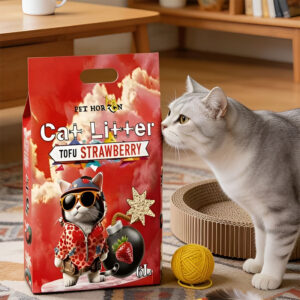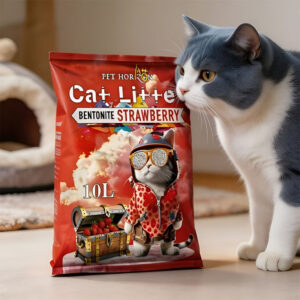




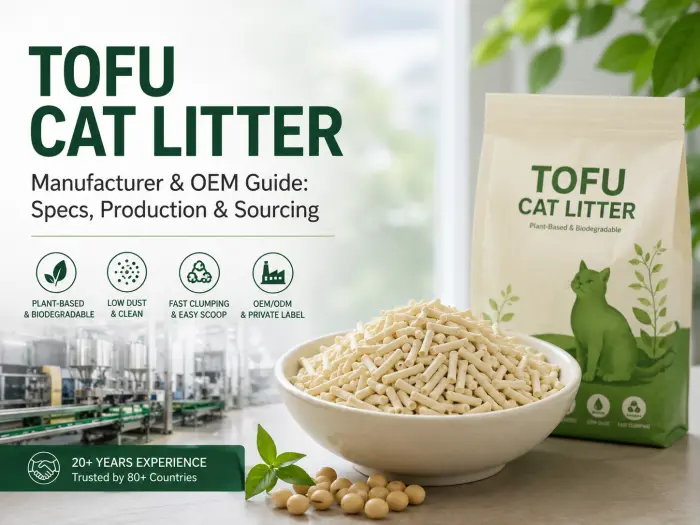
Tofu cat litter — made from compressed soybean fiber — has become the fastest-growing premium segment in the global cat-litter market. For B2B buyers and private-label brands, the question is not whether it sells, but how to specify a consistent, compliant, and brandable product from a reliable manufacturer. This guide covers what tofu litter is, the specs that matter, how it is manufactured, and how to run an OEM or private-label program with confidence.
Quick Answer
Tofu cat litter is a plant-based, biodegradable clumping litter extruded from soybean fiber (okara). B2B buyers should specify particle size (typically 1.5–3 mm), clumping speed, dust content (<1%), moisture (<8%), and hardness, then confirm flushability claims and PPWR-aligned packaging with the supplier. It is low-dust and partially flushable, but it does not clump as hard as bentonite — choose it for eco-positioning and low-tracking, not maximum odor lock. For private-label programs, partner with a manufacturer that offers 10+ years of OEM/ODM experience and can supply specification sheets, batch QC reports, and compliant packaging from the first run.
What Is Tofu Cat Litter?
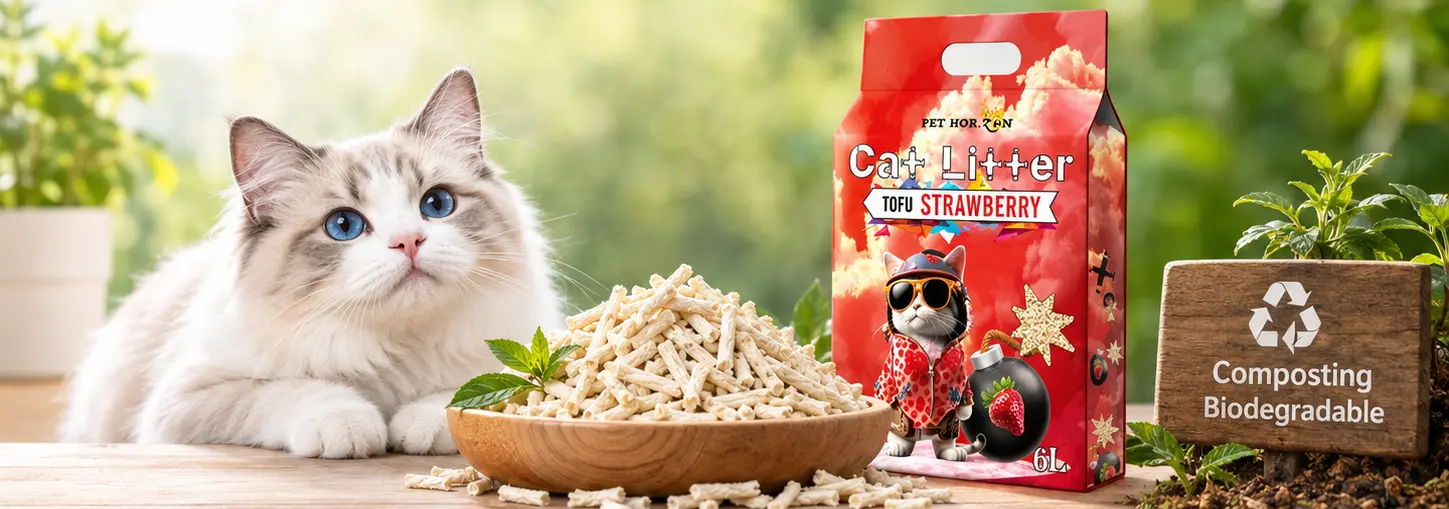
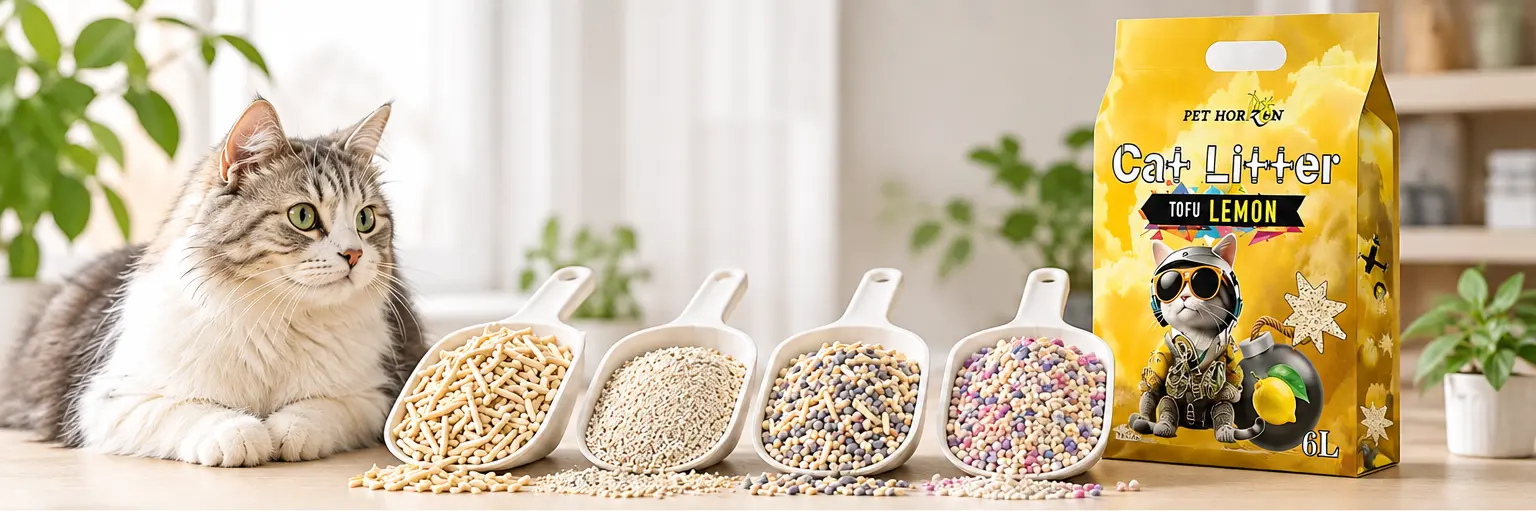
Tofu cat litter is produced from the byproduct of soy milk and tofu production — soybean residue, or okara — that is dried, milled, and extruded into slender strips or granules. The result is a light, absorbent, and naturally low-dust material that clumps on contact with liquid and is typically advertised as flushable and biodegradable. Most reputable manufacturers run dedicated okara-sourcing and drying lines to keep batch color and moisture stable.
How Tofu Cat Litter Is Made
The manufacturing sequence is straightforward but quality-sensitive:
- Material prep: okara is dried to a controlled moisture level and milled.
- Extrusion: the dough is pushed through dies into strips, then cut to length.
- Drying & curing: low-temperature drying locks hardness and keeps dust low.
- Blending: carbon, fragrance, or clump agents are mixed in by batch.
- QC: moisture, dust, clump, and hardness are checked per batch before bagging.
Because the process is sensitive to humidity, a manufacturer’s drying control and in-house QC are the two biggest drivers of batch consistency. Verify both before contracting — see our manufacturing and supplier guides for the full checklist.

Key Specs B2B Buyers Should Specify
Do not order “tofu litter” generically. Put these on your specification sheet:
| Spec | Target | Note |
|---|---|---|
| Moisture | < 8% | High moisture = soft clumps, mold risk |
| Dust | < 1% | Low-dust is the core selling point |
| Clumping time | 3–8 sec | Fast enough for daily scooping |
| Hardness | Medium | Too hard = brittle; too soft = crumble |
| Fragrance | None / light | Strong scent hurts EU market acceptance |
Tofu vs Bentonite: What B2B Buyers Should Know
These are not substitutes — they serve different buyers. Tofu wins on dust, flushability, and eco-story; bentonite wins on clump hardness and price. Many eco-positioned brands launch with a dedicated tofu cat litter product before extending into mixed formulas to capture both segments.
| Factor | Tofu | Bentonite |
|---|---|---|
| Clump hardness | Medium | Very hard |
| Dust | Very low | Moderate–high |
| Flushable | Partially (check local rules) | No |
| Price point | Premium | Economy–mid |
| Best for | Eco / low-tracking brands | Max odor lock, value |
OEM & Private Label Considerations
Tofu litter is highly customizable, which makes it ideal for private label: color, fragrance, strip length, and packaging are all adjustable at low setup cost. Confirm the manufacturer’s minimum run, lead time, and whether they hold relevant certifications (ISO 9001, BSCI, SGS). A reliable cat litter supplier will provide a specification sheet and batch QC reports on request.
How to Choose a Tofu Cat Litter Manufacturer
Specifying the product is only half the job — the manufacturer determines whether your SKU stays consistent across reorders. Vet suppliers against these six points:
- Track record: ask for 10+ years of OEM/ODM experience and references from comparable private-label programs.
- Certifications: request ISO 9001, BSCI, and SGS documentation plus recent audit reports.
- In-house control: confirm owned extrusion and low-temperature drying lines — this is what keeps batches uniform.
- QC transparency: the supplier should hand over a full specification sheet and per-batch QC reports without pushback.
- Export readiness: check they can produce destination-market labeling and customs paperwork for your target regions.
- Commercial terms: clarify MOQ, lead time, and private-label packaging support before you sign.
A manufacturer that controls raw materials, extrusion, drying, and QC in-house is generally more capable of delivering consistent quality over long-term OEM cooperation.
Typical OEM Ordering Process
A standard private-label program runs in eight steps:
- Brief: submit your spec — particle size, color, fragrance, strip length, packaging.
- Quote: the manufacturer returns pricing and the minimum order quantity (MOQ).
- Contract: sign the agreement and confirm artwork and NDA terms.
- Sample: a pre-production batch is extruded and tested against your spec.
- Approval: you sign off the sample; bulk production is scheduled.
- Production QC: in-process checks and a final batch inspection are recorded.
- Documentation: packing, palletizing, and export papers (SDS, CO) are prepared.
- Shipment: container loading and delivery to your nominated port.
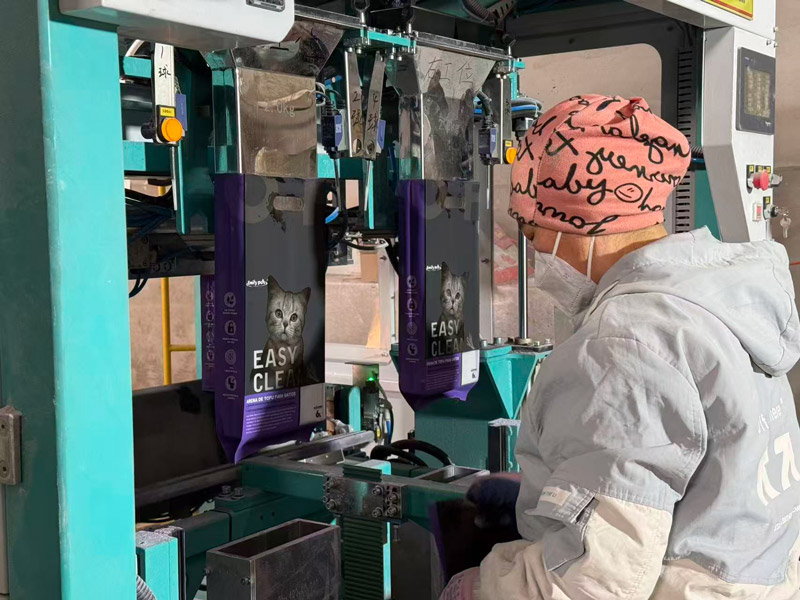
Compliance Notes for Importers
If you sell into the EU, packaging is now a regulated component under the PPWR (from August 2026) — specify mono-material or recycled-content bags from the start. Flushability claims also vary by market; confirm what local wastewater rules allow before advertising “flushable” on the pack. Also request the supplier’s SDS (formerly MSDS) together with the product specification sheet and any other export documents your destination market requires — most importers need it for customs clearance and downstream safety compliance.
Why Partner With Pet Horizon
Pet Horizon has specialized in cat litter manufacturing for more than 20 years and has supported OEM and private-label programs for over 10 years, serving distributors, importers, and retail brands across 80+ international markets. Every production batch is inspected for moisture, dust, clumping performance, and appearance before shipment.
Conclusion
Tofu cat litter is the premium, eco-friendly anchor of a modern cat-litter portfolio. Specify moisture, dust, clump, and hardness explicitly, verify the manufacturer’s drying and QC control, and align packaging with PPWR before you import. Pair it with a comparison of all litter types so your buyers can choose the right product for their market. For importers and private-label brands, choosing a manufacturer with stable production, transparent QC, and export experience is often more important than choosing the lowest price.
Frequently Asked Questions
Partially. The material is biodegradable and breaks down in water, but local wastewater rules differ — some municipalities discourage flushing any litter. Confirm the destination market’s rules before making flushability claims.
No. Tofu forms a softer, medium-hard clump. It scoops cleanly for most households but will not lock as rigidly as sodium bentonite. Mixed formulas close the gap.
Keep moisture below 8%. Above that, clumps soften, dust rises, and there is a mold risk in humid transit. It is the single most important QC number for tofu litter.
Yes. Color, fragrance, strip length, and bag design are all low-cost to customize, which is why tofu is a popular entry product for new cat-litter brands.
It is plant-based and generally considered low-risk if ingested in small amounts, but it is not food. Standard caution applies, and buyers should keep supplier food-safety documentation on file.
Tofu sits at a premium versus bentonite and most pine. Its value is in eco-positioning, low dust, and flushability — not in being the cheapest option.
Look for ISO 9001 (quality management), BSCI (social compliance), and SGS testing on the product and additives. Request current audit reports rather than just certificate scans, since dates and scope matter for importers.
Our standard minimum order quantity starts from one 20ft container, and the exact volume is negotiable depending on packaging format and formulation. Confirm the MOQ and lead time during the brief stage so it fits your launch plan.