

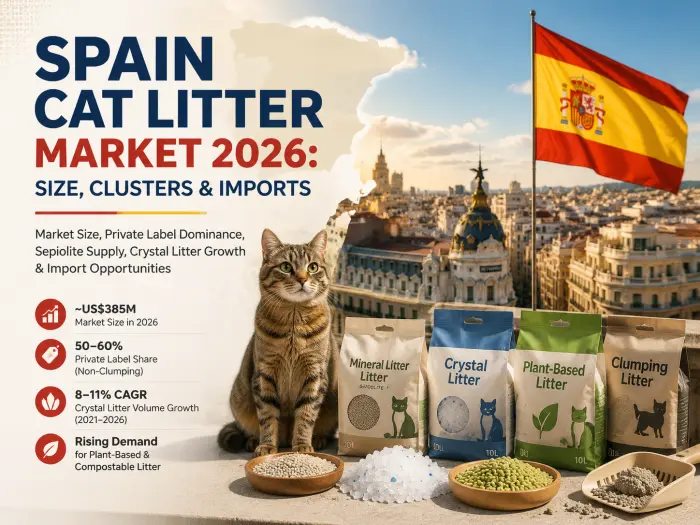
Spain is one of the most misunderstood cat litter markets in Western Europe. It is not the largest, but it is structurally distinctive: a high private-label rate, a native mineral-litter supply found almost nowhere else, and apartment-living demand that rewards low dust and odor control. For importers and private-label buyers, that combination creates a specific, winnable entry point rather than a red ocean. This guide breaks down the 2026 market using independent research and what it means for B2B sourcing.
Quick answer: Spain’s cat litter market is a mid-sized European market valued at around US$385 million in 2026, growing toward roughly US$608 million by 2035 (around 5% CAGR per one research house), with private label accounting for 50 to 60% of non-clumping sales. Spain’s differentiators are native sepiolite mineral supply, crystal litter growth of 8 to 11% volume CAGR, and 80% apartment living that makes low dust and odor control the top purchase driver. Importers should target crystal and plant-based increments, not head-on competition with local mineral litter.
Market Size and Growth
Independent estimates frame a steady, mid-sized European market. One research house sizes it at about US$385.4 million in 2026, reaching roughly US$608 million by 2035 (CAGR about 5.2%). Another uses an increment methodology, estimating about US$28.1 million of added value from 2026 to 2031 (CAGR about 3.6%). The difference is methodological, not contradictory: Spain is a stable grower, not a boom market.
| Metric | Spain Market |
|---|---|
| Market size 2026 | US$385 million |
| Growth | 3.6%-5.2% CAGR |
| Largest structure | Private label |
| Key mineral | Sepiolite |
| Fastest growth | Crystal litter |
| Main buyer | Retail procurement |
Spain’s cat litter market is a structurally distinctive, steadily growing segment defined less by size and more by private label, native mineral supply, and apartment-driven demand.
Why Spain Is Different: The Structure of Demand
About 80% of Spaniards live in apartments, which concentrates demand on two attributes: low dust and odor control. Litter that tracks, clouds, or smells spreads through small living spaces fast, so retail buyers prioritize those specs over novelty. Several city governments, including Barcelona and Madrid, also subsidize compostable pet-waste disposal, which nudges demand toward plant-based and compostable formats.
Private Label Dominates
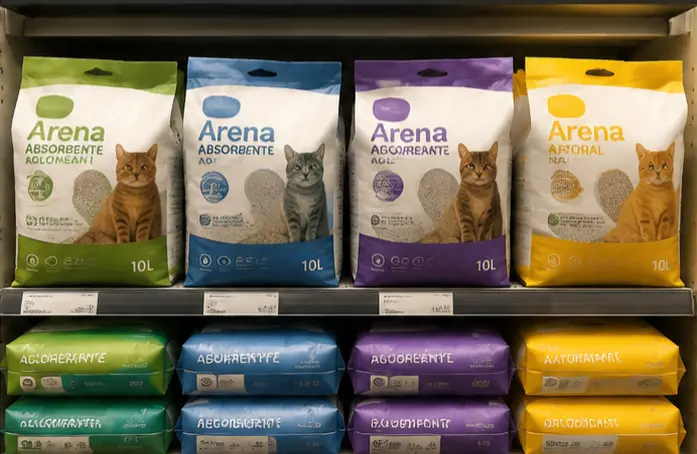
Spain has one of the highest private-label rates in the European cat litter category. Major retailers such as Mercadona, Carrefour, and Dia carry their own labels, and private label is estimated at 50 to 60% of non-clumping litter sales. For B2B suppliers, the real customer is often the retailer’s procurement team and its co-packer, not the end consumer. A Spain entry strategy that ignores private label is missing the main channel.
Sepiolite: Spain’s Native Mineral Litter
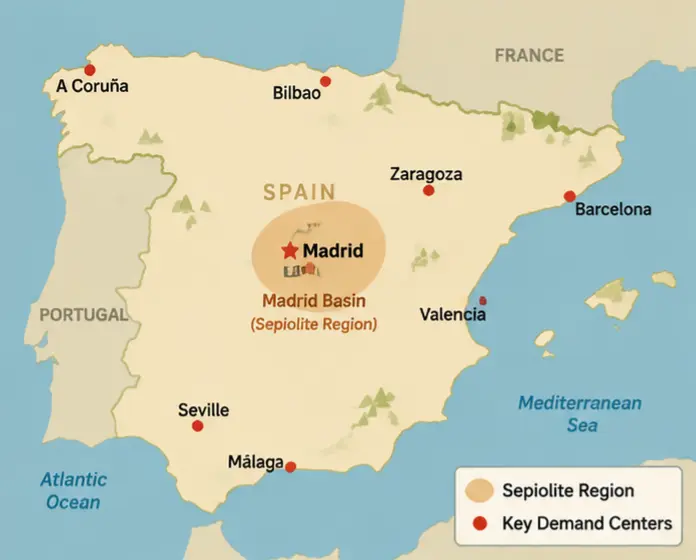
Spain is rare globally in having a domestic supply of sepiolite, a clay mineral mined from the Madrid basin by producers such as Tolsa. Sepiolite is a non-bentonite mineral litter with strong odor absorption and very low dust. This local supply means imported mineral litter competes against a home-grown, well-established alternative, so the realistic import opportunity lies elsewhere.
| Segment | Spain profile | Import opportunity |
|---|---|---|
| Non-clumping mineral (sepiolite) | Strong, locally supplied | Low, avoid head-on |
| Clumping (bentonite) | Mature, price-driven | Moderate on cost/quality |
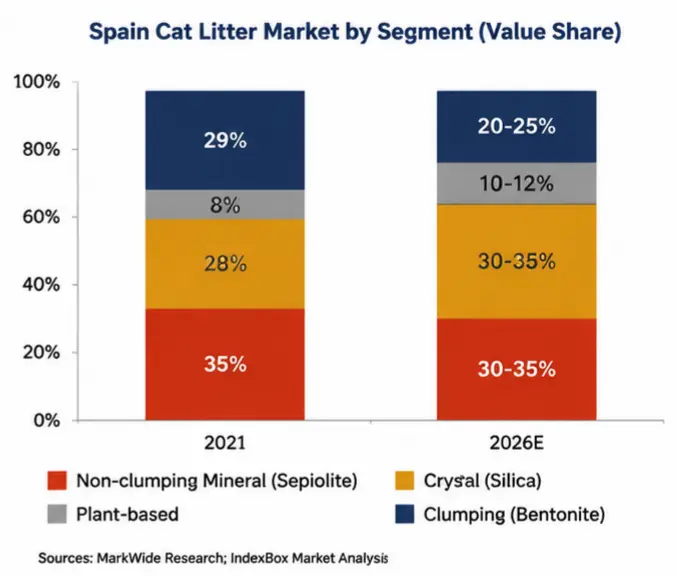
| Crystal (silica) | Fast-growing, 30–35% value share | High, silica often imported |
| Plant-based | Small but subsidized | High, differentiation play |
Crystal Litter as the Growth Engine
Crystal (silica gel) litter is the clear growth engine, with volume CAGR estimated at 8 to 11% from 2021 to 2026 and a value share rising to about 30 to 35%. Much of the silica used in Spain is imported from Germany, the Netherlands, and China, which gives Asian OEM suppliers a concrete cost-advantage entry point in the crystal segment specifically.
Import and Sourcing Considerations for B2B Buyers
For international buyers comparing Spain cat litter suppliers, the key evaluation factors are silica quality, OEM capability, compliance documentation, and logistics efficiency.
The practical sourcing logic for Spain is segmentation:
- Crystal litter: target the import-dependent silica segment where Asian OEMs are cost-competitive.
- Plant-based litter: position on compostability and sustainability, aligning with municipal subsidies.
- Mineral litter: avoid direct competition with sepiolite; if you supply bentonite, compete on price and clumping consistency, not local identity.
Compliance and documentation matter more than in some markets because retailer private-label programs require traceable quality and labeling. Buyers should review cat litter export compliance requirements early, including packaging and any market-specific labeling.
How to Enter the Spain Cat Litter Market
For a manufacturer or brand entering Spain, the steps are:
- Decide the segment: crystal or plant-based offers the clearest import wedge.
- Target the retailer or its co-packer, since private label is the dominant channel.
- Prepare compliance documentation and Spanish-language or multi-language packaging.
- Price against local sepiolite and bentonite, not against premium imported brands.
- Plan logistics through a European port or warehouse to keep shelf costs competitive.
A structured cat litter sourcing and buying guide helps map these steps, and a capable cat litter manufacturer can support private-label and OEM programs with the documentation European retailers expect.
Conclusion
Spain rewards suppliers who read its structure: a private-label-dominated, apartment-driven market with a protected native mineral segment and a fast-growing crystal and plant-based opening. The winning move is not to fight sepiolite on its home ground, but to supply the import-dependent crystal and sustainability segments with consistent quality and clean compliance. For B2B buyers, that means segment-first sourcing and retailer-facing private-label programs.
Frequently Asked Questions
About US$385 million in 2026 per one research house, growing toward roughly US$608 million by 2035. Estimates vary by methodology, so treat it as a steadily growing mid-sized European market.
Sepiolite is a Spanish clay mineral with strong odor absorption and very low dust, supplied domestically (notably by Tolsa). It is a non-bentonite local alternative to imported litters.
Major retailers such as Mercadona, Carrefour, and Dia run their own labels, estimated at 50 to 60% of non-clumping sales, making the retailer the real B2B customer.
Yes. Crystal (silica) litter is the growth engine, with volume CAGR around 8 to 11% from 2021 to 2026 and a value share near 30 to 35%. Much of the silica is imported.
Yes, especially crystal and plant-based segments. Prepare compliance documentation and Spanish or multi-language packaging, and price against local mineral litter.
Low dust and odor control, driven by about 80% apartment living. Compostable formats also gain from municipal subsidies in cities like Barcelona and Madrid.
Crystal (import-dependent silica) and plant-based (subsidized, differentiating) offer the clearest wedge; avoid head-on competition with native sepiolite mineral litter.
Retailer private-label programs require traceable quality and labeling. Review EU and Spanish packaging, language, and any waste-disposal labeling rules before launch.
The main B2B buyers are supermarket retailers, pet chains, distributors, and private-label procurement teams.
Yes. Spain’s high private-label penetration makes it one of the more suitable European markets for OEM and retailer-brand cat litter programs.
Sources:
- MarkWide Research: Spain Cat Litter Market
- IndexBox: Spain Crystal Cat Litter Market Analysis