




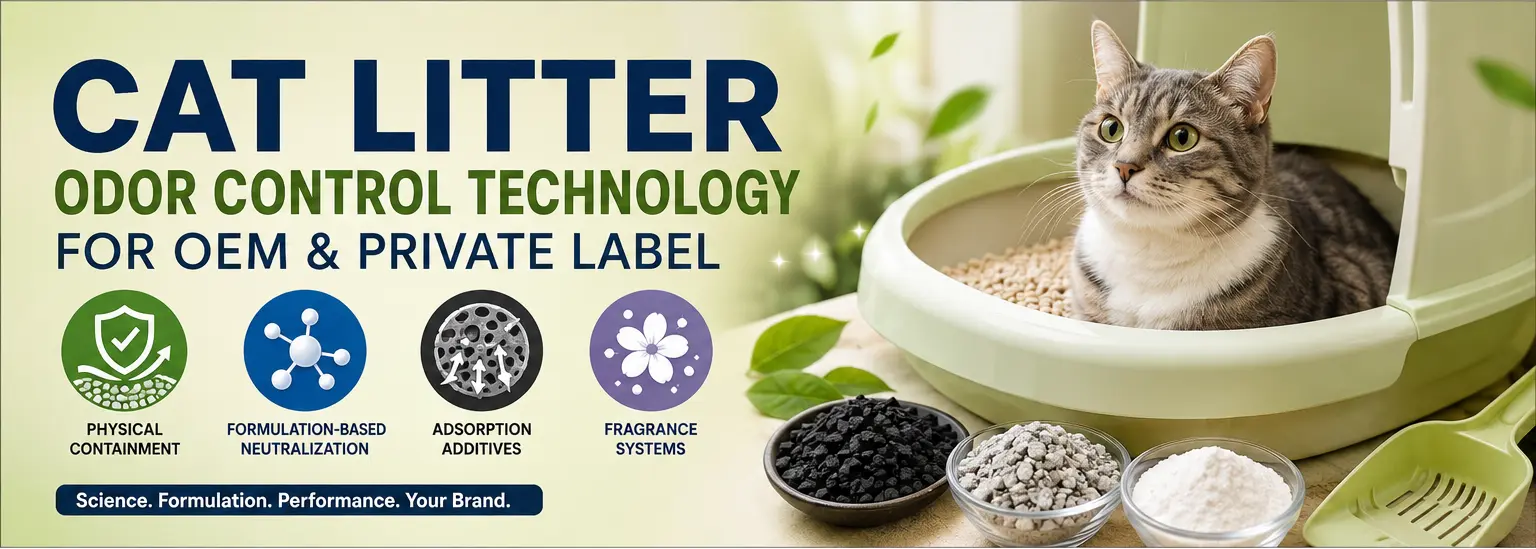
For importers, brand owners, and distributors building a cat litter program, odor control is rarely a feature you add at the end. It is an important product specification that can influence repeat purchase, complaints, and retailer acceptance. This guide explains four practical odor-control approaches used in modern cat litter and how a contract manufacturer can build them into a formula—so you can brief a supplier with precision instead of vague requests for “something that smells nice.”
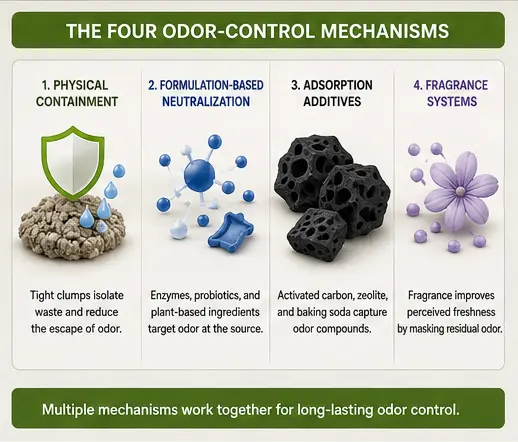
Quick answer: Cat litter controls odor mainly by containing waste, adsorbing odor compounds, using formulation-specific neutralizing or biological additives, and masking residual odors with fragrance. Clumping helps isolate urine and feces; activated carbon and zeolite can capture different odor compounds; baking soda may provide additional formulation-dependent odor control; and fragrance changes perceived odor rather than removing the source. For OEM or private-label projects, buyers should specify the mechanism, additive grade, inclusion level, test method, and acceptance criteria—not simply request “good odor control.”
Why Odor Control Matters in OEM Cat Litter Programs
For a distributor or private-label buyer, odor performance can become a retention and product-quality issue when the litter fails under real use. A formula that performs well at the point of sale but loses odor control after repeated use can contribute to complaints, poor reviews, returns, and retailer dissatisfaction. That makes odor control a formulation specification rather than a marketing footnote.
The commercial implication is straightforward: specify odor control at the formulation stage, verify it with batch testing, and document it.
The Four Odor-Control Mechanisms in Cat Litter
Odor in a litter box comes mainly from urea breaking down into ammonia, plus volatile organic compounds from feces. Different litters attack that problem in different ways. Understanding the mechanism helps buyers evaluate whether an odor-control claim is supported by the formula and the intended use conditions—not just by the wording on the package.
In practice, cat litter odor control technology is not one ingredient or process. It is the combination of waste containment, adsorption, formulation-specific odor control, and sensory masking, supported by the right base material and manufacturing process.
1. Physical Containment Through Clumping
The baseline mechanism is simple: a tight clump around liquid waste helps isolate the waste and reduces the exposed surface area through which odor can escape. Sodium bentonite swells and binds into a firm clump; high-quality plant litters form dense clumps within seconds. Firm, low-crumble clumps are better for odor control than soft, broken ones—even before any additive enters the formula. This is why clump integrity is a specification worth measuring, not just a claim on the bag.
2. Formulation-Based and Biological Odor Control
Some cat litter formulas use enzymes, probiotics, or other functional additives to target odor formation rather than simply masking it. Plant-based litters, including tofu, corn, and cassava formulas, can also contribute to odor control through liquid absorption, clumping, and physical containment, although performance varies by raw material and processing method. However, the base material should not automatically be treated as an enzymatic deodorizer. For OEM and private-label projects, buyers should therefore ask whether a claimed enzymatic or biological odor-control effect comes from the base material or from a defined additive system, and request test data that supports the claim. Our tofu cat litter is developed with this distinction in mind, pairing plant-based absorption with defined additive systems where odor performance requires it.
3. Additive Adsorption — Activated Carbon, Zeolite, Baking Soda
A common formulation approach is to blend an odor-control additive into the base. Each works differently:
- Activated carbon has a porous structure that can adsorb odor molecules, including many volatile organic compounds. It can be applied as a coating or incorporated into the granule so distribution remains reasonably uniform. Unlike fragrance, its odor-control effect is based on adsorption rather than scent release, although adsorption capacity is finite and depends on the carbon grade, loading, moisture, and target odor compounds.
- Zeolite is a porous mineral that can capture ammonia through adsorption and ion-exchange mechanisms. Peer-reviewed research has evaluated clinoptilolite-based materials for removing ammonia and sulfur-containing malodors from cat-litter headspace (Robins et al., Journal of Feline Medicine and Surgery 2022), while other studies have examined their ability to adsorb compounds such as aldehydes and amines (Czekaj & Sobuś, MDPI Materials 2024). In zeolite cat litter odor control, performance depends on the zeolite type, modification, particle size, moisture, and finished-litter formulation.
- Baking soda (sodium bicarbonate) is commonly used as a low-cost odor-control additive because it can alter local pH and interact with some odor compounds. Its effect is formulation-dependent and should not be presented as a universal solution for ammonia removal. For OEM development, the useful question is whether the finished formula shows a measurable odor benefit compared with the same base formula without bicarbonate.
4. Fragrance Systems
Scented litters apply fragrance oils—lavender, green tea, fresh linen, citrus—through a coating process. The critical distinction is encapsulated versus surface-applied fragrance. Encapsulated fragrance can release scent more gradually than a surface-applied fragrance, extending the perceived freshness of the product. It should still be treated as a masking or sensory-management system rather than proof that the underlying odor compounds have been removed. Surface-applied fragrance can release more quickly and may lose its perceived intensity sooner than an encapsulated system, after which the underlying odor may become more noticeable. For a premium private-label line, fragrance quality and release profile are differentiators worth specifying precisely with your manufacturer.
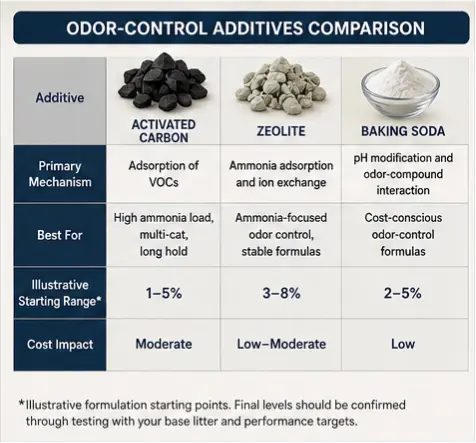
Activated Carbon vs Zeolite vs Baking Soda — What to Specify
These three additives are not interchangeable. The table below helps buyers brief a supplier on what to blend and why.
| Additive | Primary mechanism | Best for | Illustrative starting range* | Cost impact |
|---|---|---|---|---|
| Activated carbon | Adsorption of many odor compounds and VOCs | Multi-cat, complex odor profiles, premium formulas | 1–5% by weight | Moderate |
| Zeolite | Ammonia adsorption and ion exchange | Stable, long-shelf-life formulas | 3–8% by weight | Low–moderate |
| Baking soda | pH modification and odor-compound interaction | Cost-led mid-market lines | 2–5% by weight | Low |
*These ranges are illustrative formulation starting points, not universal industry specifications. Actual inclusion rates should be established through controlled trials using the selected base litter, additive grade, particle size, moisture level, and target odor-performance criteria.
Too little additive produces no measurable effect; too much can weaken clump integrity or raise cost without proportional gain. Formulation trials can begin with an appropriate range for the selected additive, then be tuned against a control batch over a defined test period, such as five to seven days.
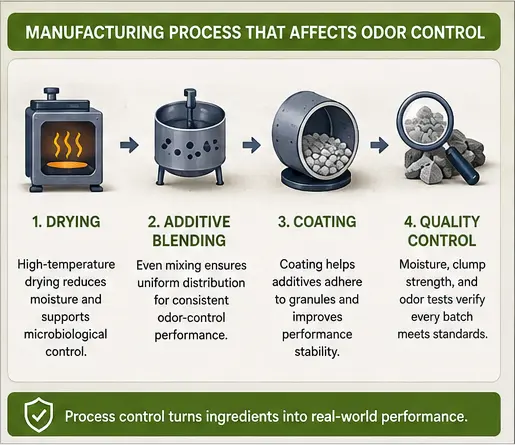
How Manufacturers Build Odor Control Into the Formula
Odor control is an outcome of process, not just ingredients. Several manufacturing decisions matter:
- Additive application method. Activated carbon should be distributed as evenly as practical, whether through coating or pre-mixing, rather than added as a loose sprinkle that can segregate during handling or transport.
- Moisture control. Controlled moisture is important for clumping, storage stability, additive distribution, and odor performance. Excess moisture can weaken some formulations and affect how odor-control additives perform, so moisture should be included in the product specification.
- Base material choice. Our bentonite cat litter provides a strong clumping foundation that pairs well with activated carbon or zeolite blends for premium odor lines.
Specifying Odor Control for Your OEM or Private-Label Line
When you brief a manufacturer, move beyond “good odor control” to measurable specs. Ask for:
For a private-label odor control cat litter program, the specification should define the target odor performance, additive system, blend range, testing protocol, and claim language before production begins.
- Zeolite characterization data, such as ion-exchange capacity and the test method used, so the buyer can compare material grades and understand their expected ammonia-capture performance.
- Particle-size distribution, so the additive spreads evenly through the blend.
- Safety and compliance testing. Ask for relevant test reports covering lead, arsenic, microbiological indicators, moisture, and other parameters applicable to the target market and litter type. For products sold or manufactured for the China market, GB/T 43839-2024 covers cat litter within its companion-animal product requirements and includes relevant safety, physical, chemical, and hygienic requirements. Where applicable, separate contaminants such as aflatoxin should be listed as their own test items rather than grouped under heavy metals.
- Per-batch odor or performance testing. Ask for defined odor-panel, ammonia, or other instrumental test results with the test conditions clearly documented. ASTM E3489-25 provides guidance for designing and analyzing odor evaluations for absorbent hygiene products, including cat litter, but it does not prescribe one universal cat-litter test method, so the supplier should state the actual test protocol and acceptance criteria used.
On-pack claims should be matched to the evidence and the destination market. Descriptions such as “zeolite-enhanced formula” or “natural mineral odor control” should accurately reflect the actual formulation and supporting test data rather than imply a performance level that has not been demonstrated. For environmental claims, ISO 14021:2026 provides principles and requirements for self-declared environmental claims, including claims used on packaging, advertising, product literature, and digital platforms. If a claim suggests a health, therapeutic, antimicrobial, or other regulated benefit, obtain market-specific regulatory advice before using it.
Common Formulation Mistakes That Let Odor Escape
- Specifying surface-applied fragrance that fades relatively quickly, leaving the original odor exposed.
- Under-dosing the additive so there is no measurable odor effect.
- Accepting weak clump integrity, which lets odor off-gas from broken clumps.
- Ignoring moisture content at intake, which accelerates ammonia development.
- Over-claiming odor performance on the pack without batch test data to back it.
Conclusion
Cat litter odor control is a stack of mechanisms—containment, formulation-based neutralization, additive adsorption, and fragrance—not a single switch. The buyers who build defensible private-label programs are the ones who specify the combination and blend rate, verify it with batch testing, and document it for retailer compliance. To plan a formula with a manufacturing partner that already runs these systems, see our OEM cat litter capability overview.
Frequently Asked Questions
Cat litter controls odor mainly through waste containment, adsorption, formulation-specific odor-control additives, and fragrance. Clumping isolates urine and feces; activated carbon and zeolite can capture different odor compounds; some formulas use enzymes or biological additives; and fragrance changes perceived odor rather than removing the source. Effective formulas may combine several mechanisms.
They target different compounds. Activated carbon adsorbs volatile organic compounds; zeolite captures ammonia through adsorption and ion exchange. Many premium formulas blend both. The better choice depends on the base litter and the odor load you need to handle.
Baking soda can provide some odor-control benefit in certain litter formulas, but its effect is formulation-dependent and should not be presented as a universal ammonia-removal mechanism. For OEM development, compare the finished formula with and without sodium bicarbonate under the same controlled test conditions.
Not necessarily. Scent only masks; it does not remove the source. Encapsulated fragrance manages odor over time, while surface-applied fragrance fades quickly. An unscented formula with strong clumping and formulation-based or adsorptive control can outperform a scented one that relies on perfume.
Often yes, because plant-based litters such as tofu, corn, and cassava contribute to odor control through rapid liquid absorption, clumping, and physical containment. Whether an enzymatic or biological effect is also present depends on whether a defined additive system is used, so buyers should request test data rather than assume the base material is itself a deodorizer. Additives such as activated carbon are still commonly blended into plant litters for higher odor loads.
There is no universal percentage that applies to every cat litter formula. A supplier may use an initial trial range, but the final inclusion level should be established through controlled testing of the selected zeolite grade, base litter, moisture level, particle size, and target odor performance. Avoid treating a fixed percentage as an industry standard.
Ask for defined per-batch odor-panel, ammonia, or instrumental test results with the test conditions documented, ion-exchange capacity data for zeolite, and safety and compliance test reports. Quote performance from a real test number rather than a marketing phrase, and confirm the actual test protocol rather than assuming a single standard method.
Whether a claim requires specific substantiation, notification, or other regulatory review depends on the destination market and the exact wording. Buyers should ensure that terms such as “natural mineral odor control” accurately describe the formulation and are supported by appropriate evidence. Claims suggesting health, therapeutic, or antimicrobial benefits should receive additional market-specific regulatory review.
It can, if it relies on clumping, formulation-based neutralization, or adsorptive additives rather than perfume. Fragrance-free is often preferred by sensitive households and avoids the fade-and-return problem of surface-applied scent.
Ask for the additive blend rate and application method, zeolite ion-exchange data, moisture specifications, drying and process controls, and per-batch odor test reports with documented test conditions. These specs determine real-world performance more than the wording on the bag.