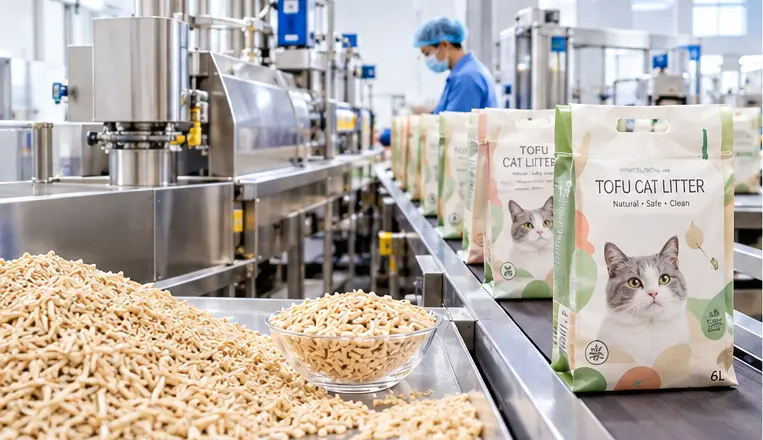






For planning purposes, a tofu cat litter bulk density of 600 g/L means about 3.6 kg per 6L and 6.0 kg per 10L. Actual density varies by formula, particle size, moisture, and test conditions, so buyers should specify a target and tolerance rather than treat 600 g/L as an industry standard. Compared with a hypothetical 800 g/L bentonite product at the same volume, 600 g/L is 25% lower in mass per liter.
What Is the Bulk Density of Tofu Cat Litter?
Bulk density is the mass of litter per unit volume, expressed as grams per liter (g/L), which is the weight per liter of the litter. For tofu cat litter, a value such as 600 g/L can be used as a purchasing example, but the measured result depends on particle shape, formula, moisture, packing condition, and the test method. When buyers compare suppliers, the useful specification is the agreed target, tolerance, sampling procedure, and test method rather than a single reference number.
Because density affects how much product fits in a bag and container, it belongs in the same specification sheet as clumping performance, dust, and moisture. Tracking density batch to batch can help buyers monitor product consistency, but density alone does not prove extrusion consistency; the measurement method and other quality parameters should be reviewed together.
Tofu Cat Litter Weight by Bag Size
Weight formula: Estimated product weight (kg) = bag volume (L) × bulk density (kg/L). For unit conversion, 600 g/L is the same as 0.6 kg/L. Using 600 g/L as a product example, the estimated product weights for common bag volumes are:
| Bag volume | Tofu litter at 600 g/L | Example bentonite at 800 g/L |
|---|---|---|
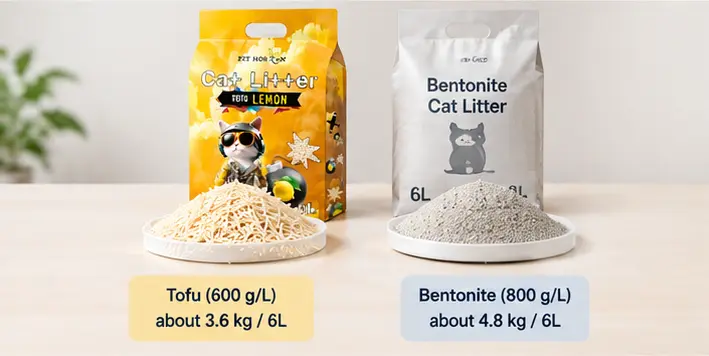
| 6L | about 3.6 kg | about 4.8 kg |
| 10L | about 6.0 kg | about 8.0 kg |
A 6L bag can be used as a simple incoming or pre-shipment weight check when the buyer has specified both nominal volume and bulk-density tolerance. Because actual filled weight can also be affected by moisture and packing conditions, the check should follow the agreed sampling and test procedure. See how tofu cat litter is made for how raw material and extrusion set the final density.
Tofu Cat Litter vs Bentonite: Density and Weight
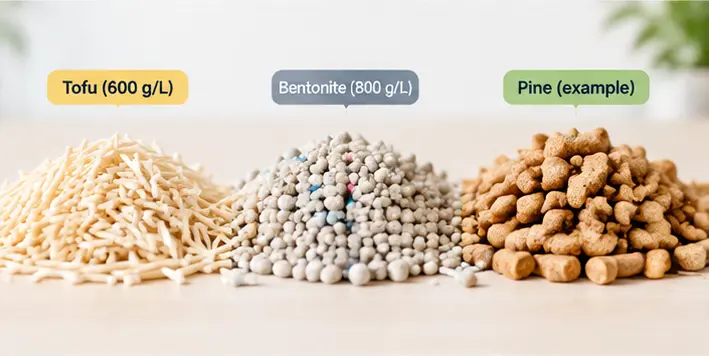
Bentonite clumping litter is typically denser; a product at about 800 g/L means a 6L bag weighs about 4.8 kg against tofu’s roughly 3.6 kg at 600 g/L. The 25% lower mass per liter is a mathematical result of comparing 600 g/L with 800 g/L at the same volume, not a property of all tofu or bentonite products.
This comparison is about physical density, not performance claims. A lower-density product may change the balance between container volume and payload limits, but the buyer should still compare clumping, dust, tracking, packaging dimensions, and actual freight cost for the target market.
Why Density Matters for OEM Orders and Freight
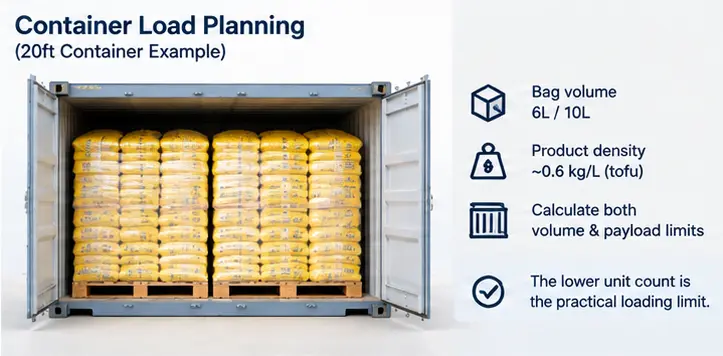
Density is one input in container-load planning, but it does not by itself determine the number of bags per container. Buyers should calculate both volume and payload limits using the filled bag dimensions, packing pattern, palletization if applicable, product density, and the container’s allowable payload. The lower resulting unit count is the practical loading limit for the shipment.
Dust should be specified separately from bulk density because it affects handling, filling, cleaning, and product acceptance. For an OEM order, define a measurable dust limit and test method so the factory and buyer use the same acceptance criteria.
How Moisture Affects Weight and Density
Moisture adds mass without increasing the dry-material volume. A batch above the agreed moisture limit can therefore weigh more at shipment and may have a higher risk of quality deterioration during storage or transit, depending on water activity, microbial load, temperature, and packaging conditions. Specify a maximum moisture level in the contract and verify it using the agreed test method and pre-shipment QC records.
How to Specify Density in an OEM Order
Put bulk density in the spec sheet as a target value with a defined tolerance, for example 600 g/L plus or minus 30 g/L, and specify the sampling and test method so the factory and buyer measure the product consistently. Pair density with dust, moisture, and clumping limits, then define whether compliance is verified by supplier QC records, certificates of analysis, periodic third-party testing, or another agreed inspection plan. Our tofu cat litter OEM service can incorporate these parameters into the product specification, packaging, and logistics requirements.
For European retail, review the destination market’s applicable product-safety, chemical, packaging, and labeling requirements separately from the physical density specification. Cat litter should not be treated as pet food simply because it is sold for cats, so FEDIAF pet-food labeling guidance is not a substitute for the requirements applicable to litter products. Visit the tofu cat litter product page for the current specification and OEM details.
Frequently Asked Questions
Bulk density varies by tofu litter formula, particle size, moisture, and test conditions. Buyers should specify the target value, tolerance, sampling procedure, and test method rather than treat 600 g/L as an industry standard.
Using 600 g/L as a product example, a 6L bag weighs roughly 3.6 kg. The actual weight depends on the specified bulk density and tolerance, so confirm it against the agreed test method.
At the same volume, 600 g/L tofu is about 25% lower in mass per liter than a hypothetical 800 g/L bentonite product. Actual weights depend on the specific product densities, so compare measured values rather than assuming one material is always lighter.
A 10L bag works out to about 6.0 kg at 600 g/L. For comparison, the same volume would be about 8.0 kg if a bentonite product had a bulk density of 800 g/L.
Density is one factor in container loading. Calculate both the volume available from the container and the allowable payload, using the filled bag dimensions, packing pattern, and product density. The practical shipment quantity is constrained by whichever limit is reached first.
Yes. Moisture adds mass to the product and can affect storage stability. Excess moisture may increase the risk of quality deterioration during transit or storage depending on water activity, microbial load, temperature, and packaging conditions. Specify a maximum moisture level and verify it using the agreed test method and pre-shipment QC records.
Convert density to kg/L, multiply by bag volume to get bag weight, then compare the total against both the container volume and the allowable payload using the filled bag dimensions and packing pattern. The loading limit is whichever constraint is reached first.
State bulk density as a target with tolerance (for example 600 g/L plus or minus 30 g/L) and attach the test method. Pair it with dust, moisture, and clumping limits, and agree whether compliance is verified by supplier QC, certificates of analysis, periodic third-party testing, or another inspection plan.