

Developing a new cat litter product involves more than selecting a material and approving a sample. Buyers need to define product specifications, evaluate formula options, check performance, and confirm that the selected formula can be reproduced on the production line. For private label and OEM projects, these steps help reduce sample revisions and prevent differences between the approved sample and the first commercial batch. This guide explains how to manage the process from the initial product brief to pilot production.
Cat litter new product development typically involves six stages: product briefing, formula sampling, sample testing, pilot production, product validation, and final specification approval. Sample approval confirms that the product meets the buyer’s requirements, while pilot production checks whether the selected formula can be reproduced under actual manufacturing conditions. Only after these checks should the product move into commercial production.
What Cat Litter NPD Means for a Buyer
For example, a buyer developing a low-dust clumping tofu litter needs to define more than the material itself. Target granule size, clumping strength, moisture content, dust level, absorption, and fragrance requirements all influence the final product. Bentonite and pine litter require different specifications and performance checks, so the development criteria should reflect the selected material.
Pet Horizon supplies tofu, bentonite, and pine cat litter for OEM and private label programs. Based in Dalian, the manufacturing facility covers 18,000 m2 and has an annual production capacity of 150,000 tonnes. For buyers developing a new product, the key consideration is how the approved specifications can be translated into consistent production requirements for commercial orders.
The NPD Stage Gate
| Stage | Main activities | Buyer approval |
|---|---|---|
| 1. Product brief | Define material, performance targets, granule specifications and packaging | Confirm product requirements |
| 2. Formula sampling | Develop and compare initial sample options | Select the preferred sample |
| 3. Sample testing | Evaluate clumping, dust, moisture, absorption and granule consistency | Approve sample performance |
| 4. Pilot production | Run the selected formula under actual production conditions | Review pilot results |
| 5. Product validation | Check product performance and consistency using pilot samples | Confirm commercial suitability |
| 6. Specification approval | Finalize product parameters, packaging and quality requirements | Authorize commercial production |
Step 1 – Brief and Specification Lock
Before sampling begins, the buyer and manufacturer should agree on a written product brief. For tofu cat litter, this may include granule size, shape, clumping strength, dust level, moisture content, and absorption performance. Bentonite projects require attention to granule distribution, bulk density, and clumping behavior, while pine litter specifications should reflect pellet dimensions, moisture content, and material consistency. These requirements should be defined according to the selected material and intended product positioning.
The brief should also cover fragrance requirements, product color where applicable, bag weight, packaging material, and private label artwork. Defining measurable targets at this stage gives both parties a consistent reference for sample evaluation and later production checks.
Step 2 – Formula Prototyping
Once the product brief is agreed, the manufacturer can prepare an initial sample based on the selected material and target specifications. Depending on the project, development may involve comparing different formulas or adjusting specific parameters such as granule size, clumping performance, dust level, or fragrance.
Sample evaluation should focus on measurable product characteristics, including:
- Clumping time and clump strength
- Dust generation
- Moisture content
- Liquid absorption and retention
- Granule size and consistency
For mixed cat litter, the development process also needs to consider blend ratios and particle compatibility. Differences in particle size, density, and shape can affect how evenly components remain distributed during handling and transportation. These factors should be checked before the formula is approved.
Step 3 – Pilot Batch on the Real Line
A formula that performs well in a laboratory sample still needs to be checked under actual production conditions. A pilot batch uses the selected formula on the production equipment to evaluate whether the material can be processed consistently and whether the finished litter meets the agreed specifications.
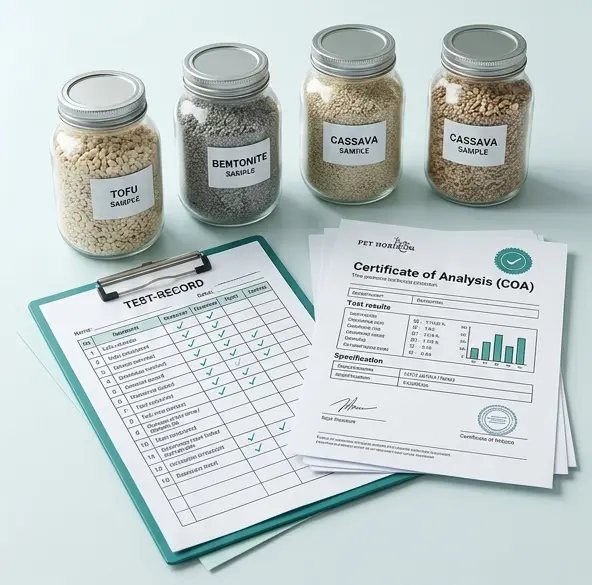
During the pilot run, the manufacturer should check relevant parameters such as granule size distribution, moisture content, dust generation, clumping performance, and packaging weight. For blended litter, the batch should also be checked for mixing consistency. A pilot-batch Certificate of Analysis (COA), supported by relevant test records where necessary, provides documented results for the parameters covered by the inspection. Buyers can use these records to review the pilot batch against the agreed product specifications before commercial production.
Step 4 – Field and Sensory Validation
After pilot production, the buyer should evaluate the product under conditions that reflect its intended market and use. Practical checks may include odor control over several days, litter tracking around the box, clump removal, and whether cats readily accept the granules.
These observations complement laboratory measurements rather than replace them. For private label projects, the buyer can also collect feedback from a small group of target users before approving the product for commercial launch. Any recurring issue should be reviewed against the product brief before the specification is finalized.
Step 5 – Final Specification Approval and Commercial Production
Once the pilot batch meets the agreed requirements, the buyer and manufacturer should finalize the product specification. This document should record the approved material, formula parameters where applicable, granule characteristics, performance targets, packaging details, and quality acceptance criteria.
The approved specification then becomes the reference for commercial production and incoming quality checks. Any later changes to raw materials, formula ratios, or key product parameters should be reviewed and approved by both parties before implementation.
The first commercial order should follow the agreed inspection and acceptance procedure, giving the buyer a clear basis for comparing delivered goods with the approved pilot sample. The time to prepare this order follows the plant’s normal manufacturing lead time, which is distinct from the product development period.
Buyer Checklist Before Approving a New Cat Litter Product
Before approving a new product for commercial production, buyers should confirm the following:
- The approved product brief and specification sheet are documented.
- Sample and pilot-batch test results meet the agreed requirements.
- The pilot batch represents the intended commercial production process.
- Packaging artwork, bag weight, and labeling details are confirmed.
- Quality acceptance criteria and batch documentation are agreed.
- Any formula or specification changes require mutual approval.
NPD Timeline Expectations
The time required to develop a new cat litter product depends on how much needs to be changed. A project using an existing material and standard packaging may move through sampling and approval relatively quickly. New formula combinations, fragrance adjustments, custom packaging, or additional performance testing can extend the process.
Buyers should distinguish product development time from commercial production lead time. The former covers specification confirmation, sampling, testing, and pilot approval; the latter begins when the product is approved and the commercial order is ready for production. Agreeing on these milestones early helps buyers coordinate sample approval, packaging preparation, and commercial order placement without confusing product development time with factory production time.
From Development to Repeatable Production
A successful cat litter development project depends on clear specifications, meaningful sample evaluation, and pilot testing under actual production conditions. For OEM and private label buyers, the most important step is to establish measurable acceptance criteria before approving commercial production.
By documenting the approved product parameters and agreeing on how future batches will be checked, buyers can make the transition from product development to repeatable manufacturing more predictable.
Frequently Asked Questions
There is no fixed timeline for every project. A product based on an existing formula and standard packaging may require less development time than a new blend or customized formula. Sampling, testing, pilot production, and approval should be planned separately from the manufacturing lead time for the first commercial order.
The number depends on the development requirements. A project involving a new formula may benefit from comparing several sample options, while a minor adjustment to an existing product may only require one revised sample. Focus on meaningful differences in performance rather than producing multiple samples without clear evaluation criteria.
Testing depends on the litter material and agreed product specifications. Common checks include moisture content, granule size distribution, dust generation, absorption, and clumping performance. Blended products may also require mixing consistency checks. The pilot-batch COA should report the relevant test results against the agreed acceptance criteria.
Formula ownership depends on the development arrangement and the written agreement. A buyer-funded custom formula does not automatically transfer ownership without clear contractual terms. Buyers should distinguish newly developed formulas from the manufacturer’s existing formulations and document ownership, usage rights, confidentiality, and exclusivity before development begins.
Yes. Mixed cat litter can be developed by combining different materials or particle types to achieve specific performance characteristics. Development should consider blend ratios, particle size, density, and mixing consistency. Pilot testing helps determine whether the components remain evenly distributed during production, packaging, and transportation.
The key documents include the approved product specification sheet, pilot-batch COA, and relevant test records. Buyers should also confirm packaging specifications and quality acceptance criteria before commercial production. These documents provide a reference for checking whether subsequent batches meet the approved requirements.