





Cat litter for catteries, veterinary clinics, and boarding facilities must meet the demands of repeated cleaning, multi-cat use, and reliable replenishment. For institutional buyers, the decision involves more than litter performance: packaging, handling time, waste disposal, storage capacity, and consistency between deliveries all affect operating costs. This guide explains how to evaluate litter options, compare supplier specifications, and plan bulk orders around actual facility consumption.
Choose cat litter for institutional use by evaluating dust performance, clump integrity where relevant, cat acceptance, cleaning workload, and disposal requirements. Trial representative samples under normal operating conditions, record consumption and handling results, then confirm product specifications, packaging, MOQ, lead time, and quality-claim procedures before committing to bulk supply.
In this article, an “institutional buyer” means a cattery, veterinary clinic, boarding facility, or animal shelter purchasing cat litter for its own multi-cat operation, not for resale. The advice is about operational fit and bulk buying, not about retail branding.
Who This Guide Is For
- Catteries that house several cats and change boxes multiple times per day.
- Veterinary clinics and hospitals where hygiene and low dust protect staff and patients.
- Boarding and daycare facilities with high daily turnover of unfamiliar cats.
- Animal shelters managing large numbers of cats in group housing.
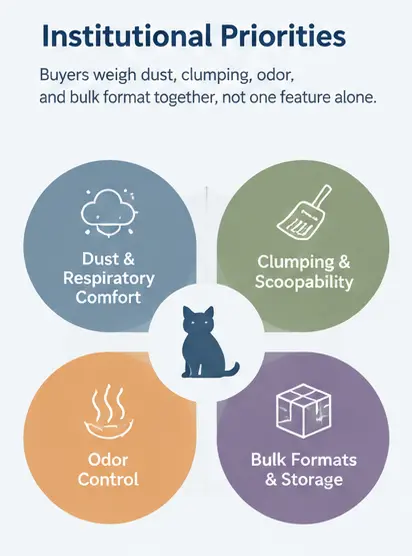
What Institutional Buyers Prioritize Differently
Home users can tolerate a product that is merely acceptable. A facility running dozens of boxes cannot, because small problems multiply across cats, staff hours, and disposal volume.
Dust and respiratory comfort
Low-dust claims should be evaluated against a defined test method rather than the product label alone. Sieve analysis can measure the proportion of particles below a specified size, while a dust-generation test evaluates dust released under particular test conditions. These measurements are related but not interchangeable. Ask suppliers to identify the method, screen opening where applicable, sample preparation, and reported result. During a facility trial, also observe dust released during pouring and scooping. A dust-free clumping cat litter option may be worth evaluating, but confirm the supporting test information before comparing products.
Odor control and scoopability
Clumping litter lets staff remove waste quickly, which is the most reliable odor control in a busy room. Scented litters can mask smell but may also repel cats or aggravate sensitive noses, so unscented is a safe default in clinical settings.
Bulk formats and storage
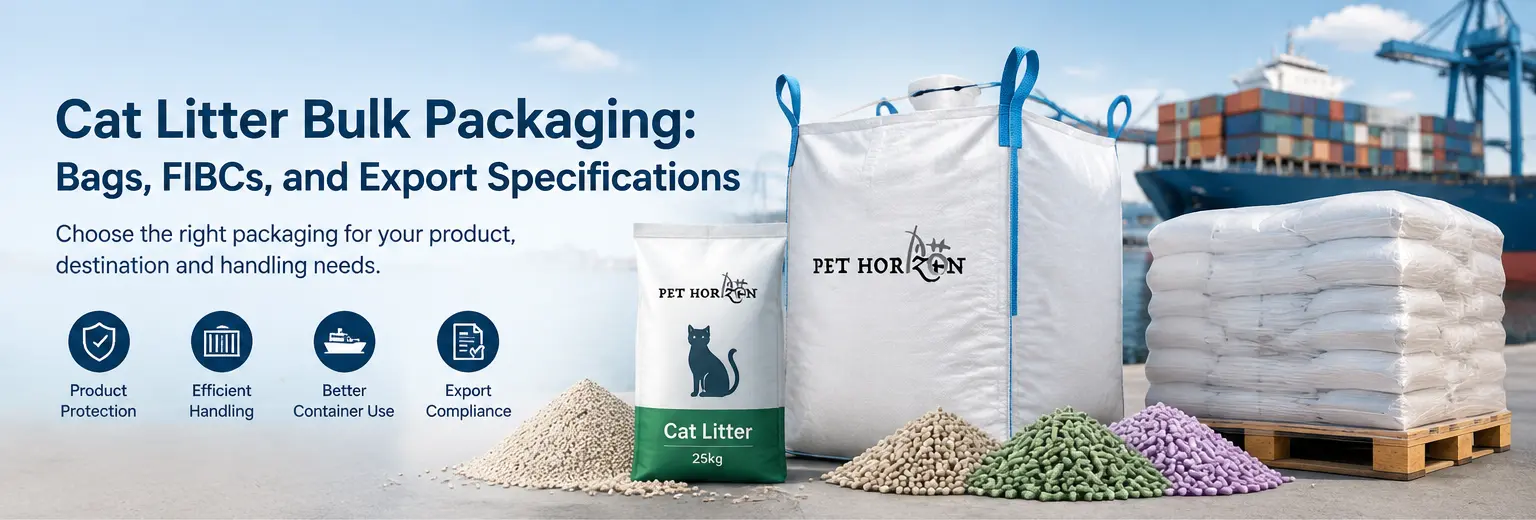
Facilities consume volume, so packaging matters. Common bulk formats include 5 to 25 kg bags, palletized for fork-lift handling, and FIBCs (jumbo bags) for very high use. The right format depends on your storage space and how the litter is poured into boxes, not on which looks convenient at retail.
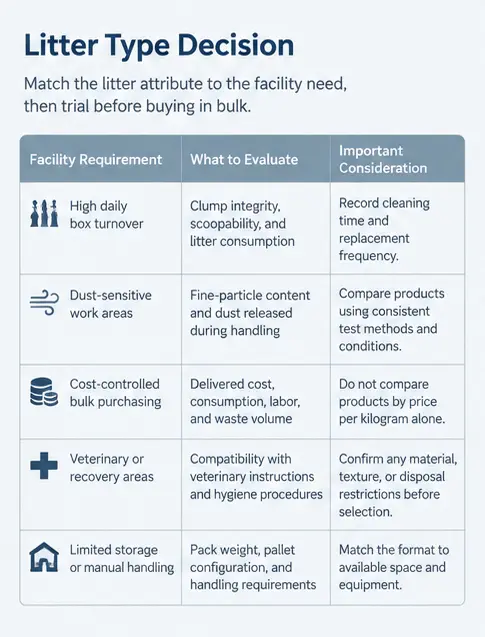
Choosing a Litter Type for the Facility
| Facility requirement | What to evaluate | Important consideration |
|---|---|---|
| High daily box turnover | Clump integrity, scoopability, and litter consumption | Record cleaning time and replacement frequency. |
| Dust-sensitive work areas | Fine-particle content and dust released during handling | Compare products using consistent test methods and conditions. |
| Cost-controlled bulk purchasing | Delivered cost, consumption, labor, and waste volume | Do not compare products by price per kilogram alone. |
| Veterinary or recovery areas | Compatibility with veterinary instructions and hygiene procedures | Confirm any material, texture, or disposal restrictions before selection. |
| Limited storage or manual handling | Pack weight, pallet configuration, and handling requirements | Match the format to available space and equipment. |
Trial before bulk commitment
Run a two-week trial in a representative room before committing to a pallet or FIBC. Track how the litter clumps, how much dust appears during pouring, and whether cats use the box readily. A trial turns a catalog choice into an operational decision backed by your own observations.
Bulk Buying and MOQ Considerations
Bulk purchasing can reduce the cost per kilogram and the frequency of deliveries, but the right order size depends on consumption, storage capacity, cash flow, MOQ, and supplier lead time. Compare the delivered cost alongside litter consumption, cleaning labor, waste handling, and packaging requirements. Use actual facility usage to estimate reorder points and safety stock, then choose an order frequency that balances inventory availability with storage and working-capital constraints. Review cat litter minimum order quantity guidance and confirm the supplier’s current ordering terms before committing.
Use a facility trial scorecard before approving a repeat order
For a like-for-like comparison, have the same staff record results for each trial lot over the same seven-to-fourteen-day period. Record the litter type, batch number, boxes served, bags opened, visible dust during pouring, clump breakage, cat acceptance, waste volume, and staff minutes spent scooping. This turns a purchasing discussion into an operational record rather than a preference survey.
Where possible, calculate litter consumption and material cost per box per day, using the same recording period and cleaning routine for each product. Keep labor time, disposal costs, and delivered product price as separate measures so buyers can see whether a lower purchase price actually reduces operating costs.
Pet Horizon can use the approved scorecard, the retained trial sample, and the agreed written specification as the repeat-order reference. That gives an institutional buyer one product baseline to compare across batches, formats, and future tenders.
A Short Supplier Checklist
- Documented product specifications and agreed acceptance criteria.
- Batch identification and traceability records appropriate to the product and order.
- Clear quality-control information for dust, clumping, moisture, or other agreed parameters.
- Confirmation of raw-material or formulation traceability information available for buyer review, subject to applicable confidentiality arrangements.
- MOQ, production lead time, shipping schedule, packaging configuration, and storage requirements.
- Applicable SDS, test reports, and certificates where required by the product, destination market, or purchasing agreement.
- A written process for reporting, investigating, and resolving off-specification or damaged deliveries.

For institutional buyers evaluating Pet Horizon, the purchasing discussion should begin with a clear facility brief covering the intended application, litter type, packaging format, order volume, and required quality criteria. Buyers can request representative samples and confirm which product specifications, quality records, and supporting documents are available before placing a bulk order. Documenting the approved product and acceptance requirements can also provide a reference for reviewing subsequent deliveries.
Key Takeaway: For catteries, clinics, and boarding, buy for operational fit, not retail appeal. Trial the litter in a real room, judge dust by measured fines rather than the label, choose a bulk format your storage can handle, and hold the supplier to batch consistency on every repeat order.
Common Buying Mistakes
- Choosing on price alone and ignoring dust or clumping in daily use.
- Assuming “low dust” on the bag means a measured, low fines result.
- Buying a full pallet before a trial confirms the cats accept it.
- Ordering bulk without a storage and reorder plan.
- Switching litter abruptly without a transition period.
- Assuming a trial at one site represents every location, even when cat populations, cleaning routines, storage conditions, or disposal procedures differ.
Conclusion
Cat litter for catteries, vet clinics, and boarding facilities succeeds when it is specified for the room, not the shelf. Define the need, trial the product, verify dust by sieve rather than label, and buy in a bulk format your team can handle. With a supplier held to batch consistency, institutional litter buying becomes a quiet operational win rather than a recurring problem.
Frequently Asked Questions
Most choose a low measured dust, unscented clumping litter that scoops quickly across many boxes. The priority is daily operability and cat acceptance, not fragrance or retail packaging.
The suitable litter depends on the clinic’s hygiene procedures, treatment area, and veterinary instructions. Buyers should evaluate dust, texture, handling, and disposal requirements before approving a product for routine use.
Yes. Shelters commonly use 5 to 25 kg bags or FIBCs, but they should plan storage space and check minimum order quantities before committing, and keep a transition plan when changing products.
Clumping is usually better for high-traffic scooping and odor control. Non-clumping bulk can lower cost where flushing or disposal rules allow, but it needs more frequent full changes.
It depends on cat count, box count, and change frequency, so track usage for a month and set a reorder point. There is no single figure; your own throughput is the only accurate basis.
Batch consistency, documented specifications, reliable delivery lead time, and a clear answer on dust, clumping, and moisture. Consistency across repeat orders matters more than a one-time low quote.
Not necessarily. Ask the supplier which test method is used and what the result measures. Sieve-based fines content and dust released during handling are different indicators, so compare results only when the methods and test conditions are sufficiently consistent.
Follow the facility’s animal-care procedures and monitor litter-box use during the change. A gradual transition may be appropriate for some cats, but the method should reflect individual needs, veterinary advice where relevant, and the facility’s hygiene requirements.