

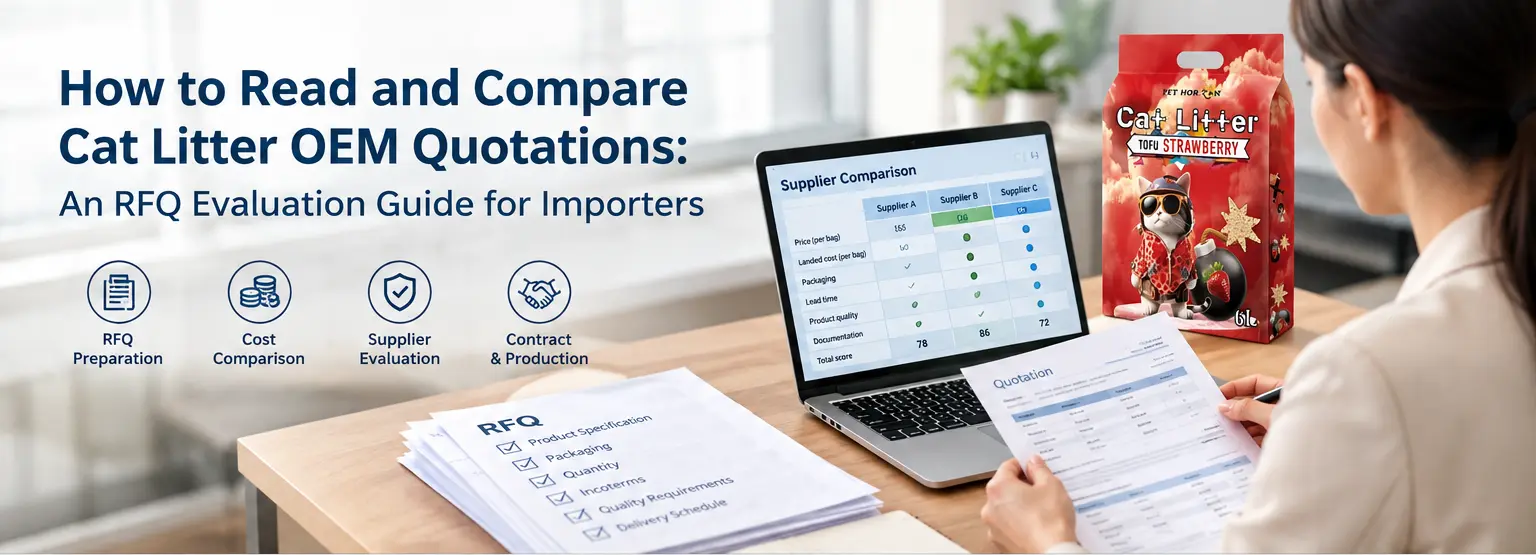
Comparing cat litter OEM quotations is not simply a matter of choosing the lowest price per bag or tonne. For importers, distributors, and private-label brands sourcing from China, a quotation is only comparable when the product specification, net fill weight, packaging, order quantity, and shipping terms are aligned. A lower price may reflect a different tofu or bentonite formula, lighter packaging, a different loading basis, or services that are not included in the quoted amount.
This guide explains how to evaluate a cat litter OEM quotation from a manufacturer’s perspective: what to include in an RFQ, how to compare quoted and landed costs, which quality and production commitments to verify, and how to carry the agreed specifications into an OEM contract. Whether you are sourcing tofu cat litter, bentonite cat litter, pine cat litter, or a mixed formula, the goal is to compare equivalent products and identify the supplier that can meet your commercial and quality requirements over repeat orders.
To compare cat litter OEM quotations fairly, send every shortlisted factory the same RFQ covering formula, net weight, packaging, order volume, quality requirements, destination, and Incoterms 2020 delivery terms. Separate one-time costs, recurring product costs, and logistics charges, then calculate the total landed cost per sellable bag or kilogram on the same basis. Before placing an order, confirm the agreed specifications, quality acceptance criteria, production lead time, inspection arrangements, and written change-control requirements. The lowest quoted price is not necessarily the lowest-cost option once freight, duties, packaging, quality risks, and rejected or unsellable goods are considered.
Why Comparing Cat Litter OEM Quotations Is Not the Same as Comparing Prices
Two quotations can show the same price per bag and still describe two completely different products. One may quote a 6-litre tofu litter at 2.5 kg with a resealable printed pouch and per-batch third-party testing; the other may quote an unprinted woven bag of approximate weight with no documentation. The number looks identical; the risk profile is not.
For a repeat-purchase product like cat litter, consistency across containers matters more than a small saving on the first order. A cat litter OEM quotation is therefore a specification document first and a price document second. Read it as a supplier’s written commitment to what they will actually manufacture and ship.
What a Complete Cat Litter OEM Quotation Should Contain
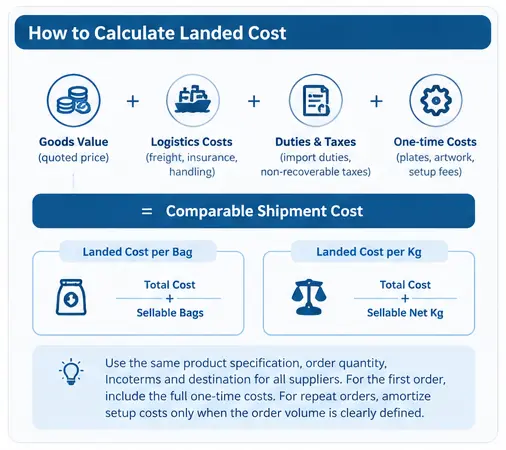
A useful cat litter OEM quotation should identify the product being priced, the costs included, the delivery basis, and the commitments the supplier is prepared to make. The table below provides a practical checklist for comparing quotations from Chinese cat litter manufacturers. Document requirements vary by product, destination market, and shipping arrangement, so confirm which records are applicable before placing an order.
| Quotation item | What to specify or verify | なぜそれが重要なのか |
|---|---|---|
| Product specification | Cat litter type, agreed formula or material composition, particle characteristics, fragrance, clumping requirements, and target performance | Two products sold under the same category name may differ in performance, material composition, and cost. |
| Net fill weight and package format | Net weight per bag, bag dimensions, material, closure, print requirements, barcode, and retail language | Ensures that the quoted unit price refers to the same sellable product. |
| Secondary packaging and loading | Master carton, pallet requirements, container loading plan, and any protective materials | Affects packaging cost, handling, shipping efficiency, and product protection. |
| One-time setup costs | Printing plates or cylinders, artwork preparation, packaging setup, and any other applicable tooling charges | Separates first-order expenses from recurring production costs. |
| Price basis and Incoterms | Currency, unit of quotation, order quantity, named place or port, and applicable Incoterms rule and version | Defines which costs and delivery responsibilities are included in the quotation. |
| Quality specifications and records | Agreed test items, test methods, acceptance criteria, sampling plan, and whether batch-specific COAs are available | Establishes how product conformity will be evaluated and documented. |
| Shipping and compliance documents | Confirm applicable SDS, certificate of origin, transport documents, and destination-specific regulatory or customs documents | Prevents assumptions about document availability or import requirements. |
| MOQ and production lead time | Minimum order by formula and packaging type, production slot, artwork approval, deposit conditions, and estimated shipment readiness | Helps buyers plan inventory, cash flow, and replenishment. |
| 料金を見積もる前に分類を確認してください | Written approval requirements for changes to formula, raw materials, packaging, net weight, or agreed product specifications | Reduces the risk of receiving goods that differ from the approved sample or purchase order. |
RFQ Fields to Submit for an Accurate Quotation
The quality of the quote you receive depends on the RFQ you send. A vague inquiry produces a vague quotation that cannot be compared. Submit the same structured RFQ to every shortlisted factory so the responses are directly comparable.
- Container type and planned volume — 20ft or 40ft high-cube, and units per quarter if known.
- Litter type — bentonite clumping, tofu, pine, mixed mineral, or a custom blended formula.
- Package specification — net weight per bag, bag style (zip, valve, or plain seal), and languages required on print.
- OEM or ODM requirement — yes or no, and any brand logo, artwork draft, or ingredient constraints.
- Target load port in China — for example Dalian, Qingdao, Ningbo, or Shanghai.
- Destination country and receiving port — for freight and duty reference.
- Quality requirements — agreed performance criteria, applicable test methods, sampling and acceptance requirements, and any required batch records or independent testing.
- Shipping needs — desiccant, container liner, pallet type, or third-party loading inspection.
- Payment expectation and required documents — commercial invoice, packing list, and certificate of analysis.
How to Normalize Cat Litter OEM Quotations Before Comparing
Before ranking suppliers, convert every quotation to the same commercial basis. A price quoted EXW cannot be compared directly with an FOB price, and a 2.5 kg bag cannot be compared with a 5 kg bag using the unit price alone. Start by aligning the formula, net fill weight, packaging, order quantity, currency, delivery terms, and destination.
Step 1: Separate One-Time Costs from Recurring Costs
Identify any first-order expenses, including printing plates, cylinders, artwork setup, or packaging development fees. Keep these separate from recurring production costs. For a realistic comparison, calculate both the first-order cost and the expected repeat-order cost. A supplier with higher initial setup fees may become more competitive when those costs do not recur on subsequent orders.
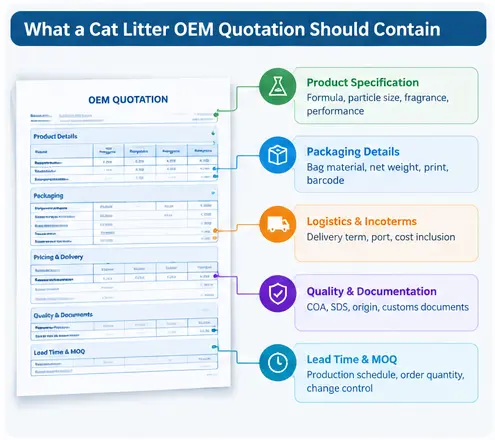
Step 2: Calculate the Comparable Landed Cost
For quotations using different delivery terms, first establish the costs that remain outside each quoted price. Depending on the Incoterms rule, destination, and transaction, these may include inland transport, export handling, international freight, insurance, import duties, taxes, customs clearance, destination handling, and delivery to the warehouse. Do not add a charge twice if it is already included in the quoted price.
Use the following formulas to compare suppliers on the same commercial basis:
- Comparable shipment cost: Quoted goods value + applicable costs not already included in the quotation + applicable import duties and non-recoverable taxes + other agreed charges + the one-time costs attributable to the order.
- Landed cost per sellable bag: Comparable shipment cost ÷ the number of bags received that meet the agreed acceptance requirements and are available for sale.
- Landed cost per kg: Comparable shipment cost ÷ the total net kilograms of accepted, sellable cat litter received.
For the first order, include the full one-time setup fees actually charged to that order. For repeat-order forecasting, show recurring production and logistics costs separately, and amortize setup fees only when the expected order volume and allocation method are clearly stated. Exclude recoverable taxes from the buyer’s net economic cost where applicable, and do not count any cost twice if it is already included in the quoted price.
Complete this worksheet using the same order quantity, delivery destination, currency, product specification, and cost assumptions for both suppliers. If a charge cannot yet be confirmed, mark it as an estimate or pending confirmation rather than treating it as zero.
| Cost item | Supplier A | Supplier B |
|---|---|---|
| Quoted goods value | Enter quotation amount | Enter quotation amount |
| One-time setup costs | Enter applicable fees | Enter applicable fees |
| Costs excluded from quoted price | Enter applicable charges | Enter applicable charges |
| Import duties and other applicable taxes | Enter destination-specific amounts | Enter destination-specific amounts |
| Other applicable costs | Enter applicable charges | Enter applicable charges |
| Total comparable cost | Sum applicable costs | Sum applicable costs |
| Number of sellable bags received | Enter confirmed quantity | Enter confirmed quantity |
| Landed cost per sellable bag | Total cost ÷ sellable bags | Total cost ÷ sellable bags |
| Landed cost per kg | Total cost ÷ sellable net kg | Total cost ÷ sellable net kg |
Step 3: Account for Cat Litter Type and Container Loading
Do not assume that the lowest price per tonne produces the lowest landed cost per bag. Bentonite, tofu, pine, and mixed cat litter can differ in bulk density, packaging weight, bag dimensions, and loading efficiency. The actual number of bags that fit in a container depends on the product, package dimensions, container payload limits, and loading plan.
Ask each factory to confirm the proposed bag count and net cargo weight for the same container type. Compare the resulting landed cost per sellable bag and per kilogram, then assess product performance and expected selling price separately. A lower landed cost does not automatically mean a better commercial product if quality, customer acceptance, or retail positioning differs.
Why Quotations Differ Across Cat Litter Types
Cat litter quotations should be compared within the context of the product being purchased. A tofu cat litter quotation may reflect plant-based raw materials, a particular pellet structure, clumping performance, and moisture-control requirements. A bentonite cat litter quotation may depend on mineral characteristics, particle-size distribution, clumping performance, and dust-control requirements. Pine and mixed cat litter products introduce their own material and processing variables.
These differences can explain why quotations for apparently similar products are not always comparable. Two tofu cat litter suppliers may quote the same net weight and bag format but offer different pellet characteristics or clumping performance. Two bentonite products may also differ in particle-size distribution and dust performance. Ask suppliers to quote against the same approved sample or written specification, and confirm the relevant performance criteria before attributing a price difference to production efficiency or material cost.
For private-label buyers, the objective is not to force every supplier into the same formula regardless of product quality. It is to define the product requirements first, then compare suppliers that can meet those requirements on a consistent commercial basis.
Red Flags in Cat Litter Factory Quotations
Certain patterns in a quotation signal risk that the headline price hides. Watch for these during your evaluation.
| Red flag | 通常それが意味するもの |
|---|---|
| No Incoterms stated | Freight, insurance, and destination charges are undefined and may appear later as surprises |
| No defined quality criteria or test method | Suppliers may use different methods or interpret the same performance claim differently, making results difficult to compare. |
| No agreed batch records or inspection procedure | The buyer may have limited evidence for verifying conformity or resolving disputes if delivered goods differ from the approved specification. |
| Vague lead time such as “about three weeks” | No committed production slot; peak-season delay risk is unmanaged |
| Substitution clause allowing material change | The factory may swap a cheaper raw material mid-run without notice |
| Unclear relationship between seller and manufacturer | The buyer may not know who controls production, verifies product quality, or takes contractual responsibility for nonconforming goods. Confirm the actual manufacturing site and the responsibilities of each party before placing an order. |
| Price far below the market without explanation | Possible down-specification of substrate, bag film, or fill weight |
Side-by-Side Comparison: How to Evaluate Cat Litter OEM Suppliers
A useful supplier scorecard separates verifiable evidence from marketing claims. Use the same criteria for every shortlisted factory, and record what has been confirmed, what remains unverified, and what must be written into the purchase order or OEM agreement.
| Evaluation criterion | 要求する証拠 | 何を確認するか |
|---|---|---|
| Manufacturer identity | Legal entity details, business license, factory address, and relevant production evidence | Whether the contracting entity and the actual manufacturing operation are clearly identified. |
| Production capability | Relevant production lines, available capacity, current workload, and a proposed production schedule | Whether the supplier can accommodate the order volume and required delivery window. |
| Product specification | Approved sample, written specification, and agreed performance criteria | Whether the quoted product matches the product the buyer intends to sell. |
| Quality assurance | Relevant test records, sampling procedures, inspection arrangements, and applicable batch documentation | Whether quality requirements are measurable and can be verified. |
| Packaging and private-label execution | Packaging material specifications, artwork approval process, print confirmation, and fill-weight controls | Whether the supplier can reproduce the approved packaging and meet the net-weight requirement. |
| 料金を見積もる前に分類を確認してください | Written approval procedure for changes to formula, raw materials, packaging, or agreed specifications | Whether changes are documented, assessed, and approved before implementation. |
| Inspection and nonconformity handling | Agreed inspection rights, acceptance criteria, defect reporting process, and corrective-action arrangements | Whether the parties have a workable process for handling nonconforming goods. |
| Commercial and shipping terms | Itemized quotation, Incoterms rule and named place, lead time, payment milestones, and document schedule | Whether costs, responsibilities, and delivery commitments are sufficiently clear. |
Do not score a supplier solely on its stated annual capacity or the number of certificates it lists. Verify the evidence that matters to your order, and distinguish confirmed facts from unverified claims. A smaller manufacturer with a suitable formula, documented quality controls, and a credible production schedule may be a better fit than a larger supplier whose quotation leaves key requirements undefined.
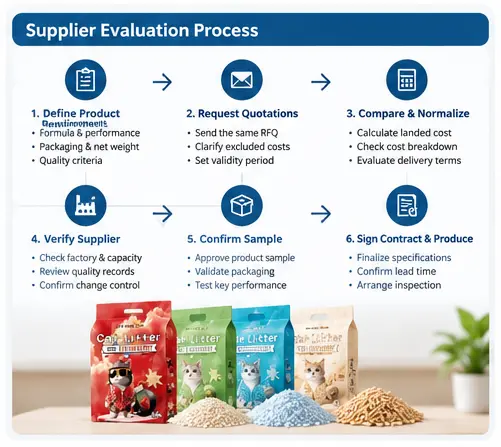
A Practical Cat Litter OEM RFQ Template
Use the following template when requesting quotations from shortlisted cat litter manufacturers. Complete the fields that apply to your project, and send the same requirements to every supplier. Ask each factory to identify any assumptions, exclusions, or specification differences in its written response.
1. Product and Order Requirements
- Product type: [tofu / bentonite / pine / mixed / other].
- Product specification or approved sample reference: [attach specification or sample details].
- Required performance criteria: [agreed particle characteristics, clumping, dust performance, moisture, or other applicable requirements].
- Net fill weight per bag: [kg or other specified unit].
- Planned order quantity: [bags, tonnes, or container quantity].
- Expected repeat-order frequency: [monthly / quarterly / other].
2. Packaging and Private-Label Requirements
- Bag format and material: [specify].
- Closure and secondary packaging: [specify].
- Private-label requirements: [OEM / ODM, logo, artwork status, print colours, barcode, and required languages].
- Packaging setup fees: [itemized separately].
- Packaging artwork approval and production sample requirements: [specify].
3. Pricing and Shipping Requirements
- Quoted currency and price unit: [USD per bag / USD per tonne / other].
- Quotation quantity basis: [MOQ and price breaks, if applicable].
- Preferred Incoterms 2020 rule and named place or port: [specify the applicable delivery arrangement].
- Destination country and port: [specify].
- Proposed container type and loading plan: [20ft / 40ft / 40ft HC, subject to cargo and container limits].
- Costs included and excluded: [itemized list].
- Quotation validity: [supplier to confirm].
- Payment terms: [deposit, balance, payment milestones, and method].
4. Quality, Documentation, and Production
- Quality specification and acceptance criteria: [attach or identify the agreed requirements].
- Available test records and batch documentation: [supplier to specify].
- Third-party inspection requirements: [if applicable].
- Estimated production lead time and the event that starts the lead-time clock: [supplier to confirm].
- Formula, raw material, packaging, and net-weight change-control procedure: [supplier to confirm].
- Applicable shipping and destination-market documents: [buyer and supplier to confirm].
Request a written quotation that follows the same field order. If a supplier cannot meet a requirement, ask it to identify the deviation and provide an alternative proposal separately. This allows you to compare compliant offers without mixing different product specifications or delivery assumptions.
From Quotation to Contract: What Changes
A quotation is an offer; the contract is the binding commitment. The evaluation you do here should flow directly into the agreement’s clauses. The cat litter OEM contract terms guide covers how to convert the promises in a quotation — substitution control, inspection rights, lead time, and defect handling — into enforceable language. Treat any line the factory will not put in writing as a line you cannot rely on.
Once the quotation has been evaluated, the next step is to turn its commercial and technical commitments into a documented OEM specification. Before approving production, confirm the formula, packaging artwork, net fill weight, applicable quality criteria, lead time, inspection arrangements, and written change-control requirements. Our cat litter OEM manufacturing service is a relevant starting point for buyers assessing private-label production requirements before placing an order.
When evaluating production capability, look beyond a factory’s stated annual output. Ask whether the proposed production schedule, product specification, and packaging requirements can be supported by the available capacity. Pet Horizon operates a cat litter manufacturing facility in Dalian, Liaoning, with a stated annual capacity of 150,000 tonnes across an 18,000-square-metre site. These figures provide operational context, but buyers should still verify the capacity, quality controls, and delivery commitments relevant to their own orders. For product-specific comparisons, review our tofu cat litter specifications and use the agreed product requirements when requesting quotations from shortlisted suppliers.
結論
A cat litter OEM quotation is a specification and a commitment, not just a price. Read each quotation for its structure — itemized lines, Incoterms, per-batch documentation, lead time, and substitution control — then normalize every supplier to the same basis and the same unit of measurement. The lowest headline number rarely wins once freight, testing, and rework risk are counted. Send a consistent RFQ, score each response on evidence, and carry the promises that matter into your OEM contract.
If you are preparing an OEM cat litter sourcing project, define your target product, bag weight, packaging requirements, order quantity, and destination before requesting quotations. Pet Horizon works with buyers evaluating cat litter manufacturing and private-label production options. Share your project requirements to discuss product specifications, packaging possibilities, and the information needed for a comparable quotation.
よくある質問
Under Incoterms 2020, FOB requires the seller to deliver the goods on board the vessel at the named port of shipment, with risk transferring to the buyer at that point. Under CIF, the seller also arranges and pays for carriage and the required insurance to the named destination port, but risk still transfers when the goods are on board the vessel at the port of shipment. Under DDP, the seller assumes the broadest delivery obligations, including import clearance and applicable import duties and taxes, subject to the rules and local legal requirements. These terms allocate responsibilities differently, so compare the named place or port, included charges, and risk-transfer point rather than comparing quoted prices alone.
There is no fixed number for every sourcing project. A practical approach is to shortlist several manufacturers that can meet your product, order-volume, destination, and quality requirements, then send them the same RFQ. The goal is to obtain enough comparable offers to understand the market without spending evaluation time on suppliers that cannot meet the basic requirements. Verify manufacturing capability and product fit before expanding the shortlist.
A batch-specific Certificate of Analysis (COA), where applicable, records test results for an identified production batch. Its usefulness depends on whether the results cover the agreed product specifications and include identifiable test items, methods, units, and acceptance limits where relevant. Depending on the formula and buyer’s requirements, evaluation may include moisture, particle characteristics, dust performance, clumping performance, or other product-specific properties. Before comparing quotations, confirm which tests are included, how samples are collected, whether results are batch-specific, and whether independent testing is required. A COA supports quality verification, but it does not replace an agreed specification, sampling plan, or acceptance procedure.
Not by itself. Normalize all quotations to landed cost per sellable bag or kilogram, then weigh structure: documentation, change control, capacity, and inspection rights. A slightly higher quote with per-batch testing and a substitution clause often protects margin better than a low quote that lacks them.
The appropriate Incoterms rule depends on the buyer’s logistics experience, the destination market, the supplier’s capabilities, and the availability of reliable freight and customs services. A buyer may prefer a quotation that includes more transport arrangements, while an experienced importer may prefer greater control over freight. Compare the responsibilities, excluded charges, risk-transfer point, and total expected cost before deciding. Do not select a delivery term simply because its quoted price looks lower.
Start by checking the contracting entity, business registration, factory address, and the relationship between the seller and the actual production site. Request relevant production-line evidence, product-specific quality records, and a remote or on-site factory audit where appropriate. Confirm that the entity issuing the quotation, signing the contract, receiving payment, and taking responsibility for product conformity is clearly identified. A trading company is not automatically unsuitable, but the buyer should understand who controls production and who is contractually responsible for the goods.
Ask both suppliers to reconfirm the same formula or approved sample, net fill weight, packaging specification, order quantity, quality criteria, delivery term, and included services. Request an itemized breakdown of one-time fees and recurring costs, and identify any differences in lead time, testing, or inspection arrangements. A lower quotation may reflect a genuine cost advantage, a different commercial assumption, or an omitted requirement. Verify the reason before treating the price difference as a saving.
Specify any third-party inspection requirements in the RFQ so the supplier can account for the arrangements when preparing its quotation. Confirm the inspection scope, timing, acceptance criteria, reporting requirements, and responsibility for inspection fees in writing. Depending on the inspection type, checks may take place during production, before shipment, or during loading. Agree on the arrangements before production begins to reduce scheduling conflicts and disputes over responsibility.
The validity period should be stated by the supplier rather than assumed by the buyer. It may depend on raw material costs, packaging specifications, exchange rates, freight arrangements, and order quantity. Before approving a quotation, confirm its expiration date, which specifications and costs are fixed, and whether any change requires a revised written offer. For repeat orders, reconfirm the applicable price and production schedule before issuing the purchase order.