




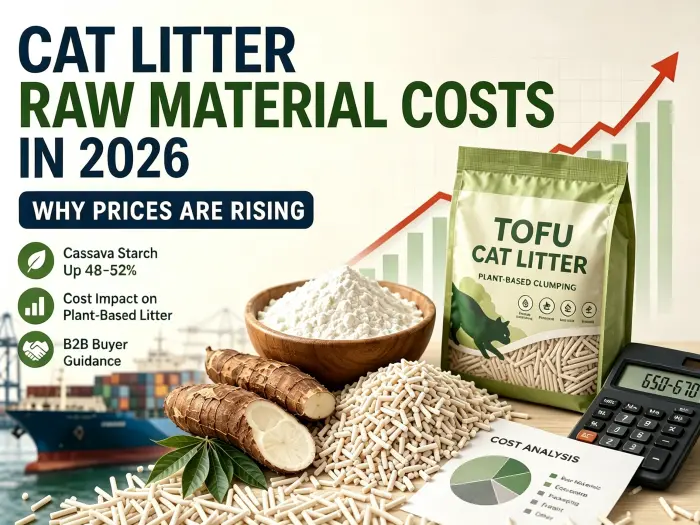
Purchasing managers who renewed cat litter contracts in the first half of 2026 are seeing quotations move for reasons that have little to do with factory margins. The pressure is upstream, and the sharpest single move sits in the cassava and tapioca starch complex that supplies binder to a share of plant-based clumping formulations. This article tracks that raw material line, shows how much of it actually reaches finished-goods cost, and sets out what importers, distributors and private-label buyers can realistically negotiate for the rest of the year.
Quick Answer
Cat litter raw material costs are up sharply in 2026 because cassava and tapioca starch, the binder used in some plant-based clumping formulations, has risen roughly 48-52% since December 2025. Thai FOB Bangkok benchmarks moved from about US$440-445 per tonne to US$650-670. Bentonite and pine feedstocks are far less exposed, so the cost shock is concentrated in tofu and mixed litter lines. However, finished cat litter prices usually increase far less than starch prices because binder represents only one component of total manufacturing costs.
Why Cat Litter Costs Are Rising in 2026
Cat litter is a low-value, high-volume commodity. Margin per tonne is thin, so any double-digit move in an input line shows up quickly in quotations. Three input lines matter in 2026: the base substrate, the binder system, and ocean freight. Packaging and conversion costs have been comparatively stable.
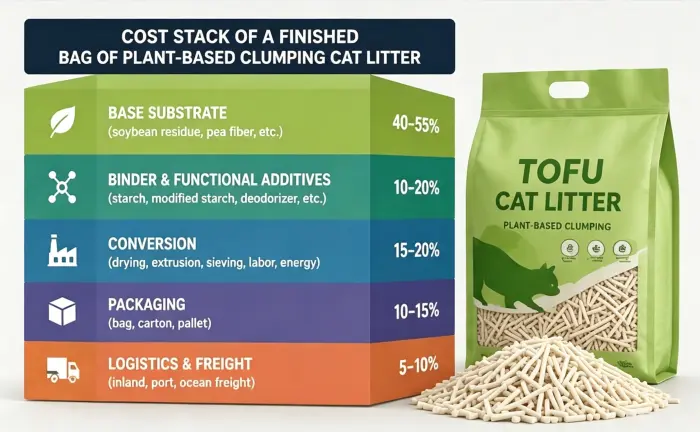
The cost stack behind a finished bag
- Base substrate – soybean residue or pea fibre for tofu litter, sodium bentonite for clay litter, sawdust or pine chips for wood pellets. This is the largest single weight component.
- Binder and functional additives – starch or modified starch for clumping strength, plus deodorising and dust-suppression additives. Small by weight, disproportionate by cost.
- Conversion – drying, extrusion or granulation, sieving, energy and labour.
- Packaging – woven PP or laminated film bags, cartons, pallets.
- Logistics – inland haulage to port, terminal handling, ocean freight.
Where the 2026 shock actually lands
The binder line is where the damage sits. Some plant-based clumping formulations use cassava or tapioca starch as a binder, and that input has repriced faster than anything else in the stack this year. Because the binder is a minority of formulation weight but a meaningful share of formulation cost, a 50% move in starch does not raise finished-goods cost by 50%, but it is large enough to break a price list built on 2025 assumptions. Different plant-based cat litter binder systems have different cost sensitivities, so buyers should verify the actual formulation before comparing quotations.
A binder is the functional ingredient that makes loose particles bond into a removable clump on contact with liquid. In plant-based litter, natural or modified starch is one of the common binder options; guar and other hydrocolloids are alternatives.
Cassava and Tapioca Starch: the 2026 FOB Price Track
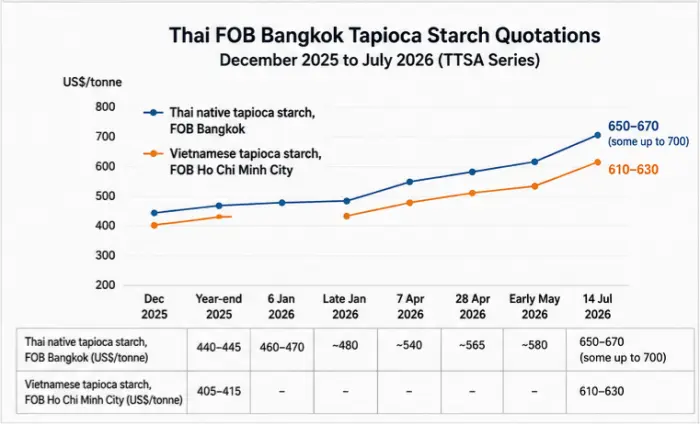
The most widely quoted benchmark for this input is the Thai native tapioca starch export price published by the Thai Tapioca Starch Association (TTSA), read alongside farmgate root data from the Thai Ministry of Agriculture. The series below is the TTSA export quotation basis, FOB Bangkok, with the Vietnamese FOB Ho Chi Minh City quotation shown at the two endpoints for comparison.
| Reference date | Thai native tapioca starch, FOB Bangkok (US$/tonne) | Vietnamese tapioca starch, FOB Ho Chi Minh City (US$/tonne) |
|---|---|---|
| December 2025 | 440-445 | 405-415 |
| Year-end 2025 | 460-470 | Not published in this series |
| 6 January 2026 | About 480 | Not published in this series |
| Late January 2026 | About 490 | Not published in this series |
| 7 April 2026 | About 540 | Not published in this series |
| 28 April 2026 | About 565 | Not published in this series |
| Early May 2026 | About 580 | Not published in this series |
| 14 July 2026 | 650-670, with some quotations reported up to 700 | 610-630 |
Measured from the December 2025 base, the Thai benchmark is approximately 48-52% higher. Treat the intermediate points as approximate weekly quotations rather than settled transaction averages: they are association quotation levels, not audited trade statistics, and actual contract prices vary by grade, viscosity specification, volume and payment terms.
Two points on sourcing the data. First, the price series should be attributed to TTSA and, for root and farmgate context, to the Thai Ministry of Agriculture. Trade publications that republish the weekly numbers, including this mid-July 2026 cassava and tapioca starch market report, are reporters rather than primary sources. Second, buyers who want a structural view of where the material originates and how the trade routes are organised will find a useful overview in this 2026 global tapioca starch sourcing overview. Cross-check both against your own supplier quotations before repricing a contract. Because raw material markets remain volatile, buyers should verify current quotations directly with suppliers before finalizing annual purchasing contracts.
What Is Driving the Cassava Starch Surge
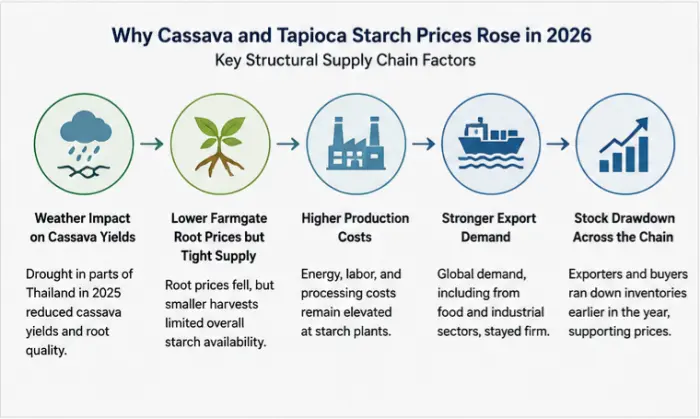
This is a supply-side event with a structural core, not a speculative spike. Four factors reinforce each other.
Thai milling capacity is running well below normal
Only 27 starch mills were operating in Thailand in July, equivalent to 26.21% of the country’s mills and nine fewer than the previous month. When roughly three quarters of national milling capacity is idle, the mills that remain online hold pricing power, and spot buyers compete for a narrow pool of available cargo. Low operating rates also lengthen lead times, which matters when you are trying to fix a shipment window.
Border phytosanitary controls tightened from late January
Since late January, strict phytosanitary controls have applied to cassava root imports crossing into Thailand from Laos and Cambodia. Thai mills have historically drawn a meaningful share of feedstock across these borders. Restricting that flow removes a supply buffer and forces mills to compete harder for domestic roots, which transmits directly into the export quotation.
Root competition between chip traders and starch mills
Cassava roots have two buyers: starch mills and chip traders who dry and export the material for feed and ethanol use. When chip demand is firm, traders bid roots away from mills. Thai Ministry of Agriculture data put the average farmgate root price at 2.79 THB per kilogram, a level that reflects genuine competition at the field gate rather than trader positioning. Higher root cost is the floor under the export price.
Demand signals from China
China is the dominant destination for Thai tapioca starch, and its 2026 buying pattern shows the classic signature of a tight market: China imported 543,200 tonnes in March, with volume down but unit price up. Inventory data points the same way. Main-port stocks stood at 139,100 tonnes on 15 July, down 14.19% month on month. Falling inventory alongside rising prices tells you the buy-side is drawing down cover rather than building it.
How the Starch Surge Reaches Plant-Based Cat Litter COGS
Binder share and cost sensitivity
Work the transmission through in three steps rather than accepting a headline percentage.
- Establish the binder inclusion rate. Ask the factory what share of formulation weight the starch binder represents in your specific SKU. Clumping strength targets, particle size and substrate type all change this number, and it is the single variable that determines your exposure.
- Apply the input move to that share only. A roughly 50% increase on a minority weight fraction produces a single-digit to low double-digit increase in ex-works cost, not a 50% increase.
- Convert to landed cost. Once packaging, ocean freight, duty and inland delivery are added, the same increase dilutes further as a share of your landed cost per tonne.
This is why a supplier asking for a 40% increase on a plant-based SKU is not passing through a raw material move; they are repricing the contract. Ask for the arithmetic. Any factory that understands its own cat litter manufacturing cost model should be able to show inclusion rate, input price basis and the resulting delta per tonne without hesitation.
What is less exposed
Not every product line is affected equally, and portfolio mix is a legitimate hedge.
- Bentonite litter – clumping performance comes from the mineral itself, so there is no starch binder exposure. Cost drivers here are mining, drying energy and freight.
- Pine and wood pellet litter – binding is mechanical and lignin-based rather than starch-based, so exposure is minimal.
- Tofu litter – exposure depends entirely on the formulation. Some tofu cat litter recipes rely on cassava or tapioca starch as the clumping binder, others use guar gum or alternative hydrocolloids, and many use a blend. Two tofu SKUs from different factories can therefore have materially different 2026 cost curves.
- Mixed litter – exposure scales with the plant-based fraction in the blend.
| Cat litter type | Exposure to starch price increases | Main cost driver |
|---|---|---|
| Tofu cat litter | High (depends on formulation) | Plant-based raw materials and binder |
| Bentonite cat litter | Very low | Mining, drying energy and freight |
| Pine cat litter | Low | Wood raw materials and processing |
| Mixed cat litter | Medium | Plant-based content ratio |
Key takeaway: before you accept or reject a price increase, confirm which binder your SKU actually uses. That single question separates a justified pass-through from an opportunistic one.
Bentonite context (2026): While bentonite litter carries no starch-binder exposure, its own cost base is not static. USGS Mineral Commodity Summaries 2026 reports U.S. bentonite production fell 7.4% to 4.82 million tonnes in 2025, driven by drought in Wyoming and South Dakota; new Wyoming mine approvals in 2026 (Bureau of Land Management) add longer-term supply. In China — the world’s largest bentonite producer — food-grade sodium bentonite suitable for cat litter runs 800–1,200 RMB per tonne ex-mine (2025–2026), up roughly 25% from 2020 on rising environmental-compliance costs and permit delays. The pressure is milder and slower-moving than the cassava-starch shock, but buyers should still track it in annual contract reviews.
Buyer Guidance: Contract Timing and FOB Negotiation
Use the Thai crop calendar
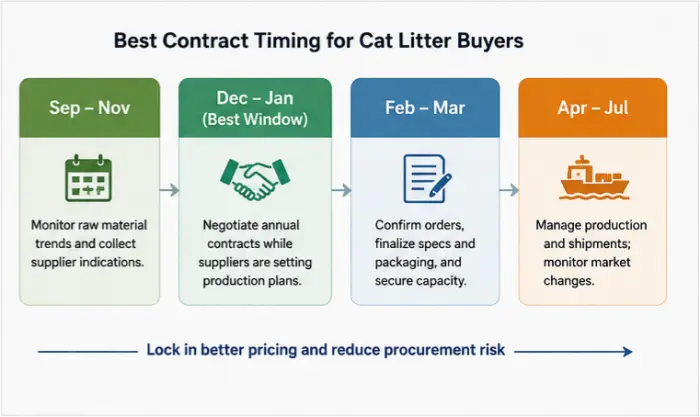
Cassava supply in Thailand is seasonal and predictable. The harvest runs from October to March, and processing peaks between December and February when root availability is highest and farmgate prices are usually at their softest point in the cycle. That seasonality gives buyers a workable playbook.
- Negotiate long-term contracts in December and January, when mills are running against peak root availability and are more willing to commit volume at a fixed level.
- Accept March and April shipment windows. Sellers value the flexibility, and you are still drawing on material bought at peak-season root cost.
- Avoid spot buying in the June to September window, when root supply is at its thinnest and mill operating rates are lowest.
- Split volume across two contract dates if your annual requirement is large, so you are not fully exposed to a single fixing date.
An FOB negotiation checklist for 2026
FOB price negotiation in a rising input market is not about pushing for the lowest headline number. It is about controlling how and when the number can change.
- Ask for a cost breakdown, not a price. Substrate, binder, additives, packaging, conversion, inland to port. You cannot audit a lump sum.
- Fix the specification before you fix the price. Clumping strength, moisture content, dust level, particle size distribution and bag weight tolerance all move cost. A cheaper quotation against a looser specification is not a saving.
- Insert an index clause with a dead band. Tie any adjustment to a named benchmark such as the TTSA FOB Bangkok quotation, and agree that no adjustment applies until the benchmark moves beyond an agreed threshold in either direction.
- Make it symmetrical. If the clause allows increases when starch rises, it must allow decreases when starch falls after the harvest.
- Separate freight from goods. Keep ocean freight out of the FOB unit price so a container rate spike does not become permanently embedded in your product cost.
- Agree a quotation validity period in writing. Seven to thirty days is normal in a volatile input market; anything shorter makes planning impossible and anything longer will simply be priced with a risk premium.
- Compare on landed cost per tonne, not FOB per tonne. Bulk density differs between formulations, and a denser product ships more kilograms per container.
Buyers building a full evaluation framework, including supplier audit criteria and document requirements, can work through the wider process in this cat litter sourcing guide.
Manufacturing Perspective: Cost Pass-Through, MOQ and Specification Control
From the factory side, a 48-52% input move creates a sequencing problem before it creates a pricing problem. Binder is bought in advance against a forward order book. When the input reprices mid-book, the factory is running orders quoted on old input costs while buying at new ones. Suppliers with real coverage absorb that lag; those without pass it through immediately, which is why quotations for the same specification have diverged so widely this year.
Several manufacturing levers exist before a price increase becomes unavoidable, and buyers should understand which ones are acceptable to them.
- Binder substitution or blending. Partial replacement with alternative hydrocolloids can hold cost, but it changes clumping behaviour. This must be validated and approved, never done silently.
- Process optimisation. Tighter moisture control and granulation efficiency reduce binder demand for the same clumping performance. This is the preferred lever because performance is unchanged.
- Specification renegotiation. Relaxing a clumping strength target reduces binder load. Legitimate only if the buyer explicitly agrees, since it changes the product the end consumer receives.
- Format and packaging changes. Larger bag formats and optimised pallet patterns lower cost per kilogram delivered.
Order size interacts directly with all of this. Pet Horizon works to a minimum order quantity of one 20ft container, negotiable, which is the practical unit at which a plant-based formulation can be run as a dedicated batch with its own binder lot. Below that threshold, changeover and lot-traceability overhead is spread across too few tonnes, and unit cost rises regardless of what starch is doing. Consolidating two or three SKUs into a single container is usually more cost-effective than splitting a container across more frequent small shipments.
Location matters for the freight side of the equation. Production near Dalian port keeps inland haulage short and predictable, which limits how much of the raw material increase compounds with domestic logistics before the goods reach the vessel. In our OEM manufacturing experience, buyers who request binder inclusion rates and raw material cost breakdowns usually achieve more transparent annual pricing negotiations than those comparing quotations alone. Our practice is to show buyers the binder inclusion rate and the input basis behind any adjustment rather than issuing a flat percentage increase.
Key Takeaways
- Cassava and tapioca starch prices increased by approximately 48-52% in 2026, making binder the primary source of cost inflation for many plant-based cat litter formulations.
- Bentonite and pine cat litter are much less affected because they do not rely on starch-based binders.
- A 50% increase in starch prices does not translate into a 50% increase in finished cat litter costs.
- December to January remains the best period for negotiating annual OEM supply contracts.
- Buyers should always confirm binder inclusion rates before accepting raw material-related price increases.
Conclusion
The 2026 increase in cat litter raw material costs is real, structural and concentrated. Cassava and tapioca starch has risen roughly 48-52% since December 2025 on the TTSA FOB Bangkok basis, driven by low Thai mill operating rates, tighter phytosanitary controls on Laos and Cambodia border root imports, and genuine competition for roots at the farm gate. Chinese import and inventory data confirm a tight rather than a speculative market.
For buyers, the response is precision rather than resistance. Establish which of your SKUs actually carry starch binder exposure, demand the arithmetic behind any pass-through, use the December to January contracting window against March to April shipment, and write symmetrical index clauses so the correction flows back to you when the next harvest lands. Portfolio mix across tofu, bentonite, pine and mixed lines remains the simplest structural hedge available to a distributor or private-label brand.
Frequently Asked Questions
Mainly because of raw material inflation in the plant-based segment. Cassava and tapioca starch, used as a clumping binder in some plant-based formulations, has risen roughly 48-52% since December 2025. Clay and wood-based lines are less affected, so the increase is uneven across the category rather than uniform.
Four things: the soybean or pea fibre substrate, the binder system, conversion cost including drying energy, and packaging. Binder is a minority of weight but a significant share of cost, which is why the 2026 starch move is visible in tofu cat litter price per ton quotations even though starch is not the main ingredient.
Supply-side constraints. Only 27 Thai starch mills were operating in July, about 26.21% of the country’s total and nine fewer than the previous month. Strict phytosanitary controls on Laos and Cambodia border root imports have applied since late January, and chip traders are competing with mills for domestic roots at an average farmgate price of 2.79 THB per kilogram.
Starch usually represents only part of a tofu cat litter formulation. Even when starch prices increase by around 50%, the finished manufacturing cost generally rises by a much smaller percentage because substrate, drying, packaging and freight still account for most production expenses.
December to January. The Thai cassava harvest runs October to March with processing peaking December to February, so root availability is highest and mills are most willing to commit volume at a fixed level. Accept a March to April shipment window as part of the trade-off.
Request a line-item cost breakdown rather than a lump sum, fix the specification before the price, and insert a symmetrical index clause tied to a named benchmark with a dead band so small fluctuations do not trigger renegotiation. Keep ocean freight separate from the FOB unit price and compare suppliers on landed cost per tonne.
Not directly. Bentonite clumps because of the mineral’s own swelling behaviour, so there is no starch binder in the formulation. Bentonite costs respond to mining, drying energy and freight instead. Buyers with mixed portfolios can shift volume toward clay lines to blunt the impact.
For most buyers, yes. Even after the binder increase, the finished-goods cost move is far smaller than the headline starch percentage, and the flushability, lower dust and biodegradability positioning still commands a retail premium in most export markets. The decision should be made on landed cost per tonne against your achievable shelf price, not on the input percentage alone.
One 20ft container, negotiable. That is the practical batch size at which a plant-based formulation can be run with a dedicated binder lot and full traceability. Consolidating several SKUs into one container is generally more economical than splitting the same annual volume into more frequent smaller shipments.