




Importing cat litter is rarely as cheap as the factory quote suggests. A cat litter landed cost model turns a bare FOB price into the true cost of getting product onto your warehouse shelf, so importers, distributors, and wholesale buyers can compare suppliers on equal terms.
Quick Answer: Cat litter landed cost is the total cost of importing cat litter and making it ready for sale at your warehouse. It includes the product price, freight, insurance, import duties, destination charges, inland delivery, and other handling costs. Because bentonite and plant-based litters have different density and loading limits, importers should compare cost per sellable bag or tonne rather than FOB price alone.
What Landed Cost Means for Cat Litter Buyers
A supplier’s ex-factory or FOB quote is only the starting point. The number that decides whether a shipment is profitable is what it costs to land the product in sellable condition at your own warehouse or distribution center.
Landed cost is the full cost of a shipment once it is in your possession and ready to sell, including product, transport, taxes, and handling—not the ex-factory price alone.
Treating FOB price as your unit cost is the most common reason a first import looks cheap on paper and loses money in practice. Buyers who model the full chain negotiate better and spot an uncompetitive quote immediately.
The Landed-Cost Formula
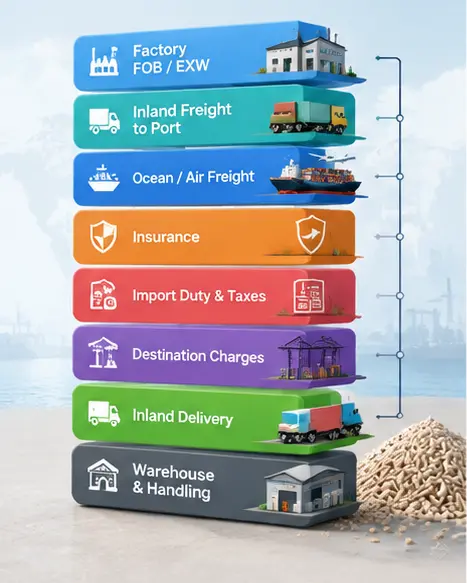
The model is additive. Start at the origin and add each layer until the product is on your shelf:
Cat litter landed cost formula:
Landed Cost = Product Cost + Freight + Insurance + Import Duty + Destination Charges + Inland Delivery + Handling Costs
| Cost component | What it covers | Typically arranged by |
|---|---|---|
| FOB price | Product cost including export clearance and delivery to the port of loading. | Supplier |
| EXW price adjustment | Additional cost required to move goods from supplier premises to the export port. | Buyer |
| Inland freight to port | Trucking from factory to origin port (included in FOB, separate for EXW) | Supplier or buyer |
| International freight | Ocean or air freight to destination port | Buyer or supplier by Incoterms |
| Marine insurance | Coverage for loss or damage in transit | Buyer or supplier by Incoterms |
| Import duty and taxes | Customs duty, VAT or GST, and any import levy | Buyer (importer of record) |
| Destination terminal charges | THC, ISPS, handling, seal, and demurrage risk | Buyer |
| Inland delivery | Port to warehouse trucking or rail | Buyer |
| Warehouse and handling | Receiving, repacking, storage, damage allowance | Buyer |
Add every row to reach true landed cost. The single most useful output is a per-sellable-unit figure (per bag or per tonne) that you can compare against your local wholesale or retail price.
Step by Step: Build a Cat Litter Landed Cost Model
1. Start with the FOB or EXW quote
Ask the supplier for a clear FOB price at your required Incoterms and pack configuration. If you receive an EXW (ex-works) quote, remember it excludes all transport to the port, so you must add inland freight yourself.
2. Add international freight by mode
Ocean freight is quoted per container, while air and courier are usually charged by chargeable weight. Request the rate for your specific lane and season, and confirm whether it is weight- or volume-limited for your product.
3. Add duty and import taxes
Duty depends on the product’s material and HS classification and on the destination market. Plant-based, mineral, and silica formulations can fall under different tariff lines, so confirm the rate for your exact composition before you calculate. A customs broker or the destination customs authority can confirm the current rate.
Before importing, buyers should confirm the correct HS code classification for their cat litter type because tariff rates may vary by material, composition, and destination market.
4. Add destination and last-mile costs
Terminal handling, drayage, brokerage, and warehouse delivery are easy to forget but routinely add a meaningful sum per container. Build them into the model from the first quote, not after the container arrives.
FOB vs CIF vs DDP for Cat Litter Imports
FOB, CIF, and DDP place different responsibilities on suppliers and buyers. FOB gives importers control over international freight, CIF includes ocean freight and insurance arranged by the supplier, while DDP provides a door-to-door price including import clearance and duties. The best option depends on your logistics capability, destination regulations, and purchasing volume.
Worked Example (Illustrative Only)
The figures below are illustrative and will vary by lane, season, product density, and supplier terms. They show the shape of a model, not a real quote.
| Line item | Illustrative USD (20ft container, ~20t bentonite) |
|---|---|
| FOB price | 11,000 |
| Inland freight to port | 450 |
| Ocean freight | 2,800 |
| Marine insurance | 120 |
| Import duty and taxes | per destination HS and rate |
| Destination terminal and drayage | 1,400 |
| Inland delivery to warehouse | 1,200 |
| Warehouse and damage allowance | 400 |
Before duty, these logistics and handling costs add a significant percentage on top of the FOB price in this illustrative heavy clay shipment. The actual impact depends on freight rates, container utilization, destination charges, and product density, so always run the numbers for your actual product and route.
Cat Litter Landed Cost Calculator Template
Use the table below as a worksheet. Enter your own numbers for each line item to build a per-shipment landed cost model before you compare supplier quotes.
| Input | Value |
|---|---|
| FOB or EXW price per unit | |
| Container quantity (units) | |
| Ocean or air freight | |
| Insurance | |
| Import duty and taxes | |
| Destination terminal charges | |
| Inland delivery to warehouse | |
| Warehouse and handling | |
| Total landed cost per unit |
For cat litter imports, the most practical comparison is usually landed cost per retail bag, carton, or pallet because packaging size and filling density directly affect the final selling margin.
Why Dense and Light Litters Model Differently
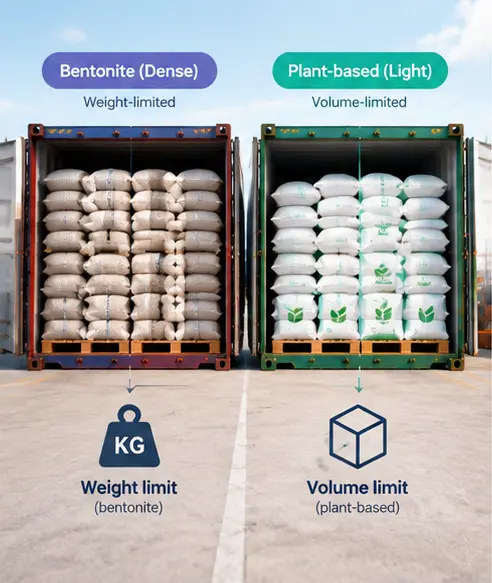
Freight savings are mode-dependent, not automatic. In ocean full-container load shipping, a container is limited by both cubic volume and payload. A low-density litter can hit the volume limit before it reaches the weight limit, so it may cost more per kilogram than a heavy clay where payload limits often dominate. Evaluate product weight, bag dimensions, carton volume, pallet pattern, and container loading together rather than assuming lighter is cheaper.
For a heavy product such as bentonite cat litter, the freight conversation is about weight utilization; for lighter formulations it is about cube utilization. The landed-cost model must reflect which limit your shipment hits.
Hidden Costs That Surprise First-Time Importers
- Destination terminal and chassis fees that some quotes omit
- Demurrage or detention if pickup is delayed
- Pre-shipment inspection by a third party when the market requires it
- Relabeling or repacking to meet destination requirements
- Damage allowance, especially for lighter or fragile bags
- Working-capital cost between deposit and final payment
Using Landed Cost to Compare Supplier Quotes
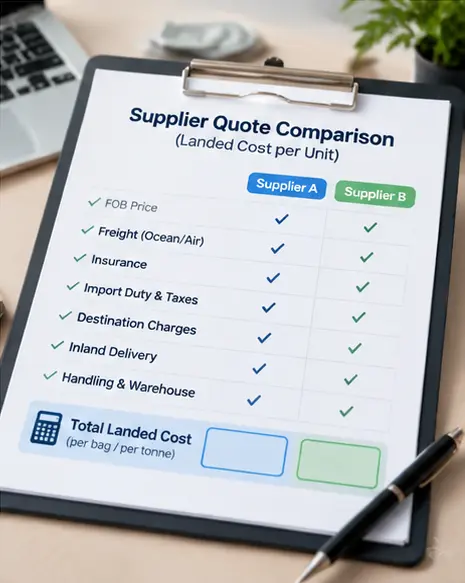
When two factories quote different FOB prices, the cheaper FOB is not necessarily the cheaper arrival. Normalize both to landed cost per sellable unit using the same Incoterms, lane, and pack size. Buyers who request FOB, CIF, and DDP quotes for the same lane can see which supplier’s logistics or duty position is genuinely stronger. The International Chamber of Commerce publishes the Incoterms rules that define which party carries each cost and risk.
Volume buyers should also review bulk cat litter wholesale pricing and container-loading guidance before committing, because loading efficiency directly changes the per-unit freight.
How Landed Cost Helps Choose a Cat Litter Supplier
A supplier with the lowest FOB price is not always the lowest-cost option. Importers should evaluate production capability, packaging efficiency, loading optimization, documentation support, and delivery reliability together with the final landed cost.
Conclusion
Building a reliable cat litter landed cost model helps importers, distributors, and wholesale buyers understand the real cost behind every shipment. Start from the FOB price, compare suppliers on landed cost per sellable unit, and verify each fee with your forwarder and customs broker before placing an order.
Frequently Asked Questions
Landed cost includes the product price, all transport from the supplier to your warehouse, insurance, import duty and taxes, destination terminal charges, and final inland delivery and handling. It is the full cost to have the product ready to sell, not the ex-factory price.
Neither term is inherently cheaper; they allocate costs and risk differently. FOB lets you control freight and shop for the best rate, while CIF bundles freight and insurance into the supplier’s quote. The lower landed result depends on your freight-buying power and destination costs, so compare both on the same lane.
Duty depends on the litter’s material composition, its HS classification, and the destination market’s tariff schedule, so there is no single rate. Plant-based, mineral, and silica formulations may be classified under different lines. Confirm the current rate for your exact product with a customs broker or the destination customs authority.
In ocean full-container shipping, the container is limited by both weight and volume. A lighter litter can fill the container by volume before reaching the weight limit, so it may cost more per kilogram than a dense clay. Compare weight, bag size, carton volume, and pallet pattern together.
Normalize both quotes to landed cost per sellable unit using the same Incoterms, destination lane, and pack configuration. Request FOB, CIF, and DDP for the same lane so you can see the real total, not just the factory price.
Budget for destination terminal and chassis fees, demurrage or detention, any required pre-shipment inspection, relabeling or repacking, a damage allowance, and working-capital cost between deposit and final payment.
It depends on your logistics capability. FOB gives you control but requires a forwarder and broker; CIF is simpler if you lack a freight desk; DDP gives a single door-to-door line item but typically costs more. Choose the term that matches your ability to manage the shipment.
A reliable supplier can improve landed cost by optimizing packaging, container loading, production efficiency, export documentation, and shipping coordination. Importers should evaluate the total delivered cost instead of choosing suppliers only by FOB price.
Calculate the total shipment cost including product, freight, duty, and handling, then divide by the number of sellable bags or units received. This gives the true landed cost per bag that importers can compare with local selling prices.