




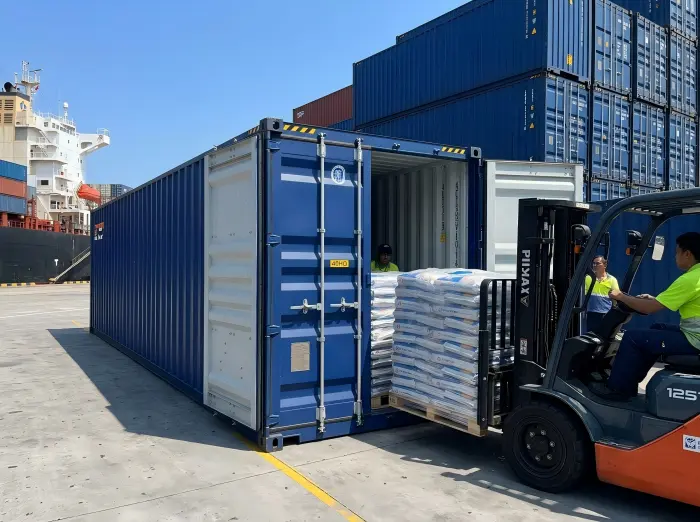
Quick Answer
A standard 40HQ container can typically hold approximately 1,000 to 14,600 bags of cat litter, depending on the bag size, litter type, product density, pallet requirements, and destination weight restrictions. Heavy bentonite cat litter is usually limited by payload, while lightweight tofu cat litter is limited by container volume. For accurate container planning, manufacturers should calculate both weight and volume before shipment.
Key Takeaways
- A 40HQ container is the preferred shipping option for most international cat litter exports because it offers the best balance of capacity and freight efficiency.
- The number of bags that fit in one container depends on bag size, litter density, pallet configuration, and destination port regulations.
- Bentonite cat litter usually reaches the legal weight limit before the container is full, while tofu cat litter is generally limited by available volume.
- Choosing between floor loading and pallet loading can change total container capacity by 6–9%.
- Proper container planning helps wholesalers reduce freight costs and avoid costly overweight or reloading fees.
Introduction
International demand for cat litter continues to grow as pet ownership increases across North America, Europe, Southeast Asia, and the Middle East. For importers, distributors, supermarket chains, and private-label brands, ocean freight remains the most economical transportation method for large-volume orders. Among all container types, the 40HQ (40-foot high cube) container has become the industry standard because it provides the largest usable cargo volume while maintaining competitive shipping costs.
One of the most common questions buyers ask before placing an order is:
How many cat litter bags fit in a 40HQ container?
The answer is not as straightforward as multiplying the container volume by the size of each bag. In practice, the loading capacity depends on multiple variables, including product density, bag dimensions, pallet requirements, destination port weight restrictions, moisture content, and packaging materials. A shipment of dense bentonite cat litter may reach the legal payload limit long before the container is physically full, while lightweight tofu cat litter often fills the available space without approaching the maximum allowable weight.
For this reason, experienced manufacturers calculate container loading based on both weight and volume, rather than relying on theoretical container dimensions alone. Accurate planning not only improves freight efficiency but also reduces the risk of overweight penalties, unexpected warehouse costs, and shipping delays.
Based on our export experience, container loading plans are prepared before production begins rather than after manufacturing is completed. This allows packaging dimensions, pallet configurations, and shipment weight to be optimized together, reducing freight costs and minimizing the risk of overweight containers.
In this guide, you’ll learn how many bags of different cat litter types can typically fit into a 40HQ container, what factors influence loading capacity, and how professional exporters optimize container utilization for international shipments.
The figures in this guide are based on common export packaging configurations and actual container loading practices. Final loading quantities may vary depending on product specifications, packaging dimensions, and destination regulations.
Why 40HQ Containers Are the Preferred Choice for Cat Litter Shipping
The 40HQ container has become the preferred choice for global cat litter exports because it offers the best balance between cargo capacity and transportation cost. Compared with 20GP and standard 40GP containers, a 40HQ provides additional internal height, allowing more efficient stacking of bagged products and better utilization of available space.
For manufacturers exporting tofu, bentonite, mixed, or silica gel cat litter, shipping a full 40HQ container typically results in a lower freight cost per bag than using smaller containers. This cost advantage becomes even more significant for wholesalers purchasing large quantities or supplying overseas warehouses.
In addition to its larger capacity, the 40HQ container is compatible with the pallet standards used by most international logistics networks. European EPAL pallets and North American standard pallets can both be accommodated efficiently, making the container suitable for automated warehouse handling and retail distribution.
However, maximizing container utilization requires more than simply filling every available space. International shipping regulations impose weight limits that vary by destination, while pallet configurations, protective packaging, and ventilation clearances all reduce the usable loading volume. Professional container planning therefore focuses on balancing cargo weight, available volume, and regulatory compliance to achieve the most cost-effective shipment.
Factors That Affect 40HQ Container Capacity at a Glance
| Factor | Impact on Loading Capacity | Why It Matters |
|---|---|---|
| Product Density | ★★★★★ | Determines whether the shipment reaches the weight limit before the container is full. |
| Bag Size | ★★★★★ | Affects stacking efficiency and total number of bags. |
| Destination Weight Limits | ★★★★★ | Different countries allow different maximum payloads. |
| Pallet Loading | ★★★★☆ | Reduces capacity but improves warehouse handling. |
| Packaging Dimensions | ★★★☆☆ | Small dimensional changes affect stacking efficiency. |
| Loading Method | ★★★☆☆ | Professional stacking increases usable space. |
The following sections explain each factor in detail and show how they affect the final loading capacity of a 40HQ container.
40HQ Container Specifications for Cat Litter Shipping
Before calculating how many bags of cat litter fit into a container, it’s important to understand the practical loading capacity of a 40HQ (40-foot High Cube) container. Many online calculations rely on theoretical dimensions, but professional exporters base their planning on usable cargo space, not the container’s maximum internal volume.
The standard internal dimensions of a 40HQ container are approximately:
| Specification | Value |
|---|---|
| Internal Length | 12.03 m (39.5 ft) |
| Internal Width | 2.35 m (7.7 ft) |
| Internal Height | 2.69 m (8.8 ft) |
| Theoretical Volume | Approximately 76 m³ |
| Practical Loading Volume | Approximately 67–70 m³ |
| Maximum Payload* | Up to 26.5 metric tons (subject to destination regulations) |
*Actual allowable payload depends on destination country regulations, road transportation limits, and shipping line policies.
Although a 40HQ container offers approximately 76 cubic meters of internal space, exporters rarely utilize every cubic meter. Clearance must be reserved for ventilation, packaging expansion, pallet handling, and safe cargo positioning. As a result, the effective loading efficiency for bagged cat litter is typically 88–92% of the theoretical capacity.
For this reason, professional manufacturers calculate container capacity using usable loading volume instead of theoretical dimensions.
What Determines How Many Cat Litter Bags Fit in a 40HQ Container?
There is no universal answer to container capacity because every shipment is different. In practice, professional exporters evaluate six key variables before confirming the final loading plan.
1. Destination Weight Limits
For bentonite cat litter, the legal weight limit at the destination is usually the most important factor.
Typical payload limits include:
| Destination | Typical Maximum Payload |
|---|---|
| U.S. West Coast | ~22 tons |
| U.S. East Coast | ~24 tons |
| European Union | ~24 tons |
| Southeast Asia | Up to 26 tons |
| Middle East | Up to 26.5 tons |
Because bentonite is significantly denser than plant-based litter, shipments to destinations with stricter weight regulations may carry 10–15% fewer bags, even when unused container space remains.
2. Product Density
Different litter materials occupy space very differently.
| Cat Litter Type | Loading Limitation |
|---|---|
| Bentonite | Weight-limited |
| Tofu | Volume-limited |
| Silica Gel | Volume-limited |
| Mixed Formula | Weight + Volume |
This is why two containers carrying the same bag size may hold dramatically different quantities depending on the product inside.
3. Bag Size and Packaging Dimensions
Larger bags reduce handling costs but also decrease the number of units that fit into a container.
Common export packaging includes:
- 2 kg retail bags
- 5 kg supermarket bags
- 10 kg wholesale bags
- 20 kg OEM bulk bags
Even small changes in bag dimensions or gusset design can significantly affect stacking efficiency.
4. Should You Choose Floor Loading or Pallet Loading?
Many buyers in North America and Europe require palletized shipments for easier warehouse handling.
| Floor Loading | Pallet Loading |
|---|---|
| More bags | Easier unloading |
| Lower freight cost | Better warehouse handling |
| Manual unloading | Forklift compatible |
| Best for Asia | Best for EU/USA |
Compared with floor loading, pallet loading generally reduces total container capacity by 6–9% because pallets occupy both floor space and vertical height.
Typical pallet standards include:
- EPAL (1200 × 800 mm) — widely used in Europe
- North American pallet (1219 × 1016 mm) — commonly used in the United States and Canada
Although pallet loading reduces the number of bags per container, it improves unloading efficiency, warehouse automation, and product protection.
5. Packaging Material
Packaging also affects loading efficiency.
Compared with standard woven bags, laminated or dust-proof PE bags expand slightly after stacking, creating additional gaps inside the container.
Typical expansion rates include:
| Packaging Type | Expansion After Stacking |
|---|---|
| Standard Woven Bag | ~2% |
| Laminated PE Bag | ~5% |
| Heavy-Duty Export Bag | 3–5% |
For low-dust premium cat litter, manufacturers should account for this expansion when estimating container capacity.
6. Loading Method
Professional loading techniques can improve container utilization without exceeding legal weight limits.
Experienced loading teams typically use:
- Cross-stacking
- Interlocking layers
- Corner optimization
- Weight-balanced distribution
Compared with simple vertical stacking, professional loading methods may increase usable container capacity by 3–4% while improving cargo stability during ocean transportation.
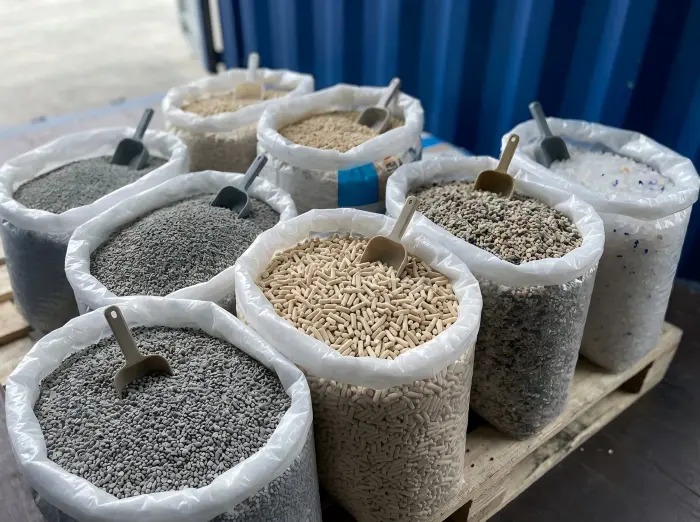
How Many Cat Litter Bags Fit in a 40HQ Container?
The final loading quantity depends primarily on bag size, product density, and destination weight regulations.
The following figures represent typical export capacities based on professional loading practices and standard packaging specifications.
Table: Typical 40HQ Container Capacity
| Bag Size | Bentonite | Tofu | Mixed Formula |
|---|---|---|---|
| 2 kg | 10,200–12,100 | Up to 14,600 | 11,000–13,000 |
| 5 kg | 4,080–4,840 | Up to 5,920 | 4,620–5,280 |
| 10 kg | 2,040–2,420 | Up to 2,760 | 2,260–2,590 |
| 20 kg | 1,020–1,210 | — | — |
*Actual quantities vary depending on pallet requirements, destination regulations, and packaging specifications.
Rather than relying on fixed numbers, experienced exporters calculate each shipment individually to maximize container utilization while complying with local transportation regulations.
Weight-Limited vs. Volume-Limited Shipments
Understanding the difference between weight-limited and volume-limited cargo is essential for international cat litter shipping. Exporters should also comply with the SOLAS Verified Gross Mass (VGM) requirements before containers are loaded onto a vessel.
Weight-Limited Cargo
Dense materials such as bentonite cat litter usually reach the legal payload before the container is physically full. In these cases, reducing product moisture, optimizing bag weight, or selecting a lighter formula can significantly improve shipping efficiency.
Volume-Limited Cargo
Lightweight products such as tofu cat litter and silica gel cat litter rarely approach the maximum payload. Instead, the container becomes full because the products occupy all available space.
For importers, recognizing this distinction helps determine the most cost-effective product type, packaging specification, and loading strategy for each destination market.
How to Maximize 40HQ Container Utilization
Optimizing container utilization is one of the most effective ways to reduce shipping costs in international cat litter trade. While container dimensions remain fixed, the number of bags loaded can vary considerably depending on product specifications, packaging design, loading methods, and destination requirements.
Professional manufacturers focus on maximizing usable space without exceeding legal weight limits or compromising cargo safety.
Match the Right Cat Litter to the Destination Market
Different export markets have different transportation regulations and logistics practices. Selecting the appropriate loading strategy for each destination helps improve shipping efficiency and reduce unnecessary costs.
United States
Many U.S. importers require palletized shipments for warehouse automation and retail distribution. In addition, West Coast ports generally enforce stricter payload limits than many other regions.
For heavy bentonite cat litter, manufacturers often optimize loading by combining different package sizes or adjusting product density to stay within legal weight restrictions while maximizing usable space.
European Union
Most European distributors prefer standardized EPAL pallet loading to simplify warehouse operations and reduce unloading time.
Although pallet loading slightly reduces the number of bags per container, it improves inventory handling, minimizes product damage, and supports automated logistics systems.
Southeast Asia
For regional shipments with shorter transit times, many customers choose floor loading instead of pallet loading.
Because fewer pallets are used, floor loading generally increases the number of bags per container and reduces the shipping cost per unit.
Middle East
Middle Eastern buyers often purchase full-container wholesale orders. Since local weight restrictions are generally less restrictive than those in North America or Europe, exporters can usually maximize payload while maintaining efficient container utilization.
Practical Tips to Increase Container Capacity
Although container dimensions cannot be changed, several practical improvements can significantly increase the number of bags loaded into each shipment.
Optimize Packaging Dimensions
Bag dimensions directly influence stacking efficiency.
Standardizing bag width and height allows bags to fit together more tightly, reducing unused space inside the container. Even minor packaging adjustments can improve loading efficiency across an entire shipment.
Select Appropriate Packaging Materials
Premium dust-proof packaging provides better moisture resistance and product protection but may expand slightly after stacking.
Manufacturers should consider packaging expansion during loading calculations to avoid overestimating container capacity.
Control Product Moisture
For mineral-based cat litter, moisture content affects total shipment weight.
Maintaining moisture within product specifications helps maximize loading efficiency while ensuring consistent product quality.
Use Professional Loading Techniques
Experienced loading teams use staggered stacking, cross-layer placement, and balanced weight distribution to improve container utilization.
Compared with simple vertical stacking, these techniques reduce empty spaces while improving cargo stability during long-distance ocean transportation.
Common Mistakes When Calculating Container Capacity
Many first-time importers estimate container capacity using only theoretical container volume.
In practice, this often leads to inaccurate freight quotations or loading problems.
The most common mistakes include:
- Using theoretical container volume instead of usable loading volume
- Ignoring destination weight restrictions
- Forgetting that pallets reduce available cargo space
- Assuming all cat litter types have the same density
- Overlooking packaging expansion during stacking
- Failing to reserve space for moisture-control materials and cargo protection
- Estimating loading quantities without confirming final bag dimensions
Avoiding these mistakes helps reduce unexpected logistics costs and minimizes the risk of shipment delays.
Expert Advice from a Cat Litter Manufacturer
At Pet Horizon, container planning begins long before production starts.
Rather than estimating container capacity based solely on bag quantity, our export team evaluates every shipment using four key parameters:
- Product density
- Bag dimensions
- Pallet configuration
- Destination country regulations
This planning process allows us to recommend the most efficient packaging specification and loading method for each customer while ensuring compliance with local transportation requirements.
For long-term OEM and private label projects, we also provide customized container loading plans to help customers forecast freight costs, optimize inventory planning, and improve overall supply chain efficiency.
Buyer Checklist Before Booking a 40HQ Container
Before confirming your order, discuss the following details with your supplier or freight forwarder:
- Which container type is recommended (20GP, 40GP, or 40HQ)?
- What are the destination country’s payload restrictions?
- Will the shipment be palletized or floor loaded?
- What is the final bag size and net weight?
- Does the destination require fumigated pallets?
- Will moisture-control materials or protective packaging be added?
- Has the supplier calculated capacity using usable loading volume rather than theoretical volume?
Answering these questions before production begins helps avoid costly adjustments later in the shipping process.
Conclusion
A 40HQ container remains the preferred choice for international cat litter shipping because it offers the best balance of cargo capacity and freight efficiency. However, there is no universal answer to how many bags fit inside one container.
Actual loading capacity depends on several factors, including product density, bag dimensions, pallet requirements, destination weight regulations, packaging materials, and loading techniques.
For importers, understanding the difference between weight-limited and volume-limited shipments is essential for controlling freight costs and improving supply chain planning. Working with an experienced manufacturer that calculates container loading based on real export conditions—not theoretical container dimensions—can help maximize container utilization while ensuring compliance with international shipping regulations.
Before arranging international shipments, buyers should also understand the typical cat litter production and shipping time to better coordinate inventory planning.
Whether you are importing tofu cat litter, bentonite cat litter, or customized private label products, careful container planning is one of the simplest ways to reduce logistics costs and improve the efficiency of every shipment.
FAQ
Why does bentonite cat litter fit fewer bags?
Because bentonite has a much higher density than tofu or silica gel litter, shipments usually reach legal payload limits before the container is completely full.
Does pallet loading reduce container capacity?
Yes. Pallet loading generally reduces usable container capacity by around 6–9%, although it improves warehouse handling and product protection.
Which cat litter type is limited by volume instead of weight?
Lightweight tofu cat litter and silica gel cat litter usually fill the container before reaching the legal payload limit.
Is a 40HQ container better than a 20GP for cat litter exports?
For most wholesale orders, yes. A 40HQ container offers greater cargo capacity and generally reduces shipping costs per bag.
Can different cat litter products be loaded in the same container?
Yes. Mixed loading is common for OEM and private-label orders, provided the total weight, packaging dimensions, and pallet configuration are carefully planned.
What information should buyers confirm before booking a container?
Importers should confirm bag size, net weight, pallet requirements, destination weight restrictions, packaging specifications, and shipping terms before production begins.
What factors affect container loading efficiency?
Product density, packaging dimensions, loading method, pallet configuration, moisture content, and destination regulations all influence loading capacity.
How can manufacturers maximize container utilization?
Professional manufacturers optimize bag dimensions, control product moisture, select suitable packaging, and use efficient stacking techniques while complying with destination weight regulations.