




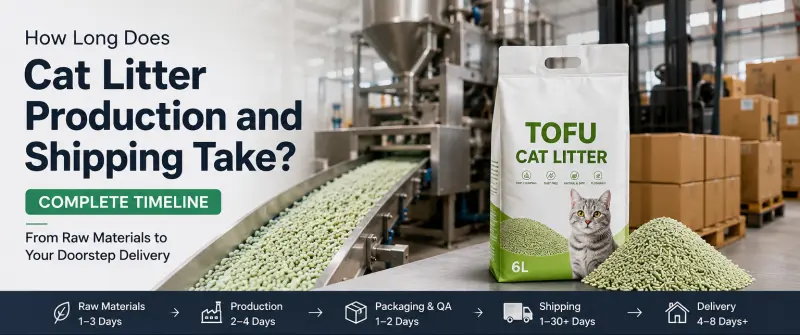
Why the Cat Litter Delivery Timeline Matters More Than You Think
Cat litter is one of those everyday essentials that most cat owners don’t think about — until the bag is almost empty. For households with one cat, a single missed restock is a minor inconvenience. For multi-cat families, pet retailers, or bulk buyers sourcing internationally, a delayed shipment can trigger real problems: stressed cats, unwanted odors, and disrupted sales cycles.
The challenge is that cat litter production and shipping time varies far more than most people expect. It’s easy to assume cat litter is a simple commodity that ships within a day or two. In reality, the journey from raw materials to your doorstep involves multiple stages — processing, quality inspection, packaging, warehousing, and logistics — each with its own timeline and potential delays.
This guide breaks down the full production and delivery cycle for cat litter, covering every step from manufacturing to last-mile delivery, along with the key variables that affect timing. Whether you’re a pet owner planning a restock or a business managing bulk orders, understanding this timeline helps you stay ahead of supply gaps.
The Complete Cat Litter Manufacturing Timeline: Raw Materials to Finished Product
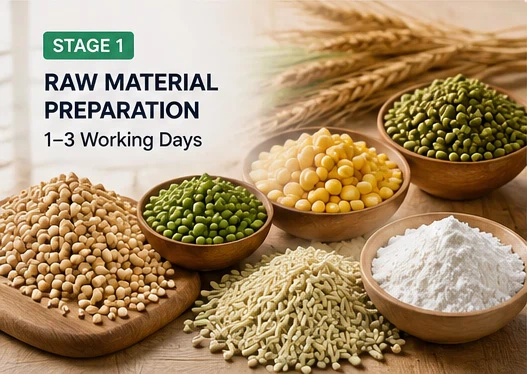
Stage 1 — Raw Material Preparation (1–3 Business Days)
Cat litter production doesn’t start the moment you place an order. Before any processing begins, the factory must source, screen, and pretreat raw materials — a step that’s often overlooked when estimating lead times.
The four main types of cat litter on the market — tofu (plant-based), bentonite (clay-based), straw-based, and blended — each require different raw material inputs, though the preparation timeline is broadly similar across categories.
Established manufacturers typically keep core materials in stock, which eliminates this wait for standard orders. But if warehouse inventory runs low, a new batch is needed, or the order calls for specialty ingredients for custom formulations, a raw material procurement window adds 1–3 business days to the start of production. During that window, staff complete essential pretreatment steps: impurity screening, moisture testing, dust removal, and particle refinement.
For tofu cat litter, this means finely processing soybean meal, soybean fiber, and corn starch to prevent clumping or mold during the product’s shelf life. For bentonite litter, raw ore goes through purification and sodium modification to achieve the clumping performance cat owners expect. This preparatory phase sets the quality foundation for everything that follows.
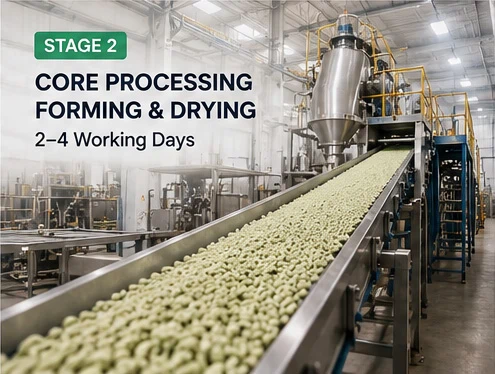
Stage 2 — Core Processing, Forming, and Drying (2–4 Business Days)
Once raw materials are ready, production enters its most time-intensive phase. Modern facilities run automated production lines around the clock, which helps with throughput — but certain physical and chemical processes simply cannot be rushed.
Plant-based litters (tofu, straw, and similar formulas) go through four steps: blending, high-pressure extrusion, low-temperature curing, and multi-layer drying. The blending stage alone takes 20–50 minutes to ensure consistent ingredient distribution. After extrusion, fresh granules carry high moisture content and must be hot-air dried until moisture drops below 5% — a threshold that prevents mold and clumping during storage. Drying and curing together account for 1–2 business days of this stage.
Bentonite cat litter follows a different path: crushing, high-temperature calcination in a kiln, tumbling modification, and secondary screening. Kiln processing alone requires 2–3 business days to achieve the target particle hardness and dust control specifications.
Standard bulk production runs average 2–4 business days through this stage. Orders for upgraded formulas — added fragrance, low-dust coatings, antibacterial treatments, or non-standard particle sizes — extend this window by 1–2 days due to equipment reconfiguration and additional process steps.
Looking for a ready-to-ship option? Our Clumping Tofu Cat Litter is produced in our own automated facility and ships from in-stock inventory — no production wait required.
Stage 3 — Quality Inspection, Packaging, and Warehousing (1–2 Business Days)
Finished granules don’t ship directly from the production line. Every batch must pass quality checks before it’s cleared for packaging. Inspectors test for clumping speed, water absorption, dust levels, deodorization performance, and particle integrity. Substandard batches — those with broken granules, excess moisture, or off-spec performance — are rejected and pulled before they reach the packaging stage.
Approved product moves to automated packaging lines for precise weighing, bag filling, sealing, and labeling with production date, batch number, ingredient list, and shelf life information. Standard cat litter with generic packaging moves through this process quickly. Customized orders — private label, custom bag sizes, or exclusive branding — require waiting for specialty packaging materials to arrive, which adds time to this stage.
Finished goods are then transferred to temperature-controlled dry storage to await dispatch. This warehousing step doesn’t extend the delivery timeline independently, but it’s part of the 1–2 business day window allocated to post-production handling before a shipment is ready to leave the facility.
Total Production Lead Time by Order Type
| Order Type | Production Lead Time | Shipping Time |
|---|---|---|
| In-stock standard orders (small batch) | 3–5 business days | 1–7 days |
| Regular bulk production orders | 7–10 business days | 3–15 days |
| Custom orders (formula, packaging, OEM) | 15–25 business days | 15–30 days |
Custom orders take the longest because they involve equipment reconfiguration, specialty material sourcing, sample approval, and additional quality verification rounds before full production begins. For cross-border bulk purchasing and private label programs, this 15–25 day window is the industry standard production lead time.
Cat Litter Shipping Timeline: Factory to Final Delivery
Domestic Short-Haul Shipping (Same City or Province): 1–3 Business Days
For most individual buyers restocking at home, domestic same-city or same-province shipping is the fastest and most reliable option. Once cat litter leaves a local or regional warehouse after sorting and loading, same-city orders typically arrive the next business day. Cross-city orders within the same province generally take 2–3 business days, accounting for transit hub sorting.
This shipping tier is highly stable. Only extreme weather events cause meaningful delays. For emergency restocking situations, choosing a supplier with regional warehouse coverage makes this the safest option to close a supply gap quickly.
Domestic Long-Haul Shipping (Inter-Provincial): 3–7 Business Days
Inter-provincial delivery is the most common shipping scenario for online cat litter purchases in China. Transit time depends on shipping distance, the number of sorting hubs, and the express carrier’s route network. Shipments from major production hubs in East, North, and South China typically reach most destinations in 3–5 business days. Deliveries to more remote areas — certain cities in the northwest and southwest — may involve two or three transfers and take 5–7 business days.
Cat litter qualifies as heavy freight, so it typically moves via dedicated trunk-line logistics rather than standard parcel express. This gives it better load priority and reduces the risk of extended delays at sorting facilities.
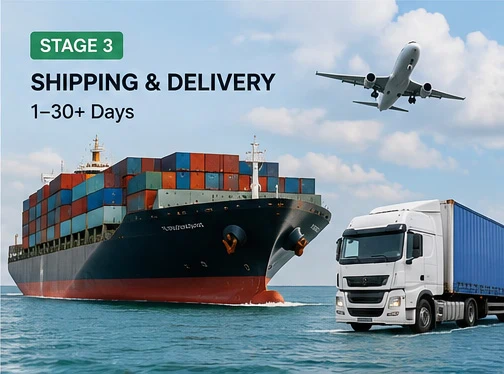
International Import/Export Shipping: 15–30 Business Days
For businesses importing or exporting cat litter across borders, the cat litter shipping timeline expands significantly. End-to-end international delivery — from domestic cargo consolidation through customs declaration, ocean or air transit, destination customs clearance, and last-mile delivery — typically takes 15–30 business days.
Ocean freight is the standard mode for international cat litter shipments due to its cost efficiency relative to the product’s weight and volume. Ocean transit alone accounts for 7–15 days, with the remaining time split between pre-departure documentation, port handling, destination clearance, and local delivery. Customs inspections, port congestion, or regulatory changes at the destination can extend this timeline further.
Air freight cuts transit time substantially but carries a cost premium that makes it practical only for small-volume urgent orders. For recurring international supply chains, ocean freight is the standard choice, and the full 15–30 day window should be built into inventory planning.
Key Factors That Affect Cat Litter Production and Shipping Time
Product Type and Process Complexity
Not all cat litter takes the same amount of time to manufacture. Basic tofu litter has a relatively straightforward production process and moves through automated lines efficiently. Bentonite litter requires high-temperature kiln calcination and secondary processing that inherently takes longer. Blended formulas demand precise layered mixing and additional dust-removal steps, adding 1–2 days to the cycle compared with single-material products. Premium categories — low-dust, antibacterial, or enhanced deodorization formulations — require additional process steps that extend production accordingly.
Order Volume and Customization Level
Small in-stock orders bypass the production queue entirely and ship as soon as warehouse picking and packing is complete. Large-volume bulk orders require production line scheduling, which means the factory must coordinate capacity across multiple active production runs before your order begins — adding time to the lead time. Customization is the single biggest timeline variable: private label packaging, proprietary formulas, special particle sizes, added fragrances, and OEM requirements all demand equipment adjustments, material sourcing, pre-production sampling, and approval rounds. These steps roughly double the production timeline compared to standard orders, which explains why custom cat litter lead time regularly runs 15–25 business days.
Before placing a large or custom order, it’s worth understanding the minimum quantities involved — see our breakdown of cat litter MOQ standards by product type.
Inventory Availability and Factory Capacity
Suppliers with large pre-built inventory reserves can fulfill standard orders immediately without waiting for a production run. This is one of the most important factors in shortening the overall cat litter delivery timeline for routine restocking. During peak demand periods — spring and fall shedding seasons, major e-commerce sales events — factory capacity tightens and warehouse stock depletes faster than normal. Buyers placing orders during these windows may face a 2–3 day production delay even for standard products. Scheduled equipment maintenance can also cause temporary gaps in production availability.
Logistics Channel and External Conditions
The choice of shipping method has an outsized impact on transit time, as the gap between same-day express and international ocean freight spans weeks. Beyond carrier choice, external factors regularly affect delivery performance: severe weather, public holidays, carrier peak-season congestion, and customs inspections all introduce variability. Around major e-commerce promotions and holidays like Chinese New Year, sorting center throughput drops and transit times across domestic networks typically extend by 1–3 business days.
How to Plan Cat Litter Restocking to Avoid Running Out
For Individual Cat Owners
The most common restocking mistake among individual buyers is waiting until the bag is almost empty before reordering. Given that even domestic in-stock orders take 3–7 business days to arrive, placing an order with two weeks of supply remaining gives you a comfortable buffer under normal conditions. Multi-cat households go through litter faster; raise that threshold to three weeks.
During high-demand periods — e-commerce promotions, pre-holiday logistics slowdowns — extend the lead time to three or four weeks. Keeping one backup bag on hand as emergency reserves eliminates the stress of urgent orders entirely and ensures your cats always have access to a clean, odor-free litter box.
For Pet Retailers and Bulk Buyers
Businesses sourcing cat litter in volume need differentiated planning based on order type. For standard in-stock purchases, placing orders approximately one week ahead of projected need covers domestic shipping windows. For international supply chains, the 15–30 day transit window applies — plan accordingly and maintain a rolling buffer of safety stock.
Customized orders — OEM programs, private label, proprietary formulas — require early supplier engagement. Factory confirmation of production scheduling, packaging materials, and pre-production samples should happen at least 30 days before the target in-warehouse date, with additional buffer for any back-and-forth on specifications. Building a dynamic inventory monitoring system tied to sales velocity helps identify reorder points before stock pressure builds.
Practical Tips to Shorten Your Cat Litter Delivery Timeline
- Buy direct from manufacturers with on-site warehousing. Suppliers who maintain finished goods inventory ship without waiting for a production run, cutting days off the lead time compared to brokers or distributors.
- Avoid peak ordering windows. Ordering during Spring Festival, 11/11, and 6/18 promotion periods means competing for production slots and logistics capacity. Ordering before or after these windows reduces delay risk.
- For emergency restocking, go local. Regional and provincial warehouse sources can deliver in 1–3 business days via short-haul logistics, making them the fastest resolution for an urgent supply gap.
Summary
Understanding cat litter production and shipping time is essential for maintaining a stable supply chain and avoiding unexpected delays — whether you’re a cat owner managing a household supply or a business running a continuous inventory cycle. The total timeline from raw material to delivery ranges from 4–8 days for domestic in-stock standard orders to 45+ days for fully customized international shipments.
The factors with the most influence on your specific timeline are order type (stock vs. custom), supplier inventory levels, shipping distance, and seasonal logistics conditions. Planning around these variables — rather than reacting to them after stock runs out — is what separates smooth operations from last-minute scrambles.
For a deeper look at how each type is made, see our full guide to the cat litter manufacturing process.
When in doubt, build in more lead time than you think you need. Cat litter shortages are inconvenient. A proactive restocking schedule costs nothing.
Frequently Asked Questions
How long does it take for in-stock cat litter to arrive after ordering?
In-stock cat litter ships without waiting for production. Domestic same-city orders typically arrive in 1–2 business days; same-province orders take 2–3 business days; inter-provincial orders take 3–7 business days, depending on distance and the number of transit hubs involved.
Why does custom cat litter take so much longer to deliver?
Custom cat litter orders require factory-side preparation that standard orders skip entirely: equipment reconfiguration, specialty material sourcing, pre-production sampling, and additional quality verification before full production begins. These steps add substantial time and typically place custom orders lower in production priority than in-stock fulfillment. The result is a custom cat litter lead time of 15–25 business days — roughly double a standard bulk order.
What should I do if my cat litter order is delayed during peak seasons?
Peak e-commerce periods and seasonal demand spikes tighten both factory capacity and carrier throughput. The most effective approach is to stock up 2–3 weeks earlier than usual, prioritize suppliers with confirmed in-stock inventory, and avoid placing large orders during the highest-congestion windows. If a delay has already occurred, contact your supplier to confirm the dispatch date and check whether regional warehouse sourcing can provide faster emergency coverage.
Why do private label cat litter orders take longer?
Private label orders involve custom packaging, formula adjustments, material preparation, and sample approval, which extend the overall lead time.
Which transportation method is most commonly used for wholesale cat litter?
Sea freight is the most common choice because it offers the best balance between cost and transportation capacity.
How can I shorten cat litter lead time?
Choosing manufacturers with sufficient inventory, automated production lines, and stable logistics channels can significantly reduce overall delivery time.