




The United Kingdom is one of the most mature pet markets in Europe, with roughly 12 million pet cats living in about 26% of households. For importers, distributors and private-label buyers, the country is unusual in one important respect: demand is large and stable, but domestic production covers only a minority of it. That gap is where the commercial opportunity sits.
This guide sets out what the uk cat litter market looks like in 2026 – how large it actually is, why published figures disagree, which sub-categories are growing, how supply reaches the shelf, and what a post-Brexit compliance file needs to contain before a first container is booked.
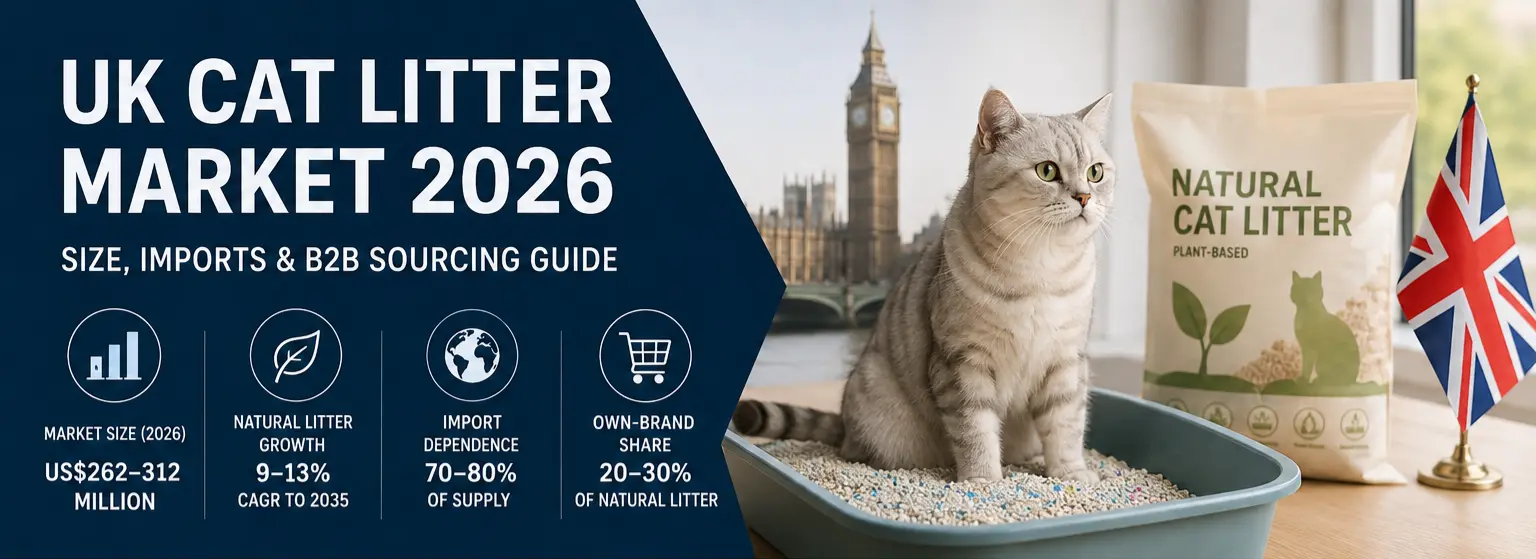
Quick answer: Published estimates put the UK cat litter market at roughly US$262–312 million in 2026, with reported growth forecasts ranging from 4.7% to 8.04% CAGR. Natural and biodegradable litter is estimated to be growing faster, at around 9–13% CAGR, with an estimated 25–30% share of retail volume in 2026. Import dependence is estimated at roughly 70–80%, while retailer own-brand programmes are estimated to account for 20–30% of natural litter volume.
For suppliers: the opportunity is strongest where imported supply, natural-substrate growth and private-label demand overlap.
UK Cat Litter Market Size: Work With a Range, Not a Single Number
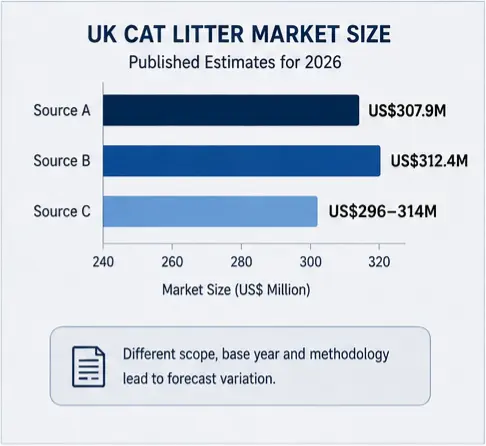
Several commercial market-research estimates place the UK cat litter category in a broadly similar 2026 range, but the published figures are not directly comparable because research firms can differ in category scope, channel coverage, currency conversion and base year. The figures below are therefore best treated as planning benchmarks rather than as an official UK market statistic. For customer-facing forecasts, suppliers should cross-check the underlying methodology and publication date of any individual estimate before using it as a precise market value.
Working definition: the UK cat litter market is the retail sales value of all cat litter substrates – bentonite clay, silica, wood, paper, tofu and other plant-based materials – sold to UK households through grocery, pet specialty, discount and online channels in a given year.
| Source | 2026 value estimate | Stated growth |
|---|---|---|
| Published research-house estimate | ~US$307.9 million | Mid single-digit CAGR |
| Published research-house estimate | ~US$312.4 million | Upper end of range |
| Published research-house estimate | US$296–314 million | Range published |
| Consolidated working range | US$262–312 million | 4.7%–8.04% CAGR |
Why Published Growth Forecasts Differ
A gap between 4.7% and 8.04% CAGR is not a rounding difference – over ten years it is the difference between a flat market and one that nearly doubles. Three methodology choices explain most of it:
- Scope. Some models count only branded retail litter; others include retailer own-brand, bulk and veterinary or shelter channels.
- Currency and base year. GBP-to-USD conversion at different reference dates moves a sterling-denominated market by several percentage points before any real growth is counted.
- Value versus volume. UK litter volume is close to flat. Most forecast growth is price and mix – the shift from cheap non-clumping clay toward premium plant-based formats – so any model that weights premiumisation heavily produces a higher CAGR.
Key takeaway: treat US$262–312 million as the planning band and build volume assumptions from unit shipments rather than from a research-house value figure. Cross-check any single source before it reaches a customer-facing document; individual market-research pages are frequently repriced, moved or withdrawn.
Sub-Category Structure: Natural Litter Is Where the Growth Sits
The headline number tells you very little about where to place a product. The category is splitting into a stable clay base and a fast-growing plant-based layer, and those two layers behave like separate markets in pricing, packaging and compliance terms.
Natural and Biodegradable Litter
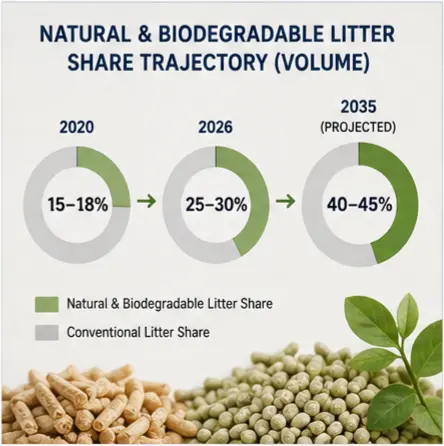
Published market-research estimates indicate that natural and biodegradable litter is growing faster than the overall UK cat litter category, with some forecasts placing its growth at around 9–13% CAGR through 2035. Because these figures come from commercial market estimates rather than an official UK statistical series, the 2020, 2026 and 2035 share figures below should be treated as indicative market benchmarks rather than audited national totals.
- 2020: natural substrates held an estimated 15–18% of retail volume.
- 2026: 25–30% of retail volume.
- 2035: a projected 40–45% if current adoption holds.
This is the single most useful data point for an exporting manufacturer. It says the incremental demand in the UK is plant-based, and that the substrate mix on a British shelf in ten years will look materially different from today’s.
Clay Holds the Base, Non-Clumping Holds the Volume
Sodium bentonite clumping litter still accounts for the largest share of value. Below it sits a large, price-led non-clumping tier: sector analysis indicates it represents roughly a quarter to a third of category value but a considerably larger share of tonnage, because unit prices are often around half those of clumping products. Own-brand penetration is heaviest in this tier.
Format Preferences That Affect Specification
UK buyers are more tolerant of pellet and coarse-granule formats than several continental markets, partly because wood-pellet litter has a long retail history in Britain. Three specification points come up repeatedly in UK tenders:
- Dust. Low-dust performance is now expected across all price tiers, not just premium lines.
- Tracking. Granule size and shape are scrutinised because tracking performance matters in carpeted and hard-floor residential environments.
- Pack weight. Grocery multiples favour packs a single shopper can carry; heavy 20 kg sacks move mainly through pet specialty and online subscription.
UK Cat Litter Import Dependence: An Estimated 70–80% of Supply
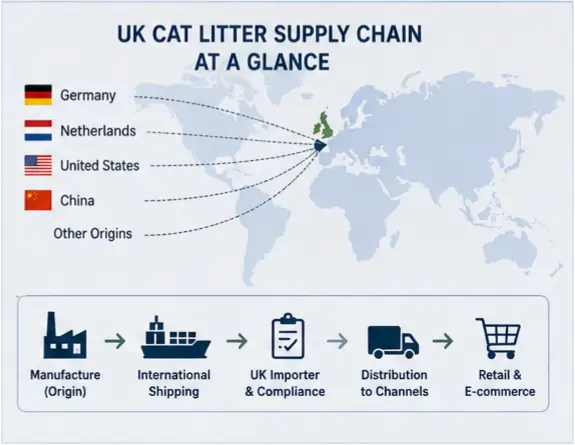
Commercial market estimates suggest that roughly 70–80% of UK cat litter supply is imported, although the exact share varies by product type and how domestic processing and re-export activity are counted. Germany, the Netherlands and the United States are among the principal origins identified in the available market estimates. Domestic processing does not necessarily mean domestic raw-material sourcing, so suppliers should distinguish between the country where litter is processed, the country of origin declared for trade purposes and the source of the underlying substrate.
| Supply factor | UK position | What it means for a supplier |
|---|---|---|
| Import dependence | 70–80% of supply | Structural, not cyclical – the door is open to new origins |
| Main origins | Germany, Netherlands, United States | Incumbents compete on lead time, not on cost base |
| Domestic bentonite | Limited processing, imported sodium clay | No protected local cost advantage in clay |
| Plant-based capacity | Minimal UK production | The fastest-growing tier is almost entirely imported |
The competitive implication is primarily logistical. Suppliers located closer to the UK can offer shorter lead times and smaller, more frequent deliveries, while overseas manufacturers may compete through production scale, substrate capability and consolidated shipment planning. For an Asian supplier, the commercial question is therefore whether the additional transit time can be offset by reliable forecasting, container utilisation, stock planning and a sufficiently differentiated product specification.
Retailer Own-Brand Is the Largest Single Demand Pool
Major UK grocery and pet-specialty retailers operate own-brand litter programmes, making private label an important source of concentrated B2B demand. Commercial estimates suggest that retailer own-brand products may account for around 20–30% of natural litter volume, but this figure should be treated as an indicative market estimate rather than a disclosed retailer-level market share.
- Documentation. A complete compliance file supplied before the audit, not after a query.
- Artwork turnaround. Own-brand programmes change packaging on retailer timelines, so re-labelling speed is a scored criterion.
- Batch consistency. Clump strength, dust and moisture must hold across shipments, because a retailer’s own name is on the bag.
Retail Channels and Route to Shelf
Four routes carry almost all UK litter volume, and each implies a different pack architecture and margin structure.
| Channel | Character | Supplier requirement |
|---|---|---|
| Grocery multiples | Tesco, Sainsbury’s, Asda; own-brand led | Carryable packs, EPR-ready packaging, audit trail |
| Pet specialty | Pets at Home and independents | Full range including premium plant-based lines |
| Discounters | Price-led, high rotation | Lowest landed cost, simple specification |
| Online and subscription | Fastest-growing for natural litter repeat purchase | Ship-in-own-container durability, light tare weight |
Subscription e-commerce deserves particular attention: it accounts for an estimated 15–20% of natural litter repeat purchase and rewards lightweight, compressible plant-based formats, because carriage is charged on weight while the shelf price is set by perceived performance.
Compliance: Three UK Requirements B2B Cat Litter Suppliers Need to Map
The UK compliance picture is broader than a single product certificate. For imported cat litter, suppliers and UK buyers may need to address packaging EPR obligations, environmental-claim requirements and, where relevant to the substances or mixtures involved, UK REACH. These requirements apply to different parties and activities, so they should not be treated as three identical shipment-level approvals. Before quoting, map which obligation sits with the overseas manufacturer, UK importer, brand owner or other party in the supply chain.
The UK compliance picture is broader than a single product certificate. For imported cat litter, suppliers and UK buyers may need to address packaging EPR obligations, environmental-claim requirements and, where relevant to the substances or mixtures involved, UK REACH. These requirements apply to different parties and activities, so they should not be treated as three identical shipment-level approvals. Before quoting, map which obligation sits with the overseas manufacturer, UK importer, brand owner or other party in the supply chain.
1. Packaging Extended Producer Responsibility
UK packaging EPR can place reporting, registration and waste-management cost obligations on organisations that meet the regulatory definition of a producer. The relevant obligation depends on how the packaging is supplied and who places it on the UK market, so the contract should explicitly allocate data collection, reporting, fees and importer-of-record responsibilities rather than assuming the overseas factory automatically carries them. For 2026 onward, recyclability and packaging material choices can also affect the cost position under the EPR system.
2. The UK Green Claims Code
The CMA’s Green Claims Code provides guidance on environmental claims under UK consumer-protection law, while the ASA and CAP apply advertising rules to environmental claims in advertising. For a cat-litter supplier, the practical requirement is to ensure that environmental statements are accurate, evidence-based and presented with sufficient context, with responsibilities agreed across the manufacturer, brand owner and retailer where claims are supplied through a private-label programme.
Practical rule: do not make a “compostable”, “biodegradable” or similar environmental claim on a UK cat-litter pack unless the specific claim is supported by appropriate evidence for the product, the claimed disposal conditions and the relevant market. A packaging compostability standard should not be treated as automatic proof that the litter itself, or pet waste mixed with it, can be composted safely through household or municipal waste systems.
This is a live commercial risk, not a theoretical one. Unsubstantiated claims lead to rework, relabelling and delisting – all of which land on the supplier’s lead time even when the claim originated with the brand owner.
3. UK REACH
UK REACH operates independently from EU REACH, and an EU registration does not automatically provide UK REACH coverage. Whether UK REACH obligations arise depends on the identity, role and annual tonnage of substances placed on the UK market, rather than simply on whether a product is labelled as cat litter. Suppliers should therefore maintain a substance and composition declaration and determine, with the UK importer or other responsible party, whether any substance in the formulation requires registration or other UK REACH action. HSE guidance states that registration generally applies to substances manufactured or imported at more than one tonne per year, subject to the relevant exemptions and conditions.
Key takeaway: build a UK-specific dossier. Buyers who have already imported into Germany will find the structure familiar – see the parallel analysis of the Germany cat litter market – but the documents themselves are not interchangeable.
What the UK Market Means for Four Types of Buyer
The same set of figures produces different priorities depending on where a business sits in the chain. The table below translates the market structure into the decision each buyer type actually has to make.
| Buyer type | Main opportunity | Main risk to manage |
|---|---|---|
| Importer / distributor | High import dependence means incumbents are displaceable on landed cost | EPR obligation and UK REACH usually sit with the importer of record |
| Wholesaler | Flat volume but rising unit value protects margin on premium lines | Heavy, low-value freight makes the sourcing radius a real constraint |
| Brand owner | Natural litter growing 9–13% CAGR with weak domestic supply | Green Claims exposure on every environmental statement |
| OEM / private-label buyer | Retailer own-brand takes 20–30% of natural litter volume | Audit readiness, artwork speed and batch-to-batch consistency |
How to Enter the UK Market: A Practical Sequence
Step 1 – Assemble the Compliance Dossier First
Before the first quotation, a UK-ready file should contain a full material and additive declaration, relevant heavy-metal and moisture test data, packaging material and weight information for EPR assessment, substantiation for every environmental or performance claim intended for the pack, and commercial and customs documentation prepared consistently with the agreed tariff classification and importer-of-record arrangement.
Step 2 – Design for Re-Labelling, Not Re-Formulation
Own-brand and multi-market programmes change artwork far more often than they change formula. Plan for it: keep the base specification stable, hold neutral bag stock where the programme allows, and agree an artwork-to-shipment lead time in the contract. Fast, accurate re-labelling is one of the clearest differentiators in UK private-label tenders.
Step 3 – Start With Small, Verifiable Batches
UK buyers rarely open with a full programme. A trial container that lands cleanly, passes goods-in inspection and performs on shelf is worth more than an aggressive price on a volume the buyer is not yet ready to commit to. Agree the sampling and inspection protocol up front so the trial produces evidence, not just stock.
Step 4 – Match Substrate to the Channel
Plant-based clumping litter suits pet specialty and subscription; economy non-clumping suits discounters and grocery entry price points. Manufacturers producing across substrates can supply both tiers from one supply chain. Pet Horizon, for example, manufactures tofu, bentonite, pine and mixed litter at its Dalian-area facility and supports OEM and ODM programmes for international buyers. Its typical MOQ is one 20 ft container, negotiable by programme, with tofu cat litter commonly used as an entry point for buyers targeting the natural segment.
Conclusion
The UK cat litter market is best treated as a US$262–312 million planning range for 2026 rather than a single definitive figure. The available market estimates point to stable baseline demand, high import dependence, faster growth in natural and biodegradable substrates, and a meaningful role for retailer own-brand programmes. The exact size, category shares and growth rates should be treated as estimates rather than official national statistics, but together they indicate a market where premiumisation and imported supply remain important commercial themes.
What separates suppliers who win UK business from those who do not is rarely price. It is a complete post-Brexit compliance file covering packaging EPR, the Green Claims Code and UK REACH; the ability to re-label quickly for own-brand programmes; and the willingness to prove performance on a small batch before scaling. Build to those three requirements and the import dependence that defines this market becomes an open door rather than a barrier.
Frequently Asked Questions
Published estimates place it at roughly US$262–312 million for 2026. Individual research houses report figures near US$308 million and US$312 million, and one gives a US$296–314 million range, so the interval is the defensible way to state it.
Scope, currency conversion and base year account for most of the gap. Some models exclude retailer own-brand or bulk channels, and growth forecasts range from 4.7% to 8.04% CAGR depending on how heavily premiumisation is weighted. Use a range and cross-check any single source.
Natural and biodegradable litter is forecast to grow at 9–13% CAGR through 2035. It has moved from an estimated 15–18% of retail volume in 2020 to 25–30% in 2026, with 40–45% projected by 2035.
Around 70–80% of UK supply is imported, mainly from Germany, the Netherlands and the United States. Domestic bentonite processing is limited, and sodium bentonite raw material is itself imported, so there is no protected local cost advantage.
No. Since Brexit, UK REACH is a separate regime administered by the Health and Safety Executive, and an EU registration does not automatically cover the UK. For cat litter, additives, fragrances, binders and colourants attract the most scrutiny rather than the base substrate.
Environmental claims must be accurate, substantiated and not misleading by omission, with the CMA setting the code and the ASA enforcing advertising. In practice, do not print “compostable” without a recognised test report such as EN 13432, and do not imply a disposal route that is unavailable locally.
Retailers specify formula, pack size and price, and the manufacturer produces under the retailer’s brand. Own-brand lines from the major grocers and pet specialists take an estimated 20–30% of natural litter volume. Selection hinges on audit-ready documentation, fast artwork turnaround and consistent batch quality.
FOB can provide a useful baseline for comparing factory-level quotations, but the better Incoterm depends on the buyer’s logistics model and importer-of-record structure. DDP should only be quoted when the parties have clearly established tariff classification, freight, duty, VAT, import clearance, packaging EPR responsibilities and who acts as importer of record. Otherwise, the delivered price can change after booking and may not be directly comparable with an FOB offer.