



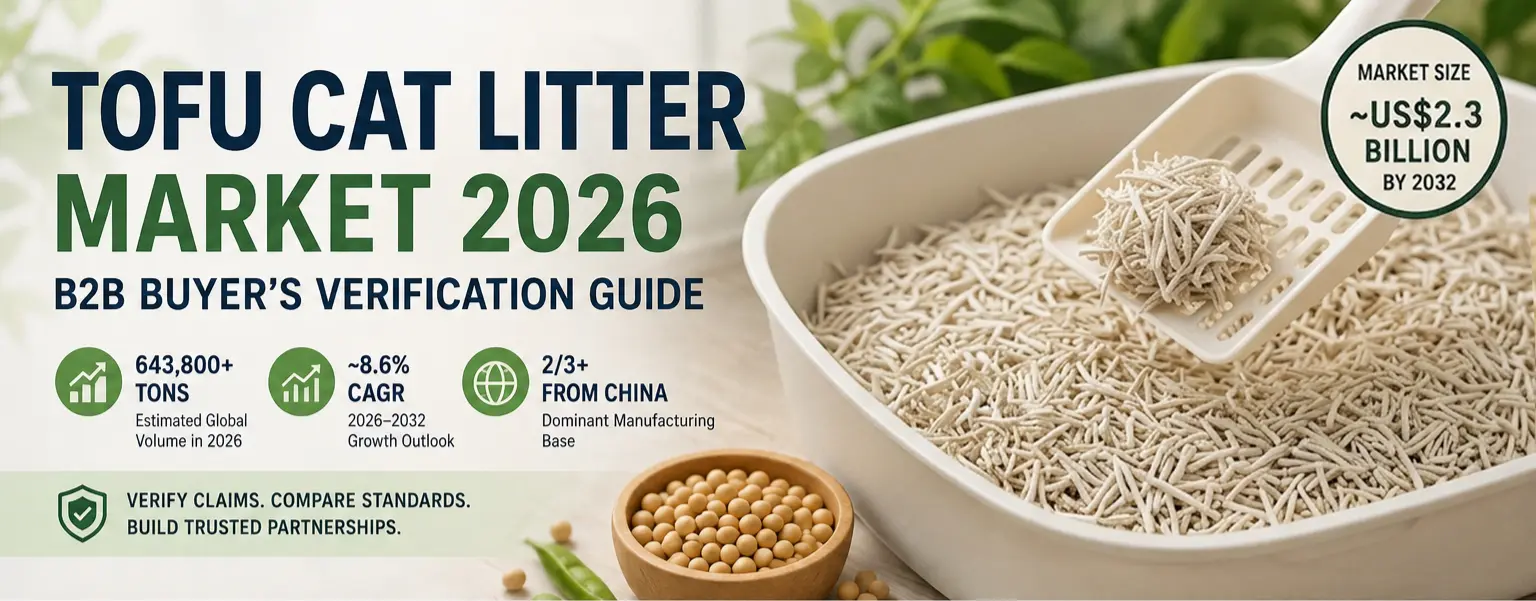
Tofu cat litter has become an established plant-based category, and 2026 market estimates indicate continued growth. Two independent 2026 market studies (QYResearch and Global Info Research) estimate global volume at roughly 643,800 tons for 2026, up from about 589,700 tons in 2025, with a compound annual growth rate near 8.6% through 2032. For importers, distributors, and private-label buyers, the opportunity is significant, but supplier claims still require careful verification. This guide reviews the 2026 market data, explains the lack of a single international testing system for claims such as “flushable,” “biodegradable,” and “low-dust,” and outlines what buyers should verify before placing an order.
Quick answer: Global tofu cat litter volume is estimated at about 589,700 tons in 2025 and 643,800 tons in 2026, with roughly 8.6% CAGR projected toward about US$2.3 billion by 2032. China accounts for more than two-thirds of global volume and remains the dominant manufacturing base. For buyers, the key issue is claim verification: “flushable,” “biodegradable,” and “low-dust” are not covered by one unified international testing system, so request third-party reports that identify the applicable standard or test method before committing to an order.
How Big Is the Tofu Cat Litter Market in 2026?
Two independent market-research publishers provide closely aligned estimates for the category. QYResearch and Global Info Research both estimate 2025 global volume at about 589,700 tons and 2026 volume at about 643,800 tons, with the weighted average price rising from roughly US$2.16 per kg in 2025 to US$2.19 per kg in 2026. Market value is estimated at about US$1.27 billion in 2025 and US$1.41 billion in 2026, with a projection of roughly US$2.3 billion by 2032.
| Metric | 2025 | 2026 (est.) | 2032 (forecast) |
|---|---|---|---|
| Global volume | ~589,700 tons | ~643,800 tons | — |
| Weighted avg. price | ~US$2.16/kg | ~US$2.19/kg | — |
| Market value | ~US$1.27 billion | ~US$1.41 billion | ~US$2.3 billion |
| Growth rate | CAGR ~8.4–8.6% (2026–2032) | ||
China accounts for more than two-thirds of global volume and remains the dominant manufacturing base. Buyers should treat these figures as directional market sizing from independent publishers, not as a single audited census. The close alignment between the two market studies provides useful directional evidence of category scale, but buyers should not interpret the estimates as a definitive measure of total global production.
Why Tofu Litter Keeps Gaining Share
Several factors are supporting tofu litter’s growth. First, urban apartment living and multi-cat households can favor lighter, lower-dust, plant-based products that are easier to carry and store. Second, cat litter is a recurring-consumption product, which can support relatively resilient demand. Third, automatic litter boxes are influencing product development, with some fine-pellet and granular tofu formulas designed around faster clumping and mechanical-screening requirements. For a comparison of material trade-offs, see our types of cat litter overview.
The Claims Problem: No Single International Test Standard
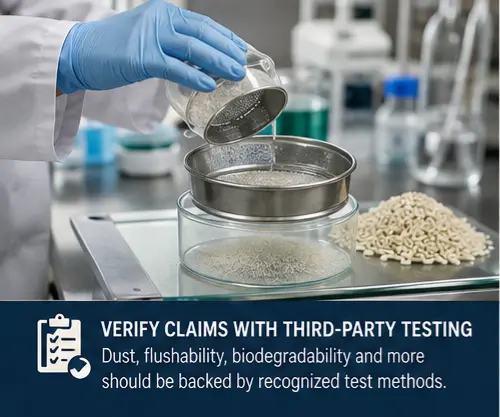
The main verification issue for B2B buyers is how supplier claims are tested and documented. Terms such as “flushable,” “biodegradable,” and “low-dust” are used across the category, yet there is no single international testing system that verifies them across suppliers. A 2026 market study explicitly notes that these claims are not checked against one unified methodology, which means supplier-reported data may not be directly comparable between products.
What standards and test methods actually exist is a patchwork rather than one global rulebook. China’s GB/T 43839-2024, “Safety Requirements for Companion Animal (Pet) Products,” took effect on 1 October 2024 and sets safety limits for cat litter, including a lead limit of not more than 50 mg/kg. Tofu-specific guidance also includes group standards such as T/CIQA 11-2020. For dust, buyers should ask laboratories to identify the specific dust or powder-rate test method used rather than treating EN 14899 as a cat-litter dust standard; EN 14899 is a general European framework for sampling waste materials. The practical result is that buyers need to compare the named standard, test method, sampling procedure, and reported result rather than relying on a generic claim such as “low-dust.”
Because there is no single unified international test method for these claims, the strongest practical verification is a third-party report that identifies the applicable standard or test method, sampling basis, test conditions, and result.
| Common claim | What is actually testable | What a buyer should request |
|---|---|---|
| “Low-dust” | Dust or powder content measured under a defined laboratory method | Third-party dust or powder-rate report identifying the exact test method, sampling procedure, and result |
| “Biodegradable” | Biodegradation under defined conditions, not “natural” | Recognized biodegradation test result, not a marketing sentence |
| “Flushable” | Disintegration in water; local wastewater rules vary | Disintegration data plus a check of your destination market’s plumbing rules |
| “Clumping” | Clump strength and re-wetting behavior | Clump-integrity test under your humidity condition |
Indirectly, this is good news for serious buyers. Requesting independent test reports from qualified laboratories against named standards can turn vague claims into comparable specifications. The SGS testing-services overview is one reference point for the type of independent testing and documentation buyers can request from a qualified supplier.
Product Innovation Buyers Should Track
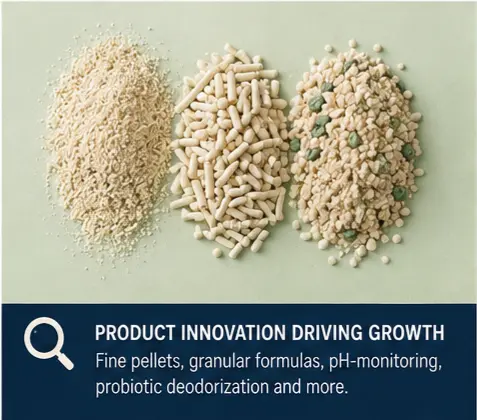
The category is moving beyond basic cylindrical pellets toward performance and function. The developments most relevant to B2B buyers are:
- Fine pellets and granular particles engineered for automatic litter-box compatibility and faster clumping.
- pH-responsive monitoring litter that changes color in response to urine pH and may serve as a screening indicator rather than a medical diagnosis.
- Particle-size specialization for different cat ages, litter-box designs, and user preferences.
- Probiotic deodorization and unscented formulations aimed at scent-sensitive households.
Each of these features can serve as a potential premium or private-label differentiator, but buyers should verify the underlying performance claim before using it in product positioning. For example, a “health-monitoring” claim should identify the indicator mechanism and clearly state what the product can and cannot indicate.
Questions to Ask a Tofu Litter Manufacturer
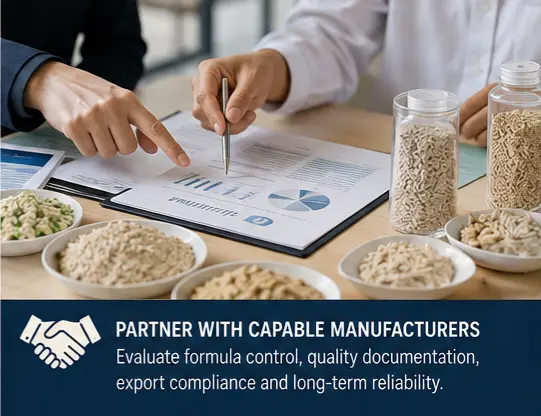
A structured questionnaire can help buyers distinguish manufacturing capability from supplier claims. Before you order, ask:
- Do you produce the litter in-house, and which fibers do you use (soybean, pea, or blends)?
- How do you control moisture and prevent softening or clump-strength loss in transit?
- What dust and powder-rate results can you show from an independent lab?
- Can you document “flushable” or “biodegradable” claims with a named test method?
- Does the test report correspond to the same formula, particle size, additives, and production specification that will be used for the bulk order?
- Which certifications do you hold (ISO 9001, BSCI, and market-specific documentation)?
- What is the MOQ per format, and is custom particle size or fragrance supported?
- Which export documents do you provide for my target market?
Pet Horizon Tofu Litter OEM
Pet Horizon manufactures tofu litter as a core part of its range, alongside bentonite, pine, and mixed formulas, from a factory near Dalian Port with 10+ years of experience and products shipped to 80+ markets. Our tofu cat litter programs cover pure tofu and tofu-mineral blends, with in-house formula control, moisture management, and export documentation. For buyers comparing a cat litter manufacturer on capability rather than price, we can provide matched samples, relevant test documentation, and OEM or private-label packaging, with specifications that can be checked against the intended bulk-order formula.
Conclusion
Tofu cat litter is a large and fast-growing category in 2026, with estimated global volume above 640,000 tons and China as the dominant manufacturing base. For B2B buyers, the key challenge is not simply market demand but verifying product claims and production consistency. “Flushable,” “biodegradable,” and “low-dust” should be supported by clearly identified test methods and documentation rather than generic marketing language. Buyers should also verify moisture control, dust performance, particle specifications, sample-to-bulk consistency, and export documentation before committing to a private-label or distribution program.
Frequently Asked Questions
Two independent 2026 market studies estimate global tofu cat litter volume at about 643,800 tons in 2026, up from roughly 589,700 tons in 2025. They indicate roughly 8.4–8.6% CAGR through 2032, with market value projected at about US$2.3 billion by 2032.
Tofu cat litter is made from plant-based materials, but that alone does not establish a verified “biodegradable” claim under a specific test method. “Flushable” also depends on disintegration performance and local wastewater or plumbing rules. Before making either claim for a private-label product, request a test report that identifies the method and conditions used, and check the requirements of the destination market.
There is no single unified international test covering all of these claims. China has product-safety requirements such as GB/T 43839-2024 and tofu-specific group standards such as T/CIQA 11-2020, while dust and powder performance may be assessed using different laboratory methods. EN 14899 is a general waste-sampling framework rather than a cat-litter dust standard. For “flushable” and “biodegradable” claims, buyers should request a third-party report that identifies the specific test method, conditions, and result.
Tofu cat litter is plant-based, but safety depends on the specific raw materials, additives, manufacturing controls, and applicable product requirements. China’s GB/T 43839-2024 sets safety requirements for companion-animal products, including limits for certain substances such as lead. Buyers should therefore review the supplier’s raw-material specifications, quality-control procedures, and relevant test documentation rather than assuming that all tofu litter has the same safety profile.
Tofu litter is plant-based and typically lighter by volume than mineral-based bentonite litter, while bentonite is known for strong clumping performance. Tofu products are often positioned around lower dust and plant-based materials, but dust performance should be verified for the specific formula. Bentonite products can offer different clumping, weight, and cost characteristics depending on grade and formulation. Mixed formulas combine plant-based and mineral materials to balance selected performance attributes.
Yes. Chinese tofu-litter suppliers commonly provide OEM or private-label options, but the available services vary by factory. Confirm whether production is in-house, the available particle sizes and fragrance options, MOQ, packaging capabilities, quality documentation, and export requirements for your target market before ordering.
Ask about in-house production and fiber source, moisture and clump-strength control, independent dust and biodegradation reports, certifications, MOQ per format, and export documents for your market.
Newer fine-pellet and granular tofu formulas are engineered for automatic-box compatibility and faster clumping, but compatibility varies by device and particle size. Request the exact particle specification and test it with your target box before volume ordering.