



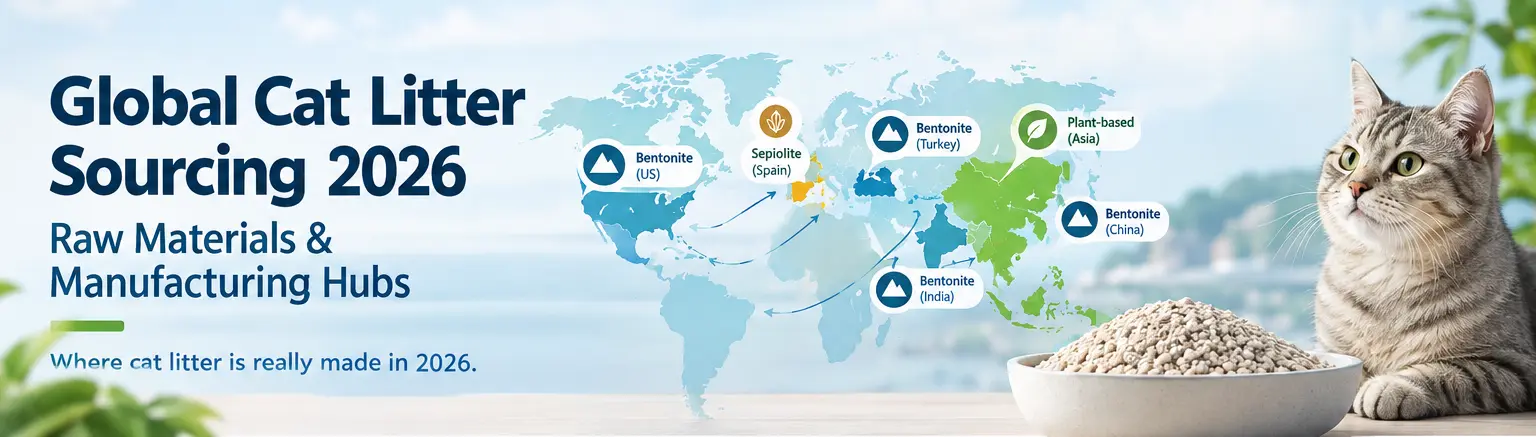
Quick Answer: Global cat litter sourcing in 2026 is concentrated around major mineral basins and manufacturing hubs rather than a small group of finished-product brands. The United States, India, Turkey, China, and other countries supply major bentonite volumes; Spain is a major sepiolite center; and Asian manufacturing bases are important for many plant-based, mixed, and processed litter formats. For B2B buyers, sourcing decisions should compare raw-material access, factory capability, tariff classification, freight cost, and private-label capacity together.
Global cat litter sourcing in 2026 is defined less by brand geography than by raw-material geography. Bentonite, sepiolite, and plant-based feedstocks are mined or processed in specific basins, and the countries that control those basins also control the cost and trade-policy exposure of finished litter. For B2B buyers, understanding where supply sits — and where tariff and logistics risk concentrates — is the first step to building a resilient sourcing mix.
The Bentonite Supply Base
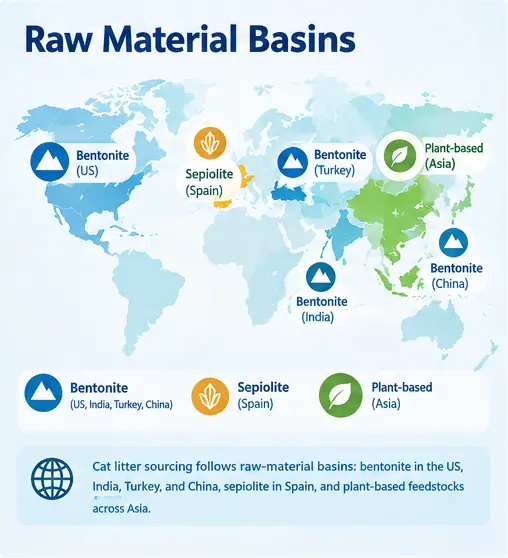
Bentonite is the backbone of clumping mineral litter, but global production is distributed across several major mining countries. USGS Mineral Commodity Summaries 2026 estimates 2025 world bentonite production at about 20 million tonnes, including roughly 4.1 million tonnes in the United States, 3.7 million tonnes in India, 2.5 million tonnes in Turkey, 2.1 million tonnes in China, 1.3 million tonnes in Iran, and 1.0 million tonnes in Greece. The United States remains a major source of sodium bentonite, particularly from Wyoming and Montana, while Turkey, Greece, and other European and Mediterranean producers serve regional markets. Secondary market-research estimates may report different China production figures because they use different industry and statistical definitions.
| Country | Bentonite production (2025, USGS est.) | Role in cat litter supply |
|---|---|---|
| United States | ~4.1 million tonnes | Major sodium-bentonite producer; important export base |
| India | ~3.7 million tonnes | Major global bentonite producer serving domestic and export markets |
| Turkey | ~2.5 million tonnes | Major producer serving Europe, MENA, and other nearby markets |
| China | ~2.1 million tonnes (USGS) | Major production and processing base |
| Iran | ~1.3 million tonnes | Significant regional bentonite producer |
| Greece | ~1.0 million tonnes | Important European production base |
| World total | ~20 million tonnes | USGS estimated world production |
Data scope: Bentonite production figures in the table are 2025 estimates from USGS Mineral Commodity Summaries 2026 and are reported in thousand tonnes. Production estimates from commercial market-research databases may differ because of differences in source coverage, reporting methods, and commodity definitions.
For buyers qualifying a bentonite cat litter supplier, production geography is only the starting point; grade consistency, sodium/calcium bentonite characteristics, clumping performance, dust control, processing capability, and export logistics should also be verified.
Sepiolite and Specialty Clays
Sepiolite is an important lightweight and absorbent clay used in some mineral and lightweight cat litters, and Spain is a major global production center. USGS Mineral Commodity Summaries 2026 estimates Spanish sepiolite production at about 690,000 tonnes in 2025 under its fuller’s-earth, sepiolite category. Companies such as Tolsa and Sepiolsa operate sepiolite mining and processing businesses in Spain, including applications in cat litter. Spain’s combination of sepiolite resources, processing capacity, and proximity to EU markets makes it an important sourcing location for lightweight and specialty mineral litter.
EU Bentonite Production and Import Position
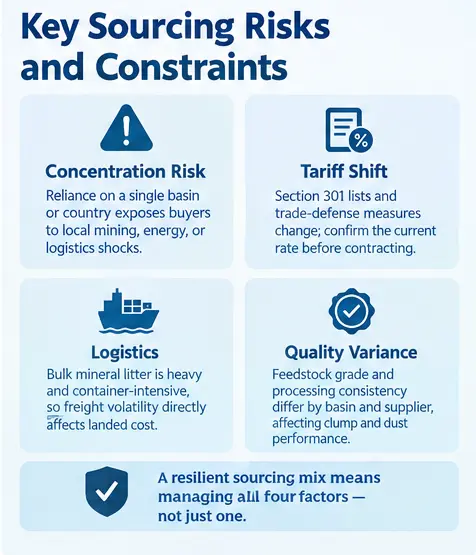
The EU has substantial domestic bentonite production but also relies on imports to meet regional demand. Production is concentrated in several member states, with Greece as a major producer and Denmark and Germany also contributing significant volumes; Spain has a smaller bentonite output but is an important sepiolite producer. IndexBox estimates EU bentonite imports at about 2.3 million tonnes in 2024, following a peak of roughly 2.6 million tonnes in 2022. For buyers, the relevant sourcing question is therefore not simply whether the EU produces bentonite, but whether a specific grade, processing specification, and delivered cost can be supplied competitively within the region.
Plant-Based Feedstocks
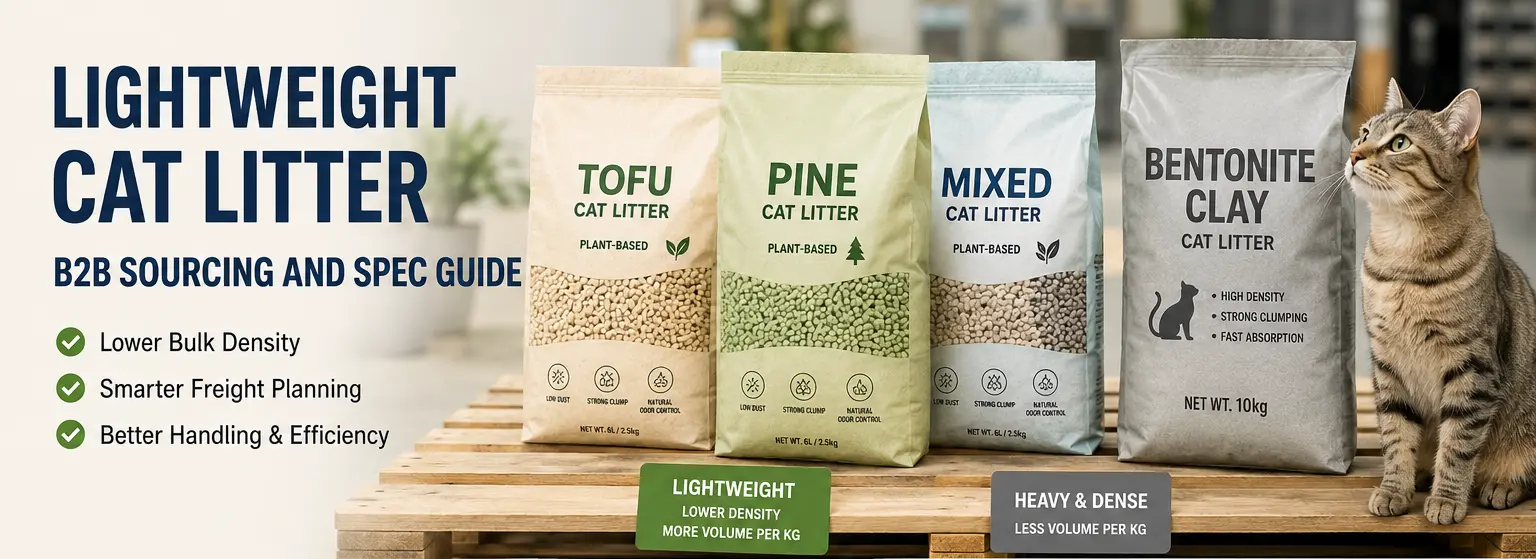
Plant-based litters draw on different supply chains: soybean and pea by-products for tofu litter, wood fiber and sawdust, and cassava or corn starch for other variants. These feedstocks and finished products move through multiple regional supply chains, including important processing capacity in Asia, and the tariff and origin treatment of plant-based litter differs from clay (see our cat litter tariff guide for the HS-code detail). Because plant-based sourcing is material-specific, buyers should evaluate each substrate’s own feedstock, processing location, and trade exposure rather than treating “plant-based” as a single category.
Cat Litter Manufacturing Hubs
Finished cat litter manufacturing does not always follow the location of the underlying raw material. China and other Asian manufacturing bases have strong capabilities in plant-based, mixed, and processed mineral formats, while Turkey, Spain, and other European locations connect mineral feedstocks with regional processing and private-label production. For B2B buyers, the practical sourcing decision is therefore two-layered: evaluate the origin of the feedstock and the location, capacity, and export infrastructure of the finished-litter factory.
For buyers considering cat litter sourcing beyond China, alternative supply bases include Turkey and other Mediterranean mineral producers, European processing and packaging hubs, and Asian manufacturers specializing in plant-based and mixed formats. Europe also has established private-label activity for pet products, so buyers should compare feedstock access, factory capability, packaging capacity, MOQ, export infrastructure, and EU market access when evaluating a manufacturing location.
There is therefore no single list of “cat litter manufacturing countries” that fits every product category: mineral, tofu, wood, mixed, and specialty litters can have different raw-material and factory locations.
Trade-Policy Overlay
Trade policy shapes where finished litter is cheapest to land, but the applicable duty must be checked at the final tariff-line level. CN 2508.40 carries a 0 percent standard EU duty, while U.S. treatment depends on the applicable HTS classification and any additional measures. For China-origin goods, Section 301 exposure must be checked against the current USTR and HTS listings because additional duties are tied to specific tariff subheadings rather than simply to the product name. Buyers should therefore compare origin, tariff classification, additional duties, and freight together when calculating landed cost.
What This Means for Buyers
A resilient 2026 sourcing mix should diversify origin and production location rather than concentrate on a single basin. Turkey provides geographic proximity to European and MENA markets for mineral feedstocks, Spain combines domestic sepiolite resources with EU market access, the United States remains a major sodium-bentonite production base, and Asian manufacturing is important for plant-based, mixed, and processed litter formats. Buyers exploring Turkey as a cat litter sourcing market or reviewing China’s cat litter export clusters should evaluate feedstock access, tariff classification, freight distance, processing capacity, and private-label manufacturing capability together.
Risks and Constraints
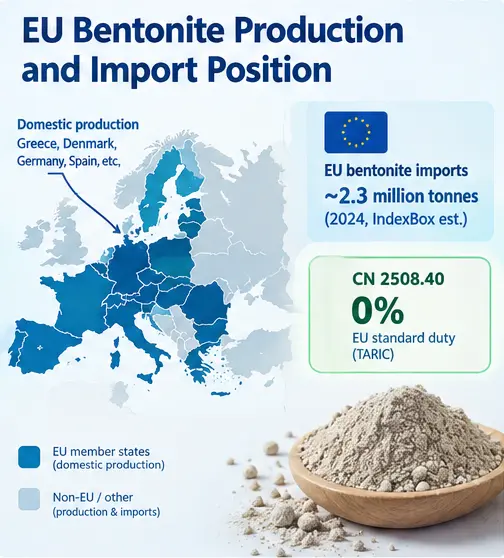
- Concentration risk: reliance on a single basin or country exposes buyers to local mining, energy, or logistics shocks.
- Tariff shift: Section 301 lists and trade-defense measures change; confirm the current rate before contracting.
- Logistics: bulk mineral litter is heavy and container-intensive, so freight volatility directly affects landed cost.
- Quality variance: feedstock grade and processing consistency differ by basin and supplier, affecting clump and dust performance.
Conclusion
Global cat litter sourcing in 2026 follows both raw-material basins and manufacturing hubs: the United States, India, Turkey, China, and other countries account for substantial bentonite production, while Spain is a major sepiolite center and Asian manufacturing bases are important for many plant-based and mixed litter formats. The EU combines domestic clay production with substantial bentonite imports, while tariff treatment depends on the exact product classification, origin, and destination market. Buyers can build a more resilient cat litter supply base by comparing feedstock access, factory capability, tariff exposure, freight cost, and private-label production capacity rather than evaluating country of origin alone.
Frequently Asked Questions
Major mineral feedstocks come from several countries, with 2025 USGS bentonite estimates of about 4.1 million tonnes in the United States, 3.7 million tonnes in India, 2.5 million tonnes in Turkey, 2.1 million tonnes in China, 1.3 million tonnes in Iran, and 1.0 million tonnes in Greece. Spain is a major sepiolite center, while plant-based litter depends on separate agricultural and forestry supply chains across multiple regions.
The EU has substantial domestic bentonite production, particularly in Greece, with additional production in countries such as Denmark, Germany, and Spain, but it also imports significant volumes. IndexBox estimates EU bentonite imports at about 2.3 million tonnes in 2024, so buyers should evaluate both EU-based and external sources when sourcing specific grades and specifications.
Start with the exact product classification rather than the general term “cat litter.” CN 2508.40 has a 0 percent standard EU duty, but that code should not automatically be treated as the classification for every finished clay cat litter product. U.S. treatment must likewise be checked against the applicable HTS subheading, including any additional measures such as Section 301 for China-origin goods. Buyers should confirm the final classification and origin before calculating landed cost.
Turkey is a major bentonite producer with geographic proximity to EU markets, which can provide a shorter regional supply route for some mineral products. Buyers should still compare the applicable origin rules, customs treatment, freight route, and product classification for each shipment rather than assuming a uniform trade advantage.
Central and Eastern European markets also participate in regional private-label manufacturing, packaging, distribution, and re-export activity for pet products. Buyers evaluating these locations should compare factory capability, labor and packaging costs, EU market access, minimum order quantities, and logistics rather than assuming that one country provides the same cost or sourcing advantage across all SKUs.
Section 301 surcharges must be checked against the current USTR listing for the specific HTS subheading; they are tied to specific tariff subheadings rather than simply to the product name, and China-origin goods may therefore face additional duty that changes the landed-cost math.
Yes. Plant-based litter uses soybean, pea, wood, cassava, corn, and other agricultural or forestry feedstocks, with processing and manufacturing distributed across multiple regions. Its HS classification and tariff treatment can differ substantially from clay, so each substrate and finished SKU should be evaluated on its own supply chain.
The main risks include supply concentration, tariff and customs-classification changes, freight volatility, and differences in raw-material or processing quality. Buyers can reduce exposure by qualifying more than one origin, confirming the tariff classification before contracting, and using product specifications and acceptance limits to control supplier variation.