




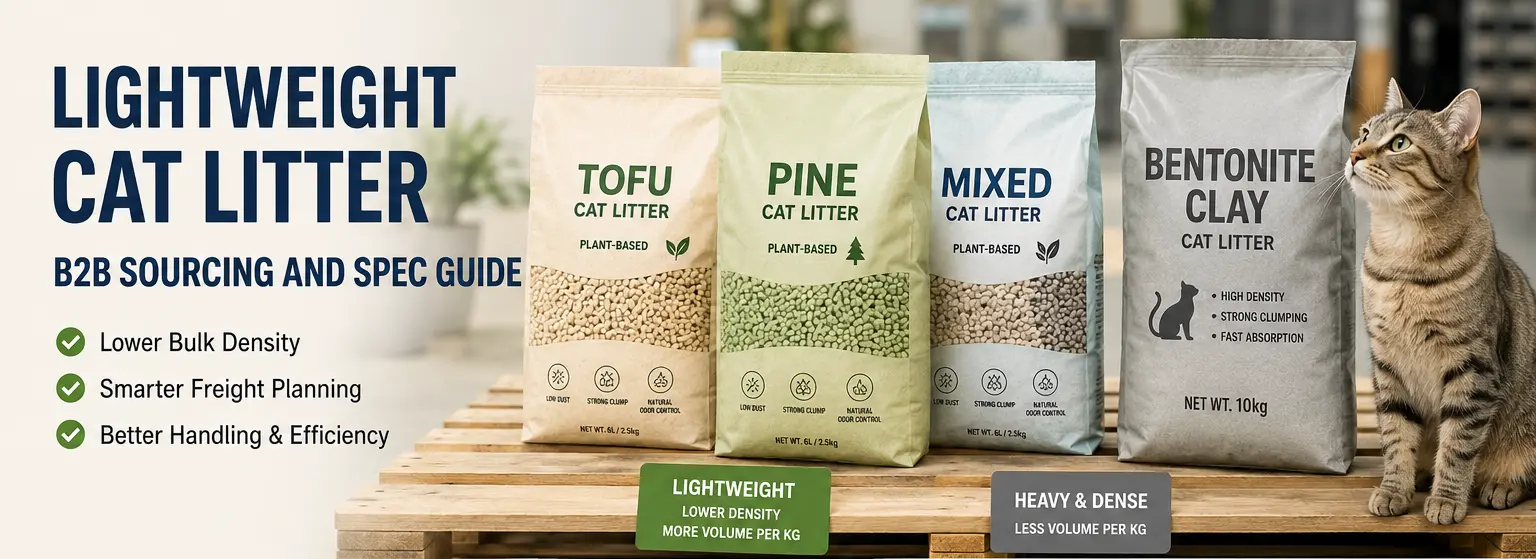
Cat litter importers, distributors, and private-label buyers increasingly evaluate lightweight formulas for more than consumer convenience. Lower bulk density can reduce product weight for a given volume and influence packaging, palletization, freight planning, warehouse handling, and e-commerce fulfillment. This guide explains how lightweight cat litter is defined, which materials are commonly used, and which specifications B2B buyers should include in an OEM or private-label sourcing brief.
Interest in natural cat litter is growing alongside demand for convenient, lighter products. Grand View Research estimates the global natural cat litter products market at USD 1.8 billion in 2025 and projects it to reach USD 3.2 billion by 2033 at a CAGR of 7.6 percent, with e-commerce and urban households among the demand drivers, according to the Natural Cat Litter Products Market report. Natural-litter market growth should not be treated as a direct measure of lightweight-litter demand.
Quick Answer
Lightweight cat litter generally has a lower bulk density than conventional bentonite clay, so the same volume of product weighs less. Tofu and other plant-based formulas commonly fall around 0.5 to 0.6 kg/L, while bentonite may range from about 0.8 to 1.1 kg/L, although actual values vary by formula and particle size. On a per-equivalent-volume basis, those ranges represent roughly 25 to 55 percent less weight, depending on the actual bulk density of each product. For B2B buyers, lower product weight can improve weight efficiency on weight-sensitive shipments and make manual handling easier, but the result depends on packaging dimensions, pallet configuration, shipping mode, and destination. Clumping strength, moisture resistance, and dust or fines should therefore be specified alongside bulk density rather than treated as automatic benefits of a lightweight formula.
What “Lightweight” Means in Cat Litter
In B2B cat litter sourcing, lightweight generally means a lower bulk density than conventional clay litter, rather than a regulated product category or a universal weight threshold.
In specification terms, this refers to bulk density, the mass of litter per unit volume, usually expressed as grams per liter (g/L) or kilograms per liter (kg/L). A lower bulk density means more volume per kilogram, so a given bag weight holds more liters, or the same liter count weighs less to carry. Bulk density is influenced by the base material, particle shape, and how tightly the product is packed.
A 5 kg bag is not automatically “lightweight” simply because it weighs less than a 10 kg bag. For product comparison, buyers should compare bulk density and usable volume under the same test conditions, because bag weight alone does not describe how much litter a SKU contains.
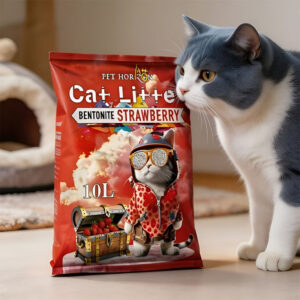
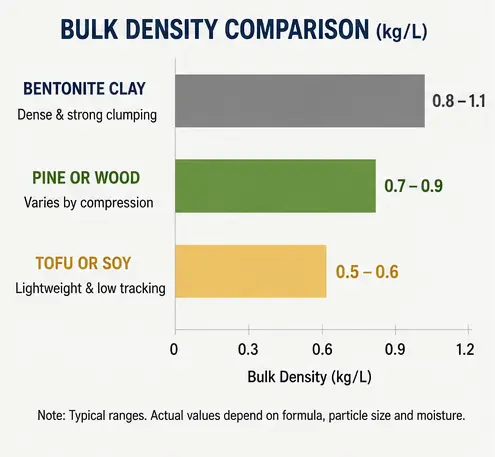
Typical product specifications may place bentonite clay litter around 0.8 to 1.1 kg/L and tofu litter around 0.5 to 0.6 kg/L, while pine and wood-based products vary according to pellet compression and particle geometry. These figures are indicative rather than universal category standards. Buyers should confirm the supplier’s actual bulk-density test method, sampling conditions, and batch result on the certificate of analysis.
| Material | Typical bulk density (kg/L) | Notes for buyers |
|---|---|---|
| Bentonite clay | 0.8 to 1.1 | Dense; commonly selected for strong, fast clumping |
| Tofu-based | 0.5 to 0.6 | Low density and low tracking; dust level depends on process control |
| Pine or wood | 0.7 to 0.9 | Density varies with pellet compression, particle size, and moisture |
| Mixed or blended | 0.6 to 0.9 | Tunable between weight and clumping |
These are typical ranges from product specifications; actual values depend on formula and particle form.
Common Lightweight Cat Litter Materials
Tofu (soy) cat litter
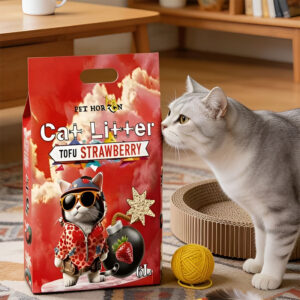
Tofu cat litter is commonly produced from processed soy or soybean fiber together with other plant-based ingredients and binders, then formed into pellets or granules. It is among the lower-density mainstream litter formats and is often selected for low-tracking and lightweight positioning. Where flushability is claimed, it depends on the formulation and should be confirmed against the supplier’s test documentation. Tofu cat litter is a core part of many lightweight sourcing programs.
Pine and wood-based litter
Pine and other wood-based litters are commonly produced from processed wood fiber, sawdust, or other wood-derived materials. Their density varies considerably with pellet compression, particle size, and moisture content. Wood-based litters can provide odor-control characteristics associated with the raw material, but performance varies by species, processing, formulation, and whether additional odor-control ingredients are used. Buyers should specify pellet dimensions, bulk density, moisture, durability, and dust or fines limits when comparing wood-based formulas.
Mixed and blended formulas
Blended litters combine a light plant base with a smaller proportion of bentonite or another mineral to balance clump hardness, density, performance, and target cost. They let buyers tune the weight-to-performance balance and can be a practical entry point for brands moving away from full-clay formulas.
Other plant-based options
Corn, wheat, cassava, and recycled-paper litters also fall in the lightweight category and are available in the market. They are mentioned here for comparison only. Formulation, sourcing, and compliance vary by supplier, and not every manufacturer offers them; buyers should evaluate each on its own specification and destination-market requirements.
Why B2B Buyers Choose Lightweight Litter
Freight and chargeable weight
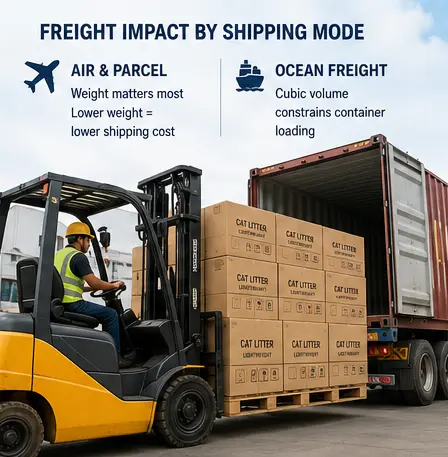
Lower product weight can improve freight economics, but the effect depends on shipping mode and how the product is packed. For air freight and parcel delivery, chargeable weight may be based on actual or dimensional weight, so a lighter SKU can reduce weight-related charges when actual weight is the limiting factor, as described in the overview of dimensional weight. For ocean freight, container loading is also constrained by cubic volume, so a lower-density litter may occupy more space per kilogram. Buyers should therefore evaluate product weight, bag dimensions, carton volume, pallet pattern, and container loading together rather than assume that lower density always means lower freight cost.
Easier handling and warehouse efficiency
Lighter cartons can reduce the weight handled per pick, lift, and replenishment cycle, which may make manual handling easier for warehouse and retail staff. For distributors and fulfillment operations, the benefit is best evaluated together with carton dimensions, units per carton, pallet pattern, and stacking strength because a lighter product can also require more packaging volume per kilogram.
E-commerce and last-mile advantage
Direct-to-consumer and marketplace fulfillment can make parcel weight and dimensional weight important cost variables. A lower-weight SKU may therefore improve shipping economics and margin potential, particularly for subscription and repeat-purchase models, although the final effect depends on packaging dimensions, carrier rules, and destination.
Trade-Offs Buyers Should Specify
Clumping strength at lower density
Some lower-density plant-based litters may produce softer or less compact clumps than high-performance bentonite formulas, but clumping depends on the specific raw materials, binder system, particle size, and formulation. Buyers should define a reproducible clump-strength or scoop-test method instead of using density alone as a proxy for performance.
Dust and moisture behavior
Low-density plant materials can still generate fines if milling, pelletizing, screening, or handling is not well controlled, and some plant-based formulas can absorb moisture during storage. Buyers should define a reproducible dust or fines test method, together with a maximum moisture limit and packaging moisture-barrier requirements. The test method and acceptance criteria should be agreed with the supplier before production rather than relying on a generic “low-dust” claim.
Packaging and palletization
Because lightweight litter occupies more volume per kilogram, carton size and pallet pattern matter. Confirm units per carton, cartons per pallet, and stack height to protect both freight efficiency and in-store display.
Specifying Lightweight Litter for Private Label or OEM
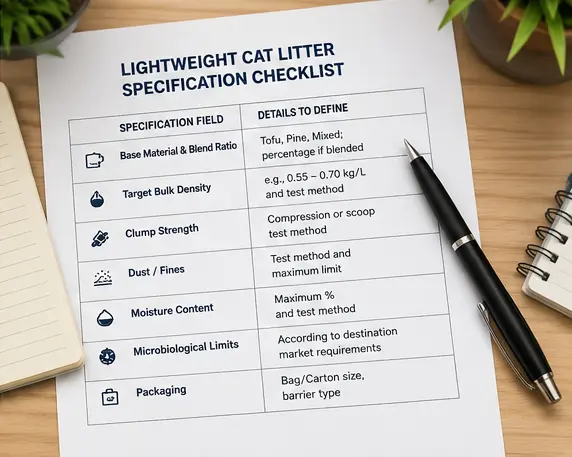
A clear specification prevents disputes and returns. The table below lists the fields most buyers include when briefing a cat litter OEM partner.
| Specification field | What to define | Why it matters |
|---|---|---|
| Base material and blend ratio | Tofu, pine, or mixed; percentage if blended | Sets weight, clumping, and claims |
| Target bulk density | For example 0.55 to 0.70 kg/L, plus test method | Controls freight and feel |
| Clump strength | Compression or scoop test method | Avoids soft-clump complaints |
| Dust or fines | Defined test method and maximum limit | Controls cleanliness and handling performance |
| Moisture content | Maximum percentage and test method | Storage stability and product consistency |
| Microbiological limits | Where applicable to the destination market | Supports import and retail acceptance |
| Fragrance and color | Optional, custom | Brand differentiation |
| Packaging | Bag or carton size, barrier type | Shelf life and freight |
Manufacturing and Quality Considerations
Lightweight formulas require consistent control of raw materials, particle size, drying, screening, and moisture. An OEM supplier should be able to provide a certificate of analysis covering agreed parameters such as bulk density, moisture, dust or fines, and microbiological results where applicable, and should align claims with the requirements applicable to the destination market.
Pet Horizon has more than 20 years of pet-care manufacturing experience and more than 10 years of OEM and ODM experience, with products supplied to more than 80 countries. Buyers should nevertheless validate production samples and each agreed batch specification against their own requirements and destination-market rules.
For material selection across the category, see our overview of cat litter types, which compares clumping, absorption, and handling by base material.
Conclusion
Lightweight cat litter is less a product claim and more a logistics and positioning decision. For importers and private-label managers, lower bulk density can improve handling and, on weight-sensitive lanes, freight economics, but the outcome depends on packaging, pallet pattern, and shipping mode. Tofu-based, wood-based, and blended formulas can provide practical options for developing a lower-density SKU, while the right specification, not the material name alone, determines whether the product performs consistently on the shelf and in the home.
Frequently Asked Questions
Tofu-based or soy-fiber litter is generally among the lightest mainstream options, with bulk density commonly around 0.5 to 0.6 kg/L, compared with about 0.8 to 1.1 kg/L for bentonite clay. Pine and wood pellets are lighter than clay but denser than tofu, and their density varies with pellet compression.
Commonly cited specification ranges put tofu litter at about 0.5 to 0.6 kg/L versus about 0.8 to 1.1 kg/L for bentonite clay. On a per-equivalent-volume basis, that range represents roughly 25 to 55 percent less weight, depending on the actual bulk density of the two products. Actual values vary by particle form and formula.
It depends on the shipping mode and the packing configuration. For air freight and parcel delivery, chargeable weight may be based on actual or dimensional weight, so a lighter SKU can reduce cost when actual weight is the limiting factor. For ocean freight, container loading is also constrained by cubic volume, and a lower-density litter may occupy more space per kilogram. Buyers should model product weight, carton dimensions, pallet pattern, and container loading together for their own lanes.
Not necessarily. Clumping depends on the raw materials, binder system, particle size, and formulation rather than density alone. Some lower-density plant-based litters may produce softer clumps than high-performance bentonite, but blended formulas and a defined clump-strength test method address the gap. Buyers should define clump performance in the specification rather than assume parity.
Define the base material and blend ratio, target bulk density with its test method, clump-strength test method, dust or fines test method and limit, maximum moisture content with its test method, microbiological limits where applicable, and packaging. A clear specification prevents returns and disputes.
Pet Horizon’s lightweight range includes tofu, or soy, litter, pine and wood-based litter, and mixed, or blended, formulas, with specification and packaging adjustable under OEM and private-label programs. Corn, wheat, cassava, and paper litters are mentioned in this guide for category comparison only and are not part of the standard range; availability should be confirmed with the supplier.
Lightweight does not by itself determine whether a cat litter is safe. Suitability depends on the raw materials, additives, dust or fines level, moisture control, microbiological quality, contaminants, and intended use. For private-label sourcing, buyers should request the relevant product specifications, testing documentation, and ingredient information and evaluate them against the requirements of the destination market.
No. “Lightweight” describes product density and weight, not environmental end-of-life properties. Some plant-based litters may be biodegradable or marketed with compostability or flushability claims, but these properties depend on the formulation, the certification or test basis, the packaging, and destination-market requirements. Buyers should verify each environmental claim separately rather than infer it from low density or plant-based content.