

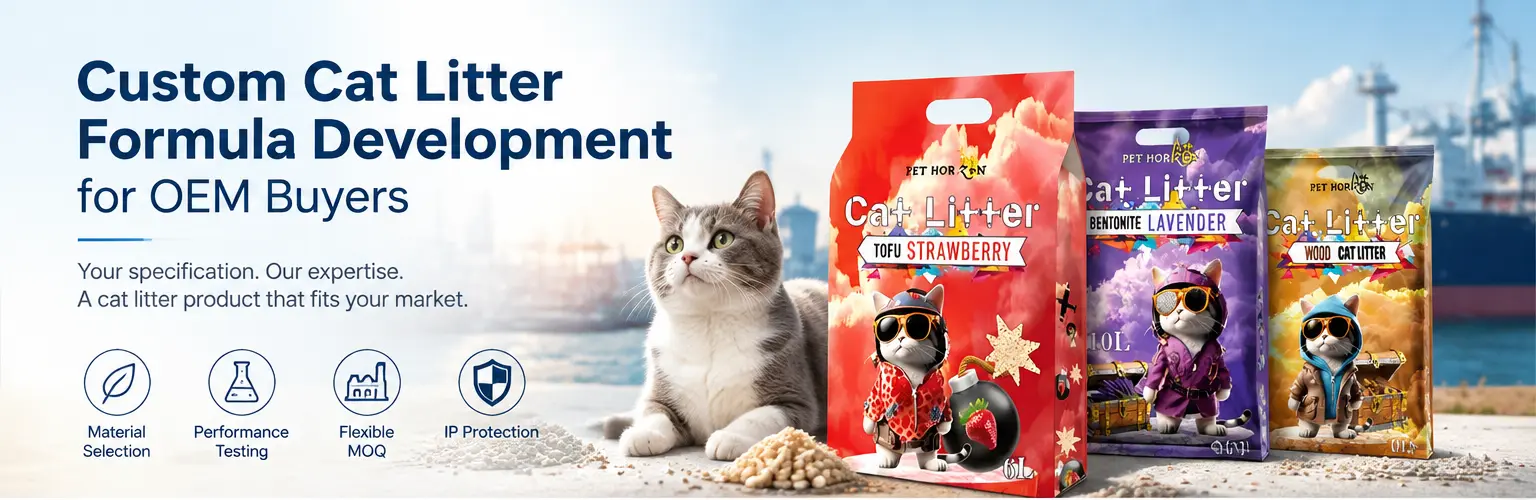
A custom cat litter formula allows a brand or distributor to develop a product based on its own performance requirements instead of selecting a standard factory recipe. For OEM buyers, the key difference is the level of product specification, including material selection, performance targets, and quality requirements agreed with the manufacturer before production.
Quick Answer: Custom cat litter formula development is the process of creating a litter product based on buyer-defined specifications with an OEM manufacturer. It covers material selection, performance targets, testing methods, MOQ, pilot validation, and agreement on specification ownership before mass production.
What a Custom Cat Litter Formula Is
A custom formula is a product specification developed around the buyer’s requirements, rather than simply applying a brand label to a standard factory product. Ownership and usage rights should be clearly defined in the OEM agreement.
A custom cat litter formula is a buyer-defined specification covering raw-material composition and agreed performance, produced by a manufacturer to that specification rather than to a standard house recipe.
That distinction matters because a well-defined custom formula can support product differentiation, consistent quality claims, and retailer requirements that a standard relabeled product may not achieve.
Why Buyers Develop a Custom Formula
- Differentiation from competitors selling the same standard litter
- Performance tuned to a regional preference (clumping speed, odor control, low tracking)
- Cost optimization while maintaining required performance
- A defensible product claim backed by a defined specification
Many private label cat litter buyers start with a standard product and move toward custom formulation when they need stronger differentiation or retailer-specific requirements.
Custom Formula vs Standard Private Label Cat Litter
| Aspect | Standard Private Label | Custom Formula |
|---|---|---|
| Product base | Existing factory recipe | Buyer-defined specification |
| Development | Limited adjustment | Formula evaluation and testing |
| Differentiation | Packaging and branding | Product performance and positioning |
| MOQ | Usually lower | Usually higher |
What You Can Actually Customize
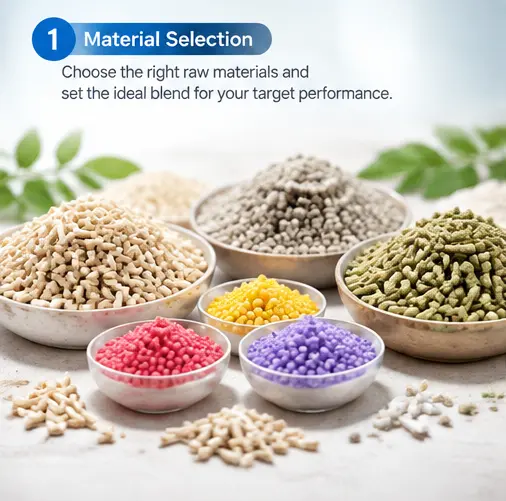
The controllable variables depend on the litter type. For example, tofu cat litter projects often focus on fiber structure, absorption speed, and flushability, while bentonite projects typically focus on clumping strength, granule size, and dust control. Mixed and pine-based formulas may require additional testing for material compatibility and moisture stability.
| Variable | Buyer decision |
|---|---|
| Material blend | Tofu, bentonite, pine, or a mixed base; ratio between components |
| Clumping and absorption | Target clumping time and liquid uptake |
| Density | Bag weight and cube utilization for freight |
| Dust or fines level | Maximum fines percentage measured by an agreed method |
| Scent and additives | Fragrance, deodorizer, or binder, with claim substantiation |
Each variable is a specification to agree, not a vague request. “Low dust” on its own is a performance claim, not a measurable target; define it as a maximum fines percentage with a named sieve or particle-size method and a batch acceptance rule.
The Feasibility Check
Before committing, experienced cat litter manufacturers should assess whether the target formula is producible on existing equipment, whether raw materials are available at the required quality, and whether any claimed benefit can be substantiated for the destination market. A capable OEM cat litter partner will tell you early which targets are realistic and which would require new tooling or materials.
Defining Performance Targets
Strong specifications state a measurement method and an acceptance range, not just a number. For moisture, agree an oven-drying or equivalent method and a per-format range validated through production and storage testing. For dust, separate the maximum fines percentage (measured on a prepared sample by an agreed sieve method) from any airborne-dust test, and define the sampling and acceptance procedure at the SKU level. This is the difference between a specification a factory can hit and a claim that fails at audit.
Testing Custom Cat Litter Before Production
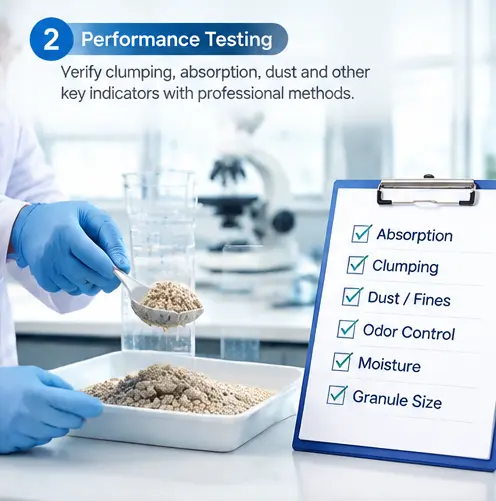
Before mass production, validate the formula against the agreed specification. Depending on the litter type, test absorption, clumping, dust or fines level, odor-control performance, moisture content, and granule size distribution, using the named methods defined in the specification. A pilot batch is the practical point to confirm that samples and bulk production will stay consistent.
MOQ and Development Lead Time
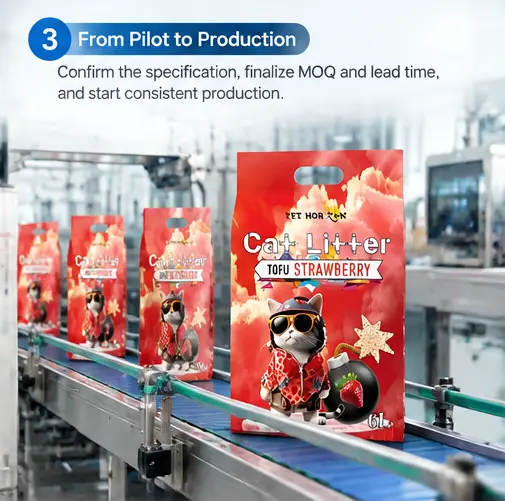
Custom formulas carry a higher minimum order quantity and a longer timeline than standard products, because the manufacturer must run trials, reserve capacity, and often prepare dedicated materials. The exact minimum and lead time depend on the formulation, pack format, and order history, so confirm both with your supplier. A typical path runs from a technical brief, to a prototype, to a pilot batch, to full production.
OEM buyers should also evaluate packaging format, export requirements, and target market regulations during the development stage, because these factors can affect the final product specification and production cost.
Protecting Your Formula and IP
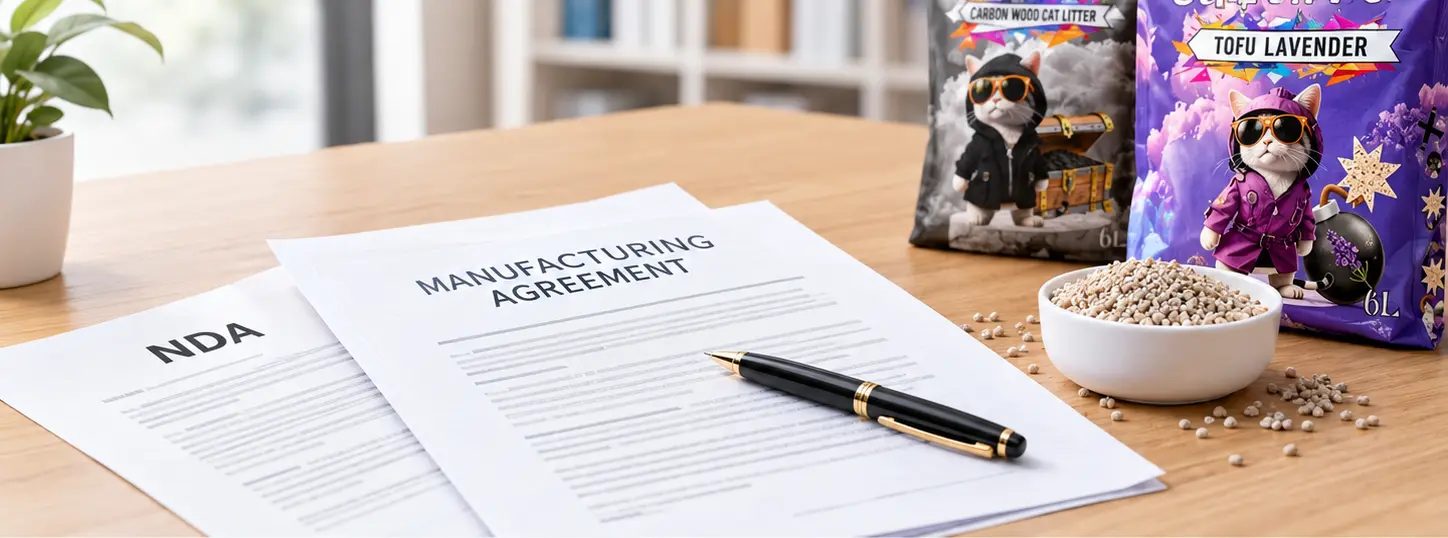
Treat the formula as a commercial asset. Put a confidentiality agreement in place before sharing detailed requirements, define in the contract who owns the formula and any related intellectual property, and keep the approved specification and batch records on file. A manufacturer executes production, while ownership and usage rights for the developed product specification should be clearly defined in the OEM agreement.
Step-by-Step OEM Formula Development
- Write a performance brief: target market, litter family, and must-have attributes
- Run a feasibility review with the manufacturer
- Agree a specification with named test methods and acceptance limits
- Approve a prototype and, if needed, a pilot batch
- Finalize MOQ, pricing, and lead time in the contract
- Lock the approved specification and start production
Common Custom Formula Mistakes
- Setting a vague “low dust” target with no measurement method
- Asking for a performance claim the material cannot substantiate
- Skipping the NDA and contract ownership discussion
- Underestimating custom MOQ and development lead time
- Changing the spec after pilot, which restarts the timeline
Working With Your Manufacturer
A manufacturer such as Pet Horizon can take a buyer’s brief for a custom mixed cat litter or single-material product and turn it into a repeatable specification, validated through its cat litter manufacturing process. The buyer defines the product; the factory delivers consistent production against it.
Conclusion
Custom cat litter formula development allows OEM buyers to move beyond standard private label products by creating a specification-based product with defined performance targets, quality requirements, and market positioning. Define the specification with named test methods and acceptance limits, confirm feasibility and lead time with your manufacturer, protect the formula contractually, and pilot before full production.
Frequently Asked Questions
Private label usually means an existing product sold under your brand, while a custom formula is developed according to buyer-defined specifications, performance targets, and agreed production requirements rather than the manufacturer’s standard product.
You can typically adjust the material blend, clumping and absorption targets, density, dust or fines limits, and scent or additives, subject to feasibility and claim substantiation in your market.
Define a maximum fines percentage with a named sieve or particle-size method, sample preparation, and a batch acceptance rule, rather than using “low dust” as a bare claim.
Custom formulas need a higher MOQ and longer lead time than standard products; the exact figures depend on the formulation, pack format, and order history, so confirm with your supplier.
Use a confidentiality agreement before sharing details, define formula and IP ownership in the contract, and keep the approved specification and batch records on file.
Ownership should always be defined in the OEM agreement. Depending on the development arrangement, the buyer may own the approved product specification, while the manufacturer may retain ownership of production methods, manufacturing know-how, or background technology.
Yes. A prototype and, for new blends, a pilot batch let you verify performance, packaging, and consistency against the approved specification before committing to a full order.