

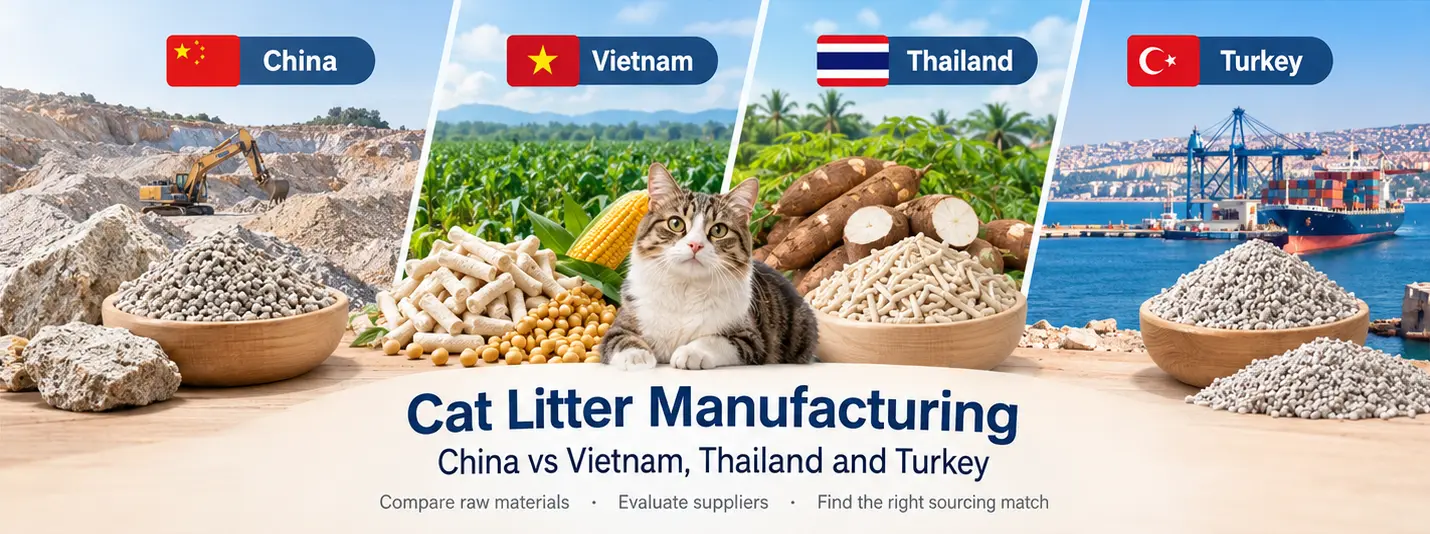
Choosing a cat litter manufacturing country involves more than comparing factory prices. For importers, distributors, and private-label brands, the decision depends on litter type, production capacity, minimum order quantities, quality consistency, shipping costs, and the import duties that apply in the destination market. China, Vietnam, Thailand, and Turkey offer different sourcing options, but their suitability varies by product format and buyer requirements. This guide compares the four countries from a B2B sourcing perspective and explains what to verify before qualifying a manufacturer.
China is a strong starting point for buyers seeking a broad range of cat litter formats, established export infrastructure, and integrated OEM sourcing. Vietnam may be worth evaluating for plant-based litter and EU-bound shipments when the product qualifies for EVFTA preferences. Thailand is an alternative to investigate for specific agricultural-based litter formats, but buyers should verify actual factory capacity and export experience rather than assume broad industry depth. Turkey may offer a logistics advantage for some European destinations, although customs treatment must be checked against the product classification and applicable documentation. Compare qualified suppliers using landed cost, product performance, production capacity, and delivery reliability—not country reputation alone.
In this article, “cat litter manufacturing” refers to the industrial production and contract manufacturing of finished litter — bentonite clays, plant-based tofu, corn and pine litters, and blended formats — destined for private-label or wholesale export. “Sourcing country” means the production origin that determines substrate access, logistics, and tariff treatment, not the brand’s headquarters.
Why Sourcing Geography Shapes Cost and Risk
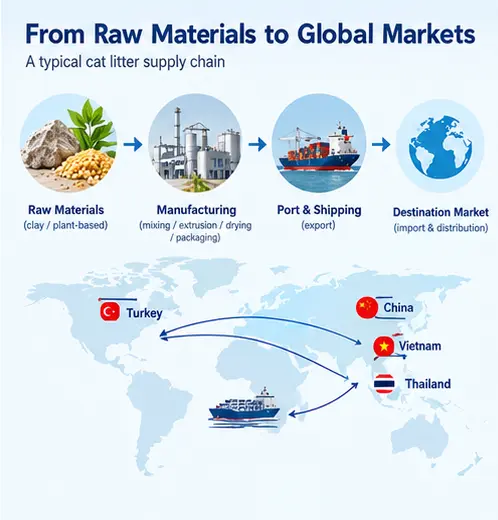
A litter program’s landed cost is not set in the factory alone. The origin country decides which raw materials sit nearby, how far goods travel to a port, which trade agreement applies to your destination, and how much supplier redundancy exists if one line goes down — which is why cat litter production cost by country is never a single ranking, but a function of format, destination, and tariff access.
Substrate Specialization by Region
Matching your required substrate to a region’s strength is the first filter, because freight and reformulation cost more than most buyers expect when the feedstock is not local.
China — A Broad Sourcing Base for Multiple Formats
China is a practical sourcing base for buyers comparing multiple cat litter formats, including bentonite, tofu, pine, and blended products. Its large manufacturing and export ecosystem can make it easier to compare specialized factories, packaging options, and OEM capabilities within one sourcing market. However, the location of a raw-material deposit does not necessarily indicate where finished litter is manufactured, and not every factory offers every substrate. Buyers should confirm the actual production site, raw-material sourcing arrangements, in-house processing capabilities, and port of export for each shortlisted supplier. Our China cat litter export clusters guide provides additional context on regional sourcing.
Vietnam and Thailand — Sourcing Options to Verify
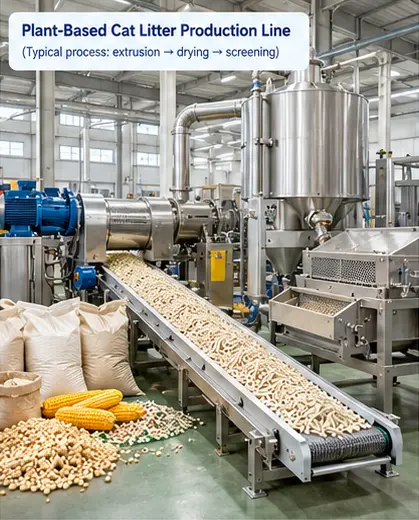
Vietnam and Thailand are worth investigating for selected plant-based cat litter programs, particularly where locally available agricultural materials can support a commercially viable formula. However, access to agricultural feedstocks does not automatically mean a country has a deep, export-ready cat litter manufacturing base. Buyers should verify whether a prospective factory operates its own production lines, which raw materials it actually uses, its sustained output, export track record, and batch-to-batch consistency. For tofu litter, assess extrusion quality, moisture control, clump strength, dust levels, and packaging stability alongside the quoted price. Our tofu cat litter product page provides a reference for evaluating this product format.
Turkey — A Proximity Option for the EU
Turkey’s litter industry is smaller in absolute scale, but its geography is the differentiator: shorter sea and land routes to the EU reduce transit time and simplify customs handling for qualifying goods. Substrate access leans on regional bentonite and imported plant-based inputs rather than the deep local feedstock clusters seen in Asia. This is a logistics-led option rather than a substrate-led one, so evaluate it against your specific European delivery window and confirmed tariff treatment.
Logistics and Port Access
Logistics costs depend on the factory’s location, inland transport, export port, shipping service, and destination. Cat litter produced in inland regions of China must be transported to an export port, while factories in coastal areas may have different inland freight requirements. Vietnam and Thailand also offer access to container shipping through their respective port networks. Türkiye may provide shorter transit times to some European destinations, but actual lead times depend on the port pair, shipping service, transshipment, and inland delivery. Compare current freight quotations and end-to-end lead times rather than assuming that geographic proximity guarantees lower logistics costs.
Tariff Access by Trade Agreement
Tariff access is often overlooked in a first quote; the same formula can face very different duties by origin and destination, and those differences compound over a year of shipments.
RCEP — China and ASEAN
The Regional Comprehensive Economic Partnership (RCEP) includes China and the ASEAN member states, as well as Japan, South Korea, Australia, and New Zealand. It provides preferential tariff schedules and regional rules of origin for eligible trade between participating economies. However, tariff reductions vary by product, destination, and implementation schedule, and eligibility depends on the applicable origin rules and supporting documentation. Buyers sourcing cat litter within the region should verify the relevant tariff line and origin requirements for each shipment. RCEP does not provide preferential access to the EU or United States.
EVFTA — Vietnam to the EU
The EU–Vietnam Free Trade Agreement (EVFTA), in force since 1 August 2020, provides for preferential tariff treatment under product-specific schedules and origin rules. For a cat litter importer, the relevant question is not simply whether Vietnam has an FTA with the EU, but whether the finished product falls under a tariff line that receives a preference and satisfies the applicable origin requirements. Obtain the proposed HS classification, verify the current EU tariff schedule, and confirm the required proof of origin before including any tariff saving in a landed-cost model. A preference should be treated as a verified scenario, not an assumed benefit.
EU–Türkiye Customs Union
The EU–Türkiye Customs Union entered its final phase on 1 July 1996 and principally covers industrial goods. It may offer a relevant customs advantage for eligible shipments between Türkiye and the EU, but buyers should not assume that every cat litter product automatically qualifies for duty-free treatment. Confirm the product’s customs classification, the applicable customs-union rules, the goods’ status, and the required movement documentation with a qualified customs broker. Also compare transport costs and supplier capabilities before treating Türkiye as a lower-cost alternative to Asian origins. See the European Commission’s guidance on the EU–Türkiye Customs Union.
The manufacturer defines technical capability and the production spec; the buyer still owns destination compliance and the logistics chain. Preferential tariff access is claimed by the importer, not granted at the factory gate. Model your cat litter landed cost with a calculator using your real HS code and destination.
Key takeaway: a trade agreement lowers duty only when the shipment meets rules of origin and the importer files the correct proof. Treat tariff access as a qualification task, not a default.
The Comparison Table
The table below frames each geography as a set of potential sourcing strengths and the checks a buyer should run, rather than a ranking of national production capacity. Supplier-level evidence should determine the final shortlist.
| Country | Potential sourcing strengths | Logistics and trade considerations | What buyers should verify |
|---|---|---|---|
| China | Multiple litter formats; OEM and private-label options; established export supply chains | Port, freight, and destination tariffs depend on the factory and shipment route | Factory capacity, raw-material sourcing, QC consistency, actual landed cost |
| Vietnam | Worth evaluating for selected plant-based litter programs | EVFTA may benefit eligible Vietnam-origin goods shipped to the EU; RCEP may apply to qualifying regional trade | Actual manufacturing capability, product-specific tariff, rules of origin, export record |
| Thailand | Potential option for specific agricultural-based litter products | RCEP may apply to qualifying trade with participating markets; no equivalent EU–Vietnam FTA preference should be assumed | Active production lines, output, substrate formulation, export references, destination duties |
| Türkiye | Potentially useful for buyers prioritizing proximity to European markets | Shorter routes may help some EU deliveries; customs treatment depends on product coverage and documentation | Product classification, customs eligibility, total freight cost, manufacturing scale, alternative suppliers |
This comparison is a sourcing framework, not a ranking of national production capacity. Supplier-level evidence, product specifications, destination-specific duties, and current freight quotations should determine the final shortlist.
Supply-Chain Maturity and Risk
Tariff and substrate decide the ceiling; maturity and risk decide whether you hit it consistently.
Supplier Ecosystem Depth
China may offer buyers a wider range of potential suppliers to screen, while the depth of qualified alternatives in Vietnam, Thailand, or Türkiye must be assessed product by product rather than assumed from the country alone. During factory qualification, distinguish management-system certification, social-compliance audits, and product testing. ISO 9001 relates to quality management; BSCI and SMETA are associated with social-compliance assessment; SGS is a testing, inspection, and certification provider rather than a single universal product certificate. Ask for current, verifiable records where relevant, then conduct SKU-level acceptance testing for parameters such as moisture, dust, clumping performance, granule consistency, and packaging integrity.
Risk Factors to Plan For
Every sourcing origin carries risks that should be assessed at the shipment and supplier level, including raw-material price changes, port congestion, currency movements, production interruptions, and changes in destination-market requirements. For EU-bound products, verify the labeling, packaging, and environmental-claims rules applicable to the specific product and sales channel. Separately, check whether export pallets or other wood packaging fall within ISPM 15 requirements. For high-volume SKUs, qualify a backup manufacturer or alternative supply route where commercially feasible, and document the quality and lead-time conditions under which it can be activated.
Key takeaway: maturity shows up as redundancy. The region with the deepest bench of qualified suppliers is the one that keeps you shipping when one line stumbles.
How to Compare Cat Litter Manufacturers Beyond Country of Origin
Country-level comparisons help narrow the search, but the final decision should be based on the factory’s actual capabilities. When cat litter sourcing from China is weighed against other origins, the same fixed product specification must be the baseline. Before requesting a quotation, standardize the product specification and compare suppliers on the following points:
- Product format and formulation: Bentonite, tofu, pine, and blended litters require different raw materials and processing controls.
- Production and quality control: Verify the actual production site, capacity, moisture control, dust management, granule consistency, and batch traceability.
- OEM and private-label readiness: Confirm bag sizes, packaging materials, artwork approval, carton or pallet configuration, and minimum order quantities.
- Export execution: Check destination-market experience, shipping arrangements, documentation, and the ability to maintain repeat-order consistency.
- Total landed cost: Compare product price, packaging, inland freight, ocean freight, duties, inspection, and inventory costs using the same assumptions.
- Backup supply: Assess whether an alternative factory can reproduce the same specification without a costly reformulation or lengthy requalification.
A supplier that offers the lowest initial quotation is not necessarily the lowest-cost option over a full purchasing cycle. Sample approval, production validation, and repeat-order consistency should be part of the qualification process.
A Manufacturer’s Perspective: Sourcing from China
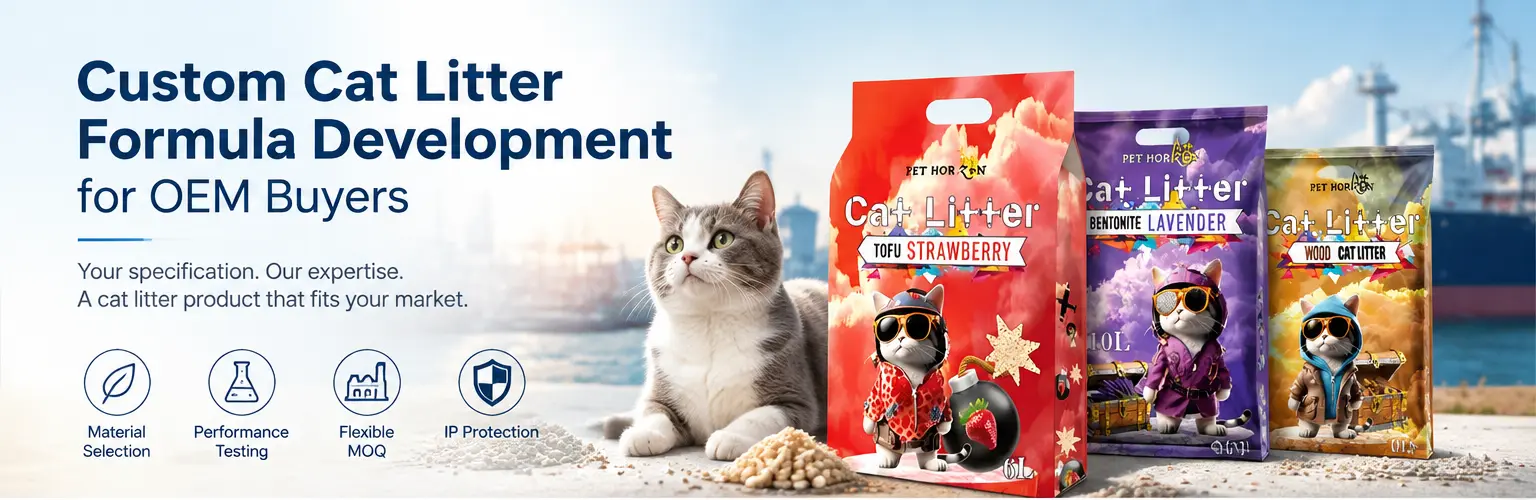
For buyers considering China, Pet Horizon offers an example of what to verify at the factory level. Based in Dalian, near Dalian Port, the company manufactures tofu, bentonite, pine, and mixed cat litter and supports OEM and private-label programs for international buyers. Rather than selecting a supplier on location alone, buyers can assess product specifications, sample performance, packaging requirements, production controls, and export arrangements before committing to a program. This is particularly relevant when comparing suppliers across different origins, where quoted prices may not include the same product specifications or delivery conditions.
Explore our cat litter manufacturing overview to learn more about our manufacturing capabilities and production process.
Decision Framework — Which Geography Fits Your Buyer Profile
Use the following framework to narrow your shortlist by buyer requirements. The suggested origins are starting points for evaluation, not fixed recommendations; actual factory capability, verified tariff treatment, and landed cost should determine the final choice.
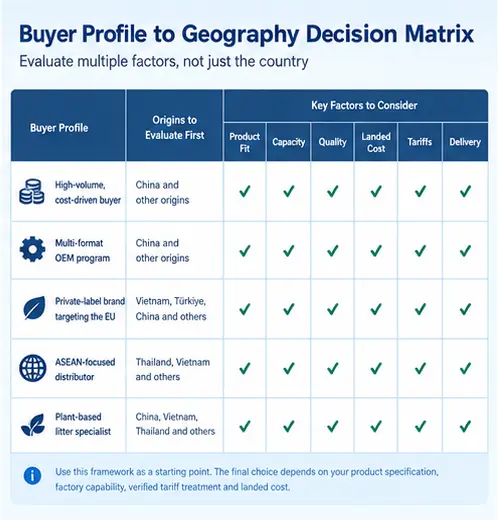
| Buyer profile | Origins to evaluate first | What determines the final choice |
|---|---|---|
| High-volume, cost-driven buyer | China and other origins with verified capacity | Comparable landed cost, sustained output, quality consistency, and supply redundancy |
| Multi-format OEM program | Manufacturers in China and other qualified production bases | Ability to meet all required specifications, packaging needs, and production schedules |
| Private-label brand targeting the EU | Vietnam, Türkiye, China, and other eligible origins | Product-specific duties, origin rules, freight costs, lead times, and factory capability |
| ASEAN-focused distributor | Qualified suppliers within or serving the target ASEAN market | Applicable tariff treatment, local demand, shipping frequency, and delivery cost |
| Plant-based litter specialist | Qualified manufacturers in China, Vietnam, Thailand, and other relevant origins | Actual feedstock, production-line capability, moisture control, dust, clumping, and export record |
Use these origins as a shortlist for investigation, not a ranking. Confirm each manufacturer’s capabilities and compare quotations using the same product specification, destination, and shipment assumptions.
Use the framework to build a shortlist, then compare actual manufacturers rather than relying on country-level assumptions. For an OEM program spanning bentonite and plant-based formats, start by checking whether a supplier can meet the full product range and quality specification. For an EU-focused launch, calculate the potential value of preferential tariffs against freight, lead time, and origin-compliance costs. For regional ASEAN distribution, compare factory location, shipping frequency, and the applicable RCEP rules. Our cat litter sourcing buying guide explains how to progress from supplier screening to factory audits and sample approval.
Conclusion
The best cat litter manufacturing country depends on the product, destination market, order volume, and supplier’s proven capabilities. China is a strong starting point for buyers seeking a broad product range and established OEM export supply chains. Vietnam may be attractive for qualifying EU-bound products, Thailand merits evaluation for specific plant-based formats, and Türkiye may suit buyers prioritizing proximity to European markets. Before committing, compare landed cost, verify the applicable tariff treatment, test production samples, and qualify a backup supplier. For Pet Horizon buyers, the practical next step is to define the target litter specification and volume, then assess suitable manufacturing capabilities against those requirements.
Frequently Asked Questions
There is no universally cheapest country for cat litter manufacturing. China may be competitive for large-volume programs and multi-format OEM sourcing, while another origin may offer advantages for a particular product or destination. Compare ex-works price, packaging, inland transport, ocean freight, import duties, testing, and inventory costs using the same product specification and shipment assumptions.
China, Vietnam, and Thailand can all be considered when evaluating plant-based cat litter, but country alone does not establish manufacturing capability. Ask each shortlisted factory which feedstocks it uses, whether it operates its own extrusion and drying lines, what sustained output it can demonstrate, and whether it can meet your requirements for moisture, dust, clumping, packaging, and export consistency.
No. RCEP covers trade among its Asia-Pacific parties — China, Japan, South Korea, Australia, New Zealand, and ASEAN — not the US or EU. For those destinations, MFN duties apply unless a separate agreement such as EVFTA for Vietnam or the EU–Türkiye Customs Union governs the specific origin and product.
EVFTA, in force since 1 August 2020, provides preferential tariff treatment under product-specific schedules and origin rules. The real question is whether the finished litter falls under a tariff line that receives a preference and meets the applicable origin requirements. Obtain the proposed HS classification, verify the current EU tariff schedule, and confirm the required proof of origin before counting any saving in a landed-cost model. A preference is a verified scenario, not an assumed benefit.
Turkey’s edge is geography and trade terms: shorter transit to the EU and potential customs-union duty relief for qualifying goods. For EU-focused brands with tight windows or duty-sensitive margins, that can outweigh Southeast Asia’s larger scale — but only after confirming the product’s customs classification and eligibility with the correct documentation.
The manufacturer owns the technical specification and production quality; the importer or brand owner owns compliance with destination-market labeling, packaging, and green-claims rules. This split holds regardless of sourcing country, so build compliance verification into your import process rather than assuming the factory handles it.
For any high-volume SKU, qualifying at least two origins is sound risk management; regional disruptions, port congestion, or feedstock swings at one origin will not then stop your supply.
The relevant checks depend on your buyer requirements and destination market. Review ISO 9001 documentation if a certified quality-management system is part of your supplier criteria, assess social-compliance audits where required, and verify the scope and results of any third-party product testing. Request test reports for the actual SKU and production batch where appropriate. For cat litter, performance testing should cover the properties relevant to the product format, such as moisture, dust, clumping, granule consistency, and packaging integrity. No single management certificate or audit replaces product-specific acceptance testing.