

A cat litter distributor program should be evaluated on more than the quoted wholesale price. For importers and regional distributors, the real commercial value depends on how pricing tiers, minimum order quantities (MOQ), territory rights, payment terms, and repeat-order conditions work together. A lower unit price may offer little advantage if it requires excess inventory, while an exclusive territory may not justify the commitment if the sales targets are unrealistic.
These decisions also depend on the cat litter format you plan to distribute. Bentonite, tofu, and pine cat litter differ in bag weight, packaging options, container loading, and replenishment requirements. This guide explains how to compare distributor offers on a consistent basis, what to confirm with a cat litter manufacturer, and which contract terms deserve attention before you commit to a market or product range.
To evaluate a cat litter distributor program, compare the effective cost per sellable bag, realistic volume-tier benefits, territory and exclusivity conditions, MOQ, lead time, payment terms, and exit clauses. Ask the manufacturer to confirm product specifications, packaging, production arrangements, and quality requirements in writing. Choose a program that fits your expected sales and replenishment cycle, not simply the offer with the largest discount.
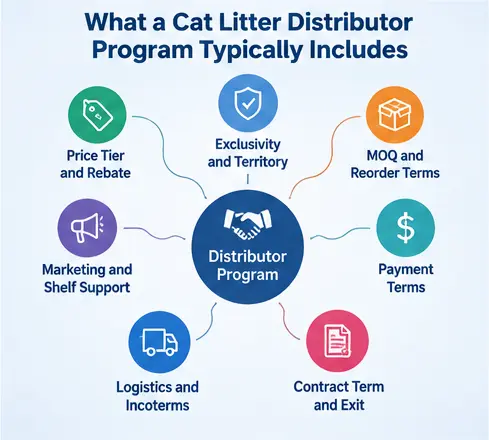
What a Cat Litter Distributor Program Typically Includes
A cat litter distributor program defines the commercial terms under which a distributor purchases products for resale in an agreed market. It may cover pricing tiers, volume commitments, territory rights, logistics, marketing support, and contract conditions. Compare these terms individually, then assess how they work together across the first order and subsequent replenishment cycles.
| Component | What it defines | Why it matters to a distributor |
|---|---|---|
| Price tier and rebate | Base price by volume band and any volume-based rebate paid after targets are met | Drives effective margin across the contract period, not just the first order |
| Exclusivity and territory | Whether you are the only distributor in a country, channel, or customer segment | Affects your protection against intra-brand competition |
| MOQ and reorder terms | Minimum order quantity per shipment and expected replenishment frequency | Determines working capital and warehouse commitment |
| Payment terms | Deposit, balance payment, payment milestones, and any agreed credit terms | Affects cash flow and upfront financial exposure |
| Marketing and shelf support | Co-funded promotions, display materials, or listing support | Influences sell-through and speed to revenue |
| Logistics and Incoterms | Who arranges freight, insurance, and import clearance | Allocates risk and cost between supplier and distributor |
| Contract term and exit | Duration, renewal, and conditions to terminate or step down | Protects you if volume or market assumptions change |
How Distributor Margin Tiers Work
Margin in a distributor program is rarely a single percentage. It is usually the result of a base price, a volume tier, possible rebates, and the costs you still carry after the goods land. Comparing the headline discount between two suppliers can be misleading if one quote excludes freight or bundles a rebate you can only earn at a much higher volume.
Most cat litter programs use volume-based tiers: the unit price improves as your committed or actual annual volume rises. Some suppliers also pay a retroactive rebate once you cross a threshold. The practical question is not “what is the discount?” but “what is my effective net margin after every adjustment?”
| Factor | Effect on effective margin | What to confirm |
|---|---|---|
| Base unit price | Starting point for all margin math | Quoted per defined bag weight, formula, and Incoterm |
| Tier rebate | Improves margin only after the volume threshold is met | Threshold value, timing of payment, and whether it is retroactive |
| Freight and delivery terms | CIF generally includes seller-arranged freight and insurance to the named destination port; DDP allocates broader delivery and import obligations to the seller. EXW and FOB allocate different responsibilities to the buyer. | Confirm the named place or port, included charges, risk-transfer point, and any costs excluded from the quotation. |
| Payment timing | Earlier deposit or faster balance can improve cash efficiency | Whether terms change at higher tiers |
| Defect and replacement cost | Returns, rework, or unsellable goods reduce real margin | Who bears cost and how nonconformity is handled |
Key takeaway: Model your margin per sellable bag on a landed-cost basis, including the freight and duties you absorb, then apply the tier rebate only if your forecasted volume realistically reaches the threshold. A larger printed discount with unfavorable freight or strict rebate conditions may yield a lower effective margin than a smaller discount on better terms.
How to Compare Two Manufacturer Quotations
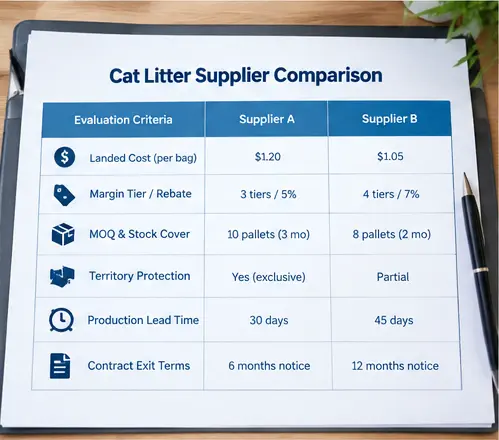
Use the same product specification, bag weight, order volume, and delivery basis when comparing quotations from different cat litter manufacturers. For each offer, calculate the landed cost per sellable bag before estimating your resale margin.
Landed cost per sellable bag = (product cost + freight + insurance + import duties and taxes that are not recoverable + applicable handling costs + incremental quality-related costs not already reflected in the sellable-bag count) ÷ expected number of sellable bags.
Gross margin = (net selling price per bag − landed cost per sellable bag) ÷ net selling price per bag × 100%.
Apply volume rebates only when the relevant threshold and payment conditions are achievable. Keep recoverable taxes, internal operating expenses, and other costs separate where appropriate to your accounting method. This makes it easier to compare offers without treating every cost as part of the same margin calculation.
For a like-for-like comparison, use a consistent tax and accounting basis for both offers. Exclude sales taxes collected on behalf of tax authorities from net selling revenue, and include import taxes in landed cost only to the extent that they are non-recoverable under the applicable rules. Apply the same treatment to both quotations.
Before accepting a higher-volume price tier, compare the additional margin benefit with the extra inventory, storage, and working capital it requires. A lower unit price is only commercially attractive when the expected sales volume and cash flow can support the larger order.
Exclusivity and Territory Rights
Exclusivity can protect a distributor’s investment in local marketing, retailer relationships, and product development, but the label alone provides little protection. The agreement should identify the territory, sales channels, covered products, permitted direct sales, and any restrictions on the manufacturer’s appointment of other distributors. It should also explain how online sales, key accounts, and cross-border orders are treated.
Pay particular attention to the relationship between exclusivity and minimum purchase commitments. A supplier may require annual volume targets, new-account development, or agreed listing milestones in exchange for territory protection. Before accepting these obligations, estimate the sales volume needed to meet them and confirm whether the targets are measured by purchase orders, shipped volume, or paid invoices.
For a new market, consider negotiating an initial non-exclusive period or a limited trial period before committing to full exclusivity. The agreement can define a review date, realistic performance milestones, a cure period for shortfalls, and the conditions for reducing or ending exclusivity. Also confirm how pending orders, existing customers, and remaining branded inventory will be handled if the relationship ends.
Exclusivity is worthwhile only when the commercial protection is proportionate to the commitment. Have the final agreement reviewed for enforceability and local competition-law requirements, especially where territorial restrictions or resale arrangements are involved.
MOQ, Reorder Frequency, and Lead Time
Minimum order quantity affects how much working capital a distributor must commit before sales begin. Depending on the manufacturer and product, MOQ may be defined by SKU, bag count, production batch, pallet, total weight, or container shipment. Confirm the unit of measurement rather than assuming that a quoted MOQ applies to every product in the range.
Bentonite, tofu, and pine cat litter can differ in bag weight, packaging dimensions, bulk density, and container-loading requirements. For private-label programs, printed packaging, artwork approval, and SKU-specific production arrangements may also affect the minimum order and production schedule. Two offers with the same MOQ in tonnes can therefore result in different numbers of sellable bags, warehouse requirements, and inventory turnover.
- Request the MOQ for each product format, bag weight, and packaging configuration.
- Confirm whether different SKUs can be combined in one shipment and whether each SKU has a separate production minimum.
- Ask when the production lead time begins: deposit receipt, specification approval, artwork approval, or another agreed milestone.
- Estimate monthly sales, stock coverage, warehouse capacity, and the reorder point before accepting a larger volume tier.
- Confirm whether first-order pricing, repeat-order pricing, and volume rebates follow the same conditions.
A lower unit price at a higher MOQ is not automatically the better deal. Compare the expected margin improvement with the extra stock, storage, financing cost, and risk of slow-moving SKUs. For a new territory, a manageable initial order with a clearly defined replenishment plan may be commercially safer than committing too early to a large annual volume.
Payment Terms and Incoterms in Distribution Agreements
Payment structure affects both cash flow and true cost. A lower deposit reduces your upfront exposure but may come with a higher balance or less favorable freight terms. The Incoterms rule in the quotation determines who arranges and pays for international transport, insurance, and import clearance — and therefore who carries the risk during transit.
Under Incoterms 2020, FOB and CIF are sea and inland-waterway rules. Under both terms, delivery and risk transfer occur when the goods are on board the vessel at the port of shipment, although the seller arranges and pays for ocean freight and insurance under CIF. DDP generally places the broadest delivery obligations on the seller, including import clearance and applicable import formalities, subject to the parties’ ability to comply with local law. Payment milestones are separate contractual terms and should be documented independently. Before comparing offers, confirm the named port or place, the applicable Incoterms rule, and the costs excluded from each quotation.
For a full breakdown of how payment milestones and delivery terms change your landed cost, review our cat litter payment terms and Incoterms guide before finalizing the commercial schedule.
Evaluating a Cat Litter Distributor Partnership
A useful evaluation separates verifiable evidence from marketing language. Apply the same criteria to every program you consider, and record what is confirmed, what is assumed, and what must be written into the distribution agreement.
| Evaluation criterion | Evidence to request | What to verify |
|---|---|---|
| Manufacturer backing | Legal entity, business license, and the actual production site | Whether the contracting party and the factory are clearly identified |
| Product range and consistency | Approved samples and batch records across formats | Whether quality is stable across reorder volumes |
| Commercial terms | Written price tiers, MOQ, payment, and Incoterms | Whether the offer is comparable to others on a landed-cost basis |
| Exclusivity and support | Territory scope and any marketing or training support | Whether the protection matches your market investment |
| Contract flexibility | Renewal, step-down, and termination clauses | Whether you can adjust if volume assumptions change |
| Compliance documents | SDS, certificates, and destination-specific records | Whether imports and labeling can be supported |
Before choosing a program, classify each item as confirmed, pending, or unacceptable. Give particular attention to product specifications, landed cost, realistic volume commitments, territory protection, and documented production lead times. An attractive offer should not compensate for an unresolved critical issue, such as unclear product specifications or an unworkable delivery commitment.
Do not judge a cat litter manufacturer by stated capacity or certificate count alone. Verify the actual production site, the specifications of the products you intend to buy, applicable quality-control records, and the production schedule available for your order. Pet Horizon operates an 18,000 m² facility in Dalian, China, with a stated annual production capacity of 150,000 tonnes. For prospective distributors, these figures provide useful background, but the more important questions are whether the required cat litter formats can be supplied to specification, whether quality checks are documented, and whether production slots can support the agreed delivery schedule. Request written confirmation of the products, volumes, and lead times covered by your proposed program before making a market commitment.
Red Flags in a Cat Litter Distributor Program
Some supplier offers look attractive on paper, but the advertised margin may hide risks in pricing, territory rights, minimum order requirements, or contract terms. Watch for these during evaluation.
| Red flag | What it usually means |
|---|---|
| Margin quoted without volume proof | The number may depend on a tier you cannot realistically reach |
| Undefined or shared territory | You may face parallel imports or direct manufacturer competition |
| Hidden MOQ penalties | Small shortfalls could trigger price step-downs or fees |
| No clear written distribution agreement | Commercial terms, territory rights, performance obligations, and exit conditions may be harder to verify or enforce in a dispute. |
| Unverifiable manufacturing relationship | You may not know who controls production or quality |
| Pressure to commit before specification confirmation | Risk of locking into undefined product or terms |
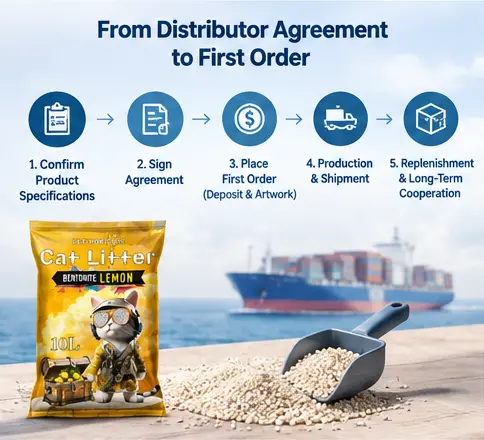
From Distributor Agreement to First Order
Once you have compared programs on equivalent terms, the next step is to move from agreement to a manageable first order. Confirm the product specification, price tier, MOQ, payment milestones, and Incoterms in writing, then align the production and shipping schedule with your warehouse and sales plan.
Review our cat litter distributor program for current partnership terms, and evaluate the product formats you intend to carry — for example, bentonite cat litter — against the same specification and landed-cost method used in this guide.
Conclusion
A cat litter distributor program should be evaluated as a commercial system, not a discount. Compare effective margin on a landed-cost basis, confirm exclusivity and territory in writing, size MOQ to your real sell-through, and verify the manufacturing and contract backing behind the offer. The program that protects your margin across repeat orders — not the one with the largest printed discount — is the better long-term partnership.
If you are evaluating a cat litter distribution partnership, start with your target market, preferred product formats, estimated order volume, and packaging requirements. Pet Horizon works with distributors, importers, and private-label buyers sourcing tofu, bentonite, and pine cat litter. Share these requirements with our team to discuss product specifications, MOQ, pricing tiers, production lead times, and a replenishment plan suited to your market.
Frequently Asked Questions
There is no fixed number. A supplier may appoint a single exclusive distributor in a small or developing market, or multiple distributors by channel or region in a large one. The right structure depends on market size, the supplier’s support capacity, and whether exclusivity is tied to volume commitments. As a distributor, confirm whether you are exclusive and exactly which territory or channel that covers.
There is no universal margin for cat litter distributors because resale prices, freight, import costs, channel fees, and local competition vary by market. Start with your expected selling price and calculate the landed cost per sellable bag, then subtract channel-specific costs to estimate the margin available to cover overhead and profit. Ask the manufacturer for written volume-tier prices and rebate conditions, and test the calculation at both your expected sales volume and a slower-sales scenario. This shows whether the proposed program remains viable if you do not reach the highest pricing tier.
Exclusivity can protect the local marketing and customer development you invest in, but it usually carries volume or listing obligations and reduces your flexibility. Sign it only when the territory is clearly defined, the performance conditions are realistic, and the exit or step-down terms are acceptable. If the market is uncertain, a non-exclusive or limited-exclusivity agreement may be safer.
Cat litter MOQ depends on the manufacturer, product format, bag weight, packaging configuration, and whether production or shipment requirements set the minimum. It may be defined by SKU, bag count, batch, pallet, total weight, or container shipment. For bentonite, tofu, and pine cat litter, ask for the MOQ per specific format and packaging option, whether different SKUs can be combined, and how many sellable bags the order will contain. Check the resulting stock coverage and warehouse requirements against your sales forecast before committing.
Incoterms define delivery responsibilities, cost allocation, and risk transfer, but they do not independently determine payment milestones. Under FOB and CIF, risk generally transfers when the goods are on board the vessel at the port of shipment; under CIF, the seller also arranges and pays for carriage and insurance to the named destination port. DDP generally places broader delivery and import-clearance obligations on the seller, subject to local legal requirements. Compare the named place or port, included charges, excluded costs, and payment terms before evaluating the final landed cost.
Yes, especially at the start of a partnership. Suppliers may adjust tier thresholds, first-order pricing, or onboarding rebates in exchange for a committed launch volume, a deposit, or a phased rollout plan. Negotiate the thresholds that matter to your forecast rather than asking for a uniformly lower price, and get any concession in writing.
Request the contracting entity’s business license, evidence of the actual production site, applicable product certifications, batch-specific Certificates of Analysis where relevant, Safety Data Sheets, and reference shipments or existing distributor references in comparable markets. These documents support import clearance, retailer onboarding, and your own verification of who controls production and quality.
Onboarding typically moves through sample confirmation, agreement signing, deposit and artwork approval, first production, pre-shipment checks, and shipment — but the calendar depends on product format, customization, and production slots. A standard format with confirmed specs can move faster than a customized private-label launch. Confirm each stage’s trigger and expected duration before committing a market launch date.