

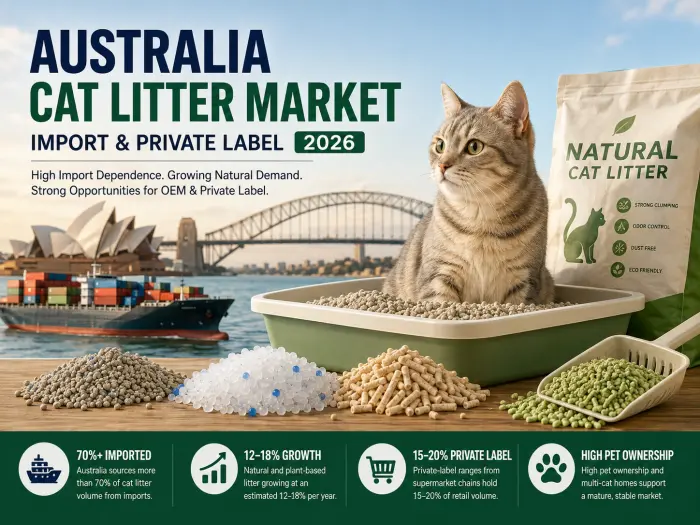
Australia is one of the world’s highest pet-ownership markets by household, and its cat litter category is unusually open to imports. For importers, brand owners, and private-label buyers, the combination of high per-cat spend, rising plant-based demand, and a retail base that already runs large store brands makes the market a practical target for an Asian OEM or ODM partner.
Quick Answer: Is the Australia Cat Litter Market Worth Entering?
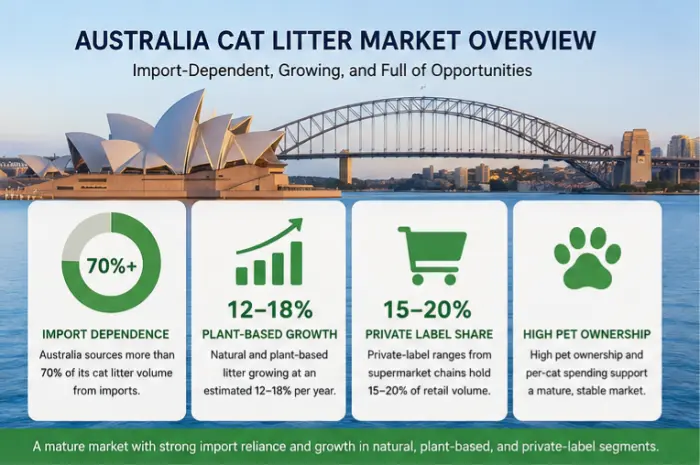
Yes. Australia’s cat litter market is estimated to source more than 70% of its volume from imports, with natural and biodegradable formats growing at roughly 12–18% per year — two to three times the pace of conventional clay. Private-label ranges from the national supermarket chains already hold an estimated 15–20% of retail volume. For a manufacturer, that means a steady, import-dependent, and still contestable opportunity in both bentonite and plant-based segments.
Australia Cat Litter Market Size and Structure
Published estimates frame the category as a mature, high-value market where import supply is the norm rather than the exception. The most useful planning figures come from market research house IndexBox, which sizes the broader cat litter and accessories category around a multi-hundred-million-dollar annual base with stable long-term demand.
- Import dependence. More than 70% of clay litter volume is tied to overseas supply, historically from major bentonite-producing regions and processors in North America and Asia.
- Natural and biodegradable share. Plant-based and biodegradable formats represent an estimated 25–30% of retail value and are expanding at 12–18% per year.
- Multi-cat households. Households keeping more than one cat are estimated at 40–45% of cat-owning homes, raising per-home consumption.
Treat single-source market figures as planning ranges rather than precise totals: methodology differs between research houses, but all agree on the direction — a high-value, import-reliant category with above-average growth in natural formats.
What Is Driving Demand in the Australian Cat Litter Market?
Several structural drivers support multi-year demand:
- High pet penetration. Australia ranks among the highest globally for pet ownership by household, supporting a large and resilient base of recurring purchases.
- Apartment and dense-city living. Urban housing raises the value of odor control, low tracking, and easy scooping — all clumping-litter benefits.
- Premiumization and product differentiation. Retailers increasingly offer premium options differentiated by low dust, odor control, clumping performance, scent, and plant-based materials.
- Multi-cat homes. With 40–45% of cat homes keeping several cats, per-household volume is structurally higher than in single-cat markets.
Product Mix: What Australian Buyers Purchase
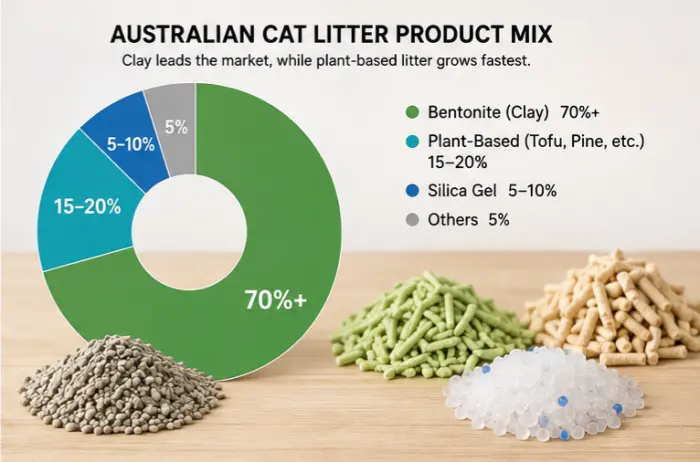
The category is still clay-led, but the edges are moving toward plant-based:
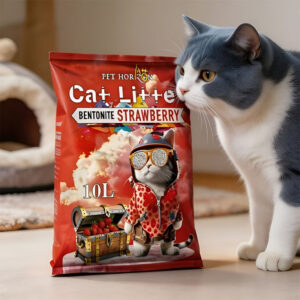
- Bentonite clumping litter remains the volume backbone, favored for strong clumping and acceptable price.
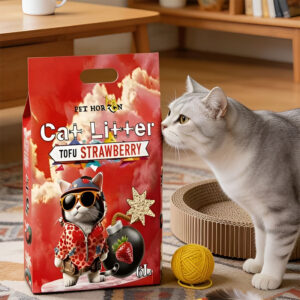
- Plant-based clumping litters (tofu, pine, and blended formats) are the fastest-growing segment at an estimated 12–18% annual growth, driven by eco-conscious and multi-cat buyers.
- Silica and crystal litters hold a smaller share but appeal on low-dust, long-lasting performance.
- Blended products (bentonite with odor additives or plant-based mixes) are the main innovation space within the clay segment.
Private Label and Retail Dynamics
Australia’s national supermarket chains operate large private-label ranges across pet care, and private-label cat litter is estimated at 15–20% of retail volume and still expanding. This reflects both price sensitivity and the commodity-like nature of the core product. For an OEM or ODM manufacturer, that is a direct opening: retailers and e-commerce brands need reliable, cost-competitive supply — exactly what an experienced plant-based and bentonite producer can provide.
At the same time, the Australian Competition and Consumer Commission (ACCC) has been tightening scrutiny of “biodegradable” and “compostable” environmental claims. Brands and their suppliers must be able to substantiate green claims with formulation and testing evidence rather than marketing language alone.
Where Are the Best Opportunities in the Australian Cat Litter Market?
- Bentonite private label. A core volume opportunity for retailers and distributors competing on clumping performance and price.
- Plant-based private label. Tofu, pine, and blended formats offer differentiation around material choice and sustainability positioning.
- Multi-cat products. Larger pack sizes, strong clumping, and odor-control positioning can address higher household consumption.
- OEM customization. Retailers and e-commerce brands can differentiate through formulation, particle profile, packaging, and pack size rather than competing only on brand.
Import Dynamics and Sourcing From Asia
Australia produces little cat litter domestically, so finished product and bulk raw material move by sea. For Asian manufacturers, the logistics are workable:
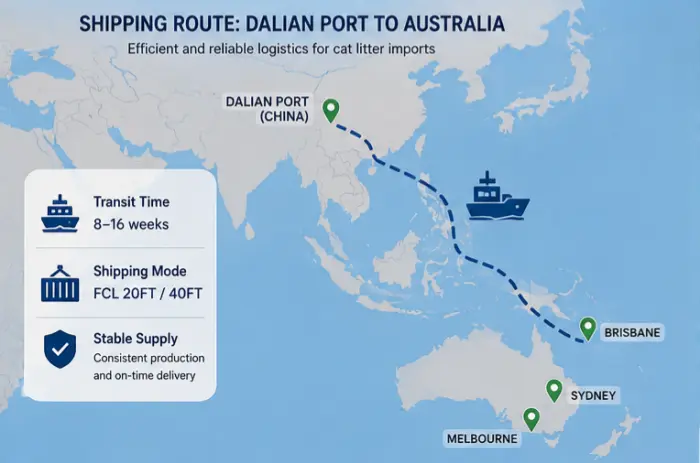
- Route. A mill in Dalian (northern China) ships through Dalian Port to Australian gateways such as Sydney, Melbourne, Brisbane, and Fremantle — a mature container lane.
- MOQ. Typical OEM orders move in 1×20ft container loads, negotiable, which keeps entry volume manageable for a first private-label program.
- Cost levers. Bulk containers and bag formats compress per-kilogram logistics across Australia’s long, fragmented distribution geography.
- Freight exposure. Ocean freight can represent 20–30% of landed cost with 8–16 week lead times, so forward booking and multi-source planning hedge clay-supply disruption.
Where Pet Horizon Fits as an OEM/ODM Partner
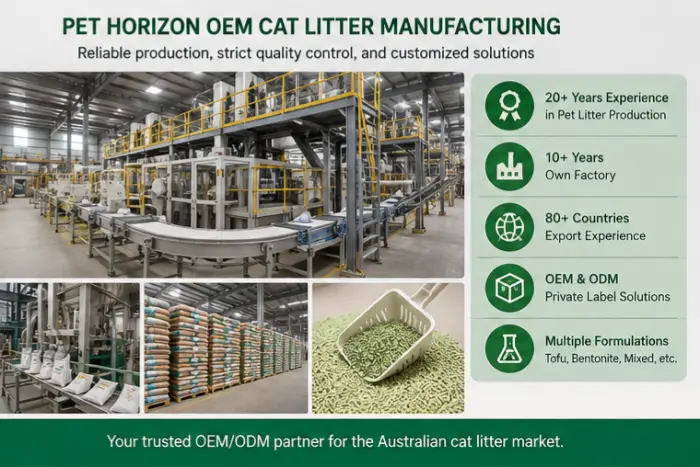
Pet Horizon is a cat litter manufacturer and OEM/ODM supplier based in Dalian, China, within reach of Dalian Port — a practical advantage for Australian importers. Our credentials:
- 20+ years in the cat litter industry, with 10+ years operating our own OEM/ODM factory.
- Export experience across 80+ country markets.
- Real production across tofu (plant-based), bentonite, pine, and mixed litter formats — covering the exact segments growing in Australia.
- OEM programs built around private label, custom clumping profiles, low-dust formulas, and flexible MOQs.
For an Australian brand or retailer evaluating a supplier, the combination of a plant-based and bentonite production base plus a Dalian Port shipping position shortens lead times and lowers landed cost versus distant-source supply. Substantiated environmental claims are supported by formulation documentation, helping brands stay ahead of ACCC green-claim expectations.
Conclusion
Australia is a mature, import-reliant cat litter market with a clay-led product mix, growing interest in plant-based formats, and an established private-label channel. For Australian importers and brand owners, the most relevant opportunities are consistent bentonite supply, differentiated plant-based products, and private-label programs supported by reliable production and export logistics.
Supplier selection should be based on total landed cost, product consistency, MOQ, packaging capability, lead time, and documentation rather than factory price alone. For buyers considering Chinese supply, Pet Horizon’s Dalian production and export position provides an option for evaluating both tofu and bentonite programs. Explore our tofu cat litter page or bentonite cat litter page for product details.
Frequently Asked Questions
Australia sources an estimated 70%+ of its cat litter volume from imports, because domestic production is limited. That makes the market structurally reliant on overseas manufacturers and a practical target for Asian OEM and ODM supply.
Natural and plant-based clumping litters are growing at an estimated 12–18% per year — two to three times the pace of conventional clay — while bentonite clumping remains the volume leader.
Yes. National supermarket private-label ranges already account for an estimated 15–20% of retail cat litter volume and are still expanding, creating direct opportunities for OEM and ODM partners.
Yes. Australia is highly import-reliant, and a Dalian-based supplier can ship via Dalian Port to Sydney, Melbourne, Brisbane, or Fremantle on an established container lane.
For Pet Horizon OEM programs, orders can be structured around 1×20ft container loads, negotiable, depending on the litter type, packaging configuration, and order mix. MOQ should therefore be confirmed against the specific product and private-label program rather than treated as a universal industry standard.
The ACCC has been increasing scrutiny of “biodegradable” and “compostable” environmental claims. Brands and suppliers should be able to substantiate green claims with formulation and testing evidence rather than marketing language.
For multi-cat households, buyers commonly prioritize strong clumping, odor control, low dust, and efficient scooping because these features can reduce maintenance frequency and help manage higher litter consumption. Both bentonite and plant-based clumping formats can be positioned around these requirements.
Australian buyers should evaluate at least six areas: product consistency, clumping and dust performance, odor-control requirements, packaging and private-label capability, MOQ and production capacity, and total landed cost. They should also request relevant product documentation and confirm that any environmental claims can be substantiated. See our cat litter export compliance guide for documentation basics.
Source note: Market figures in this article are based primarily on IndexBox’s Australia Cat Litter & Accessories Market analysis and are presented as planning ranges. Estimates can vary depending on market definition, product coverage, and methodology; they should not be interpreted as official Australian government statistics.