

Cat litter pre-shipment inspection (PSI) is the final quality check performed on a finished production lot before shipment. For importers, distributors, and private-label buyers, it verifies that the goods, packaging, quantities, and documented test results meet the approved sample, written specification, and purchase order. Depending on the agreed inspection plan, checks may use representative sampling, targeted measurements, or 100% inspection of selected characteristics.
Quick Answer: Pre-shipment inspection of cat litter checks a finished lot against agreed quality and packing requirements before shipment. Typical checks include granule appearance, moisture, fines, clumping performance where applicable, net weight, labels, packaging condition, and order quantity. It helps identify discrepancies before loading, but sampling does not guarantee that every bag or every unit is defect-free.
In this guide, pre-shipment inspection means verifying finished, packed goods against agreed requirements before shipment. Pre-order sample testing evaluates a product before a production order is placed; PSI evaluates the actual production lot. Third-party inspection refers to an independent inspection service commissioned under the buyer’s or seller’s agreed arrangements.
What Pre-Shipment Inspection Is — and Is Not
Buyers sometimes conflate separate control points and then wonder why a “tested” product still arrives wrong. Three distinct steps are easy to mix up: pre-order sample testing, pre-shipment inspection of the finished lot, and container loading inspection. Each answers a different question.
Pre-Order Sample Testing vs. Pre-Shipment Inspection
Pre-order sample testing is the gate you run before you commit: you run your protocol on a trial batch and decide whether the supplier is worth a production order. It is a go or no-go decision on the relationship. Our method is documented in the cat litter sample testing protocol, the right tool for supplier selection.
Pre-shipment inspection runs after the order is built. It does not ask “should I trust this factory?” It asks “does this specific lot match the approved sample and the written spec?” A supplier can pass sample testing on one batch and still ship a drifting lot later as raw-material batches and line calibration change. Pre-shipment inspection is the lot-level check that targets that gap.
Why Lot-Level Inspection Matters for Cat Litter
Cat litter inspection should reflect the material and the agreed product specification. Bentonite, tofu, pine, and blended litters can differ in granule integrity, particle-size distribution, fines, moisture requirements, and clumping or absorption performance. Variations in raw materials, processing conditions, screening, or handling may affect the finished lot. For importers and private-label buyers, comparing the actual production lot with the approved sample and written specification helps identify discrepancies before shipment.
The Cat Litter Pre-Shipment Inspection Checklist
Use the following checklist as a starting point for the inspection instructions attached to your purchase order. Define the sampling method, test conditions, acceptance limits, and required records before production is completed. The approved sample provides a visual and performance reference, but measurable requirements should be written into the specification wherever possible.
Before sampling, define the inspection lot, identify how units will be selected across the available production and packing run, and record any areas that cannot be accessed. Avoid selecting only convenient or visibly undamaged units. Use the agreed sampling plan to determine sample size and acceptance criteria, and document any limitations that could affect representativeness.
| Inspection item | Method | Acceptance basis | Record or responsibility |
|---|---|---|---|
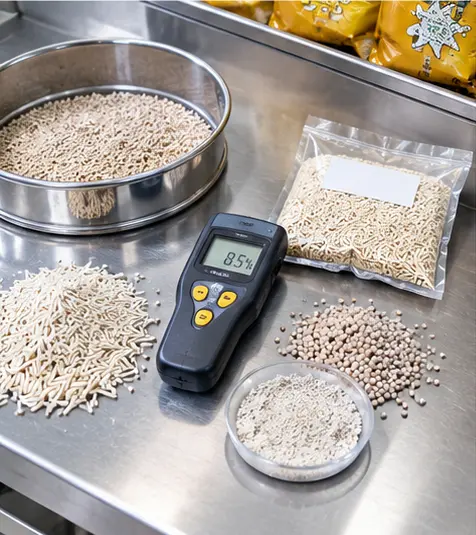
| Appearance and granule size | Visual comparison and sieve analysis where specified | Approved sample and agreed particle-size distribution | Record sample locations and test results |
| Moisture content | Agreed meter or laboratory method under defined test conditions | Material-specific specification and agreed test method | Record method, readings, and sampling locations |
| Fines and dust-related indicators | Agreed sieve or other defined test method | Specified fines limit or approved baseline | Record method and measured result; do not treat visual dust alone as a quantitative result |
| Clumping and absorption | Standardized test where applicable, with controlled water quantity and test timing | Agreed performance criteria for the product type | Record conditions and results; omit if not relevant to the product |
| Net weight | Calibrated scale checks using the agreed sampling plan | Declared net weight and applicable contractual or legal tolerances | Record individual readings and any nonconformities |
| Packaging and labels | Visual inspection, artwork comparison, and barcode verification where required | Approved artwork, purchase order, and agreed market requirements | Check print quality, seal integrity, required information, and coding |
| Odor, color, and additives | Comparison with the approved product reference; verify formulation records where required | Agreed product description, color, fragrance, and additive requirements | Document deviations; sensory checks alone cannot establish additive composition |
| Wood packaging (where applicable) | Check for ISPM 15 mark on pallets/crates used in international shipping, where applicable | Applicable ISPM 15 requirements for regulated wood packaging | Record mark presence; not applicable to the cat litter itself or standard poly bags |
| Quantity and packing list | Count or weigh against the approved packing list and purchase order | Ordered quantity, carton/pallet configuration, and packing list | Reconcile and document discrepancies |
Understanding AQL for Cat Litter Pre-Shipment Inspection
AQL stands for Acceptance Quality Limit. It is used in acceptance-sampling systems to select sample sizes and define lot acceptance or rejection criteria. For packaged cat litter, buyers may reference ISO 2859-1 or ANSI/ASQ Z1.4 when establishing an attribute-inspection plan for issues such as damaged bags, incorrect labels, or other countable nonconformities.
An AQL value is not a guarantee that the accepted lot contains no defects, nor is it a simple percentage of defects that a buyer can automatically accept. The applicable sampling plan, inspection level, lot size, defect classification, and acceptance and rejection numbers must be established using the selected standard and agreed in the purchase order or inspection instructions.
For cat litter, use attribute sampling for countable packaging and labeling defects, and define separate measurable limits and test methods for properties such as moisture, particle-size distribution, fines, and clumping performance. These product characteristics should be assessed using methods appropriate to the material and the agreed specification rather than relying on a defect-count AQL alone. Sampling against an AQL reduces inspection effort but does not by itself confirm that every bag in the lot is defect-free.
In-House QC vs. Third-Party Inspector
A recurring decision is whether to rely on the factory’s own quality team or commission an independent inspector. The right choice depends on the supplier relationship, order value, and how costly a defect would be in your market.
When to Use the Factory’s Own QC
For established suppliers with a strong track record and mature quality system, the factory’s documented QC plus your batch records may be sufficient. This is typically faster and cheaper, and works when you have already audited the line. A structured cat litter factory audit checklist is the prerequisite that makes factory-led QC more trustworthy.
When to Hire a Third-Party Inspector
For new suppliers, high-value orders, or shipments where defects would be costly, an independent inspector can provide an additional layer of verification. Inspection bodies such as SGS and Bureau Veritas may offer relevant services, subject to their local availability and agreed scope. Before booking, provide the approved sample, written specification, sampling plan, defect classifications, and acceptance criteria. Compare the inspection fee and scheduling requirements with the potential cost of rework, shipment delays, or rejected goods. The value of independent inspection depends on the order, the risks being controlled, and the scope of the service. The resulting report documents the checks performed and the findings observed; it does not guarantee that every unit in the lot is defect-free.
Container Loading Inspection: A Separate Shipment Control
Passing pre-shipment inspection does not by itself confirm that the correct goods will be loaded or that they will be protected properly in transit. For orders where loading verification is required, arrange a separate container loading inspection or loading-supervision service.
The inspector should verify the container’s visible condition, cleanliness, dryness, and suitability for the cargo; reconcile the goods and quantities loaded against the approved packing list; observe stacking and handling; and record the container number and seal number. Any damaged packages, quantity discrepancies, or unsuitable container conditions should be documented and resolved before the container is sealed. Agree in advance whether this service is included in the PSI booking or commissioned separately. It is a distinct control point from the lot inspection described above.

Documents Issued at Shipment
A pre-shipment inspection is only as useful as its paper trail. Before releasing payment or booking freight, buyers may expect:
- Inspection report — what was checked, the method, the result, and the pass or fail decision against your spec.
- Photographic evidence — timestamped images of the lot, any nonconformities found, and the loading seal where applicable.
- Certificate of Analysis (COA) — supplier data on measured properties such as moisture, where applicable per the agreed spec.
- Batch record — production date, batch or lot number, and quantity, tying the goods to the manufactured run.
- Packing list and seal record — what was loaded and under which container seal.
Keep these together. They are your evidence if a lot is disputed on arrival and your record that the shipped goods matched the agreed specification at the factory gate, subject to the agreed terms.
Common Lot Defects and How Inspection Can Help Catch Them
The table maps lot defects buyers sometimes see in cat litter to the inspection step that may help catch each. The listed responses are options to consider under the contract, not automatic remedies.
| Common lot defect | Why it may drift | How inspection can help catch it | Possible buyer response |
|---|---|---|---|
| Moisture drift | Ambient humidity, storage, or raw-material batch variation | Meter or agreed method reading versus agreed range | Hold the affected lot and agree on investigation, approved rework, retesting, or rejection |
| Fines and dust rise | Handling, sieve shift, or source-material change | Agreed sieve or defined method versus baseline | Assess the affected quantity and agree on corrective action or rejection |
| Clump-hardness variance | Binder level or curing time off spec | Agreed clump test versus approved sample | Verify the result and document any approved corrective action or acceptance deviation |
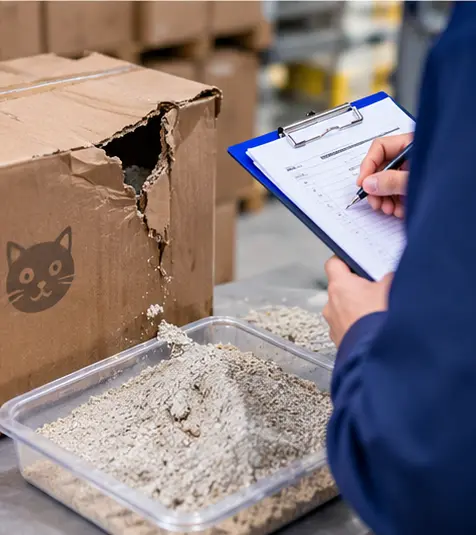
| Packaging damage | Stacking, in-plant transit, or forklift contact | Visual check at line and container | Segregate affected units and arrange approved repair or replacement before loading |
| Short weight | Filler calibration or line speed drift | Scale audit of filled units | Hold affected goods, verify the extent of the issue, and correct it under the purchase agreement and applicable requirements |
Building Your Inspection Plan
A workable plan starts before the container. Define the approved sample and written specification during onboarding, and agree the acceptance basis in the purchase order. Where a Chinese national or industry standard is relevant to the product, identify the applicable standard and confirm its scope and test methods before including it in the inspection plan. The approved product specification and purchase order should define the acceptance criteria, while the importer or brand owner remains responsible for verifying destination-market requirements.
For a mineral product such as bentonite cat litter, define the relevant particle-size, fines, moisture, and clumping checks in the product specification. For plant-based and blended litters, set the inspection criteria according to the material and the approved product reference.
Conclusion
Pre-shipment inspection is the lot-level quality check that confirms your produced cat litter matches the approved sample and the written specification before the container leaves the factory. It is distinct from pre-order sample testing, which selects the supplier; pre-shipment inspection verifies the lot. With a clear checklist, an agreed acceptance-sampling plan such as one based on ISO 2859-1 or ANSI/ASQ Z1.4, the right call on in-house versus third-party inspection, a separate container loading inspection where required, and a complete document set, you can build a more documented and defensible shipment. Sampling reduces risk but does not guarantee every unit is defect-free.
Frequently Asked Questions
The rejection window is a contract term, not a fixed rule. Many buyers set the inspection pass as a condition for the final payment and for freight booking, so a failed lot is typically addressed at the factory before stuffing. Agree the remedy — rework, replacement, or price adjustment — in the purchase order so there is less ambiguity on the day.
Who pays for third-party inspection depends on the purchase agreement and the arrangements made with the inspection provider. Confirm the fee, inspection scope, appointment date, report delivery time, and responsibility for any reinspection before booking. Schedule the inspection early enough to allow for review and corrective action before the shipping cutoff.
AQL plans such as ISO 2859-1 are commonly used for attribute inspection, where sampled units are classified as conforming or nonconforming. Net weight can be checked by weighing sampled bags against the agreed nominal weight and tolerance, with the sampling and decision rules specified in the inspection plan. Moisture, fines, and clumping performance generally need separate test methods and acceptance limits. If a variable-sampling standard is considered, confirm that its statistical assumptions and scope fit the measurement and process.
There is no single moisture threshold that applies to every bentonite cat litter product. Use the range specified for the product and supplier, together with the agreed measurement method and sampling procedure. If a result falls outside that range, hold the affected lot for review and verify the result before deciding whether corrective action is needed. Any implications for clumping performance or shelf life should be assessed against the product specification and relevant test evidence rather than inferred from moisture alone.
For new suppliers or products with limited quality history, inspecting each shipment can provide closer oversight during the initial orders. Once performance is supported by consistent inspection results, traceable batch records, and effective corrective actions, buyers may consider a risk-based inspection frequency. Any reduction should reflect defect history, order value, product changes, and the agreed quality plan rather than supplier familiarity alone.
A COA is supplier-issued and should list the measured properties you agreed to control — commonly moisture, and where relevant, particle-size or fines data, plus batch number and production date. It is a supplier document, not an independent verdict, which is why it pairs with the neutral inspection report rather than replacing it.
Start from the documented spec and the approved sample, not from memory. Share the inspection report and photos, cite the contractual acceptance basis, and propose the remedy already agreed in the order. An independent inspector’s timestamped record may carry more weight than a factory self-report, which is one reason buyers commission one for contentious or high-value lots.
It can verify that the printed label matches the agreed artwork, but the supplier does not “set” destination rules — the importer or brand owner owns compliance with the labeling laws of the market where the product is sold. Build the required marks into the approved artwork and have the inspector confirm the printed result, while you retain responsibility for the underlying regulatory compliance.