



Indonesia is one of Southeast Asia’s most promising cat litter markets, supported by a large urban population, expanding commercial pet care, and growing demand for convenient indoor cat-care products. For importers, brand owners, and private-label buyers, the opportunity is strongest for suppliers that can combine competitive landed costs, consistent product quality, and flexible OEM or local-packing options.
Quick Answer: Is the Indonesia Cat Litter Market Worth Entering?
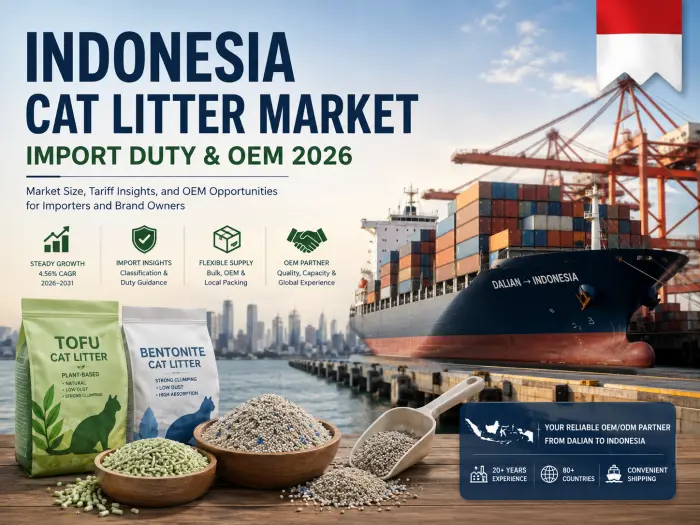
Yes. The Indonesia cat litter market is forecast to grow at an estimated 4.56% CAGR in revenue terms from 2026 to 2031, supported by urbanization, increasingly formalized pet care, and growing demand for commercially produced litter. For importers and private-label buyers, the opportunity is particularly relevant where imported products can compete on price, quality, packaging flexibility, and product differentiation.
Indonesia Cat Litter Market Size and Growth
Indonesia’s scale comes from population and a rapidly urbanizing pet base. Published research frames the category as a mid-growth emerging market where modern retail and e-commerce are pulling demand upward:
- Category growth. An estimated 4.56% CAGR in revenue terms from 2026 to 2031, supported by urbanization and apartment living.
- Cat ownership. Urban cat ownership and commercial pet-care adoption are increasing, supporting recurring demand for commercially produced litter.
- Modern-channel lift. Supermarkets, hypermarkets, specialty retail, and e-commerce are making commercially produced pet-care products more accessible to urban buyers.
Because the 4.56% CAGR is a market-research forecast, buyers should treat it as a planning indicator rather than a guaranteed outcome. The broader direction is consistent with continued urbanization, formalizing pet care, and increasing demand for commercially produced pet-care products.
Cat Litter Product Trends in Indonesia
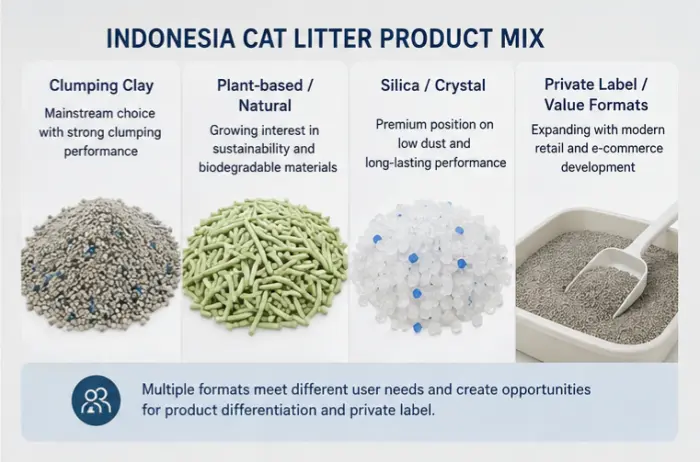
Indonesia’s cat litter market includes established clay-based formats alongside growing interest in plant-based, biodegradable, and premium alternatives. For B2B buyers, the opportunity is best assessed by product performance, price positioning, packaging format, and the target retail or e-commerce channel:
- Clumping clay litter remains an important mainstream format because of its strong clumping performance and relatively accessible price point.
- Natural and biodegradable litter is an emerging segment, supported by growing interest in plant-based materials and sustainability among urban buyers.
- Silica and crystal litters occupy a more premium position on low-dust, long-lasting performance.
- Private-label and value formats are expanding as modern retail and e-commerce develop, opening room for differentiated positioning.
Import Duty and Tariff Structure
Indonesia’s import treatment for cat litter depends on the product’s material, formulation, and customs classification. Cat litter should therefore not be treated as having one universal HS code or one fixed import-duty rate. HS headings discussed in preliminary sourcing research may cover specific formulations or packaging components rather than all finished cat litter products. Indonesian importers should confirm the applicable HS classification, MFN duty, preferential tariff eligibility, VAT, and other import charges with an Indonesian customs broker or the relevant customs authority before calculating landed cost.
| Item | Classification approach | Planning note |
|---|---|---|
| Finished cat litter | Depends on material and formulation | Confirm the exact HS code before import |
| Bentonite-based litter | Classification depends on product composition and customs interpretation | Broker verification recommended |
| Plant-based litter | Classification depends on material and formulation | Do not assume a single universal HS code |
| Retail packaging | May have a separate HS classification | Check packaging-specific tariff treatment |
Even where the headline customs duty is relatively low, total landed cost also depends on freight, port handling, taxes, customs clearance, packaging, and local distribution, so buyers should compare suppliers on landed cost rather than FOB price alone. For a full documentation checklist, see our cat litter export compliance guide.
Domestic Supply and Local Mixing
Indonesia has domestic mineral and pet-product capabilities, but litter-grade processing and product consistency can vary by material and supplier. For differentiated clumping, silica, and plant-based formats, importers may therefore consider imported or OEM-supplied products when local options do not meet their required specifications.
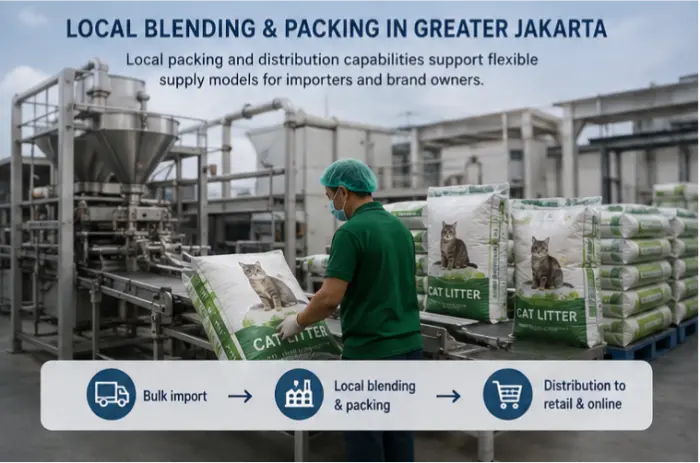
Local pet-product and packaging capabilities are concentrated around major industrial and consumer markets such as Greater Jakarta. However, the availability of suitable cat-litter processing, blending, and packing capacity varies by product type and supplier. For importers, a practical sourcing model can therefore combine imported bulk or finished litter with local packing when the local partner, cost structure, and regulatory requirements support it.
Channel Dynamics and Private Label
E-commerce is becoming increasingly relevant to cat-litter distribution, while traditional pet stores, supermarkets, and other modern retail channels remain important. For suppliers, this creates opportunities for private-label programs with differentiated packaging, product positioning, and pack sizes suited to both retail and online channels.
Import Dynamics and Sourcing From Asia
For Chinese suppliers, Indonesia can be served through established maritime routes to major Indonesian gateways. A sourcing program can be structured around finished-product containers, bulk supply, or semi-finished products depending on the buyer’s packaging and cost requirements.
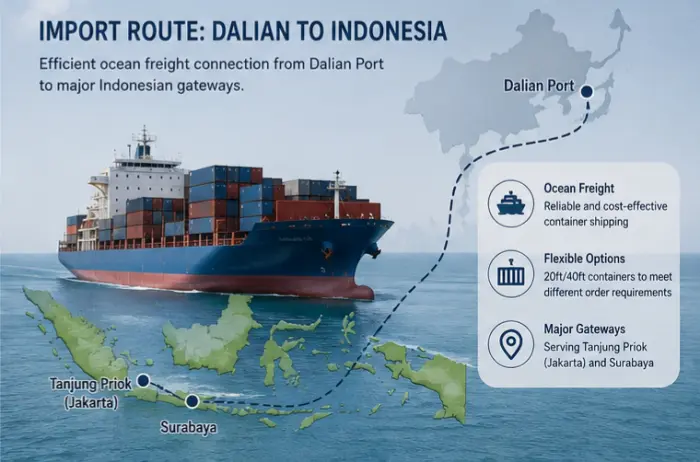
- Shipping. Dalian-based production can serve Indonesian gateways such as Tanjung Priok and Surabaya through ocean freight.
- MOQ. Pet Horizon’s typical OEM starting point is 1×20ft container load, with flexibility depending on the program.
- Local packing. Where commercially and legally suitable, bulk or semi-finished supply can be combined with local packing.
- Cost control. Packaging format, container utilization, freight terms, and local distribution should be evaluated together when comparing suppliers.
Where Pet Horizon Fits as an OEM/ODM Partner
Pet Horizon is a cat litter manufacturer and OEM/ODM supplier based in Dalian, China, within reach of Dalian Port — a practical advantage for Indonesian importers. Our credentials:
- 20+ years in the cat litter industry, with 10+ years operating our own OEM/ODM factory.
- Export experience across 80+ country markets.
- Real production across tofu (plant-based), bentonite, pine, and mixed litter formats — covering the segments growing in Indonesia.
- OEM programs built around private label, custom clumping profiles, low-dust formulas, and flexible MOQs, including bulk-plus-local-pack models.
For an Indonesian brand, distributor, or retailer, the combination of bentonite and plant-based production capabilities with access to Dalian Port provides an additional sourcing option for comparing product quality, freight, packaging, and total landed cost.
Conclusion
Indonesia is one of Southeast Asia’s most promising cat litter markets, with steady forecast growth, a developing modern retail base, and rising demand for convenient indoor cat-care products. For importers and brand owners, the model is clear: combine a reliable OEM/ODM partner with a Dalian Port shipping position and, where useful, a local-pack step near Greater Jakarta. Explore our bentonite cat litter page for the volume backbone of the category, or our tofu cat litter page for plant-based product options.
Frequently Asked Questions
The Indonesia cat litter market is forecast to register a 4.56% CAGR in revenue terms from 2026 to 2031, according to StrategyHelix. The broader growth outlook is linked to urbanization and the increasing formalization of pet care.
There is no single universal import-duty rate for all cat litter products because classification can depend on the litter’s material and formulation. Indonesian buyers should confirm the applicable HS code, tariff treatment, taxes, and other import charges with a customs broker before calculating landed cost.
Clumping clay remains an important mainstream format because of its clumping performance and accessible price, while plant-based and other differentiated formats provide opportunities for premium and private-label positioning.
Yes. Indonesia is served by established maritime import routes, and a Dalian-based supplier can ship via Dalian Port to Tanjung Priok (Jakarta) or Surabaya. Confirm product classification and import documentation with a licensed broker before ordering.
OEM orders typically start at 1×20ft container loads, negotiable, which lets an Indonesian brand or distributor launch a private-label program without large volume.
Blending and packing capabilities exist around Greater Jakarta and other industrial centers. Importers can explore bulk or semi-finished supply combined with local packing where the local partner and regulatory requirements support it.
Private-label and value formats are expanding as modern retail and e-commerce develop, creating direct OEM and ODM openings for differentiated packaging and positioning.
Verify production formats (bentonite, plant-based, mixed), dust and clumping performance, private-label and packaging capability, MOQ flexibility, and shipping position relative to Indonesian ports. Buyers should also confirm product classification and import documentation before placing an order.
Cat litter market figures cited from StrategyHelix (Indonesia Cat Litter Market 2026–2031, revenue CAGR). Broader Indonesian pet-market growth context from Mordor Intelligence (Indonesia Pet Food Market). Estimates vary by methodology; treat ranges as planning assumptions, not guarantees.