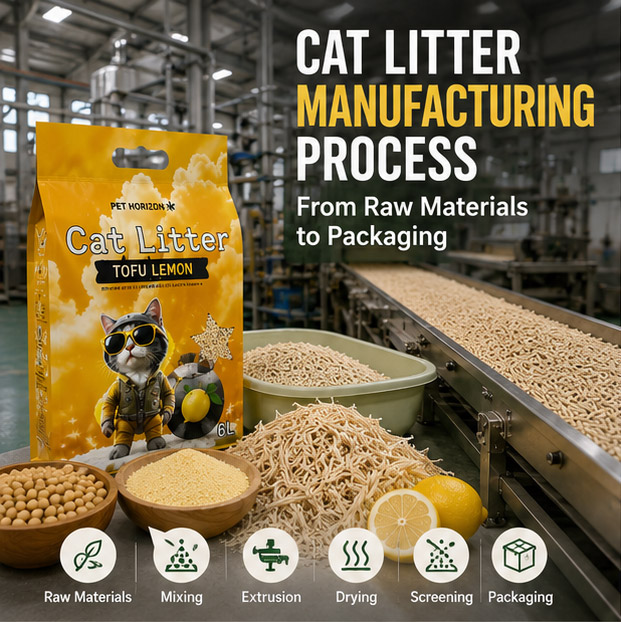





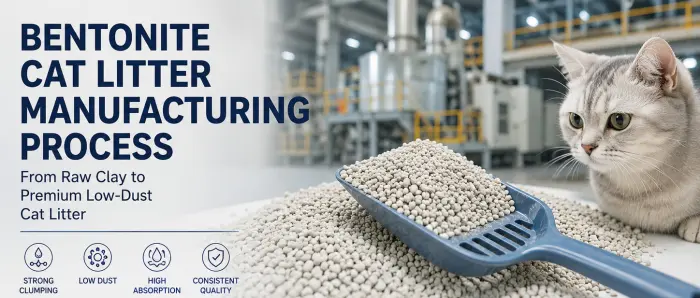
The bentonite cat litter manufacturing process consists of raw material selection, crushing, sodium activation, drying, granulation, dust suppression, quality inspection, and packaging. Each production stage directly affects clumping strength, dust levels, moisture absorption, and overall product consistency.
Professional manufacturers carefully control every production stage to ensure stable particle size, low dust, strong clumping performance, and consistent quality across every batch. Standardized manufacturing also helps meet the requirements of wholesalers, distributors, and private label brands worldwide.
This guide explains every stage of the bentonite cat litter manufacturing process, helping importers, distributors, and private label brands better understand how premium clumping litter is produced.
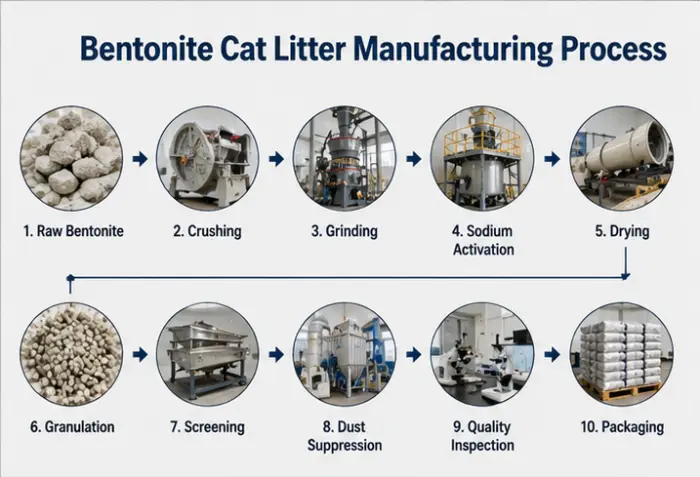
Step 1: Raw Material Selection
Every high-quality bentonite cat litter begins with carefully selected raw materials. Although bentonite is a naturally occurring clay, not every deposit is suitable for cat litter production. The mineral composition, swelling capacity, moisture content, and impurity level all influence the final product’s performance.
Professional manufacturers therefore treat raw material selection as the foundation of the entire manufacturing process. Consistent raw materials make it easier to achieve stable clumping performance, uniform particle size, and predictable production quality throughout every batch.
Why Raw Material Quality Matters
Bentonite consists primarily of the mineral montmorillonite, which gives the clay its characteristic ability to absorb water and form firm clumps. However, bentonite extracted from different mines can vary significantly in purity and physical properties.
Using inconsistent raw materials often leads to unstable product performance, making it difficult to maintain uniform quality across different production batches.
Professional manufacturers therefore evaluate incoming bentonite before production begins, helping ensure that every batch meets predefined manufacturing standards.
| Raw Material Factor | Impact on Finished Cat Litter |
|---|---|
| Montmorillonite Content | Influences clumping strength and water absorption |
| Moisture Content | Affects drying efficiency and granule stability |
| Mineral Purity | Reduces unwanted impurities and improves consistency |
| Particle Uniformity | Supports stable processing during manufacturing |
Selecting Suitable Bentonite Sources
Most manufacturers establish long-term relationships with qualified mining suppliers rather than purchasing raw materials from multiple short-term sources. Stable sourcing helps maintain consistent mineral characteristics while reducing production variability.
Before raw bentonite enters the production line, suppliers and manufacturers typically verify that the material satisfies internal quality specifications. This evaluation minimizes production risks and provides a more stable foundation for downstream processing.
- Consistent mineral composition
- Controlled moisture content
- Low impurity levels
- Stable particle characteristics
- Reliable long-term supply
Incoming Raw Material Inspection
Once raw bentonite arrives at the factory, it normally undergoes an incoming inspection before entering production. The objective is to confirm that the delivered material matches manufacturing requirements and can be processed consistently.
Inspection procedures may include laboratory analysis, moisture measurement, visual examination, and sampling from multiple locations within each delivery. Manufacturers generally reject or isolate materials that fail to meet established quality standards.
| Inspection Item | Purpose |
|---|---|
| Visual Appearance | Identify contamination or abnormal coloration |
| Moisture Measurement | Confirm suitability for production |
| Particle Distribution | Support efficient downstream grinding |
| Laboratory Sampling | Verify consistency between batches |
Building Consistency from the First Step
Although raw material selection receives less attention than granulation or dust control, it influences every stage that follows. High-quality bentonite allows manufacturers to maintain stable production conditions, reduce process variation, and improve overall product consistency.
Key Takeaway
Reliable bentonite cat litter starts with consistent raw materials. Careful supplier selection and incoming quality inspection create the foundation for stable manufacturing, predictable product performance, and long-term batch consistency.
Step 2: Crushing & Precision Grinding
During bentonite cat litter production, the first processing stage begins with crushing and precision grinding, which prepare the raw bentonite for activation.Although this step appears straightforward, it plays a critical role in determining production efficiency and the consistency of the finished cat litter.
Raw bentonite is typically delivered in large lumps with irregular sizes and varying moisture levels. Before the material can be activated, granulated, and dried, it must first be processed into a controlled particle size suitable for downstream manufacturing.
Why Particle Size Matters
Uniform particle size allows every production stage to operate under more stable conditions. When oversized particles remain in the material, they absorb moisture differently, respond inconsistently during sodium activation, and often produce irregular granules after pelletizing.
Professional manufacturers therefore establish target particle distributions before the material enters the next production stage.
| Grinding Objective | Manufacturing Benefit |
|---|---|
| Uniform particle size | Improves activation consistency |
| Reduced oversized particles | Produces more uniform granules |
| Stable material flow | Supports continuous production |
| Controlled powder distribution | Improves downstream processing efficiency |
Primary Crushing
The first stage normally uses heavy-duty crushing equipment to reduce large bentonite rocks into smaller fragments. This initial reduction prepares the material for finer grinding while protecting downstream equipment from excessive wear.
Depending on the characteristics of the raw clay, manufacturers may employ one or more crushing stages to achieve a suitable feed size for precision milling.
Precision Grinding
Following primary crushing, the material passes through grinding equipment that further reduces particle size to meet production specifications. The objective is not to create extremely fine powder, but to produce a controlled and consistent particle distribution that supports efficient activation and granulation.
Grinding parameters are carefully monitored throughout production to maintain stable throughput and minimize unnecessary energy consumption.
- Stable feed rate
- Consistent grinding efficiency
- Controlled particle distribution
- Reduced equipment vibration
- Continuous production stability
Process Control During Grinding
Professional factories continuously monitor grinding performance rather than relying solely on equipment settings. Sampling during production allows operators to verify that particle size remains within the desired specification before material progresses to the activation stage.
Consistent grinding reduces production variability and provides a more reliable foundation for subsequent moisture conditioning and sodium activation.
Once the target particle size has been achieved, the processed bentonite is transferred to the sodium activation stage, where its swelling capacity and clumping performance are further enhanced.
Key Takeaway
Crushing and precision grinding establish a uniform particle foundation for the entire manufacturing process. Stable particle size improves activation efficiency, supports consistent granulation, and contributes to reliable product quality.
Step 3: Sodium Activation
Sodium activation is one of the most important stages in producing clumping bentonite cat litter, It enhances the clay’s natural swelling capacity and improves its ability to absorb moisture and form strong, compact clumps after contact with liquid.
For manufacturers producing premium clumping cat litter, this process is a key factor separating high-performance products from lower-grade alternatives.
What Is Sodium Activation?
Natural bentonite deposits vary in mineral composition. Some clays already contain a high proportion of sodium bentonite, while others contain more calcium bentonite and require activation to improve performance.
Sodium activation modifies the clay under carefully controlled production conditions, helping increase swelling capacity and improve the physical characteristics required for premium cat litter manufacturing.
Why Activation Is Important
Without proper activation, bentonite may exhibit weaker clumping performance, slower liquid absorption, and reduced granule strength. Carefully controlled activation improves product consistency and helps manufacturers meet customer expectations across different markets.
| Activation Benefit | Result |
|---|---|
| Improved water absorption | Faster liquid uptake |
| Enhanced swelling capacity | Stronger clump formation |
| Better particle cohesion | Reduced granule breakage |
| More consistent performance | Stable product quality between batches |
Controlling the Activation Process
Professional manufacturers carefully regulate multiple production parameters throughout the activation stage. Consistency is achieved through standardized operating procedures rather than relying on a single adjustment.
Typical process controls include:
- Uniform material feeding
- Controlled moisture conditioning
- Stable mixing time
- Continuous process monitoring
- Routine quality verification
Maintaining stable operating conditions helps ensure that every production batch receives consistent treatment before moving to the drying stage.
Preparing Material for Drying
Once activation is complete, the conditioned bentonite contains elevated moisture and requires controlled drying before granulation. Maintaining the proper balance between activation and moisture removal is essential for achieving stable downstream processing.
Over-processing or excessive moisture variation at this stage can reduce production efficiency and negatively affect the uniformity of the finished granules. Professional manufacturers therefore treat sodium activation and drying as closely connected processes within a standardized manufacturing system.
After activation is complete, the conditioned material moves directly into controlled drying, where excess moisture is removed before granulation.
Key Takeaway
Sodium activation is the core process that enables bentonite to deliver strong clumping performance. By carefully controlling activation conditions, manufacturers improve water absorption, particle stability, and overall product consistency before the material enters the drying stage.
Step 4: Drying & Moisture Stabilization
Following sodium activation, the bentonite contains elevated moisture that must be carefully reduced before granulation. Drying is far more than simply removing water—it is a controlled process that helps stabilize the material and prepares it for forming durable, uniform granules.
Professional manufacturers aim to achieve a consistent moisture level rather than the lowest possible moisture content. Proper moisture stabilization improves processing efficiency, supports granule strength, and contributes to stable clumping performance in the finished product.
Why Moisture Control Is Critical
Moisture directly influences the physical behavior of bentonite throughout the remaining production stages. Excess moisture can cause material to stick together during granulation, while insufficient moisture may reduce particle cohesion and increase dust generation.
Maintaining a controlled moisture range allows downstream equipment to operate more consistently while helping manufacturers achieve stable product quality.
| Moisture Condition | Potential Impact |
|---|---|
| Too High | Reduced granulation efficiency and uneven particle formation |
| Too Low | Lower particle cohesion and increased dust generation |
| Properly Controlled | Stable granulation and consistent product performance |
Controlled Drying Process
Industrial drying systems are designed to remove moisture gradually while minimizing unnecessary thermal stress on the material. Consistent airflow, controlled temperature, and stable material flow all contribute to more uniform drying results.
Rather than relying solely on drying time, professional manufacturers continuously monitor process conditions to maintain consistent moisture levels throughout production.
Maintaining Production Stability
Drying performance affects both product quality and manufacturing efficiency. Stable operating conditions reduce production variation, improve equipment utilization, and help ensure that each batch enters the granulation stage under similar conditions.
- Consistent drying temperature
- Controlled residence time
- Uniform airflow distribution
- Continuous moisture monitoring
- Stable material throughput
Preparing for Granulation
Once the target moisture range has been achieved, the conditioned bentonite is transferred to the granulation process. Consistent moisture provides the physical properties required for forming granules with uniform size, strength, and durability.
With moisture stabilized, the material is ready for granulation, where particle size and granule strength are formed under controlled production conditions.
Key Takeaway
Controlled drying stabilizes activated bentonite and prepares it for efficient granulation. Maintaining consistent moisture is essential for producing durable, low-dust granules with reliable clumping performance.
Step 5: Granulation & Screening
Granulation is one of the most important stages in the bentonite cat litter manufacturing process, because it determines particle size, granule strength, and product consistency.During this process, conditioned clay is transformed into granules with controlled size, shape, and mechanical strength. The consistency achieved here has a direct impact on product appearance, dust generation, clumping performance, and customer satisfaction.
Professional manufacturers combine granulation with multi-stage screening to ensure that only particles meeting product specifications proceed to packaging.
Why Granule Size Matters
Particle size is one of the most visible quality characteristics of bentonite cat litter. Uniform granules provide a cleaner appearance, more consistent liquid absorption, and improved handling during packaging and transportation.
Irregular particle sizes may reduce product consistency and negatively affect the user experience.
| Granule Characteristic | Benefit |
|---|---|
| Uniform Size | Improves product consistency |
| Controlled Strength | Reduces breakage during transportation |
| Balanced Density | Supports efficient packaging |
| Stable Shape | Improves visual appearance |
Granulation Process
During granulation, conditioned bentonite particles combine under carefully controlled operating conditions to form stable granules. Manufacturers regulate production parameters throughout this stage to achieve consistent particle formation while minimizing unnecessary material loss.
The objective is to produce granules that maintain their structure during storage, transportation, and everyday use while still breaking down naturally during clump formation.

Manufacturer’s Tip
Maintaining a narrow particle size distribution during granulation not only improves the appearance of bentonite cat litter but also minimizes dust generation during transportation and long-term storage.
Multi-stage Screening
After granulation, the material passes through screening equipment that separates particles according to size. Oversized particles and excessive fines are removed from the main production flow, allowing only qualified granules to continue toward the next manufacturing stage.
This screening process helps improve overall product consistency while reducing variation between production batches.
| Screening Result | Processing Action |
|---|---|
| Qualified Granules | Continue to surface treatment |
| Oversized Particles | Returned for reprocessing |
| Fine Particles | Recovered or recycled where appropriate |
Improving Manufacturing Efficiency
Professional production lines often recycle suitable oversized particles and recover usable material generated during screening. This approach improves raw material utilization while maintaining consistent product quality.
Continuous monitoring of granule size distribution also helps manufacturers optimize production efficiency and reduce unnecessary waste.
After screening, qualified granules proceed to surface treatment, where dust suppression further improves product cleanliness and customer experience.
Key Takeaway
Granulation and screening determine the final physical structure of bentonite cat litter. Uniform particle size, controlled granule strength, and efficient screening contribute to consistent appearance, stable performance, and reduced material waste.
Step 6: Surface Treatment & Dust Suppression
Manufacturing low dust bentonite cat litter requires more than effective dust collection. It depends on process control throughout the entire production line. Even when granules exhibit excellent clumping performance, excessive dust can reduce user satisfaction, create cleaning challenges, and negatively affect product perception.
For this reason, professional manufacturers integrate dust suppression into the production process rather than treating it as a simple finishing step.
Why Low Dust Matters
Dust is primarily generated when small particles separate from the surface of finished granules during manufacturing, packaging, transportation, or handling. Reducing loose surface particles improves both product appearance and customer experience.
| Benefit of Low-Dust Production | Customer Value |
|---|---|
| Cleaner pouring | Improved daily usability |
| Reduced airborne dust | Cleaner home environment |
| Lower transportation loss | Better product integrity |
| Improved retail presentation | Higher perceived product quality |
Surface Treatment Process
Following screening, qualified granules may undergo surface treatment to reduce loose particles remaining on the exterior of each granule. This treatment improves particle stability while helping maintain a cleaner finished product.
The exact production method varies between manufacturers, but the objective remains the same: minimizing unnecessary dust generation without compromising clumping performance.
Integrated Dust Collection
Professional manufacturing facilities also employ dust collection systems throughout the production line. These systems capture airborne particles generated during crushing, grinding, screening, and packaging, improving both product cleanliness and workplace safety.
- Dust collection during grinding
- Enclosed conveying systems
- Screening dust recovery
- Packaging dust extraction
- Routine equipment cleaning
Delivering Consistent Product Quality
Effective dust suppression depends on the combined performance of every manufacturing stage rather than a single process. Consistent raw materials, proper moisture control, stable granulation, and effective screening all contribute to producing a cleaner finished product.
To learn more about industrial dust reduction technologies, read our Cat Litter Dust Control Guide.
Best Practice
Professional manufacturers reduce dust through process optimization across the entire production line rather than relying on a single coating or finishing treatment.
The finished granules are then sampled for laboratory inspection before entering the packaging line.
Key Takeaway
Low-dust bentonite cat litter is achieved through integrated process control rather than a single production step. Surface treatment and dust collection systems help deliver cleaner granules while supporting consistent product quality.
Step 7: Quality Inspection
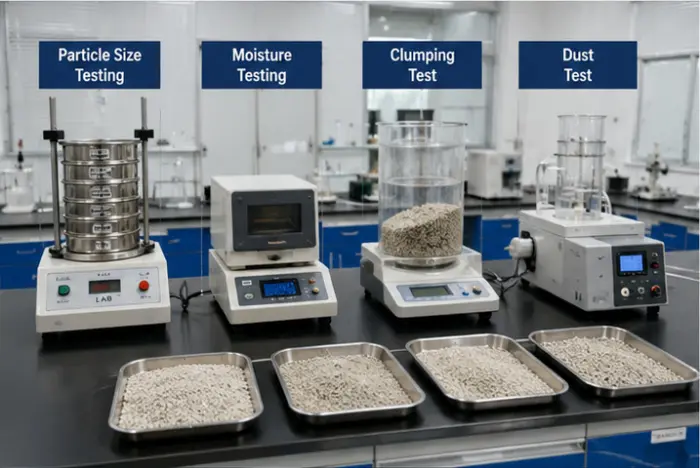
Before bentonite cat litter is packaged for shipment, every production batch should undergo quality inspection to verify that it meets the manufacturer’s production standards. Consistent testing helps ensure that customers receive products with stable performance across different batches.
Key Quality Indicators
Professional manufacturers typically evaluate multiple quality indicators rather than relying on visual inspection alone. These tests help verify that the finished product meets predefined manufacturing specifications.
| Inspection Item | Purpose |
|---|---|
| Particle Size Distribution | Confirm uniform granule size |
| Moisture Content | Verify product stability |
| Clumping Performance | Evaluate product functionality |
| Dust Level | Support low-dust product quality |
Batch Consistency
Routine sampling throughout production allows manufacturers to identify variations before products enter final packaging. Consistent batch quality improves customer confidence while reducing quality-related complaints.
Continuous Quality Improvement
Inspection data also provides valuable feedback for production optimization. Monitoring production trends enables manufacturers to improve process stability and maintain consistent quality over time.
Key Takeaway
Quality inspection verifies that every production batch satisfies established manufacturing standards before packaging and shipment.
Step 8: Packaging & Storage
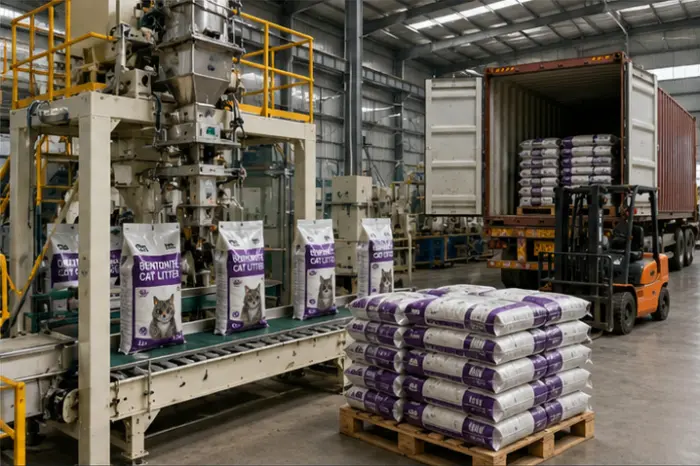
In a modern bentonite cat litter factory, the final production stage focuses on packaging, storage, and shipment preparation. Proper packaging helps protect bentonite cat litter from moisture, contamination, and physical damage during warehousing and transportation.
Packaging Formats
Manufacturers generally provide different packaging options according to customer requirements, including retail bags, wholesale packaging, and private label solutions.
| Packaging Type | Typical Application |
|---|---|
| Retail Bags | Pet stores and supermarkets |
| Wholesale Bags | Distributors and importers |
| Private Label Packaging | OEM brand owners |
Moisture Protection
Moisture-resistant packaging materials and reliable sealing help maintain product quality throughout storage and international transportation.
Storage Conditions
Finished products are typically stored in clean, dry warehouses before shipment. Proper storage conditions help preserve product performance until delivery.
Key Takeaway
Effective packaging and proper storage help maintain the quality achieved throughout the manufacturing process.
If you’re evaluating production capability in addition to manufacturing technology, you may also find our guide to choosing a reliable cat litter manufacturer helpful.
Conclusion
The bentonite cat litter manufacturing process involves far more than processing natural clay. From raw material selection to final packaging, every production stage contributes to the quality and consistency of the finished product.
Manufacturers that implement standardized production processes and comprehensive quality management systems are better positioned to deliver reliable products for wholesalers, distributors, retailers, and private label brands.
For importers, distributors, and private label brands, understanding the manufacturing process provides a practical framework for evaluating supplier capability beyond price alone. Manufacturers with standardized production systems are generally better equipped to deliver consistent quality across long-term supply partnerships.
Frequently Asked Questions
What raw material is used to make bentonite cat litter?
Bentonite cat litter is made from natural bentonite clay. Depending on the deposit and manufacturing requirements, producers may use sodium bentonite directly or enhance calcium bentonite through sodium activation to improve clumping performance.
Does all bentonite cat litter use sodium activation?
No. Some natural bentonite deposits already contain a high percentage of sodium bentonite and require little or no additional activation. Other manufacturers use sodium activation to improve the swelling capacity, liquid absorption, and clumping performance of calcium bentonite.
What particle size is commonly used for bentonite cat litter?
Most bentonite cat litter is produced in particle sizes ranging from approximately 0.5 mm to 2.5 mm. However, the ideal granule size depends on market preferences, packaging requirements, and customer specifications.
What factors affect the clumping performance of bentonite cat litter?
Clumping performance depends on several factors, including raw material quality, sodium activation, moisture control, granule size, and overall process consistency. Optimizing every stage of production helps manufacturers produce stronger and more durable clumps.
How is dust reduced during bentonite cat litter manufacturing?
Low-dust bentonite cat litter is achieved through integrated process control, including precision grinding, moisture stabilization, effective screening, surface treatment, and industrial dust collection systems. Professional manufacturers focus on reducing dust throughout the entire production process rather than relying on a single treatment.
Can bentonite cat litter be customized for different markets?
Yes. Many manufacturers can customize particle size, fragrance, color, packaging, and private label branding to meet the requirements of different countries, retailers, distributors, and OEM customers.
How long does bentonite cat litter production usually take?
Production time varies depending on factory capacity, order quantity, and customization requirements. Standard products can often be manufactured more quickly, while OEM orders may require additional time for packaging approval, production scheduling, quality inspection, and export preparation.
How can buyers evaluate a bentonite cat litter manufacturer?
Buyers should evaluate raw material quality, production capacity, quality control procedures, dust control capability, product consistency, export experience, and OEM support. A manufacturer with standardized production processes is generally better positioned to provide reliable long-term supply.