

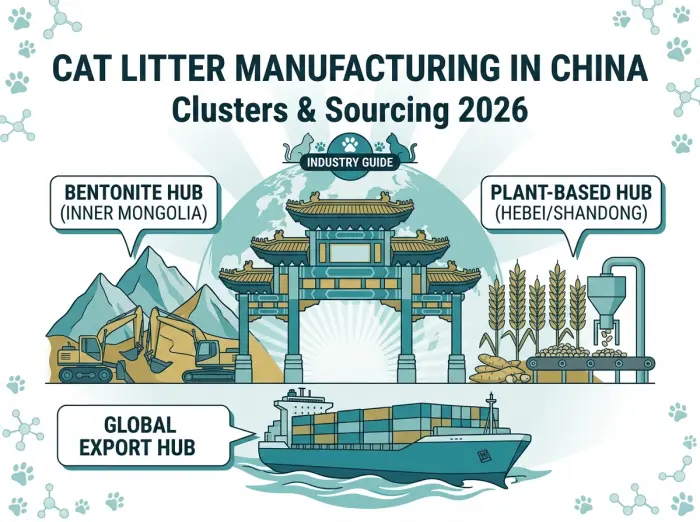
China has become one of the world’s largest cat litter manufacturing and export hubs, but “Chinese cat litter” is not one thing. The main production areas include Ningcheng in Inner Mongolia, the Liaoxi bentonite belt in Liaoning, plant-based litter regions in Hebei and Shandong, and export hubs such as Dalian. Production is organized into regional clusters shaped by raw-material access and export logistics — bentonite in the north, plant-based litters near agricultural belts, and coastal factories built for overseas shipping. For importers, distributors, and private-label buyers, understanding where litter is made and what that means for price, quality, and lead time is a core due-diligence skill. This guide maps the real landscape and explains how to choose a factory, including the perspective of a Dalian-based plant-based and mineral litter manufacturer.
Quick Answer: Why China Is a Major Cat Litter Supply Hub
China has become one of the world’s largest cat litter manufacturing and export hubs for both bentonite and plant-based formats. Bentonite production concentrates in two northern belts: Ningcheng County, Inner Mongolia — the single largest cluster, widely reported (state media and local government) at roughly two-thirds of China’s output and about one-fifth of global volume (1.5–2 million tons per year) — and the Liaoxi belt around Chaoyang/Jinzhou in Liaoning, which styles itself “China’s bentonite hometown” and reports mineral litter at roughly half of national output. Plant-based litters concentrate in northern agricultural belts such as Hebei (Nanhe) and Shandong. Coastal cities like Dalian — itself inside the Liaoning raw-material zone — act as export gateways. For buyers, the practical step is to verify a factory’s raw-material radius, quality system, and export documentation rather than assume all Chinese litter is identical.
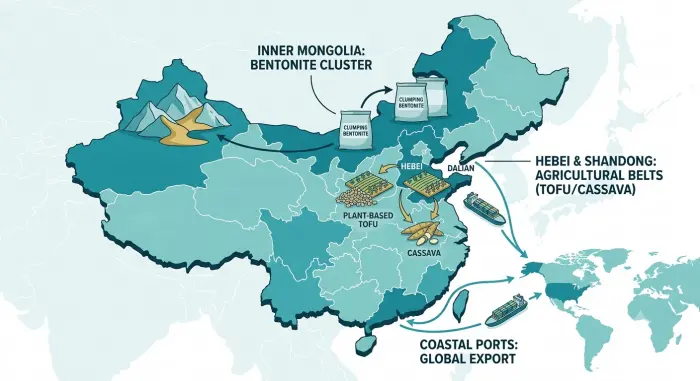
| Region | Main litter type | Advantage |
|---|---|---|
| Ningcheng, Inner Mongolia | Bentonite | Largest single bentonite cluster; large mineral reserves |
| Chaoyang, Liaoning | Bentonite | “China’s bentonite hometown”; processing cluster |
| Hebei / Shandong | Tofu & plant-based | Agricultural raw-material streams |
| Dalian, Liaoning | Export manufacturing | Port logistics, direct overseas shipping |
China’s Role in the Global Cat Litter Supply
Cat litter is a high-frequency consumable: roughly 65% of cat owners replace litter 2–3 times per month, which makes stable, scalable supply the decisive factor for any brand or distributor. China’s combination of raw-material reserves, mature equipment ecosystems, and export infrastructure has made it a major global production base for the category. The domestic Chinese market itself is also large and fast-growing — industry estimates put it at roughly US$908.4 million in 2025, expanding at about 6.4% a year through 2033 (according to Grand View Research industry estimates) — but the export engine is what matters most for international buyers.
China’s cat litter supply is organized into regional clusters shaped by raw-material access and export logistics, not by a single national production center.
China’s Two Bentonite Belts: Ningcheng and Liaoxi (Liaoning)
Bentonite cat litter is not made in one place. China’s supply sits in two main northern belts, and understanding both helps a buyer judge where a quote actually comes from. According to official and state-media reporting:
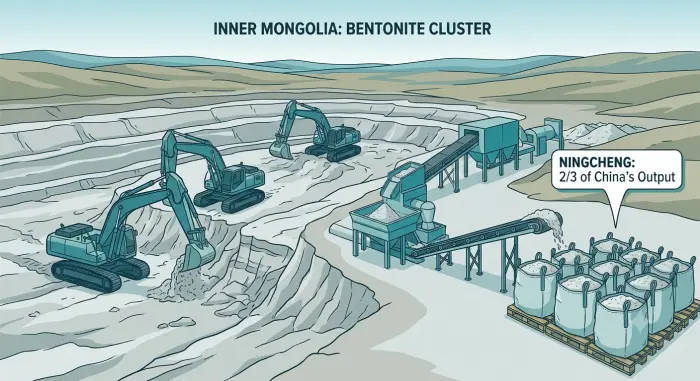
- Ningcheng’s bentonite cat litter output is about two-thirds of China’s total, one-third of Asia’s, and one-fifth of the world’s volume.
- The county cluster produces 1.5–2 million tons per year across dozens of processors, with reported annual output value above RMB 1 billion.
- Local reserves are substantial — roughly 16.4 million tons of bentonite in reserve and 2 billion tons of potential resource — giving the cluster a durable raw-material moat.
- Producers there supply 80–100+ countries and 1,400+ brand partners, with a large share of volume exported to Japan, Korea, Europe, and North America.
The second belt is the Liaoxi cluster centered on Chaoyang (Jianping), Liaoning — which calls itself “China’s bentonite hometown” and reports mineral cat litter at roughly half of national output (about 2 million tons and RMB 2.1 billion in value for 2024). It sits in the same Liaoning raw-material province as Dalian, the export port many Northeast and Liaoxi plants ship through. Hebei forms a third, smaller node linking the two. For a buyer, the practical read is that bentonite clumping litter from China traces largely to these northern belts — and a Dalian-based plant like Pet Horizon draws on the same Liaoning raw-material zone while shipping from its own port.
That concentration supports price stability and spec maturity across the belts — but it also means specification discipline matters when comparing quotes from neighboring factories, because raw material and plant quality vary district to district.
The two belts are not interchangeable on quality and price. The Liaoxi/Chaoyang belt — centered on Jianping — is associated with higher-grade calcium bentonite (lower impurities, stronger clumping), making it the preferred base for mid-to-high-end clumping litter. Ningcheng supplies the high-volume, cost-effective segment that anchors economy-grade mass production. A widely reported practice is to blend Jianping high-grade ore with Ningcheng ore to balance clumping performance and landed cost, so a quote’s “belt mix” matters as much as its factory address. For a Dalian-based plant inside the Liaoning zone — closest to Jianping and with the lowest inland freight — drawing on both belts supports a bentonite range that spans economy through premium tiers. At the top of the spec ladder sits naturally sodium-based bentonite (no chemical modification needed), the premium raw material used for unmodified high-end mineral litters.
Plant-Based Clusters: Agricultural Belts, Not Mines
Plant-based litters (tofu, cassava, corn, wheat, and mixed formats) follow crop geography rather than mineral deposits. The established bases sit in northern agricultural provinces:
- Hebei (Nanhe, Xingtai): an early-disclosed plant-based cluster that helped define China’s tofu-litter supply and remains a reference point for the segment.
- Shandong: a growing plant-based base leveraging soybean and cassava by-product streams from nearby food processing, with several exporters shipping tofu and cassava litter to 30+ countries.
- Northeast (Liaoning and neighbors): soybean-rich and port-adjacent, supporting plant-based production that ships directly from coastal gateways such as Dalian — and sitting within the same Liaoning bentonite belt that anchors the Liaoxi cluster.
These belts benefit from cheap, food-grade agricultural residues (soybean pulp, corn starch, cassava) and mature OEM ecosystems. For private-label buyers, the practical takeaway is that plant-based supply is scaled and contestable — differentiation comes from formula control and quality consistency, not scarcity.
Coastal Export Bases and Logistics
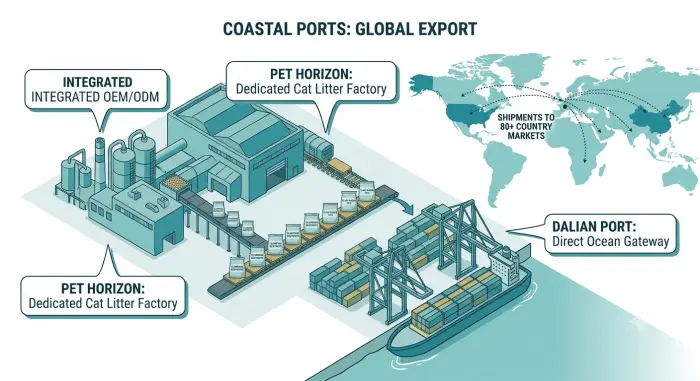
Export logistics are decided as much by geography as by factory capability. A litter plant near a major port can consolidate containers faster and absorb freight volatility better than an inland plant reliant on long haulage. Dalian Port on the northeast coast is one such gateway, serving manufacturers in Liaoning and the wider northeast with direct ocean links to East Asia, Europe, and North America. Dalian is not only a logistics node — it is also a real manufacturing base: multiple cat litter producers operate there with export-oriented lines, confirming the city’s role in the national supply map. Dalian also sits inside the Liaoning raw-material belt that feeds the Liaoxi cluster, so a Dalian plant combines near-source bentonite access with direct port export — a geometry many inland producers cannot match.
Environmental and Dual-Carbon Pressure
China’s dual-carbon (peak carbon, carbon neutral) agenda and tightening environmental enforcement are reshaping litter manufacturing in two opposite directions:
- Bentonite mining faces higher barriers. Environmental inspections and mine-permit discipline push low-compliance, small-scale capacity out, concentrating volume in cleaner, automated plants. Buyers should expect consolidated, more compliant supply — and slightly firmer baseline pricing.
- Plant-based and low-dust formats are favored. Biodegradable, flushable, and near-zero-dust litters align with green-consumption policy and consumer demand, accelerating R&D and export interest in tofu, cassava, and pine formats.
The net effect is a shift toward larger, cleaner, more export-ready factories — exactly the profile an international buyer should be screening for.
How to Verify a Cat Litter Factory
When evaluating a cat litter factory in China, buyers should review production capacity, raw-material sourcing, export experience, and OEM capability. Cluster membership alone does not guarantee a good partner. A short due-diligence checklist:
- Raw-material radius: ask where the soybean, corn, cassava, or bentonite is sourced and how it is inspected on arrival.
- Quality system: confirm incoming-material, in-process, and pre-shipment checks, plus batch consistency records.
- Export documentation: verify the factory handles customs, certificates (e.g., ISO, REACH where relevant), and multi-language packaging.
- MOQ and lead time: align order size with your market; many factories operate on container-scale minimums.
- Formula control: confirm they can adjust clumping, dust, fragrance, and particle size to your spec.
Pet Horizon’s Position in the China Landscape
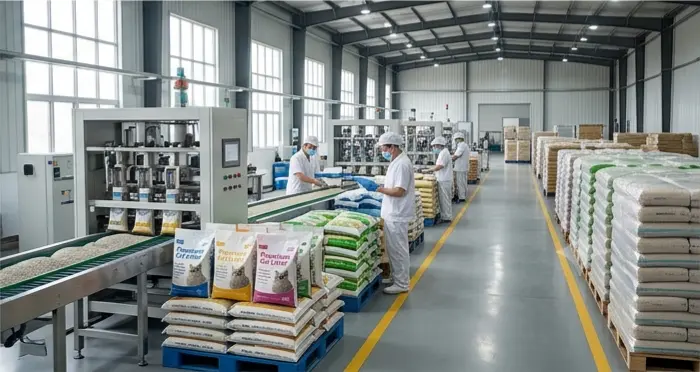
Pet Horizon is a China cat litter manufacturer based in Dalian, Liaoning, near Dalian Port. As a transparent cat litter manufacturer, we document each production step rather than avoid it, and a structured cat litter sourcing approach keeps checks disciplined for buyers comparing Chinese suppliers. With 20+ years in the cat litter industry and 10+ years operating our own OEM/ODM factory, we ship to 80+ country markets and produce plant-based and mineral litters including tofu, pine, bentonite, and mixed formats — with our bentonite range spanning economy calcium-based clumping litter through premium naturally sodium-based (unmodified) specifications — supported by OEM and private-label programs with OEM packaging, formula customization, and export documentation support for international buyers. We are a coastal Northeast exporter with direct port access, not a cluster-anchored inland plant — which means shorter export lead times and steadier freight handling for overseas buyers. The fundamentals that decide stable supply are always raw-material control, quality consistency, and export readiness.
Conclusion
China’s cat litter manufacturing is cluster-based and export-driven: major bentonite belts in Ningcheng (Inner Mongolia) and Liaoxi/Liaoning, plant-based belts across Hebei, Shandong, and the Northeast, and coastal gateways like Dalian moving volume overseas. For importers, the winning move is not to memorize cluster names but to verify the fundamentals — raw-material radius, quality system, and export capability — and to partner with a factory whose location and compliance fit your market. Whether a supplier sits inland or at a port like Dalian, those fundamentals decide whether your supply is stable, compliant, and priced fairly. For brands and distributors looking for OEM cat litter suppliers in China, factory location is only the first step — production control, customization capability, and export experience determine long-term supply reliability.
Frequently Asked Questions
Production is cluster-based. Bentonite concentrates in two northern belts — Ningcheng, Inner Mongolia (the largest single cluster, about two-thirds of national output) and the Liaoxi belt around Chaoyang/Jinzhou in Liaoning (which calls itself “China’s bentonite hometown”) — while plant-based litters follow agricultural belts in Hebei, Shandong, and the Northeast. Coastal cities like Dalian, inside the Liaoning zone, handle export flow.
Two northern belts dominate. Ningcheng County, Chifeng (Inner Mongolia), is widely recognized as China’s largest bentonite cat litter cluster and about one-fifth of global volume, 1.5–2 million tons per year. The Liaoxi belt around Chaoyang/Jinzhou, Liaoning is the second major zone (Chaoyang styles itself “China’s bentonite hometown” and reports mineral litter near half of national output); Hebei links the two. Regional figures are self-reported estimates, so treat them as directional, not exact.
Northern agricultural provinces lead: Hebei (Nanhe), Shandong (soybean and cassava by-product streams), and the soybean-rich Northeast. Plant-based supply is scaled and contestable, so formula control and consistency decide differentiation.
China is the leading global export base for both bentonite and plant-based litters. The domestic market alone was about US$908.4 million in 2025 (≈6.4% CAGR to 2033, according to Grand View Research industry estimates), and a large share of production is exported to Japan, Korea, Europe, North America, and Southeast Asia.
Dual-carbon and environmental enforcement raise barriers for small bentonite miners (consolidating supply into cleaner plants) while favoring biodegradable, low-dust plant-based formats — pushing the industry toward larger, more compliant, export-ready factories.
Check raw-material sourcing and inspection, the quality system and batch records, export documentation, MOQ and lead time, and formula-control capability. Cluster scale supports volume but does not replace per-factory verification.
Yes. Dalian is a coastal export gateway in Liaoning with direct ocean links, and multiple cat litter producers operate there with export-oriented lines. Pet Horizon is one such Dalian-based OEM/ODM factory.
Many factories operate on container-scale minimums (commonly one 20ft container, negotiable). Confirm exact MOQ and lead time during sampling.
Before choosing a China cat litter manufacturer, buyers should check raw-material sourcing, production capacity, dust-control standards, quality inspection procedures, OEM flexibility, export experience, and shipping capability. Cluster scale supports volume, but these per-factory checks decide whether supply stays stable, compliant, and fairly priced.
Sources: Economic Information Daily (Xinhua) (Ningcheng, Inner Mongolia as China’s largest bentonite cat litter cluster — roughly two-thirds of national output, one-fifth of global) and Chaoyang Municipal Government (Jianping, Liaoning as “China’s bentonite hometown” and a major mineral-litter belt, ~half of national output). Cluster figures are regional self-reported estimates; treat ranges as planning assumptions, not exact measurements.