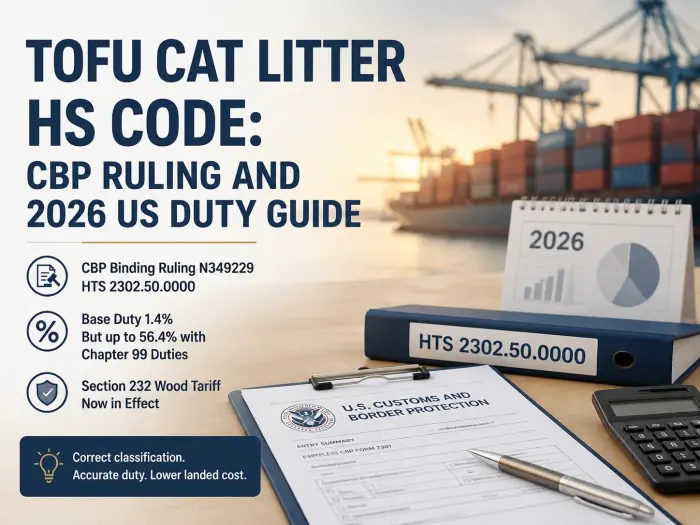





Once you have the right HS code, the next question every cat litter importer asks is simple: how much duty will I pay? The answer is rarely a single number. Import duty on cat litter depends on the HS subheading, the destination market, and — increasingly — the country of origin. For distributors and private-label brands, misunderstanding the duty is the fastest way to blow up a landed-cost model. This guide explains what sets the rate, where to look it up per market, and how tariffs flow into the price you actually pay.
Quick Answer
Cat litter import duty is set by the destination market’s tariff schedule against your HS subheading, and is usually calculated as a percentage of customs value (ad valorem). The rate varies by material and by country of origin; some markets apply additional origin-specific duties. Look the rate up in the official tool for your market — the US HTS (via the ITC), the EU TARIC database, or your national customs schedule — using the HS code from our HS code guide. Always model duty into landed cost before you quote a customer.
What Determines Cat Litter Import Duty
Four inputs decide the duty you pay at the border:
- HS subheading. The classification from our HS code guide is the key that opens the rate table.
- Destination market. The US, EU, UK, and others each maintain their own schedules with different rates for the same product.
- Country of origin. Trade remedies and origin-specific duties can add to the base MFN (most-favored-nation) rate.
- Customs value. Duty is normally a percentage of the transaction value, so your invoice amount drives the absolute duty paid.
Where to Look Up the Tariff Rate by Market
Use the official, free schedule for the market you are importing into. Search by your HS code (or the first 6 digits, which are harmonized internationally), then read the national subheading rate.
| Market | Official tool | What to search | Note |
|---|---|---|---|
| United States | Harmonized Tariff Schedule (HTS), via the U.S. ITC | 10-digit HTS code | Section 301 or other trade-remedy duties may apply on certain goods from certain origins; confirm current status |
| European Union | TARIC database | 8- or 10-digit TARIC code | Also shows VAT, quotas, and protective measures |
| United Kingdom | UK Integrated Online Tariff | Commodity code | Post-Brexit schedule, distinct from the EU |
| Other markets | National customs schedule | HS subheading | Rates and rules vary widely; confirm locally |

Ad Valorem vs Specific Duty
Most cat litter enters under an ad valorem duty — a percentage of customs value. Some markets or product lines use a specific duty (a fixed amount per unit, e.g. per kilogram), or a mixed rate. Knowing which applies matters because it changes how volume pricing and freight-in-cost affect your duty. When the rate is ad valorem, a higher declared value raises both the price and the duty proportionally.
Origin Matters: Country-of-Origin Surcharges
The base MFN rate is only part of the story. Many markets apply additional duties based on where the goods were made, not just where they were shipped from. For cat litter sourced from China, importers should check whether origin-specific measures apply in their destination market and build that into the quote. This is precisely why a supplier’s origin documentation and a clear certificate of origin are part of a defensible import — and why our shipping and logistics guide lists them in the document checklist.
How Tariffs Flow Into Landed Cost
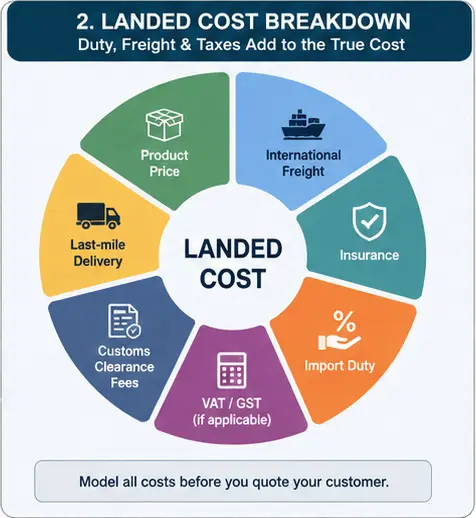
Landed cost is what the product truly costs to reach your warehouse. A simplified model:
Landed cost = product price + international freight + insurance + import duty + VAT/GST (if applicable) + clearance fees + last-mile delivery.
Duty and tax are often among the largest variable costs not shown in a supplier’s quotation. Experienced importers calculate these costs before confirming an order to avoid unexpected margin erosion after customs clearance. Model them before committing to MOQ and pricing — see the MOQ guide for how volume interacts with per-unit landed cost.
Importer Tip: Before requesting a quotation, ask your supplier to confirm the HS classification, country of origin, and preferred Incoterm in writing. These three items determine most of your landed-cost calculation and reduce the risk of customs surprises after shipment.
Reducing Tariff Exposure Legitimately
- Classify correctly. An accurate HS code avoids both over-payment and penalty risk.
- Diversify origin. Where allowed, sourcing from multiple origins can reduce exposure to origin-specific duties.
- Negotiate Incoterms. The right Incoterm changes who pays freight and insurance, shifting where duty is calculated — see the logistics guide.
- Use bonded or deferred schemes. Some markets allow duty deferral or bonded warehousing; check local eligibility.
Common Tariff Mistakes Importers Should Avoid
- Using an incorrect HS code when requesting quotations.
- Assuming duty rates are identical across all destination markets.
- Ignoring country-of-origin surcharges or trade remedy measures.
- Estimating landed cost without including customs duty and taxes.
- Failing to verify Incoterms before comparing supplier quotations.
Conclusion
Cat litter import duty is not a fixed number—it depends on the combination of your HS subheading, destination market, country of origin, and customs value. Looking up the correct tariff before placing an order is essential for calculating accurate landed costs and protecting your profit margin.
Professional importers reduce customs risk by confirming product classification, origin documentation, and Incoterms before production begins. Combined with proper freight planning and reliable customs documentation, these steps help avoid unexpected costs, customs delays, and pricing mistakes throughout the supply chain.
For the complete import process, start with our Cat Litter Import Guide, then use our HS Code Guide and Shipping & Logistics Guide to complete your import planning.
Frequently Asked Questions
Can customs change my HS classification?
Yes. Customs authorities may review your declared HS code during clearance and reclassify the product if they believe another classification is more appropriate. A different HS code can change the applicable duty rate and may result in additional duty, taxes, or penalties. Importers should work with experienced suppliers and customs brokers to ensure the classification is accurate before shipment.
What documents are required to claim preferential tariff treatment?
The required documents vary by country and trade agreement, but commonly include a Certificate of Origin, commercial invoice, packing list, bill of lading, and any supporting origin declarations required by the importing customs authority. Always confirm the documentation requirements before shipment to avoid losing preferential duty eligibility.
What happens if I declare the wrong customs value?
An incorrect customs value can lead to underpaid or overpaid import duty. If customs determines that the declared value is inaccurate, they may reassess the shipment, request additional documentation, impose penalties, or delay customs clearance. Ensure your commercial invoice accurately reflects the transaction value and complies with local customs regulations.
How do I find the tariff rate for cat litter in the US?
Use the Harmonized Tariff Schedule (HTS) on the U.S. ITC website. Search your 10-digit HTS code (derived from the HS subheading) and read the general rate. Also check whether Section 301 or other origin measures apply to your country of origin.
Will cat litter be affected by tariffs?
It can be. Base MFN duty applies by HS code, and additional origin-specific duties may apply depending on where the litter is manufactured. The exact impact depends on your material, destination, and origin — confirm in the official schedule.
Is cat litter import duty ad valorem or specific?
Most cat litter enters under an ad valorem duty (a percentage of customs value), though some markets or lines use a specific or mixed rate. Check the schedule for your exact subheading.
Does country of origin change the duty?
Often, yes. Beyond the base MFN rate, many markets apply additional duties based on country of origin. Maintain a certificate of origin and confirm origin-specific measures in your destination market.
Who pays the tariff — the supplier or the buyer?
It depends on the Incoterm. Under DDP the seller covers duties; under FOB or EXW the buyer typically pays import duty. Choose the Incoterm deliberately — the logistics guide covers the options.
How do tariffs affect my pricing?
Duty and import tax are part of landed cost, which sets your minimum viable price. Model them before quoting so a shipment does not erode your margin after it arrives.
Are there tariff-free paths for cat litter?
Some markets offer duty-free quotas, trade-agreement preferences, or deferred-duty schemes. Eligibility varies, so verify against your specific HS code and origin in the official schedule.