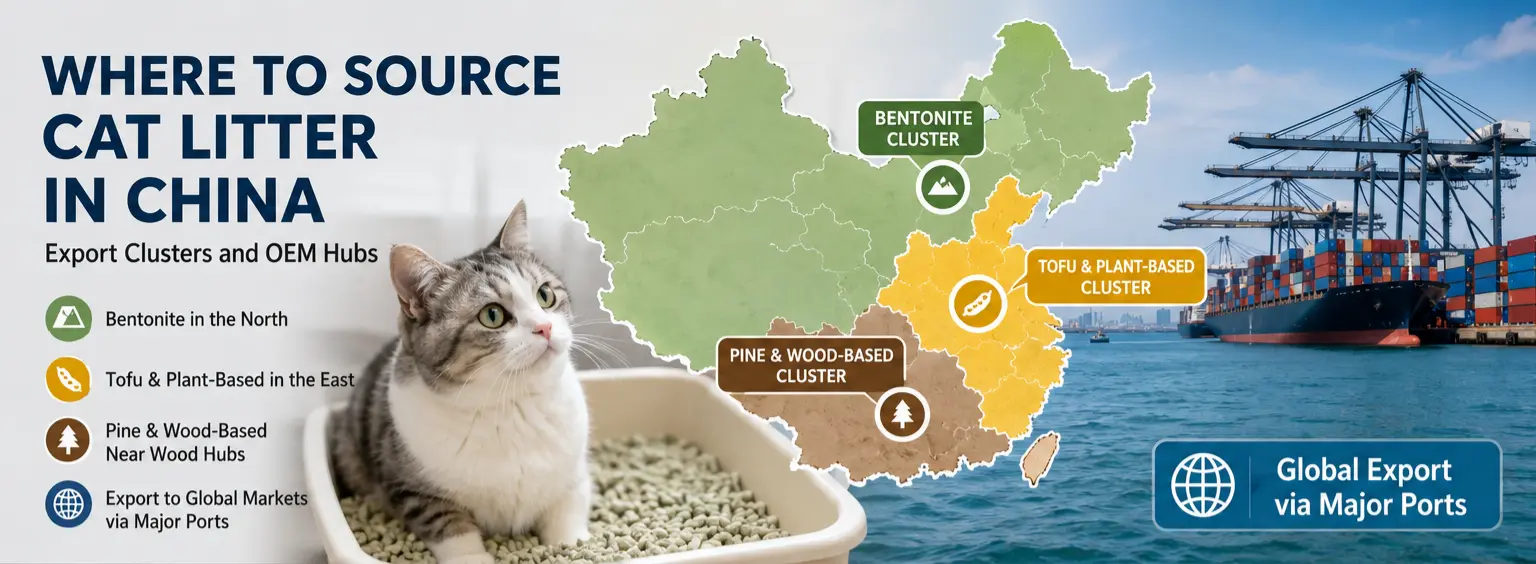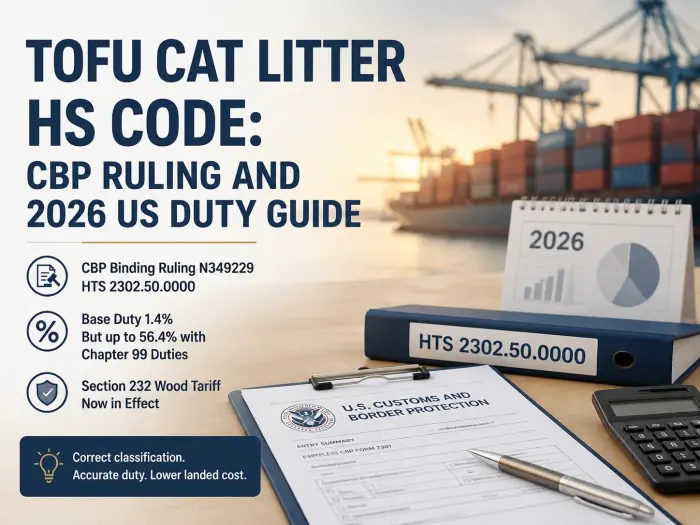





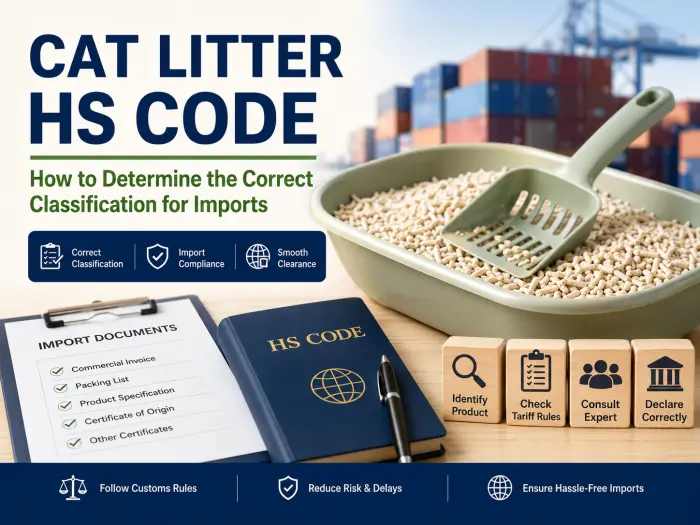
Importing cat litter involves much more than choosing a supplier or booking ocean freight. One of the earliest and most consequential steps is determining the correct cat litter HS code for your product. The Harmonized System (HS) code declared on your customs paperwork influences import duties, the documents you need, inspection risk, and how quickly your shipment clears the border. For importers, distributors, wholesalers, supermarkets, and private-label brands, an incorrect classification can mean a held container, unexpected duties, or a rejected shipment.
Unlike many standardized commodities, cat litter does not have a single universal customs code. Bentonite, tofu, pine, recycled-paper, and blended litters are made from different raw materials and processed in different ways. Customs authorities classify these products according to internationally recognized tariff rules rather than simply because they are sold as “cat litter.” This guide explains how customs determines the right classification, what documentation importers should prepare, and how an experienced supplier can reduce classification risk through accurate product information.
Quick Answer
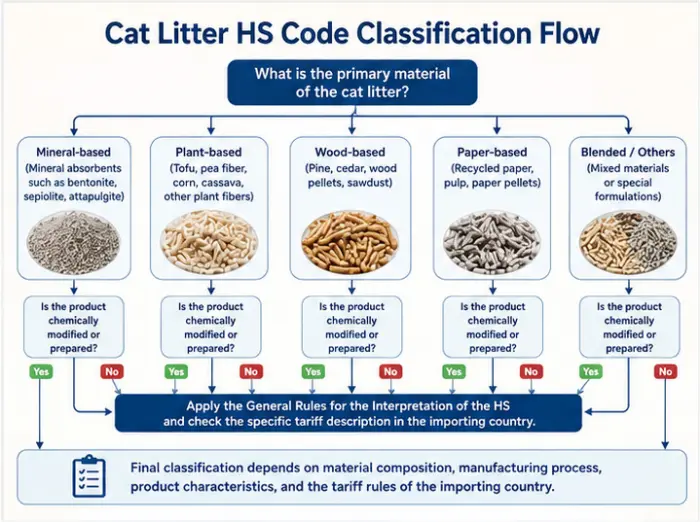
There is no single global HS code for cat litter. Customs authorities classify cat litter based on its material composition, manufacturing process, product characteristics, and the tariff rules of the importing country. Mineral-based, plant-based, wood-based, paper-based, and blended litters may be classified differently depending on how they are made and presented for import. Before shipping, always verify the applicable tariff classification using the official customs tariff of the destination country or consult a licensed customs broker.
What Is an HS Code?
The Harmonized System (HS) is the international product classification system used by customs authorities to identify goods traded across borders. It is administered internationally by the World Customs Organization (WCO). The first six digits of an HS code are standardized across most trading countries, giving a common framework for classifying products.
Many countries then extend those six digits with additional national numbers for customs administration, import duties, trade statistics, or regulatory purposes. For example, the United States uses the Harmonized Tariff Schedule (HTS), while the European Union applies the Combined Nomenclature (CN) and the TARIC system. Because national tariff schedules can differ beyond the international six-digit level, the same product may ultimately receive a different full classification depending on the destination market.
This is why experienced importers verify the applicable code for every country they ship to, rather than assuming one code applies worldwide. The six-digit HS describes the product family; the complete national code determines the duty and the declaration requirements.
Why Cat Litter Does Not Have One Universal HS Code
A common misconception among first-time importers is that every product has a single universal customs code. The term “cat litter” describes a product’s intended use, not its physical characteristics. Customs authorities classify imported goods according to tariff rules that place greater weight on what a product is made from, how it was processed, and its essential characteristics than on its commercial name.
Two products both sold as cat litter may be manufactured from entirely different raw materials. One may consist primarily of naturally occurring mineral absorbents; another may be produced from soybean fiber, recycled paper, wood, or blended ingredients with added deodorizing agents. Although both serve the same purpose for pet owners, customs may evaluate them differently because their composition and manufacturing processes differ.
This distinction matters even more for OEM and private-label importers. Two suppliers can produce visually similar products using different formulations or additives. Assuming both can be declared under the same classification without verification increases the risk of customs queries, delayed clearance, or reassessment of import duties. Instead of relying on the product name, customs officers evaluate technical information and apply the relevant tariff rules to determine the most appropriate classification.
Factors Customs Authorities Consider During Classification
While every customs authority applies its own tariff schedule, the underlying classification process follows similar principles. Rather than asking whether a product is marketed as cat litter, officers evaluate the product’s objective characteristics and supporting documentation. The factors most commonly considered include:
- Material composition. The primary raw material is one of the most important considerations. Cat litter made from mineral absorbents, soybean fiber, wood, recycled paper, or mixed ingredients may be evaluated differently depending on the applicable tariff rules of the importing country.
- Manufacturing process. Crushing, pelletizing, extrusion, drying, blending, chemical treatment, or other production steps may influence classification depending on the finished product’s characteristics.
- Product formulation. Additives such as fragrances, antibacterial agents, deodorizing compounds, activated carbon, or other functional ingredients may affect how the product is evaluated if they significantly influence its essential character.
- Commercial presentation. Packaging, labeling, technical specifications, and the product’s intended commercial use may all be reviewed alongside laboratory reports or ingredient declarations.
- Supporting documentation. Declarations are strengthened by complete technical documentation — product specifications, formulation information, applicable safety documentation, and commercial papers from the manufacturer. Well-prepared documents help customs understand exactly what is being imported and reduce clearance delays.
Classification Considerations by Material
Although there is no universal HS code for cat litter, understanding how customs evaluates different materials helps importers prepare accurate documentation and avoid unnecessary disputes. The descriptions below explain what authorities typically examine — they are not a recommendation of a specific code.
Bentonite and Other Mineral-Based Cat Litter
Bentonite cat litter is manufactured primarily from naturally occurring clay minerals processed into absorbent granules. During review, authorities may consider whether the product consists primarily of natural mineral material, the degree of processing, whether additives have significantly changed its essential character, and how the product is described in the official tariff schedule of the importing country. Importers should avoid assuming that every mineral-based litter is classified identically; similar products may receive different classifications depending on national tariff rules and specifications.
Tofu and Other Plant-Based Cat Litter
Tofu cat litter is typically produced from plant-derived raw materials such as soybean fiber or soybean residue that have been processed into clumping pellets. When evaluating plant-based litter, customs may consider the principal material composition, the manufacturing process used to produce the finished pellets, whether functional additives have been incorporated, and the finished commercial presentation. Because classification practices can differ between importing countries, suppliers should provide detailed product specifications that clearly identify the primary ingredients and production process.
Pine, Wood, and Paper-Based Cat Litter
Wood pellets, pine litter, and recycled-paper litter are manufactured from different fiber sources and production methods. Customs may review whether the product is made from wood, paper, or mixed fibers, the processing methods used during production, whether additional ingredients alter the product’s essential characteristics, and the applicable tariff descriptions published by the destination country’s customs authority. Clear manufacturing information helps officials understand the product and supports consistent classification.
Mixed and Enhanced Formulations
Many modern litters contain more than one primary ingredient — for example, bentonite blended with tofu, activated carbon, deodorizing minerals, natural fragrances, baking soda, or antibacterial additives. Mixed formulations often require additional attention because customs evaluates the product as a whole rather than each ingredient individually. The principal material, the role of additives, and the product’s essential character may all influence the final classification. Importers should obtain detailed formulation information from the manufacturer instead of relying solely on marketing descriptions.
How to Verify the Correct HS Code Before Shipping
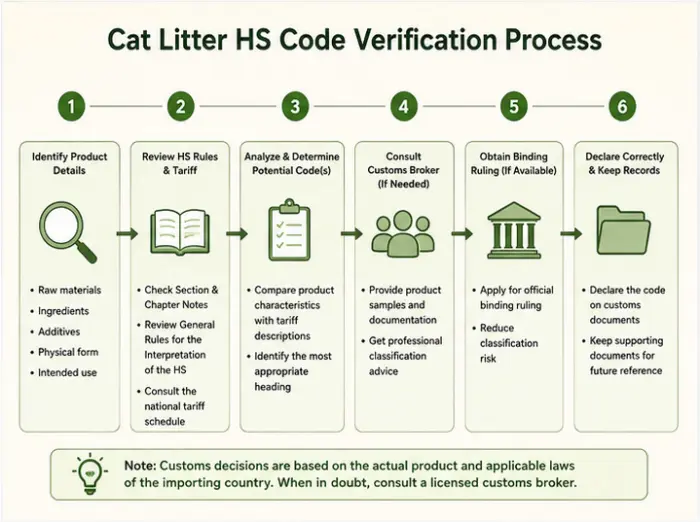
One of the most effective ways to avoid customs delays is to confirm the appropriate classification before production is completed. Waiting until the shipment is ready to depart often leaves too little time to resolve classification questions. A practical verification process typically includes the following steps.
Step 1 — Request Complete Product Specifications
Before discussing tariff classification, ask your supplier for a technical data sheet, product specification sheet, ingredient or material composition, manufacturing process summary, product photos, and packaging information. These documents provide the technical details customs uses when evaluating the product.
Step 2 — Review the Destination Country’s Official Tariff Schedule
Always consult the official customs tariff published by the importing country. Authoritative sources include the United States Harmonized Tariff Schedule (HTS), the European Union TARIC database, the UK Integrated Online Tariff, the Canadian Customs Tariff, and the Australian Working Tariff. Official databases contain legal descriptions, explanatory notes, and national subdivisions that are more reliable than third-party websites.
Step 3 — Consult a Licensed Customs Broker
Experienced customs brokers work with tariff classifications daily and understand how local authorities interpret national schedules. For new products, private-label programs, or blended formulations, consulting a broker before shipment is usually far less expensive than correcting a classification after clearance has been delayed.
Step 4 — Consider an Advance Classification Decision
Some customs authorities let importers request an official advance classification decision before importing. Examples include Binding Tariff Information (BTI) in the European Union and Binding Rulings issued by U.S. Customs and Border Protection (CBP). Where available, these official decisions provide greater certainty for future imports and reduce classification disputes.
Step 5 — Keep Supporting Documents With Your Import Records
Even after clearance, retain all documentation supporting the declared classification: commercial invoice, packing list, product specification, technical data sheet, material composition, test reports where applicable, and any certificates requested by the destination market. Organized records help demonstrate reasonable due diligence if customs later reviews the shipment.
Documents That Support HS Classification
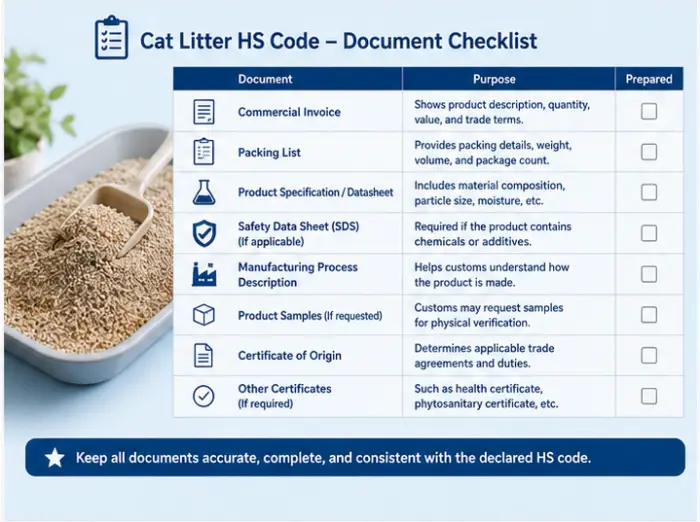
A correct declaration depends not only on selecting an appropriate tariff code but also on maintaining documentation that accurately describes the imported goods. For OEM and private-label cat litter, the following documents are particularly valuable.
| Document | Purpose |
|---|---|
| Commercial Invoice | Describes the goods and the declared transaction value. |
| Packing List | Confirms packaging quantities and shipment details. |
| Product Specification Sheet | Defines physical and technical characteristics. |
| Technical Data Sheet (TDS) | Explains product performance and composition. |
| Material Composition / Ingredient Information | Supports customs classification and essential-character assessment. |
| Certificate of Origin (if required) | Supports origin declarations and preferential tariffs where applicable. |
| Safety Documentation (where applicable) | May be requested depending on formulation and destination market. |
Common Classification Mistakes Importers Should Avoid
Even experienced importers encounter customs delays because of incorrect classifications. In most cases the issue is not intentional misdeclaration but reliance on incomplete information or assumptions carried from previous shipments.
- Assuming every cat litter uses the same code. Customs evaluates the actual characteristics of the goods, not the name on the package. Different formulations, methods, and compositions may require different classifications.
- Copying a previous shipment’s code. Reusing a code without confirming identical specifications is risky when changing suppliers, switching OEM manufacturers, launching a private-label product, modifying ingredients, or adding fragrances or functional additives.
- Relying only on online search results. Unofficial HS lists often lack explanation or legal support. They are a starting point, not a substitute for the official tariff or a licensed broker.
- Failing to keep supporting documentation. Selecting the code is only part of compliance. Retain specifications, formulation information, invoices, packing lists, and clearance documents to answer any customs inquiry.
How Pet Horizon Supports Import Compliance
For international buyers, selecting a reliable manufacturer involves more than comparing price or capacity. A professional supplier should also provide the technical documentation needed to support customs clearance and trade compliance. Pet Horizon supports OEM, private-label, wholesale, distribution, and brand-owner customers by preparing export documentation that aligns with the products we manufacture.
Depending on the product and destination market, we can provide product specification sheets, technical data sheets, material and ingredient information, packing lists, commercial invoices, and certificates requested for export where applicable. Our manufacturing team works closely with customers during product development to ensure technical documentation accurately reflects the finished product before shipment. While the final tariff classification is determined by the importer and the destination customs authority, complete and accurate product information reduces uncertainty and supports smoother clearance.
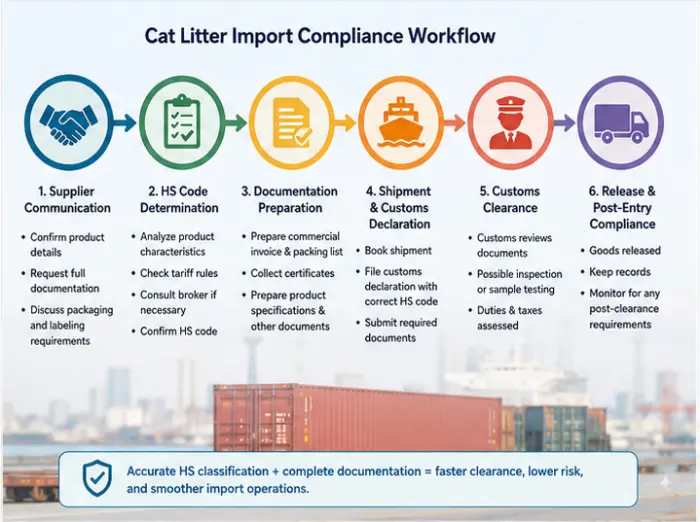
Best Practices Before Importing Cat Litter
Before placing your first production order, use this checklist to reduce customs risk:
- Confirm the exact product formulation with your supplier.
- Request complete technical specifications and supporting documentation.
- Review the official tariff schedule of the destination country.
- Consult a licensed customs broker if classification is uncertain.
- Consider requesting an advance classification decision where available.
- Keep all import documentation for future customs reference.
- Verify that product descriptions stay consistent across invoices, packing lists, shipping documents, and customs declarations.
Conclusion
Determining the correct cat litter HS code is not about finding one number that works for every shipment. It is about understanding how customs evaluates products and ensuring your declaration accurately reflects the goods being imported. Because cat litter is made from a wide range of materials — mineral, plant-based, wood, paper, and blended — classification depends on composition, manufacturing process, applicable tariff rules, and the requirements of the destination country.
Successful importers reduce risk by verifying classifications before shipment, maintaining complete technical documentation, and working with experienced suppliers and customs professionals. When classification is treated as part of an overall import compliance strategy, it improves clearance efficiency, reduces unexpected costs, and supports long-term sourcing success. For the duty side of the same equation, see our cat litter import tariffs guide; for moving the goods, our shipping and logistics guide; and for the full import sequence, our cat litter import guide.
Frequently Asked Questions
Is there a universal HS code for cat litter?
No. There is no single international HS code that applies to every cat litter product. Customs classify goods according to material composition, manufacturing process, and the tariff rules of the importing country.
Why do different suppliers provide different HS codes?
Different manufacturers may use different formulations, production methods, or additives. Even products with similar commercial names can require different classifications depending on their technical characteristics.
Who is legally responsible for declaring the correct HS code?
In most countries, the importer of record is ultimately responsible for the customs declaration, even when a supplier provides classification guidance.
Should I trust the HS code printed on a supplier’s invoice?
Supplier information is an important reference, but you should verify the classification using the official tariff schedule of the destination country or consult a licensed customs broker before shipment.
Can additives change the customs classification of cat litter?
Potentially, yes. Depending on the importing country’s tariff rules, additives or processing may influence how customs evaluates the product’s essential characteristics.
What documents help support customs classification?
Useful documents include product specification sheets, technical data sheets, material composition information, commercial invoices, packing lists, certificates of origin where applicable, and any supporting technical documentation requested by customs.
What is the difference between an HS code and an HTS code?
The Harmonized System (HS) provides the internationally standardized six-digit framework. Some countries, such as the United States, extend those six digits into national schedules such as the Harmonized Tariff Schedule (HTS) for duty assessment and customs administration.
What should I do if I am unsure about the correct classification?
Gather complete technical information from your supplier, review the official tariff schedule of the importing country, and consult a licensed customs broker. Where available, consider requesting an advance classification decision from the relevant customs authority.