




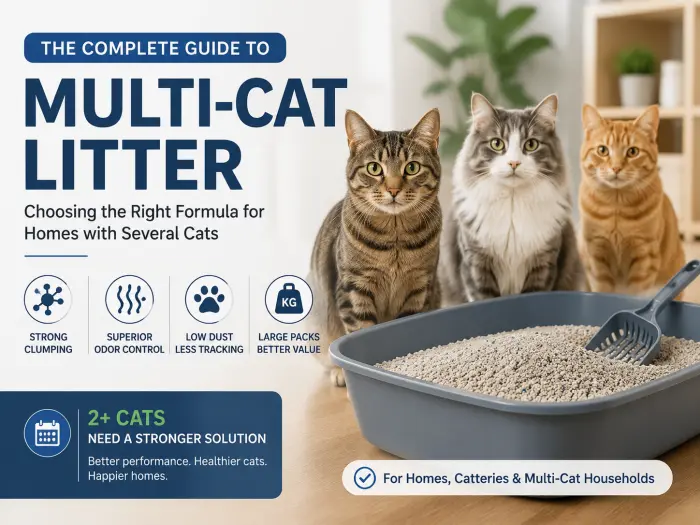
Cat ownership is shifting upward. More households now keep two or more cats, and that changes the math on litter performance, volume, and cost. For brands, importers, distributors, and retailers, a dedicated multi-cat litter is no longer a niche SKU. It is one of the fastest-growing and most profitable segments in the category.
Quick Answer
Multi-cat litter is a clumping formula engineered for homes or facilities with two or more cats, where waste load and ammonia buildup are far higher than in single-cat settings. It delivers stronger clumping, faster odor adsorption, and larger granules to reduce tracking. Choose it when a standard box runs out too quickly or smells of ammonia between scoops.
Quick Comparison: Multi-Cat Litter at a Glance
Choosing the right litter for multiple cats usually comes down to four factors: odor control, clumping strength, material choice, and pack size. The table below summarizes the main points buyers consider before switching to a multi-cat formula.
| Question | Short Answer |
|---|---|
| What is multi-cat litter? | Multi-cat litter is a high-capacity clumping formula designed for households with two or more cats, where waste volume and odor pressure are higher. |
| Is multi-cat litter different from regular litter? | Yes. Multi-cat formulas typically use stronger clumping systems, higher odor adsorption capacity, and larger granules to handle heavier daily use. |
| How many cats need multi-cat litter? | Most households with two or more cats can benefit from a multi-cat formula, especially when cats share litter boxes. |
| What size pack is best for multiple cats? | Large packs around 15–20 kg are commonly preferred because multi-cat homes consume litter faster and benefit from lower cost per kilogram. |
| What is the best material for multi-cat litter? | Bentonite-heavy and mixed formulas usually provide the strongest odor control, while tofu and low-dust blends target premium eco-focused markets. |
What Makes a Litter “Multi-Cat”?
A multi-cat litter is a formula built for two or more cats sharing the same space. The core difference is load. One cat produces a predictable volume of urine and stool; add a second or third cat and the waste load multiplies faster than the number of animals, because boxes are shared and traffic is constant. Urine that is not sealed quickly breaks down into ammonia, and ammonia is what makes a multi-cat home smell within hours.
In simple terms, multi-cat litter is a high-capacity cat litter category designed for households with two or more cats, where odor load, moisture volume, and scooping frequency are higher than single-cat homes.
To handle that load, multi-cat formulas adjust three things: clump strength, odor-adsorption capacity, and granule size. The clump must hold together under heavier scooping traffic. The odor system must absorb more ammonia and urea compounds. The granules are usually a little larger to reduce tracking and dust when several cats enter and leave the box.
The demand shift is real and measurable. According to APPA data, U.S. households with three or more cats grew 36% since 2018, while dual-cat households grew 8%. Over the same period, the single-cat household share fell from 64% to 58%. More cats per home means more large packs and stronger formulas moving through the supply chain.
Independent market research confirms the same pattern in Europe. IndexBox country reports estimate the Netherlands multi-cat litter retail market at roughly €160–190 million per year, equal to about 85,000–95,000 tonnes of product Netherlands multi-cat litter market analysis. In Poland, multi-cat formulas already account for about half of total cat litter volume, with value growth of 6–8% against 2–4% for the single-cat segment Poland multi-cat litter market analysis.
Two buying habits stand out across these markets. Multi-cat households prefer 15–20 kg large packs, and they trade up to premium odor-control formulas. For a B2B buyer, that combination — bigger packs, higher price per kilogram, and repeat purchase — makes multi-cat the most attractive heavy-goods segment to stock.
Why Odor Control Matters Most in Multi-Cat Homes
Odor is the single reason households switch to a multi-cat formula. Cat urine contains urea, which bacteria convert into ammonia. In a single-cat home, a standard litter can absorb and mask that smell for a day or two. In a multi-cat home, the ammonia load builds within hours, and a weak formula saturates and starts to smell.
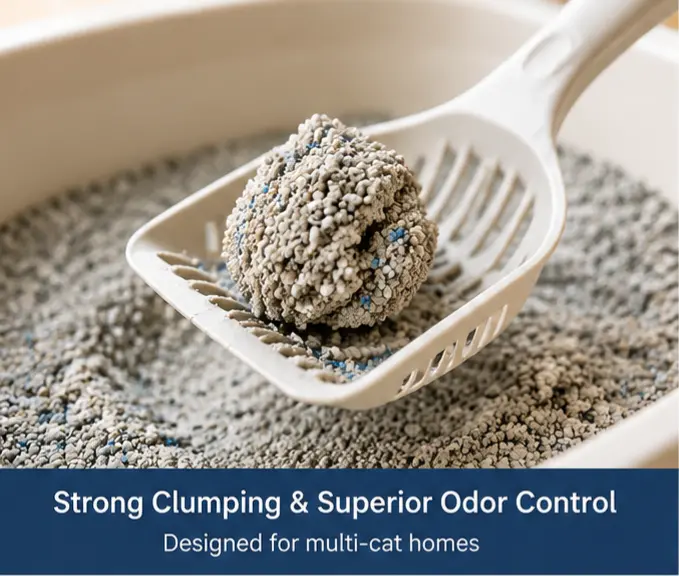
A proper multi-cat litter attacks the problem at two points. First, it forms a fast, tight clump that seals liquid away from the lower litter layer and the box base, where odor-causing bacteria multiply. Second, it carries a higher load of adsorbents — typically activated charcoal, zeolite, or mineral compounds — that bind ammonia gas rather than merely covering it with fragrance.
Scented versus unscented is a separate decision. Fragrance can mask odor short term but does not remove ammonia. For genuinely multi-cat performance, the adsorption capacity matters more than the perfume. Many importers therefore stock both an unscented control variant and a lightly scented variant to serve different retail channels.
How Much Litter for Two Cats (and More)
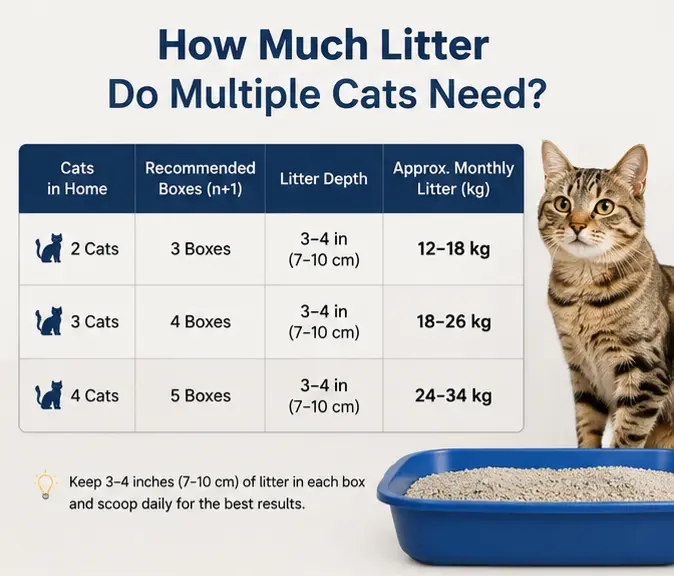
The most common question from multi-cat owners is simple: how much litter do two cats need? The answer depends on box count, depth, and how often you scoop. The practical rule is to keep 3–4 inches (7–10 cm) of litter in every box so clumps form fully and the base stays dry.
Use the “one box per cat, plus one” rule. Two cats should have three boxes. Each box at 3–4 inches depth needs roughly 4–6 kg of litter to fill, then about 2–3 kg per month of top-up lost to scooping and clump removal. Across three boxes, that is about 12–18 kg of litter per month for two cats. Three cats in four boxes run closer to 18–26 kg, and four cats in five boxes approach 24–34 kg.
| Cats in home | Recommended boxes (n+1) | Litter depth | Approx. monthly litter (kg) |
|---|---|---|---|
| 2 cats | 3 boxes | 3–4 in (7–10 cm) | 12–18 kg |
| 3 cats | 4 boxes | 3–4 in (7–10 cm) | 18–26 kg |
| 4 cats | 5 boxes | 3–4 in (7–10 cm) | 24–34 kg |
Daily scooping removes the clumps and most of the lost volume, so you top up rather than fully replace. With multi-cat formulas, a full box change is usually needed every 2–4 weeks rather than weekly, because the stronger clump keeps the base clean. Buying 15–20 kg packs matches this consumption and lowers the cost per kilogram versus small bags.
Multi-Cat Household Litter Box Setup
Even the best multi-cat litter fails if the boxes are wrong. The setup determines whether cats use the boxes consistently and whether odor stays controlled.
- Follow n+1. Provide one box per cat, plus one extra. Crowded boxes drive cats to eliminate elsewhere and concentrate odor.
- Spread boxes apart. Place them in separate rooms or at least opposite corners. Cats are territorial, and a cluster of boxes reads as one territory.
- Size up. Multi-cat boxes should be larger than standard. Bigger cats and more traffic need more surface area.
- Choose covered with care. Covers hide mess but can trap ammonia. If you use covered boxes, scoop at least twice daily and ensure ventilation.
- Scoop often. In multi-cat homes, once daily is the minimum. Twice daily keeps ammonia from building between cleanings.
Multi-Cat Litter vs Regular Litter
Buyers often ask whether a separate multi-cat product is necessary or just marketing. The differences are concrete and tied to performance under heavier load.
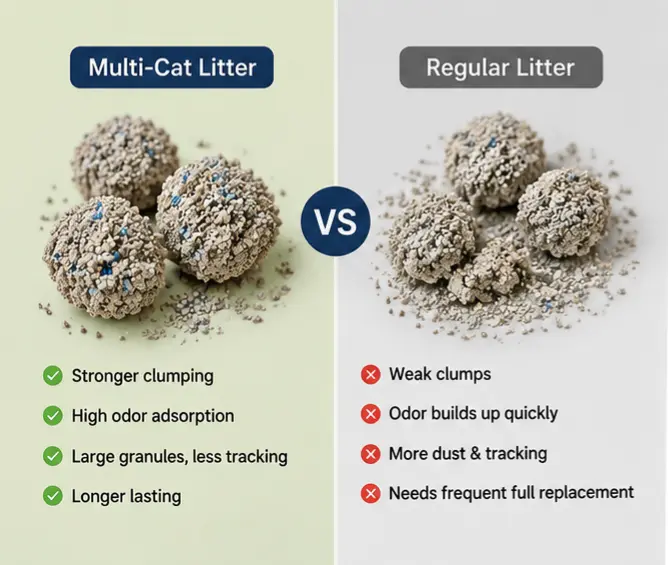
| Attribute | Regular litter | Multi-cat litter |
|---|---|---|
| Clump strength | Standard, can break under traffic | Stronger, holds under heavy scooping |
| Odor control | Moderate adsorption | High-capacity adsorbents for ammonia |
| Granule size | Fine to medium | Larger to reduce tracking and dust |
| Typical pack size | 5–10 kg | 15–20 kg |
| Price per kg | Lower | Higher |
| Repurchase frequency | Standard | More frequent in multi-cat homes |
The higher price per kilogram is justified by performance, not by filler. A regular litter in a two-cat home saturates faster, smells sooner, and gets thrown out more often. The multi-cat variant lasts longer per box and protects the brand from returns and complaints.
Best Cat Litter for Multiple Cats: Material Options
The “best” material depends on the retail market and local disposal rules, but three bases dominate multi-cat assortments. Each has a clear trade-off that a buyer should understand before choosing cat litter types overview.
- Bentonite clumping litter. The strongest clump and the best raw-material base for high ammonia adsorption when loaded with charcoal or mineral adsorbents. Heavier and dustier unless processed for low dust, but unmatched for odor in dense multi-cat use.
- Tofu litter. Low dust, lighter, and accepted for flushing in some regions. Softer on paws but weaker clump under heavy traffic unless blended. Popular with premium and eco-positioned retail channels.
- Mixed litter. A blend of tofu and bentonite that pairs a fast firm clump with lower dust and better odor than tofu alone. A mixed cat litter is increasingly the default choice for multi-cat SKUs because it balances clump, dust, and odor.
For pure odor performance in busy multi-cat homes, bentonite-heavy or mixed formulas usually win. For low-dust premium positioning, a well-built mixed or tofu formula is the safer retail bet.
Common Mistakes in Multi-Cat Litter Management
Most multi-cat odor and avoidance problems come from a short list of repeatable errors. Avoiding them protects both the cat owner relationship and the brand’s reputation.
- One box for many cats. Skipping the n+1 rule concentrates waste and drives avoidance. More boxes solve more problems than a stronger formula alone.
- Under-filling depth. Less than 3 inches lets urine hit the box base, where it smells and resists scooping.
- Buying small packs. 5 kg bags cost more per kilogram and force constant reorders. Multi-cat homes want 15–20 kg packs.
- Weak clumping litter under traffic. A fragile clump breaks apart, spreads odor, and makes scooping ineffective.
- Ignoring the box base. Ammonia builds at the bottom. A full box change every 2–4 weeks matters more than the daily scoop.
- Abrupt formula switching. Cats reject sudden changes. Transition over 7–10 days by mixing the old and new litters.
How Manufacturers Build a Multi-Cat Formula
From a manufacturing perspective, a multi-cat litter is an exercise in pushing three parameters without breaking the others. Stronger clumping usually means higher bentonite activation or added binder. Stronger ammonia adsorption means a higher load of charcoal or zeolite. Larger granules reduce tracking and dust but can soften the paw feel, so granule size is tuned, not maximized.
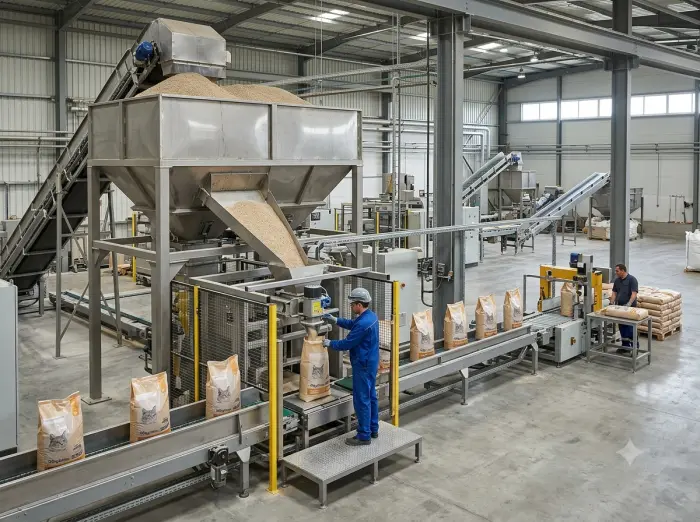
The 15–20 kg pack spec is not just a retail preference. It changes the production line. Larger bags need stronger film and adjusted fill speed, and the heavier unit weight changes pallet patterns and container loading. A 20ft container of 15–20 kg packs carries more tonnage and better margin per shipment than the same weight split into small bags, because handling and freight stay fixed while sell-through rises.
For importers, multi-cat is the best heavy-goods margin segment: higher unit price, higher repurchase frequency, and larger tonnage per shipment. For OEM and private-label buyers, the opportunity is even simpler. A multi-cat variant is an easy SKU extension of the same base — bentonite, tofu, or mixed — achieved by adjusting clump and odor parameters. That means minimal new tooling, no new raw-material line, and a fast route to launch.
About Pet Horizon
Pet Horizon is a cat litter manufacturer with 20+ years of industry experience and 10+ years in OEM/ODM production. We export to 80+ countries and support formula customization, dust control, and in-house quality control across bentonite, tofu, and mixed bases. Our standard MOQ is 1×20ft Container, negotiable depending on the market and formula. A multi-cat variant is a natural extension of any base we already produce, which lets partners launch a high-margin SKU without rebuilding their supply line.
Conclusion
Multi-cat litter is a distinct, fast-growing category defined by stronger clumping, higher odor adsorption, and larger granules that suit shared boxes and heavier traffic. Plan for 12–18 kg per month for two cats across three boxes, follow the n+1 setup rule, and choose a bentonite-heavy or mixed base for the toughest odor jobs. For buyers, the segment rewards large packs and repeat purchase. If you are sourcing or private-labeling for this demand, review our cat litter wholesale program to match pack size and formula to your market.
Frequently Asked Questions
Yes, when made from standard, non-toxic base materials with controlled dust. The stronger odor system uses adsorbents such as charcoal or zeolite rather than heavy fragrance, which is safer for sensitive cats. Avoid litters with irritating perfumes in homes with respiratory issues.
Two cats using three boxes at 3–4 inches depth typically need about 12–18 kg per month, counting fill and daily top-up from scooping. Exact use rises with scoop frequency and box size.
Follow the n+1 rule: one box per cat plus one extra. Two cats need three boxes, three cats need four, and so on. Spacing boxes in separate rooms reduces territorial conflict and odor concentration.
The main difference is performance under heavier waste loads. Multi-cat litter is designed with stronger clumping, higher odor adsorption, and improved tracking control for homes where multiple cats use the same litter boxes. Regular litter may work for single-cat households but can become saturated faster in multi-cat environments.
The price per kilogram is higher because of added adsorbents and stronger clumping agents. In use it is often cheaper, since it lasts longer per box and needs fewer full changes in a multi-cat home.
Only specific tofu or other flushable bases are suitable, and only where local plumbing and regulations allow. Bentonite and mixed formulas should never be flushed. Always check the base material and local rules before recommending flushability.
For maximum odor control, bentonite-heavy or mixed (tofu plus bentonite) formulas perform best. For low-dust premium positioning, a well-built mixed or tofu formula is the safer retail choice. The right pick depends on your market and disposal rules.
Yes. A multi-cat variant is an easy extension of an existing bentonite, tofu, or mixed base, made by adjusting clump strength and odor parameters. It needs minimal new tooling, so it is one of the fastest SKUs to launch.
At Pet Horizon the standard MOQ is 1×20ft Container, negotiable based on formula and market. Because the variant reuses an existing base, a custom multi-cat SKU is practical even for mid-size import programs.
Scoop at least once daily, ideally twice. Do a full box change every 2–4 weeks with a strong multi-cat formula, versus weekly with a weak one, because the tighter clump keeps the base dry and odor-free longer.
A 20 kg bag of multi-cat litter can last approximately one to two months for some two-cat households, depending on the number of litter boxes, litter depth, scoop frequency, and cat habits. Homes with more cats or larger boxes will use litter faster.
For strong odor control in multi-cat homes, bentonite-heavy and mixed formulas generally perform well because they combine firm clumping with high adsorption capacity. Activated charcoal, zeolite, and other mineral adsorbents are commonly used to help reduce ammonia-related odors.