




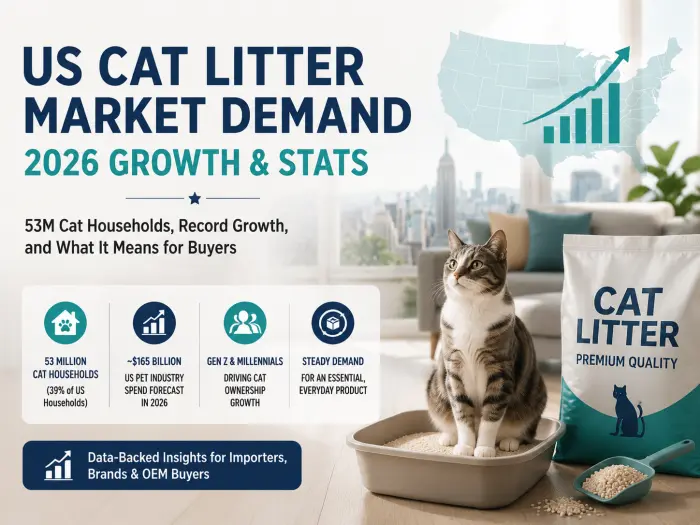
The US cat litter market demand picture for 2026 is shaped by one clear signal: more American households are living with cats than ever before. For importers, private label brands, and OEM buyers, this shift is not a passing trend. It is a structural change in how the largest pet market in the world consumes an essential, non-discretionary product.
Quick Answer
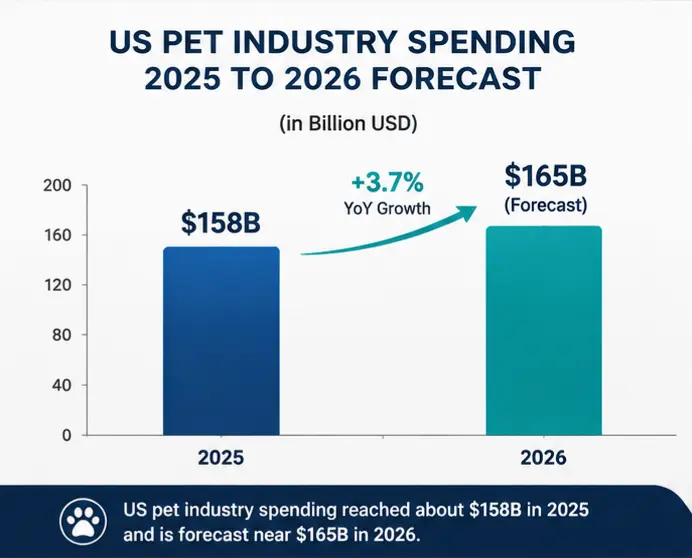
US cat litter market demand is growing. In 2026, cat-owning households reached a record 53 million, up roughly 5% year over year, while total US pet industry spending reached about $158 billion in 2025 and is forecast near $165 billion in 2026. Because litter is an essential purchase, demand stays resilient even when owners cut discretionary pet spending.
US cat litter market demand refers to the purchasing demand for cat litter products among American cat-owning households, including retail consumption, wholesale distribution, and private label supply opportunities. It is mainly influenced by cat ownership growth, repeat purchase behavior, consumer preferences, and product trends such as low-dust and plant-based litter.
US Pet Industry Spending in 2025 and 2026
The broader pet economy provides the backdrop. According to industry association data, total US pet industry spending reached approximately $158 billion in 2025, an increase of about 3.7% over the prior year. Forecasts place 2026 spending near $165 billion. Pet ownership itself remains deeply embedded in American households.
Across the country, about 95 million households, roughly 71.6% of all US households, live with at least one pet. That base has held steady through economic uncertainty, which is one reason the category attracts long-term B2B investment from distributors and contract manufacturers.
The American Pet Products Association (APPA) is the authoritative trade association behind the annual pet ownership and spending benchmarks most US buyers reference. Its data is widely cited by retailers, importers, and analysts because it draws on a large, recurring national survey. When APPA reports a movement in ownership, the market treats it as a credible signal rather than an isolated anecdote.
Cat Ownership Statistics 2026
Cat ownership statistics 2026 show a category that is quietly outpacing the wider market. The number of US households with cats rose to 53 million, representing about 39% of all households and a year-over-year increase of roughly 5%. APPA described the rise in cat ownership as a “record” movement, underscoring how significant the jump is relative to historical norms.
| Metric | 2025–2026 Value | Note |
|---|---|---|
| Total US pet industry spend (2025) | ~$158 billion | +3.7% YoY |
| Forecast US pet spend (2026) | ~$165 billion | Steady growth |
| Pet-owning households | ~95 million (71.6%) | Stable majority |
| Cat-owning households | 53 million (39%) | +5% YoY, record rise |
| Cat ownership driver | Gen Z & Millennials | Small homes, flexible schedules |
| Gen X pet ownership | +12% YoY | Fast-growing segment |
Data source note: US pet ownership and spending figures referenced in this article are based on publicly available reports from the American Pet Products Association (APPA) and related industry research coverage. Figures represent market estimates and are intended for B2B market evaluation and sourcing decisions.
How Many Households Own Cats in the US
The direct answer to “how many households own cats in the US” is 53 million, or close to 4 in 10 households. This matters for B2B planning because cat penetration now sits near dog-owning levels in many metro markets, and cat owners tend to buy litter continuously rather than seasonally.
For wholesalers and distributors, the implication is predictable replenishment. A 39% household penetration rate means a very large, repeat-purchase base that does not depend on gift seasons or weather. Importers can plan container volumes around steady monthly offtake rather than volatile spikes, which improves cash flow and warehouse planning.
Gen Z Pet Ownership Trends Are Reshaping the Category
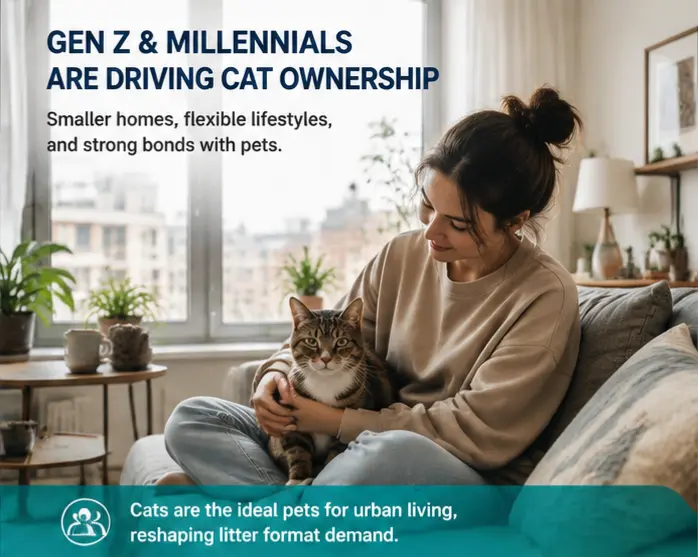
Gen Z pet ownership trends explain much of the recent acceleration. Younger owners and Millennials are entering pet ownership at a time when smaller living spaces, urban apartments, and flexible or remote schedules make cats a practical first pet. Cats require less outdoor space and fit compact housing far better than large dogs.
This demographic shift favors lighter, low-dust, and easy-to-ship litter formats such as tofu and mixed recipes. Brands targeting younger buyers should expect demand for odor control, plant-based positioning, and convenient packaging. For manufacturers, that means formulation flexibility and private label options matter more than ever. Detailed behavioural context on shifting owner habits is available from independent pet market research such as Pet Worldwide’s changing behaviour report.
Gen X is also part of the story. Pet ownership among Gen X households grew roughly 12% year over year, suggesting the category is broadening across age groups rather than relying on a single generation. A widening demographic base reduces the risk that demand peaks and then fades with one cohort.
| Demand Driver | Impact on Cat Litter Market |
|---|---|
| More cat households | Larger recurring customer base |
| Apartment living | Higher preference for cats |
| Low dust demand | Growth of tofu and premium litter |
| Private label growth | More OEM opportunities |
The Shift From Discretionary to Essential Spending
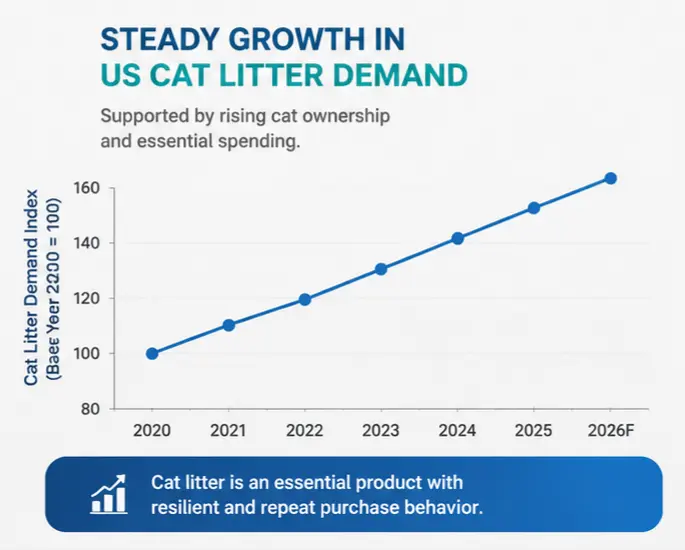
A second force supports US cat litter market demand: the way owners allocate their budgets. Surveys of owner behavior show roughly half of pet owners maintained their spending level, while about 22% reported cutting back. The cuts fell most heavily on discretionary items, toys, accessories, and premium treats, not on essentials.
Cat litter sits firmly in the essential column. A cat must be cared for every day, and litter is non-discretionary. That defensive quality makes the category attractive to importers and brands building resilient revenue. When consumers tighten budgets, they may trade down on brand but rarely stop buying litter entirely.
Is the US Cat Litter Market Growing?
Yes, the cat litter market is growing in the US. The clearest evidence is the record rise in cat-owning households to 53 million, the steady expansion of total pet spending toward $165 billion, and the defensive nature of litter as an essential product. Demographic tailwinds from Gen Z, Millennials, and Gen X add further momentum.
Growth is not uniform, however. It concentrates in value and performance segments where imported products compete strongly. Buyers increasingly weigh clumping performance, dust control, and total cost per use. For suppliers, that rewards manufacturing efficiency and consistent quality more than premium branding alone.
For a wider view of regional dynamics, our analysis of the global cat litter market in 2026 covers how these US trends connect to worldwide supply.
- 53 million US households own cats
- Cat litter is a recurring essential purchase
- Low-dust and plant-based formats are gaining attention
- Private label opportunities continue expanding
Common Mistakes When Interpreting US Cat Litter Demand
B2B buyers sometimes misread the data. Avoid these errors:
- Treating total pet spend as cat-litter spend. The $158B figure covers all pets and products; litter is a sub-segment, so size it from cat-household counts.
- Assuming growth is uniform across formats. Clumping, low-dust, and plant-based products grow faster than legacy non-clumping clay in many channels.
- Ignoring the essentials effect. A 22% discretionary cut does not mean a 22% litter cut; essentials hold up far better.
- Over-relying on a single survey. Cross-check APPA benchmarks with retail and import data before committing container volumes.
- Underestimating younger buyers. Gen Z and Millennial preferences drive formulation, packaging, and private label demand.
What US Demand Means for Importers, Brands, and OEM Buyers
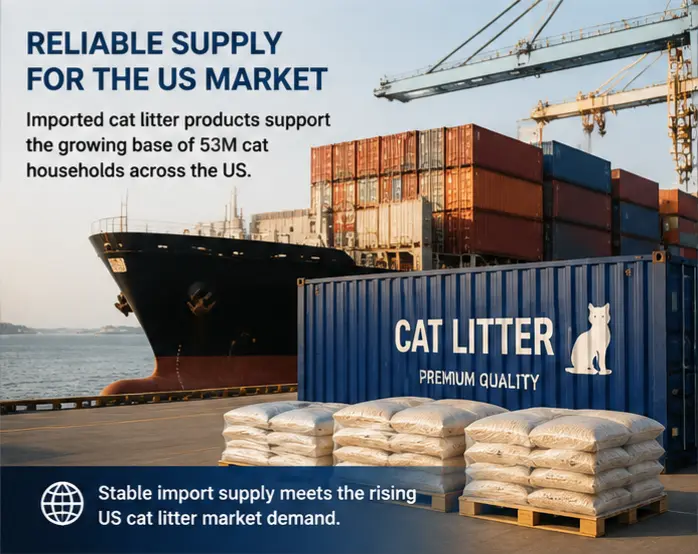
For importers, brands, and OEM buyers, the data points to a durable opportunity. A still-expanding US demand base means shelf space and private label programs continue to open for suppliers who can deliver consistent quality at competitive landed cost. Value and performance positioning strongly favors imported products, where manufacturing scale and formulation control determine margin.
Official association data also strengthens negotiation positions. APPA benchmarks give importers and brands credible, third-party backing when discussing volume commitments, pricing, and retail listings with US partners. The APPA report and its resilient-ownership findings are summarized by trade coverage such as Animal Health News’ analysis of the 2026 APPA report. Suppliers who can speak the language of category data win more shelf and contract conversations.
What US Cat Litter Demand Means for Manufacturers
Manufacturers serving the US market need to focus on three priorities: consistent quality, competitive landed cost, and flexible private label capabilities. These factors determine whether suppliers can compete in a market where demand is growing but buyers remain price-conscious.
Pet Horizon is a cat litter manufacturer with more than 20 years of industry experience and over 10 years dedicated to OEM and ODM partnerships. We export to more than 80 countries and support both branded and private label programs with formulation customization, dust-control process control, and consistent quality inspection.
Our minimum order quantity starts at 1×20ft container and is negotiable depending on recipe and packaging. For importers planning US-bound volumes, that flexibility helps align production with the steady, repeat-purchase demand described above. Buyers can review our complete cat litter sourcing and buying guide for practical steps on specifications, sampling, and logistics.
Conclusion
US cat litter market demand remains on a clear upward path. Record cat ownership of 53 million households, resilient pet spending near $165 billion, and the essential nature of litter all support a stable, growing category. For importers and OEM buyers, the opportunity lies in value and performance products backed by real category data.
To plan your assortment, explore our cat litter buying guide for format selection, and read the global cat litter market 2026 outlook to connect US demand with worldwide supply and sourcing.
Frequently Asked Questions
About 53 million US households own cats as of 2026, according to APPA benchmarks. That represents roughly 39% of all US households and reflects a record year-over-year rise of about 5%.
The main drivers include rising cat ownership, repeat purchase behavior, demand for low-dust products, plant-based litter adoption, and growth of private label pet products.
Gen Z and Millennial buyers are driving cat ownership growth because smaller homes, apartments, and flexible schedules favor cats over large dogs. This shifts demand toward low-dust, plant-based, and easy-to-ship litter formats.
Growth is strongest in performance-focused categories such as tofu cat litter, low-dust clumping litter, and plant-based formulas, as buyers increasingly prioritize convenience and sustainability.
Cats require daily care, and litter is a non-discretionary purchase. Even when owners cut discretionary pet spending by about 22%, essentials like litter hold up because owners cannot stop caring for their cats.
Because roughly half of owners maintain spending and cuts fall on discretionary items, litter demand stays resilient. Owners may trade down on brand but keep buying, which protects volume for importers and brands.
US import demand is supported by a still-expanding cat-owning base of 53 million households and a preference for value and performance products. Importers benefit from consistent monthly offtake rather than seasonal spikes.
OEM buyers should combine APPA ownership and spending benchmarks with retail and import data. The 53 million cat-household count, ~$165B 2026 spend forecast, and 39% penetration are the core figures for volume planning.
Pet Horizon’s minimum order quantity starts at 1×20ft container and is negotiable based on recipe and packaging. We have over 20 years of industry experience and 10+ years of OEM/ODM partnerships across 80+ countries.
Importers can cite APPA’s record cat-ownership rise and resilient spending as third-party proof of category growth. This strengthens discussions on volume commitments, pricing, and retail listings with US partners.