



Key Takeaways
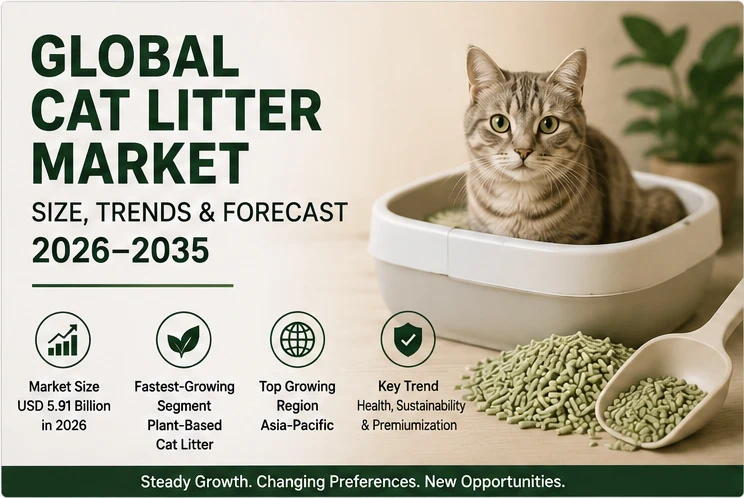
- The global cat litter market is projected to reach USD 5.91 billion in 2026, with a long-term forecast of USD 9.9 billion by 2035.
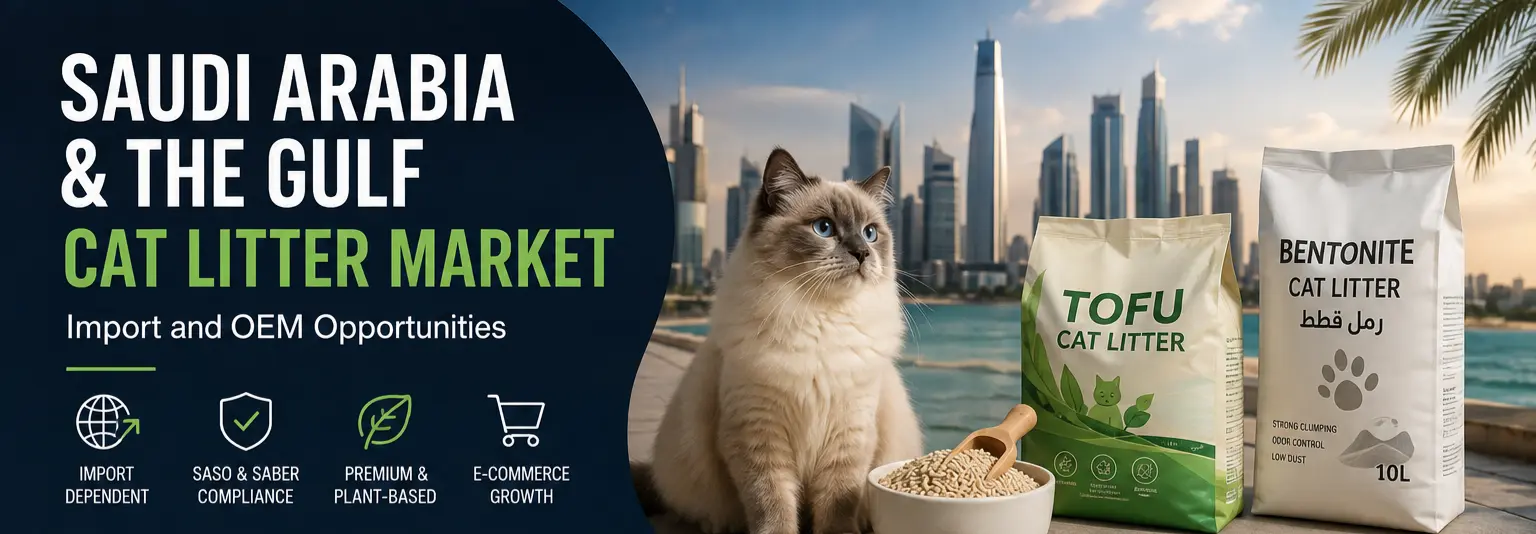
- Plant-based cat litter is the fastest-growing segment, expanding at over 10% annually as demand for biodegradable and low-dust cat litter continues to rise.
- Mixed cat litter is becoming a dominant category in key markets such as China, commanding 48.2% share and achieving the highest user satisfaction rate of any category at 89%.
- Asia-Pacific is the fastest-growing regional market, projected to grow over 12% in 2026, led by China’s expanding pet ownership base.
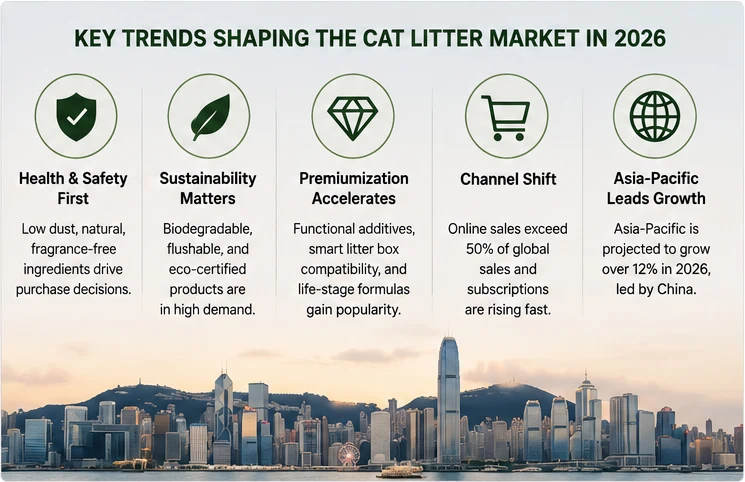
- Health, sustainability, and premiumization are the three forces reshaping global cat litter market trends.
Introduction: Why the Cat Litter Market Is Having Its Moment
The global pet economy continues to expand, with cats becoming one of the fastest-growing companion animal segments. Quiet, independent, and relatively affordable to keep, cats have become the go-to companion for households across the world. By 2025, the number of cat-owning families had surpassed 350 million globally, with 63% of those cats living exclusively indoors. That shift matters — because indoor cats need cat litter, and they need it every single day.
Cat litter isn’t a discretionary purchase. It’s a recurring essential in the pet care industry, and that makes the global cat litter market one of the most resilient segments in consumer goods.
In 2026, the global cat litter industry is undergoing a transformation driven by sustainability, product innovation, and premiumization. Pet humanization is pushing demand beyond basic clumping and odor control — today’s cat owners want products that are safe, sustainable, and genuinely better. Meanwhile, raw material innovation, new distribution models, and fast-growing regional markets are reshaping competitive dynamics across every price tier.
This analysis covers cat litter market size, category performance, consumer behavior, regional dynamics, and the key challenges and opportunities shaping the industry in 2026.
1. Global Cat Litter Market Size in 2026: Steady Growth With Room to Run
Overall Market Scale
The global cat litter market reached approximately USD 5.58 billion in 2025. In 2026, forecasts from major research firms put the figure between USD 5.91 billion (Global Growth Insights, +5.9% YoY) and USD 6.6 billion (Future Market Insights, 6.9% CAGR). As is common in emerging consumer categories, industry estimates vary due to differences in methodology, market scope, and regional coverage across research reports — but the directional consensus is clear: steady, durable cat litter market growth with a long runway ahead.
Looking further out, the market is projected to reach USD 9.9 billion by 2035, sustained by a CAGR of approximately 5.9%. That trajectory firmly places this category in the “resilient essentials” tier of consumer goods.
A few numbers that explain the stability:
- 58% of cat-owning households purchase cat litter on a monthly basis
- 46% of consumers specifically prefer clumping cat litter
- 39% are willing to pay a premium for high-end or eco-friendly options
High repurchase frequency plus growing willingness to trade up creates a market that compounds reliably — a defining characteristic of cat litter industry economics.
Core Growth Drivers
Pet Humanization and Rising Ownership
Globally, pets have shifted from animals to family members, and cat owners have never been more invested in the health and quality of life of their cats. In North America alone, 67% of cat-owning households regularly use commercial cat litter, and penetration rates across Europe and Asia-Pacific are rising steadily. The growth of single-person households and couples without children has made cats the dominant choice for emotional companionship — directly expanding the addressable market for cat litter year over year.
Urbanization and the Indoor Cat Mainstream
Rising urbanization rates have concentrated living spaces into apartments and smaller homes, making cats the practical pet of choice. With 63% of cats now living exclusively indoors, the performance bar for cat litter has risen significantly. Indoor environments demand effective odor control, minimal dust, and easy cleanup in compact spaces — requirements that drive continuous product upgrades and reinforce cat litter’s position as a non-negotiable household essential. At the same time, reduced outdoor access lowers health risks for cats, consolidating the long-term demand base.
Health Awareness and Consumption Upgrade
Post-pandemic consumers scrutinize what enters their homes far more carefully than before. In the cat litter market, 52% of buyers now list health and safety as their primary purchase criterion — driving sustained demand for low-dust, fragrance-free, and naturally derived formulations. Products that rely on synthetic scenting to mask odors are losing ground to those that lead with ingredient transparency and natural safety credentials. At the same time, an expanding middle class globally is willing to pay more for quality, pushing the market toward higher-value, more functional products and steadily lifting average selling prices across the category.
2. Cat Litter Category Analysis: Who’s Winning in 2026
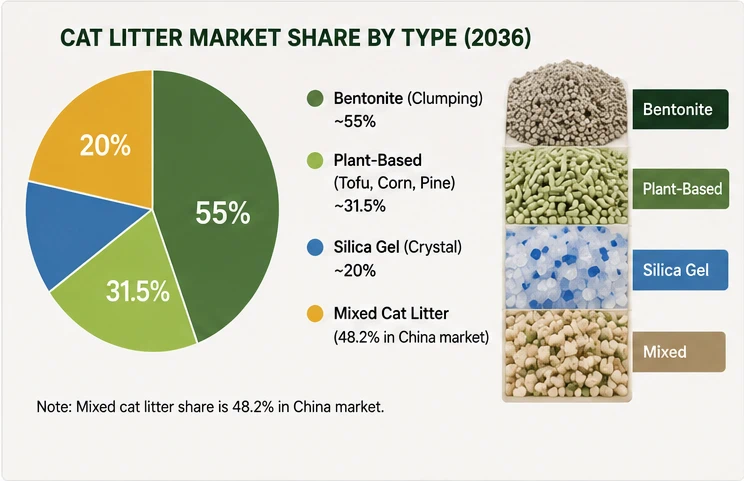
The 2026 global cat litter market spans four major categories, each serving different owner priorities and household contexts. Market share continues to shift as consumer values evolve.
Comparison of Major Cat Litter Types in 2026
| Type | Market Share | Main Advantages | Best For |
|---|---|---|---|
| Bentonite (Clumping) | ~55% (2025) | Strong clumping, affordable, widely accepted by cats | Multi-cat households, budget-conscious buyers |
| Plant-Based (Tofu, Corn, Pine) | ~31.5% (2026 est.) | Biodegradable, low dust, flushable, natural | Small apartments, eco-focused owners |
| Mixed Cat Litter | 48.2% in China; growing globally | Balanced performance across all key metrics | First-time owners, most households |
| Silica Gel (Crystal) | ~20% (2025) | Near-zero dust, long usage cycle, antimicrobial | Single-cat households, premium buyers |
Bentonite (Clumping) Cat Litter — The Established Category
Clumping bentonite cat litter still holds the largest share of the global cat litter market — roughly 55% in 2025 — and maintains its core position in 2026. Its advantages are well established: strong clumping performance, reliable odor absorption, affordable price points, and broad acceptance among cats across different breeds and ages. For multi-cat households and budget-conscious buyers, it remains the practical default. 46% of consumers globally give priority to clumping bentonite cat litter when making purchase decisions.
The category’s biggest liability is dust. 33% of consumers who move away from bentonite cite dust as the primary reason. In 2026, leading brands are responding with finer particle formulations, dust-reduced processing technologies, and upgraded deodorization systems — working to improve the product experience and defend market share against fast-growing alternatives. The bentonite segment’s story in 2026 is largely one of steady improvement rather than expansion.
Plant-based Cat Litter — The Fastest-Growing Segment
Plant-based cat litter — including tofu cat litter, corn litter, and pine litter — is the standout growth story in the 2026 cat litter market. Market share is expected to reach 31.5% this year, growing at over 10% annually. Its core advantages align directly with where consumer values are heading: biodegradable, low dust, flushable, and free of synthetic additives. With 44% of global consumers prioritizing eco-friendly cat litter, this category has structural tailwinds that bentonite simply doesn’t.
Tofu cat litter is the breakout sub-category. Made from soybean fiber, it produces virtually no dust, can be safely flushed down the toilet, and carries a natural mild scent — making it particularly well-suited to smaller apartments and owners with respiratory sensitivities. User satisfaction sits at 87%, among the highest in the category. Pine-based litter serves a different niche: longer usage cycles and potent natural deodorization make it a practical choice for adult cats in households where minimizing litter change frequency matters.
In 2026, the plant-based segment is maturing. Brands are investing in performance improvements — particularly clumping strength and product longevity — and pursuing third-party certifications like compostable and additive-free labels to justify premium pricing and build consumer trust in a crowded field.
Mixed Cat Litter — The Market Leader by Volume
If there’s a consensus winner in the 2026 cat litter market, it’s mixed cat litter. Blending bentonite with tofu, activated carbon, or diatomite in carefully calibrated ratios, mixed cat litter is engineered to address all core performance requirements simultaneously: clumping strength, odor control, low dust, and biodegradability — without the compromises inherent to single-material formulations.
In China, mixed cat litter already commands 48.2% of the market, and the format is gaining ground globally. User satisfaction sits at 89%, the highest among all categories. For first-time cat owners and multi-cat households — two of the fastest-growing owner segments — mixed litter is the obvious starting point. Brands are competing on formula sophistication: adjusting blend ratios (such as 70% tofu litter combined with 30% bentonite), adding probiotic or bacteriostatic particles, and incorporating slow-release deodorizing microcapsules to deliver a genuine all-in-one experience.
For brands and importers exploring private label opportunities in this category, mixed cat litter offers the most flexible formulation platform currently available. See our OEM cat litter solutions for customization options.
From our experience working with international cat litter importers and private label clients, demand for mixed and plant-based formulations has shifted decisively over the past two years. Buyers are moving away from single-feature products — they’re asking for stable supply, verified low-dust performance, and the ability to customize blends for their specific markets. That shift is showing up clearly in order patterns and product development requests across both established and emerging markets.
Mixed cat litter is a hybrid cat litter category that combines different materials — typically mineral and plant-based — to balance clumping performance, odor control, and sustainability in a single product.
Silica Gel (Crystal) Cat Litter — The Premium Niche
Silica gel cat litter holds a stable ~20% share of the global cat litter market and continues its steady penetration in 2026. Its advantages are real and meaningful for the right buyer: near-zero dust, strong antimicrobial properties, and a usage cycle that can extend to one to two months without full replacement. For owners who prioritize minimal maintenance and are willing to pay for it — 41% of premium-tier consumers give priority to silica gel — crystal litter delivers a genuinely differentiated experience.
The barriers to wider adoption remain cost and non-biodegradability. There is also a safety consideration: cats that accidentally ingest silica gel particles face potential health risks, which limits uptake among cautious owners. In 2026, brands are addressing these friction points by optimizing particle hardness to reduce ingestion risk, introducing anti-ingestion formulations, and gradually reducing prices to widen the accessible buyer pool — particularly targeting single-cat households and high-end pet owners.
3. Consumer Behavior: Cat Litter Market Trends Shaping 2026
Health and Safety — The #1 Purchase Driver
Health and safety have become the primary purchase criteria in the global cat litter market, cited by 52% of buyers. Low dust is a standalone selling point for 29% of consumers, and the demand for fragrance-free, fluorescent-free, and degradable products has moved firmly into the mainstream. Consumers are actively rejecting products that use inferior bentonite or synthetic fragrances to mask odors, and brands that can validate their natural, low-allergen credentials with ingredient transparency are consistently taking share. The expectation in 2026 is not just that a product works — it’s that it can be trusted.
Sustainability as Core Competitiveness
Sustainability has become a baseline requirement in many developed markets, especially in Europe and North America. Tightening environmental policies and a genuine shift in consumer values are driving the market toward biodegradable, flushable, and compostably certified products. 44% of consumers globally now give priority to eco-friendly cat litter when making purchase decisions. In 2026, leading brands have added carbon footprint labels to packaging, launched environmentally friendly packaging lines, and built sustainability messaging into core brand identity — not just product features. Environmental positioning has become a primary competitive axis in the cat litter industry.
Premiumization and Functional Segmentation
The trend toward pet humanization is driving meaningful consumption upgrades across the global cat litter market. 39% of consumers are now willing to pay a premium for high-end cat litter — and in 2026, premium cat litter is defined by functional performance rather than material alone. It means functional differentiation: probiotic additives that inhibit bacteria, slow-release deodorizing microcapsules, compatibility with smart automatic litter boxes, and formulations tailored to specific life stages. The mid-market is thinning as consumers polarize toward value or premium tiers, and the upper end of the market has meaningful headroom as average selling prices continue to rise.
Channel Diversification: Online, Offline, and the Rise of Subscriptions
In 2026, global cat litter sales channels follow a clear pattern: online leading, offline supplementing, and subscription accelerating. Online channels — e-commerce platforms, livestream commerce, and direct-to-consumer brands — account for over 50% of global sales, with advantages including transparent pricing, broad category selection, and purchase convenience. Offline channels — pet specialty stores, supermarkets, and veterinary clinics — retain their role for experiential buying and immediate needs. The subscription model is the fastest-growing channel format: 42% of consumers actively use or are interested in auto-delivery services, drawn by lower per-unit pricing and the convenience of automated restocking for a heavy, bulky product. For brands, subscription is increasingly the primary lever for improving retention and customer lifetime value.
2026 Market Direction Summary
- Premiumization is accelerating across all regions as pet humanization deepens
- Mixed cat litter is becoming the default household choice globally
- Plant-based products are shifting from niche to mainstream
- Asia-Pacific is reshaping global supply chains and competitive dynamics
- Subscription and DTC channels are redefining brand-to-consumer relationships
4. Regional Breakdown: Global Cat Litter Market Growth by Region
From a regional perspective, North America and Europe remain the core consumer markets, together accounting for over 65% of global volume. Asia-Pacific has emerged as the primary growth engine, while Latin America, the Middle East, and Africa represent the next wave of market development.
North America — Mature Market, Premium Leadership
North America is the largest and most mature cat litter market globally, with high penetration and strong demand for premium products, accounting for roughly 38% of global volume in 2025. Market growth has slowed relative to emerging regions but remains stable, driven by consistent repurchase cycles and ongoing premiumization. The penetration rate among American cat-owning households exceeds 67%, with clumping bentonite controlling 61% of domestic volume. Demand for high-end and environmentally friendly alternatives is strong and growing. Established players — Nestlé Purina, Clorox (Fresh Step), and Mars — dominate shelf presence, and the North American market continues to set the pace for product innovation and category evolution globally.
Europe — Regulation-Driven, Sustainability-First
Europe accounts for approximately 27% of the global cat litter market. Strict environmental policy frameworks have fundamentally reshaped consumer expectations: degradable and plant-based options now exceed 40% of regional volume, while bentonite’s share is in structural decline as environmental concerns about non-degradable products grow. The European market places a premium on product certification — compostable labeling, verified dust content limits, and additive restrictions are baseline requirements for credible retail presence. The regulatory environment is pushing the entire industry toward greater standardization and transparency, with Europe functioning as the global benchmark for environmental compliance standards.
Asia-Pacific — The Growth Engine
Asia-Pacific is the fastest-growing region in the global cat litter market, holding approximately 29% of global share in 2025 and projected to grow at over 12% in 2026. China is the main growth driver of the Asia-Pacific cat litter market. The Chinese cat litter market is expected to reach 21.5 billion RMB in 2026, an 8.5% increase year-over-year — fueled by younger pet owners (over 70% of cat owners in China are between 25 and 35 years old), rising urbanization rates, and the rapid growth of the single-person household economy.
The Chinese market has distinct structural characteristics: mixed cat litter dominates, online and social commerce channels are deeply embedded in purchasing behavior, cost-performance is the primary competitive metric, and domestic brands have built formidable positions. Brands including pidan, Xiao Pei, and Chong Xing have grown rapidly through rapid product iteration and sharp value positioning, and are now accelerating international expansion — becoming meaningful competitors in the global cat litter market for the first time.
Latin America, Middle East, and Africa — Emerging Upside
These regions collectively account for approximately 6% of global cat litter sales today, but the growth trajectory is clearly upward. Rising middle-class incomes, accelerating urbanization, and the gradual normalization of pet culture are driving initial market penetration — primarily through affordable bentonite and basic plant-based options. As purchasing power grows and indoor cat ownership expands, the conditions for premiumization and category diversification will follow. Brands that establish early positions in these markets with accessible, reliable product lines will be well placed to capture the next wave of global cat litter market growth.
5. Challenges and Opportunities in the Global Cat Litter Industry
Key Challenges
Raw Material Cost Volatility
The core inputs for cat litter — bentonite, soybean fiber, and silica gel — are subject to price volatility driven by supply chain disruptions, climate conditions, and export policy changes. 36% of cat litter manufacturers report active cost pressure from raw material fluctuations. Bentonite supply is particularly exposed: production is concentrated in a handful of countries, and geopolitical developments or export restrictions can rapidly tighten availability and squeeze margins. Managing raw material risk has become a strategic priority for manufacturers at every scale.
Product Homogeneity and Price Competition
Low barriers to entry have created a highly competitive and fragmented market with significant product overlap. Core functions — clumping and odor control — are now widely commoditized, and the differences between mid-market products from competing brands are often marginal. With 41% of consumers identifying as price-sensitive and giving priority to lower-priced options, the downward pressure on pricing is persistent. Brands that cannot build defensible differentiation through formula innovation, brand equity, or distribution advantages risk being trapped in a margin-eroding price war that benefits no one in the long run.
Environmental Compliance Costs
Global environmental policy continues to tighten. Restrictions on non-degradable packaging, stricter waste disposal requirements, and more rigorous ingredient standards are increasing the compliance burden for manufacturers worldwide. 33% of cat litter companies report material environmental compliance pressure. Meeting these requirements demands meaningful investment in R&D for sustainable formulations, process upgrades, and third-party certification — costs that are now effectively a market entry requirement in regulated markets like Europe and an emerging expectation in North America and Asia-Pacific.
Key Opportunities
Emerging Market Expansion
Asia-Pacific, Latin America, the Middle East, and Africa collectively represent a large and structurally underserved population of current and potential cat owners. Market penetration in these regions remains low relative to North America and Europe, and the growth conditions — rising incomes, urbanization, and normalizing pet culture — are firmly in place. Brands that establish early positions with accessible, reliable products will build durable competitive advantages in markets that are poised for sustained multi-year growth.
Technology and Innovation
Material science and biotechnology are opening new performance frontiers for cat litter products. Slow-release deodorizing microcapsules, probiotic bacteriostatic additives, ultra-low-dust processing technologies, and smart litter box compatibility integrations are all active development areas in 2026. Each represents a genuine opportunity to create differentiated products that support premium pricing and build the kind of functional loyalty that resists price competition.
Chinese Brand Global Expansion
China’s cat litter manufacturers combine mature supply chain infrastructure, high-capacity production, rapid product iteration capabilities, and hard-won cost-performance expertise developed in one of the world’s most competitive consumer markets. Domestic brands that have proven their model at home are now accelerating international expansion, creating new competitive pressure for incumbent Western brands and new sourcing options for global buyers. This shift is one of the most consequential structural changes in the global cat litter industry in 2026. For more information on lead times and logistics planning, see our guide to cat litter production and shipping timelines.
Conclusion
The global cat litter market in 2026 is defined by steady overall growth alongside structural shifts in product mix and regional demand. Mixed cat litter is emerging as the dominant format. Plant-based options are growing faster than any other segment. Bentonite is holding its ground through product improvement. And Asia-Pacific — China in particular — is rewriting the competitive map in ways that will shape the industry for years to come.
For manufacturers, OEM suppliers, and private label brands, key priorities include product differentiation, sustainability positioning, and supply chain resilience. For consumers, 2026 offers a broader and better selection of cat litter than any previous year — products that genuinely balance performance, safety, and sustainability in ways that weren’t possible even three years ago.
The fundamentals driving this market — rising cat ownership, the shift to indoor living, deepening pet humanization — are not cyclical. The cat litter market has a long growth cycle ahead of it, and the most consequential competitive battles are just getting started.
Frequently Asked Questions
What is the global cat litter market size in 2026?
The global cat litter market is projected to reach between USD 5.91 billion and USD 6.6 billion in 2026, depending on the research methodology used. The market stood at approximately USD 5.58 billion in 2025 and is forecast to grow to USD 9.9 billion by 2035, at a compound annual growth rate of approximately 5.9%.
What are the main cat litter market trends in 2026?
The three defining cat litter market trends in 2026 are: health and safety (low dust, natural and fragrance-free ingredients), sustainability (biodegradable and compostable formulations), and premiumization (functional additives, smart litter box compatibility, life-stage-specific products). At the channel level, online sales now exceed 50% of global volume, and subscription-based purchasing models are growing rapidly.
Which cat litter category is growing fastest?
Plant-based cat litter — including tofu, corn, and pine litter — is the fastest-growing category in the global cat litter market, expanding at over 10% annually. Its growth is driven by consumer demand for biodegradable, low-dust, and naturally safe products that align with broader sustainability values.
Why is mixed cat litter becoming more popular?
Mixed cat litter combines the strengths of multiple materials — typically bentonite with tofu litter or activated carbon — to balance clumping performance, odor control, low dust, and biodegradability in a single product. This versatility eliminates the trade-offs inherent to single-material formulations, making it the most practical choice for a wide range of households. User satisfaction for mixed cat litter sits at 89%, the highest of any major category.
Which region has the highest cat litter demand?
North America is currently the largest cat litter market by volume, accounting for approximately 38% of global sales. However, Asia-Pacific — led by China — is the fastest-growing region, with a projected growth rate exceeding 12% in 2026. China’s cat litter market alone is expected to reach 21.5 billion RMB in 2026.
Is plant-based cat litter better than bentonite?
It depends on priorities. Plant-based litter excels on environmental impact, dust levels, and natural safety — making it a strong choice for eco-conscious owners and those with respiratory sensitivities. Bentonite offers superior clumping strength and is more cost-effective at scale, particularly for multi-cat households. Many owners are choosing mixed litter to access the performance benefits of both without the limitations of either.
What is the best type of cat litter in 2026?
Mixed cat litter is the top recommendation for most households — it balances clumping strength, odor control, low dust, and biodegradability without significant trade-offs. Owners in small apartments or with respiratory sensitivities often prefer tofu cat litter for its near-zero dust and flushable convenience. Multi-cat households managing costs typically get the best value from low-dust clumping bentonite. Silica gel litter suits owners who prioritize minimal maintenance and are willing to pay a premium for longer usage cycles.
How often should you change cat litter?
For single-cat households using clumping litter: scoop daily, replace the full box weekly. Multi-cat households should perform a full change every three to five days. Silica gel litter has a substantially longer cycle — full replacement every one to two months — though solid waste should still be removed on a regular basis to maintain hygiene.