




Quick Answer
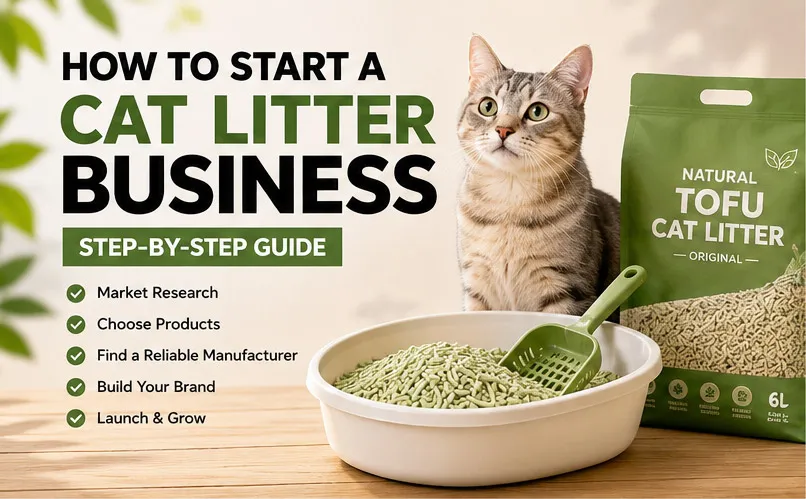
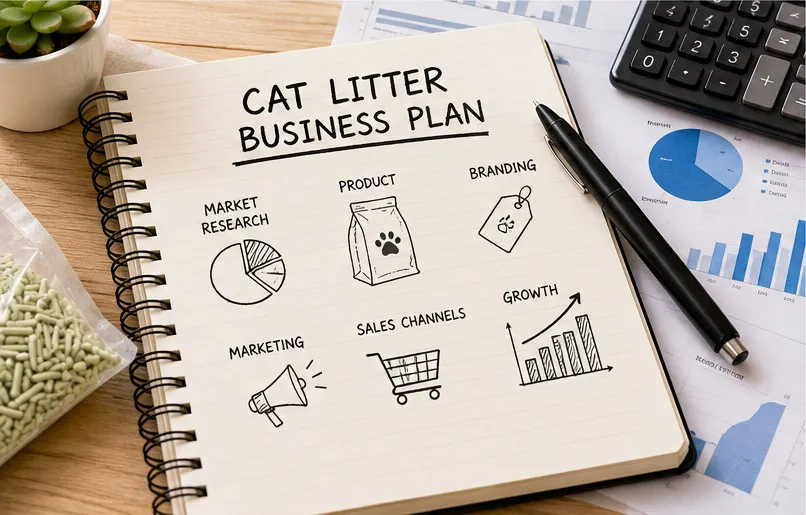
Starting a cat litter business involves six essential steps: researching the market, selecting the right cat litter products, finding a reliable cat litter manufacturer, building a recognizable brand, creating a profitable pricing strategy, and launching effective sales and marketing campaigns. Most successful startups begin with OEM or private label cat litter manufacturing to reduce investment costs and accelerate market entry.
Introduction
The global pet care industry continues to grow rapidly, and cat litter remains one of the most stable and frequently repurchased pet products on the market. As cat ownership increases worldwide, demand for high-quality, low-dust, environmentally friendly, and odor-control cat litter products continues to expand.
For entrepreneurs, distributors, wholesalers, and pet product startups, launching a cat litter business offers significant opportunities. Compared with pet food manufacturing, entering the cat litter industry typically requires lower investment, fewer regulatory barriers, and a faster path to market.
Today, many successful pet brands do not own factories. Instead, they partner with experienced OEM and private label manufacturers to develop products under their own brand names while focusing on marketing, customer acquisition, and brand growth.
This guide explains how to start a cat litter business from scratch, covering everything from market research and product development to supplier selection, pricing, branding, and long-term business growth.
1. Research the Cat Litter Market Before Launching
Before designing packaging or contacting a manufacturer, the first step is understanding the market.
Many new brands fail because they attempt to compete directly with established brands without identifying a unique market opportunity. Successful cat litter brands are built around solving specific customer problems.
Understand Customer Pain Points
Modern cat owners are increasingly focused on convenience, hygiene, sustainability, and pet health.
Some of the most common complaints about traditional cat litter products include:
- Excessive dust generation
- Weak odor control
- Poor clumping performance
- Tracking outside the litter box
- Chemical fragrances
- Difficulty disposing of used litter
- Environmental concerns
Understanding these pain points helps entrepreneurs identify opportunities for differentiation.
For example:
- Families with multiple cats often prioritize strong clumping and odor control.
- Apartment owners may prefer low-dust formulas.
- Environmentally conscious consumers often seek biodegradable cat litter.
- First-time cat owners frequently choose flushable litter for convenience.
Rather than targeting every customer, successful brands usually focus on one primary audience first.
Identify Market Opportunities
The cat litter market continues to evolve, creating opportunities for specialized products.
Popular growth segments include:
Premium Natural Cat Litter
Made from plant-based ingredients such as peas, corn, soybean fiber, or cassava.
Key selling points:
- Low dust
- Natural ingredients
- Flushable
- Eco-friendly
Multi-Cat Household Solutions
Designed for homes with multiple cats.
Key selling points:
- Strong clumping
- Superior odor control
- Cost efficiency
Sustainable Cat Litter
Consumers increasingly seek products with lower environmental impact.
Popular features include:
- Biodegradable materials
- Compostable packaging
- Renewable raw materials
Specialized Functional Cat Litter
Products designed for:
- Kittens
- Senior cats
- Sensitive cats
- Long-haired cats
- Cats recovering from illness
Selecting a focused niche allows new brands to establish market positioning more effectively.
2. Choose the Right Cat Litter Products
Product selection is one of the most important decisions when starting a cat litter business.
Instead of launching multiple products immediately, most successful startups begin with one or two carefully developed products and expand later.
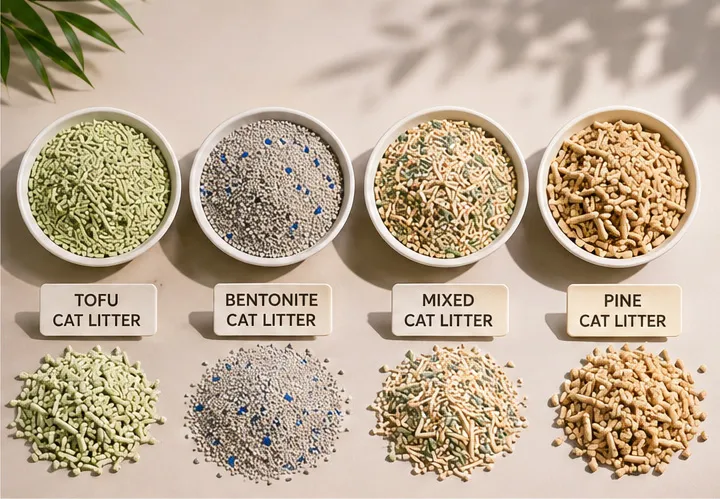
Compare the Main Types of Cat Litter
Understanding the strengths and weaknesses of each product category helps determine which products best match your target market.
Tofu Cat Litter
Tofu cat litter has become one of the fastest-growing segments in the global market.
Typically made from soybean fiber and other plant-based materials, it appeals to environmentally conscious consumers.
Advantages:
- Low dust
- Lightweight
- Flushable
- Biodegradable
- Suitable for kittens
Disadvantages:
- Higher production costs
- Clumping performance varies by formula
For many new brands, tofu cat litter provides an excellent starting point due to strong global demand and growing consumer awareness.
Bentonite Cat Litter
Bentonite cat litter remains one of the most widely used products worldwide.
Its popularity comes from its strong clumping ability and cost-effectiveness.
Advantages:
- Fast liquid absorption
- Hard clumps
- Strong odor control
- Affordable pricing
Disadvantages:
- Higher dust levels
- Non-biodegradable
- Heavier transportation costs
Many high-volume distributors continue to prioritize bentonite cat litter due to its strong consumer acceptance and competitive pricing.
Mixed Cat Litter
Mixed cat litter combines the benefits of tofu cat litter and bentonite cat litter.
Common formulas include:
- 70% tofu + 30% bentonite
- 80% tofu + 20% bentonite
Advantages:
- Better clumping
- Lower dust
- Improved odor control
- Strong consumer acceptance
Many manufacturers report mixed cat litter as one of the fastest-growing product categories in export markets.
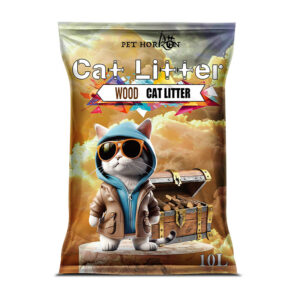
Pine Cat Litter
Pine cat litter appeals to environmentally conscious consumers seeking natural alternatives.
Advantages:
- Natural wood aroma
- Biodegradable
- Sustainable sourcing
Disadvantages:
- Smaller customer base
- Different user experience
Pine litter often serves as a complementary product rather than a primary product line.
Define Product Specifications
Once a category is selected, product specifications must be clearly defined.
Important quality indicators include:
- Dust level
- Clumping strength
- Water absorption speed
- Odor control performance
- Particle size
- Raw material composition
- Tracking resistance
For example, a premium mixed cat litter product may target:
- Low dust formula
- Fast clumping within seconds
- Strong odor control
- Natural ingredients
- No artificial fragrances
- No formaldehyde
- No harmful additives
Clearly defined specifications help create meaningful product differentiation and simplify communication with your OEM cat litter manufacturer.
Develop a Unique Selling Proposition (USP)
The cat litter industry is highly competitive.
To stand out, your product needs a clear and memorable value proposition.
Examples include:
- Ultra-Low Dust Cat Litter
- Flushable Tofu Cat Litter
- Multi-Cat Odor Control Formula
- Sustainable Plant-Based Cat Litter
- Veterinary-Inspired Cat Litter
- Premium Natural Cat Litter
A strong USP makes marketing more effective and improves customer retention over time.
3. Find a Reliable Cat Litter Manufacturer
Choosing the right manufacturing partner is one of the most important decisions when starting a cat litter business.
A strong supplier can help you maintain consistent product quality, reduce operational risks, shorten development timelines, and improve profitability. In contrast, choosing the wrong supplier often results in quality complaints, shipping delays, inventory issues, and damaged brand reputation.
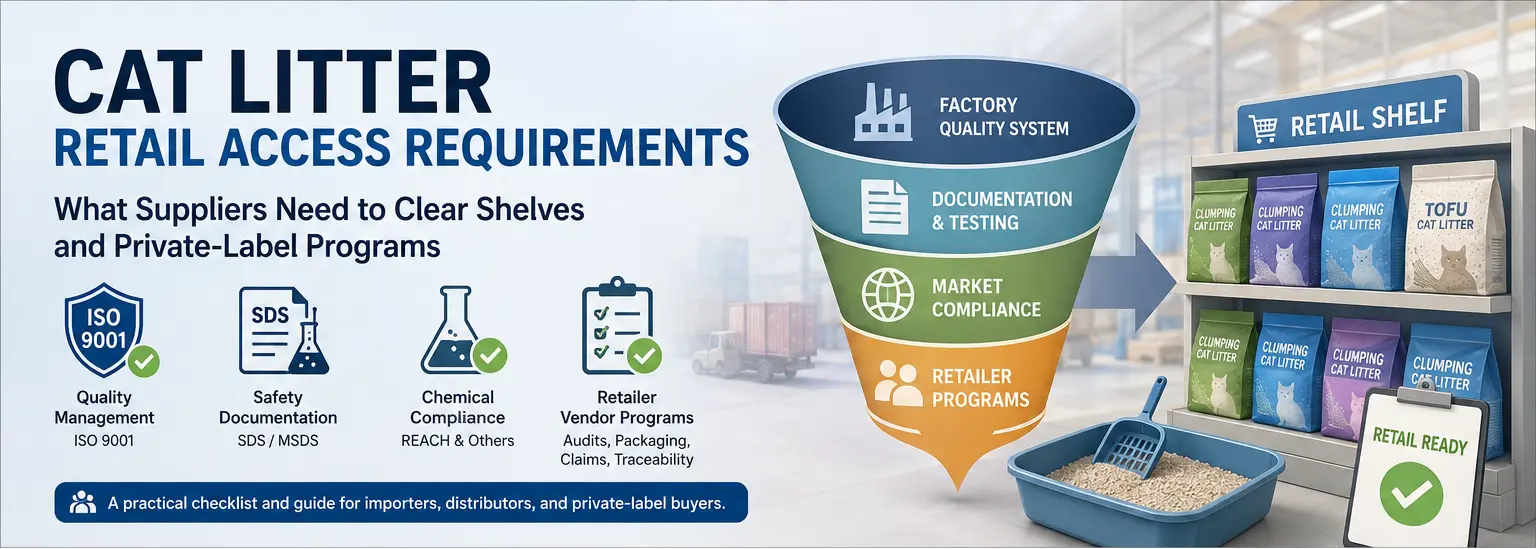
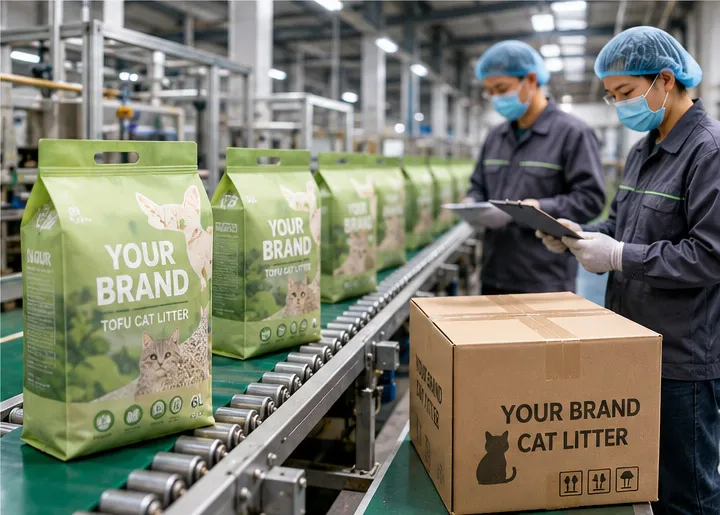
For most startups, partnering with an experienced cat litter manufacturer through OEM or private label production is the most efficient way to enter the market.
OEM vs Private Label Cat Litter: Which Is Better?
Many entrepreneurs confuse OEM and private label manufacturing, but they serve different business goals.
OEM Cat Litter
OEM (Original Equipment Manufacturing) allows you to use existing cat litter formulas while applying your own brand name and packaging.
Advantages:
- Faster market entry
- Lower development costs
- Lower minimum order quantities
- Reduced business risk
- Ideal for startups
Disadvantages:
- Limited product differentiation
- Similar products may be offered to other brands
OEM manufacturing is often the best option for entrepreneurs launching their first cat litter brand.
Internal Link:
Private Label Cat Litter
Private label manufacturing generally offers greater flexibility in packaging, branding, and sometimes formula customization.
Advantages:
- Stronger brand identity
- Better product differentiation
- Greater long-term competitiveness
Disadvantages:
- Higher initial investment
- Longer development cycles
As a brand grows, many businesses gradually transition from standard OEM products to more customized private label solutions.
Internal Link:
What to Look for in a Cat Litter Manufacturer
Not all factories offer the same level of quality and service.
When evaluating a potential cat litter supplier, consider the following factors.
Manufacturing Experience
Look for a manufacturer with proven experience producing:
- Tofu cat litter
- Bentonite cat litter
- Mixed cat litter
- Private label products
Experienced factories typically have more mature quality control systems and stronger export capabilities.
Production Capacity
A growing brand needs a supplier capable of scaling production.
Ask questions such as:
- Monthly production capacity
- Number of production lines
- Lead times during peak seasons
- Inventory management capabilities
Stable supply is critical for long-term growth.
Quality Control Standards
A reliable cat litter factory should implement strict quality management procedures.
Evaluate:
- Raw material inspection
- Production monitoring
- Finished product testing
- Batch traceability
- Packaging inspections
Consistent quality is often more important than obtaining the lowest price.
OEM and Packaging Support
Many startups lack in-house packaging and design resources.
An ideal manufacturing partner should offer:
- Packaging customization
- Artwork support
- Label compliance assistance
- Export documentation
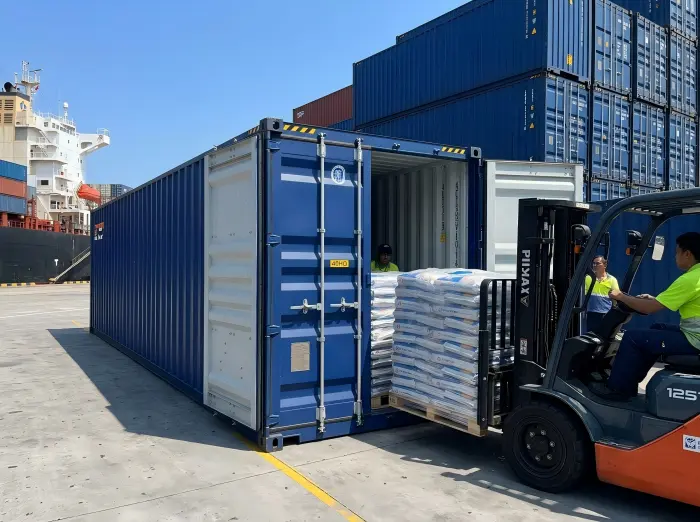
- Logistics coordination
These services can significantly simplify the launch process.
Request Product Samples Before Ordering
Never place a large production order without testing samples.
Sample evaluation should include:
Dust Level
Low-dust products are increasingly preferred by consumers.
Evaluate:
- Airborne dust during pouring
- Dust accumulation after use
Clumping Performance
Strong clumping is one of the most important purchase factors.
Check:
- Clump hardness
- Breakage resistance
- Scoopability
Odor Control
Test litter performance under realistic conditions.
Assess:
- Ammonia control
- Long-term odor absorption
- Fragrance intensity (if applicable)
Tracking Resistance
Consumers dislike litter scattered around the home.
Evaluate:
- Particle size consistency
- Tracking distance
- Paw adhesion
Common Supplier Mistakes New Brands Make
Many new businesses focus solely on price.
This often leads to costly problems later.
Common mistakes include:
- Choosing the cheapest supplier
- Ignoring quality certifications
- Skipping sample testing
- Ordering excessive inventory
- Failing to sign detailed contracts
- Overlooking logistics costs
A reliable cat litter manufacturer should be viewed as a long-term strategic partner rather than simply a supplier.
Recommended Reading
If you’re evaluating suppliers, these resources may help:
How to Choose a Reliable Cat Litter Manufacturer
Cat Litter Manufacturing Process
4. How Much Does It Cost to Start a Cat Litter Business?
One of the most common questions entrepreneurs ask is:
“How much money do I need to launch a cat litter brand?”
The answer depends on product type, packaging complexity, order quantity, and marketing strategy.
Fortunately, starting a cat litter business generally requires far less investment than launching a pet food brand or manufacturing operation.
Startup Cost Breakdown
Below is a typical budget range for a small-to-medium cat litter startup.
| Item | Estimated Cost |
|---|---|
| Brand Registration | $200–$1,000 |
| Packaging Design | $300–$2,000 |
| Product Sampling | $100–$500 |
| Initial Inventory | $2,000–$10,000 |
| Product Photography | $200–$1,000 |
| Website Development | $500–$3,000 |
| Marketing Budget | $500–$5,000 |
| Logistics & Storage | Variable |
Calculate Your Product Costs
Before setting retail prices, calculate all expenses carefully.
Key costs include:
Manufacturing Costs
- Raw materials
- Processing
- Quality control
Packaging Costs
- Packaging bags
- Labels
- Cartons
- Printing
Logistics Costs
- Ocean freight
- Truck transportation
- Warehousing
- Customs clearance
Marketing Costs
- Social media advertising
- Influencer campaigns
- Marketplace fees
- Promotional discounts
Business Expenses
- Trademark registration
- Certifications
- Website maintenance
- Customer service
Ignoring hidden costs is one of the most common reasons new brands struggle to achieve profitability.
Set a Profitable Pricing Strategy
Pricing should align with your target audience and market positioning.
Premium Positioning
Suitable for:
- Natural cat litter
- Eco-friendly products
- Specialty formulas
Focus on:
- Higher margins
- Strong branding
- Product differentiation
Mid-Market Positioning
Suitable for:
- Mixed cat litter
- Mainstream consumers
Focus on:
- Competitive pricing
- High value
- Repeat purchases
Value Positioning
Suitable for:
- Bulk packaging
- Multi-cat households
Focus on:
- Cost efficiency
- Volume sales
Understand Cat Litter Profit Margins
Profit margins vary significantly depending on:
- Product type
- Market channel
- Brand strength
Generally, brands with strong customer loyalty and differentiated products achieve higher margins than those competing primarily on price.
The most successful cat litter businesses focus on building brand value rather than engaging in price wars.
Why Most New Cat Litter Brands Fail
Before moving on to marketing and sales strategies, it’s important to understand why many startups struggle.
The most common reasons include:
Poor Supplier Selection
Unstable product quality quickly damages customer trust.
Weak Product Differentiation
Products that look identical to competitors often compete solely on price.
Excessive Inventory
Over-ordering creates cash flow pressure and inventory risks.
Unrealistic Pricing
Prices that are too low reduce profitability, while prices that are too high discourage trial purchases.
Lack of Brand Positioning
Consumers need a clear reason to choose your product.
Brands that solve a specific problem usually outperform generic competitors.
5. Build a Strong Cat Litter Brand
A successful cat litter business is built on more than just product quality. Branding plays a crucial role in customer acquisition, customer retention, and long-term profitability.
Many products in the market offer similar performance, but brands with clear positioning and strong visual identities often achieve higher customer loyalty and stronger profit margins.
Create a Unique Brand Positioning
Before designing your logo or packaging, define what your brand stands for.
Ask yourself:
- Who is your target customer?
- What problem does your product solve?
- Why should customers choose your brand over competitors?
Examples of effective positioning include:
Premium Natural Cat Litter Brand
Focus on:
- Natural ingredients
- Low dust
- Eco-friendly materials
- Premium packaging
Multi-Cat Household Brand
Focus on:
- Strong odor control
- Powerful clumping
- Cost efficiency
Sustainable Cat Litter Brand
Focus on:
- Biodegradable litter
- Renewable materials
- Environmentally responsible packaging
Veterinary-Inspired Brand
Focus on:
- Cat health
- Safety
- Scientific product development
The clearer your positioning, the easier it becomes to attract the right customers.
Design Professional Packaging
Packaging is often the first interaction consumers have with your brand.
Good packaging should communicate:
- Product benefits
- Brand identity
- Product specifications
- Usage instructions
- Trust and professionalism
Key information typically includes:
- Product type
- Weight
- Main ingredients
- Clumping performance
- Dust level
- Odor control features
- Manufacturer information
For most cat litter brands, common retail sizes include:
- 2.5kg
- 5kg
- 10kg
Many brands also launch trial-size packaging to encourage first-time purchases.
Build Trust Through Transparency
Modern consumers increasingly value transparency.
Provide clear information about:
- Raw materials
- Manufacturing standards
- Product testing
- Safety certifications
Brands that openly communicate product quality often achieve stronger customer trust and repeat purchases.
6. Launch Your Cat Litter Business and Build Sales Channels
Once products and branding are finalized, the next step is acquiring customers.
The most successful cat litter businesses typically combine multiple sales channels rather than relying on a single source of revenue.
Sell Through E-Commerce Platforms
Online marketplaces are often the fastest way for new brands to enter the market.
Examples include:
- Amazon
- Shopify stores
- Walmart Marketplace
- Regional e-commerce platforms
Advantages include:
- Lower startup costs
- Immediate market access
- Faster customer feedback
For new brands, e-commerce often provides the most efficient route to initial sales.
Develop Wholesale and Distribution Partnerships
As sales grow, many brands expand into wholesale channels.
Potential partners include:
- Pet stores
- Supermarkets
- Distributors
- Veterinary clinics
- Pet grooming businesses
Wholesale channels can significantly increase sales volume while strengthening brand visibility.
Build Your Own Website
Owning your website provides greater control over:
- Branding
- Customer relationships
- Marketing campaigns
- Data collection
A dedicated website also helps establish credibility when approaching distributors and retailers.
7. Use Content Marketing to Grow Your Cat Litter Brand
Content marketing is one of the most effective ways to build trust and generate organic traffic.
Instead of focusing solely on advertising, successful brands educate consumers through valuable content.
Create Educational Content
Popular topics include:
- How to choose cat litter
- Tofu cat litter vs bentonite cat litter
- Cat litter odor control tips
- Cat litter safety guides
- Multi-cat litter box management
Educational content helps attract potential customers before they are ready to purchase.
Publish Product Comparison Articles
Comparison articles often perform well in search engines.
Examples:
- Tofu Cat Litter vs Bentonite Cat Litter
- Flushable Cat Litter vs Traditional Cat Litter
- Clumping vs Non-Clumping Cat Litter
These articles target high-intent buyers who are actively evaluating products.
Leverage Social Media
Social media helps brands build awareness and engage directly with pet owners.
Useful content formats include:
- Product demonstrations
- Before-and-after tests
- User-generated content
- Customer reviews
- Cat care tips
Authentic content generally performs better than heavily promotional content.
Cat Litter Business Startup Checklist
Before launching your cat litter brand, make sure you have completed the following steps:
Identified your target market
- Selected your primary cat litter category
- Defined product specifications
- Tested multiple product samples
- Chosen a reliable cat litter manufacturer
- Finalized packaging design
- Registered your trademark
- Calculated product costs and margins
- Built a website or online store
- Prepared a marketing strategy
- Established logistics and inventory plans
- Created customer service procedures
Completing these steps significantly reduces risk and improves your chances of a successful launch.
Conclusion
Starting a cat litter business is one of the most accessible opportunities in the pet products industry. With growing global demand, increasing pet ownership, and the availability of OEM and private label manufacturing, entrepreneurs can launch a professional cat litter brand without investing in their own factory.
Success depends on several key factors: understanding market demand, selecting the right products, partnering with a reliable cat litter manufacturer, building a strong brand, implementing a profitable pricing strategy, and maintaining consistent customer engagement.
Rather than competing solely on price, the most successful cat litter brands focus on quality, differentiation, and customer trust. By continuously improving products, strengthening branding, and responding to market trends, entrepreneurs can build a sustainable business and establish a strong presence in the growing pet care market.
Frequently Asked Questions
How much money do I need to start a cat litter business?
Startup costs vary depending on product type, order quantity, packaging, and marketing strategy. Many entrepreneurs begin with OEM or private label manufacturing to reduce upfront investment and accelerate market entry.
Can I start a cat litter business without owning a factory?
Yes. Most successful startups partner with an experienced cat litter manufacturer that provides OEM or private label services. This approach eliminates the need for large capital investments in equipment and facilities.
What is the best type of cat litter for a new brand?
Many new brands begin with tofu cat litter or mixed cat litter because these categories offer strong market demand, broad customer appeal, and opportunities for differentiation.
How do I find a reliable cat litter manufacturer?
Evaluate suppliers based on manufacturing experience, quality control systems, production capacity, certifications, sample quality, and customer support.
OEM or private label cat litter: which is better?
OEM manufacturing is typically better for startups seeking faster market entry and lower investment. Private label solutions provide greater branding flexibility and product differentiation for long-term growth.
How long does it take to launch a cat litter brand?
Most brands can launch within several months, depending on product development requirements, packaging design, manufacturing lead times, and marketing preparation.
What are the most important factors when choosing a cat litter supplier?
Key factors include:
Product quality
Production capacity
Consistency
Packaging support
Export experience
Communication efficiency
Is cat litter still a profitable business?
Yes. Cat litter remains a high-frequency consumable product with strong repeat-purchase behavior. Brands that focus on product quality, customer experience, and clear market positioning often achieve sustainable long-term growth.