




Key Takeaways
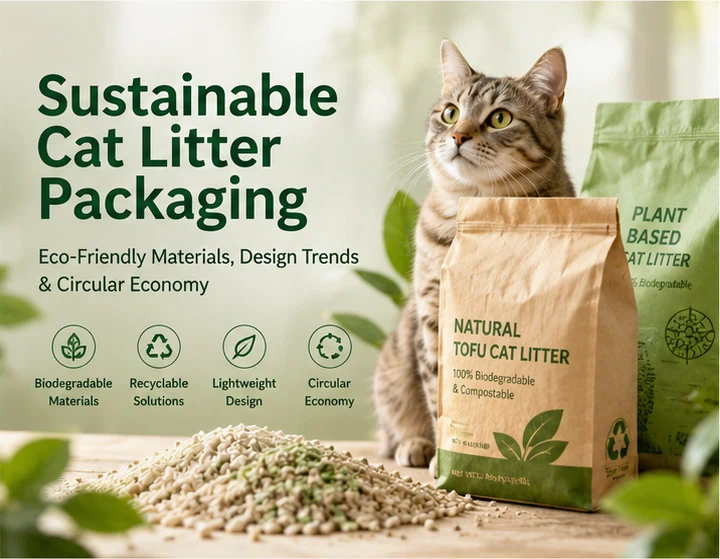
- Sustainable cat litter packaging uses biodegradable, recyclable, or reusable materials — including compostable kraft paper, PLA, and rPET — to replace conventional multi-layer plastic.
- Over 30% of new cat litter brands launched in 2024–2025 have fully adopted sustainable packaging; leading brands have cut conventional plastic use by up to 60%.
- Resealable, lightweight, and refillable packaging designs are becoming standard features across the category, not premium add-ons.
- Consumer demand, tightening plastic regulations, and brand differentiation pressure are the three core market forces accelerating the shift.
- Remaining challenges — higher unit costs and underdeveloped recycling infrastructure — are narrowing as sustainable materials production scales up.
Sustainable cat litter packaging refers to packaging solutions engineered to minimize environmental impact across the full product lifecycle — from raw material sourcing through manufacturing, logistics, and end-of-life disposal. In practice, sustainable cat litter packaging incorporates biodegradable substrates such as compostable kraft paper and PLA (polylactic acid), recyclable materials such as rPET, or closed-loop reuse systems built around refillable containers and degradable refill pouches. Unlike conventional PE/PP multilayer composite plastic — which resists standard recycling streams and persists in the environment for hundreds of years — sustainable cat litter packaging is designed to be processed through home composting, industrial composting, or mainstream municipal recycling without generating persistent plastic waste. For cat litter manufacturers and brands sourcing packaging at scale, understanding these material distinctions is the starting point for any credible green transition.
Driven by the global green consumption wave and the rapid expansion of circular economy regulation, the pet industry is undergoing a sweeping sustainable upgrade. For years, environmental innovation in this category centered on the cat litter itself — tofu litter, plant-based litter, and similar formats. Now the competitive focus has shifted to what surrounds the product: packaging has become a primary arena for brand differentiation, regulatory compliance, and supply chain optimization.
The numbers are unambiguous. According to pet packaging industry data from 2024–2025, more than 30% of new cat litter brands have fully transitioned to sustainable packaging, and top-tier brands have reduced conventional plastic packaging use by roughly 60% year-on-year. What was once a premium positioning choice has become the category mainstream. This guide draws on manufacturing and supply chain experience across the cat litter export sector to break down the leading eco-friendly materials, key design trends, critical market drivers, and the outlook every brand and buyer needs to plan around.
Why Sustainable Cat Litter Packaging Is Now a Core Manufacturing Decision
Cat litter is one of the highest-frequency consumables in the pet category — households repurchase every two to four weeks. At that replenishment cadence, packaging waste accumulates at a pace unlike most other product types, and the sourcing decisions made at the manufacturing stage have outsized downstream consequences. For brands and OEM suppliers operating in the export market, sustainable cat litter packaging is no longer a brand positioning optional — it is a procurement requirement, a compliance obligation, and a logistics optimization lever simultaneously.
- Environmental impact: Waste cat litter packaging in China alone exceeds 10,000 tonnes annually. Most of it — built from non-recyclable multi-layer plastic — ends up in landfill or incineration, leaching pollutants into soil and releasing harmful gases into the air. Transitioning to compostable or recyclable materials directly reduces this burden at scale.
- Logistics cost reduction: Lightweight sustainable packaging cuts per-unit transport weight, increases pallet density, and lowers carbon emissions and freight costs across every shipment. For high-volume cat litter brands, this is not a marginal saving — it compounds significantly across annual volumes.
- Brand differentiation: In a category where product performance differences are narrowing and price competition is intense, sustainable packaging creates genuine, visible differentiation. Environmental certification and clear sustainability messaging are now active purchase filters for the Gen Z and Millennial pet owner cohort — the dominant and growing buyer segment.
- Regulatory pressure: Plastic restriction policies, carbon reduction mandates, and environmental compliance requirements for imported goods are tightening globally. Brands that have already transitioned to plastic-free cat litter packaging or certified biodegradable alternatives are insulated from this compliance risk; those that haven’t face growing exposure.
For manufacturers seeking to reduce environmental impact throughout the entire supply chain, packaging improvements should be considered alongside the cat litter manufacturing process.
1. Why Traditional Packaging Falls Short: The Case for Sustainable Cat Litter Packaging
1.1 Non-Recyclable Multilayer Plastics: A Supply Chain and Compliance Liability
Conventional cat litter packaging is built from PE and PP multilayer composite plastics. Achieving the required moisture resistance, leak-proof performance, and load-bearing strength demands multiple chemical coatings and bonding layers — a construction that is fundamentally incompatible with standard household recycling streams. From a manufacturing standpoint, this complexity also makes the material harder to source responsibly, harder to certify, and increasingly harder to export into markets with strict extended producer responsibility (EPR) frameworks. The natural degradation cycle for this type of industrial plastic runs into hundreds of years. Against the backdrop of genuinely degradable cat litter products — tofu, corn, wheat — the non-degradable packaging has become the most glaring weak point in the pet industry’s environmental profile.
1.2 Oversized, Overweight, and Functionally Limited
Traditional plastic cat litter packaging is typically over-engineered: thicker walls, heavier gauge material, and more overall mass than necessary. That adds up to higher raw material consumption, higher carbon emissions per unit, and steeper logistics costs — all of which compound across the high purchase frequency of the category. Beyond the supply chain, the end-user experience is poor. Most traditional plastic pouches offer no resealable closure, making proper storage after opening difficult. Exposed cat litter absorbs moisture, clumps prematurely, and becomes a breeding ground for bacteria — waste that consumers feel directly in their budgets.
1.3 Homogeneous Design Out of Step with Green Consumers
For most of the cat litter industry’s history, packaging was a purely utilitarian container. A decade of look-alike plastic pouches created a sea of sameness — indistinguishable on shelf and increasingly misaligned with modern consumer values. Today’s pet owner evaluates brands on environmental responsibility and brand identity, not just price per kilogram. Generic plastic packaging communicates neither. Brands that invest in distinctive, sustainable cat litter packaging design are building immediate differentiation and stronger emotional connections with environmentally conscious buyers.
2. Sustainable Cat Litter Packaging Materials: A Manufacturer’s Comparison
Selecting the right sustainable cat litter packaging material is not a single decision — it requires matching substrate performance to product weight, fill characteristics, storage conditions, target market recycling infrastructure, and price-tier positioning. The following comparison covers the four materials that currently account for the majority of sustainable packaging transitions across the cat litter export market.
| Material | Environmental Benefit | Performance Strengths | Best Fit |
|---|---|---|---|
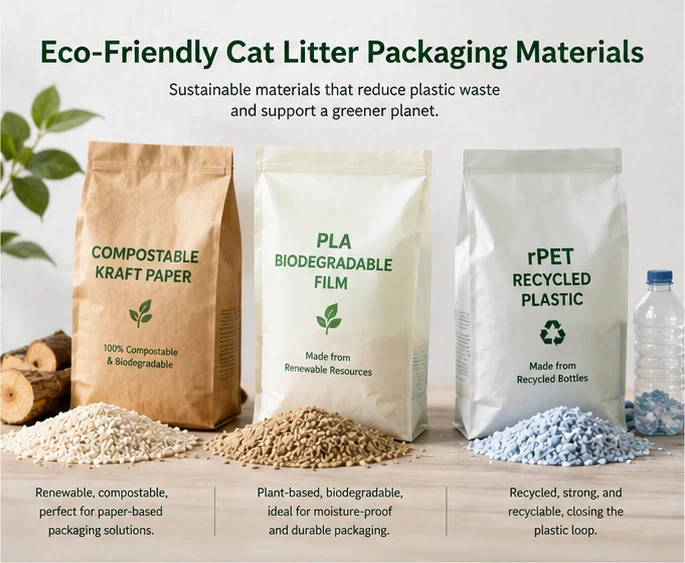
| Compostable Kraft Paper | 100% compostable; zero plastic residue; no harmful off-gassing | Plant-based waterproof film; moisture-resistant; tear-resistant; premium minimalist aesthetic | Mid-to-premium plant-based cat litter brands |
| PLA Biodegradable Plastic | Derived from corn starch / sugarcane; breaks down to CO₂ and water under composting | Superior toughness and seal integrity; temperature-stable; lightweight | Large-capacity, mid-to-high-end cat litter |
| rPET Recycled Plastic | Uses post-consumer waste; significantly lower carbon footprint than virgin plastic | Load-bearing; moisture-resistant; compatible with existing production lines | Mass-market and value-tier cat litter products |
| Paper–PLA Composite | Balances biodegradability with functional performance | Resolves the “eco but fragile” trade-off; moisture-proof with a degradable substrate | Brands seeking both strong environmental credentials and durability |
2.1 Compostable Kraft Paper: The Industry’s First Choice
Compostable kraft paper is the most widely adopted sustainable cat litter packaging material on the market today, and the default upgrade path for leading brands. By 2025, many mainstream pet brands had completed their packaging transitions, replacing conventional plastic with compostable kraft and cutting plastic use by more than 60% in the process. Modern kraft packaging uses plant-based waterproof film in place of chemical coatings — delivering genuine moisture resistance and tear strength without any plastic residue. When disposed of, it decomposes fully in natural conditions. It also pairs seamlessly with plant-based cat litter products such as tofu cat litter, creating a coherent sustainability story from fill material to outer packaging. The clean, minimalist kraft aesthetic resonates strongly with younger pet owners and performs well in the home environment.
2.2 PLA Biodegradable Packaging: The High-Performance Solution
Where kraft paper reaches its structural limits — particularly in large-capacity formats — PLA biodegradable cat litter packaging fills the gap. PLA (polylactic acid) is derived from renewable feedstocks including corn starch and sugarcane fiber. Under industrial or home composting conditions, it breaks down completely into carbon dioxide and water, leaving no environmental residue. From a performance standpoint, PLA outperforms kraft paper on toughness and seal reliability — a critical factor for preventing moisture ingress and odor migration during storage. Its lightweight, thin-wall construction keeps overall package weight low, reducing logistics carbon footprint and per-unit shipping costs. PLA is also temperature-stable, maintaining structural integrity in high-temperature summer storage and low-temperature winter transport alike. Paper-PLA composite formats — a kraft outer with a PLA inner film — combine the aesthetic and environmental credentials of paper with the functional robustness of biodegradable plastic, effectively resolving the longstanding industry tension between eco credentials and real-world durability.
2.3 rPET Recycled Plastic: The Scalable Bridge Technology
Recyclable cat litter packaging made from rPET (recycled polyethylene terephthalate) represents the pragmatic, immediately scalable path to sustainable packaging across the full market. Rather than producing new plastic, rPET recovers and repurposes post-consumer plastic waste — substantially reducing both energy consumption and virgin resource extraction. The packaging retains the load-bearing strength and moisture resistance of conventional plastic while carrying a significantly lower production carbon footprint. Crucially, rPET works within existing production lines with minimal capital investment, making it accessible at every price tier, not just premium. Broad adoption of rPET packaging also helps build the closed-loop infrastructure the industry needs — more material collected, more material available for reprocessing — gradually supporting a genuine circular economy model for cat litter packaging.
3. Sustainable Cat Litter Packaging Design Trends Shaping Product Development
Material selection determines environmental eligibility; structural design determines real-world performance and consumer adoption. The following four design directions are defining the next generation of sustainable cat litter packaging across both export-oriented private label programs and global branded lines.
3.1 Lightweight and Minimal: Cutting Carbon Across the Whole Supply Chain
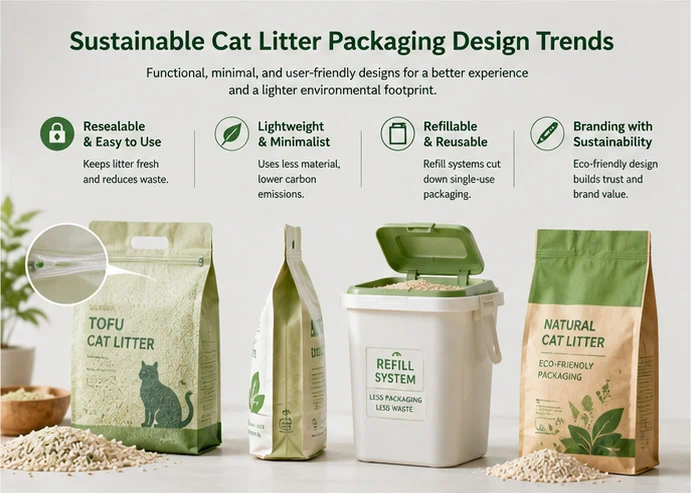
Lightweighting is one of the highest-impact design levers in sustainable cat litter packaging — its benefits compound at every stage of the product lifecycle. By optimizing wall thickness and removing redundant structural elements, manufacturers reduce raw material use at source, cut production energy, lower per-unit transport weight, and increase pallet density. The result is a measurable reduction in carbon costs from factory to doorstep. Stripping out excess ink layers and chemical coatings simultaneously reduces environmental contamination and produces a visual identity that reads as clean, modern, and intentional.
3.2 Resealable Design: Closing the Gap Between Eco and Usable
For years, “eco-friendly packaging” was associated with packaging that sacrificed convenience. That trade-off no longer holds. The current generation of resealable cat litter packaging integrates ziplock closures and self-standing gusseted bases that make everyday storage genuinely practical. A well-designed resealable system prevents moisture intrusion between uses, extends product freshness, reduces the risk of bacterial growth in exposed litter, and helps consumers extract more value from each purchase. Packaging that performs as well as it looks — and leaves less environmental impact — is the format the market is converging on.
3.3 Refillable Systems: The Zero-Waste Future of Sustainable Cat Litter Packaging
The most ambitious development in sustainable cat litter packaging is the emergence of refillable systems — a model that fundamentally decouples ongoing consumption from packaging waste. Since 2024, a growing number of pet brands have launched zero-waste cat litter systems built around durable, reusable hard containers paired with lightweight, degradable refill pouches. Consumers purchase the system once and resupply via compact refill packs, dramatically reducing packaging waste per purchase cycle. The commercial case is compelling: brands operating refill systems have reported six-month user retention rates reaching 50%, driven by the combination of subscription-style convenience and a strong sustainability narrative — creating loyalty that conventional single-use packaging simply cannot match.
3.4 Smart, Low-Carbon Print and Packaging Traceability
Conventional cat litter packaging often relies on high-coverage color printing with laminated film and metallic foiling — processes that introduce chemical pollutants and complicate recycling. Sustainable packaging design has moved toward digital inkjet printing with water-based or UV-curable inks, which carry minimal environmental impact. The resulting visual language — clean typography, restrained color palettes, intentional white space — aligns closely with contemporary home aesthetics. Some brands are adding environmental traceability QR codes, allowing consumers to verify packaging materials, degradation timelines, and certifications with a single scan, building genuine transparency and brand trust.
4. Sustainable Cat Litter Packaging Market Drivers: What’s Forcing the Transition
The shift toward sustainable cat litter packaging is not primarily driven by idealism — it is being forced by converging commercial, regulatory, and consumer pressures that brands and their packaging suppliers can no longer defer. Understanding these drivers is essential for manufacturers planning medium-term production roadmaps.
4.1 Consumer Expectations Have Fundamentally Shifted
Contemporary pet owners — particularly those under 40 — increasingly frame pet care as part of a broader sustainable lifestyle. Environmental packaging performance has become a real purchase filter, not just a feel-good bonus. Consumers are demonstrating willingness to pay a reasonable premium for cat litter products with credible environmental certification and plastic-free cat litter packaging or certified biodegradable materials. Social media has amplified this shift significantly: educational content about pet packaging waste has reached large audiences and created sustained pressure on brands that lag behind.
4.2 Regulatory Pressure Is Accelerating
Policy environments globally are moving in one direction: stricter. Plastic restriction policies, mandatory waste sorting frameworks, carbon reduction commitments, and tightening environmental compliance requirements for imported goods are all raising the packaging bar. The pet category — with its high purchase frequency and correspondingly high packaging throughput — is a natural focus area for environmental regulators. Brands that have transitioned to certified sustainable cat litter packaging are insulated from compliance risk; those operating on conventional plastic face growing exposure and potential market access constraints.
4.3 Sustainable Cat Litter Packaging as a Brand Differentiation Strategy
In a category where product-level performance differences are narrowing and price competition is intensifying, packaging has emerged as a genuine differentiator. Establishing a clear green brand identity through a comprehensive sustainable cat litter packaging upgrade builds recognition, communicates values, and generates word-of-mouth in a way that incremental product improvements rarely achieve. The commercial rationale is straightforward: sustainable packaging addresses consumer values, reduces regulatory risk, and generates earned media — all while expanding the brand’s addressable market among environmentally conscious buyers.
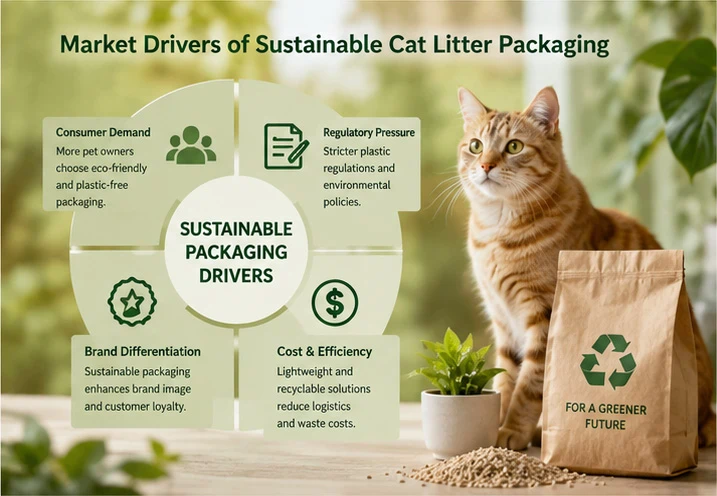
Many pet brands are now working with manufacturers that offer OEM cat litter packaging solutions to develop customized sustainable packaging that aligns with their environmental goals and brand identity.
5. The Future of Sustainable Cat Litter Packaging: Challenges and Industry Outlook
For manufacturers and brands currently planning packaging transitions, a clear-eyed view of the remaining obstacles — and the trajectory they are on — is as important as understanding the opportunity.
5.1 Where the Industry Still Has Work to Do
Despite rapid progress, sustainable cat litter packaging faces real obstacles. Cost is the most significant: biodegradable materials and recycled feedstocks carry higher production costs than virgin plastic, and that differential is reflected in end prices — manageable for premium products, but creating friction at mass-market price points. Performance gaps persist in some formats: pure paper packaging can struggle in high-moisture environments, and some biodegradable films underperform under heavy transport conditions. Most structurally important, recycling and composting infrastructure remains underdeveloped in many markets; packaging engineered for composting only delivers its environmental benefit if consumers can access appropriate disposal channels.
5.2 The Direction of Travel Is Clear
The medium-term trajectory is well established. As sustainable materials production scales, unit costs will decline and the price premium over conventional plastic will compress. New material formulations — combining high biodegradability, superior durability, and lower cost — are in active development across leading packaging suppliers. Smart packaging integrations, circular leasing models, and closed-loop refill systems will mature from brand experiments into category norms. Certification frameworks — including compostability standards such as EN 13432 and ASTM D6400, and recycled content verification under GRS (Global Recycled Standard) — will become standard sourcing requirements rather than differentiators. Within five to ten years, sustainable cat litter packaging is expected to be the baseline requirement for any product sold into environmentally aware markets — not a premium credential, but a minimum entry point.
FAQ: Sustainable Cat Litter Packaging
Which material is best for sustainable cat litter packaging?
It depends on your product format and price tier. Compostable kraft paper suits mid-to-premium plant-based litter. PLA biodegradable plastic handles large-capacity, heavy-fill formats better. rPET recycled plastic is the most scalable option for mass-market products. Paper-PLA composites offer the strongest all-round balance of eco credentials and functional performance.
Is PLA better than kraft paper for cat litter packaging?
They serve different needs. Kraft paper leads on aesthetics and compostability but has structural limits for heavy fills. PLA offers superior toughness, seal integrity, and temperature stability — better for large-format applications. Most brands now combine both in paper-PLA composite structures to capture the strengths of each material.
What is the most sustainable packaging for pet products?
Refillable systems — a durable container paired with degradable refill pouches — generate the least waste per use over time. For single-use formats, the sustainability hierarchy runs: compostable > biodegradable > recycled material > conventional plastic. Compostable kraft paper and PLA currently offer the lowest lifecycle environmental impact among single-use options.
Is eco-friendly cat litter packaging as durable as conventional plastic?
Yes, when properly specified. Paper-PLA composites and PLA film-laminated packaging match conventional plastic on moisture resistance and tear strength. Performance varies by construction — verify claims against specific material specs, not general category labels. Quality eco-friendly cat litter packaging fully meets moisture, transit, and shelf-life requirements.
Do biodegradable cat litter packaging materials require special conditions to break down?
No specialized equipment is needed. PLA and compostable kraft paper break down under standard home or industrial composting conditions. Industrial composting facilities produce faster, more complete degradation than backyard composting. Follow local waste sorting guidelines — most materials in this category are compatible with household organic waste streams.
Is sustainable cat litter packaging worth the higher unit price?
For most brands, yes. Resealable designs reduce product waste and support per-use savings. Sustainable packaging reduces regulatory exposure, enables price premiums, and builds brand equity. As production scales, the cost gap with conventional plastic continues to narrow — making the business case for sustainable cat litter packaging stronger each year.