




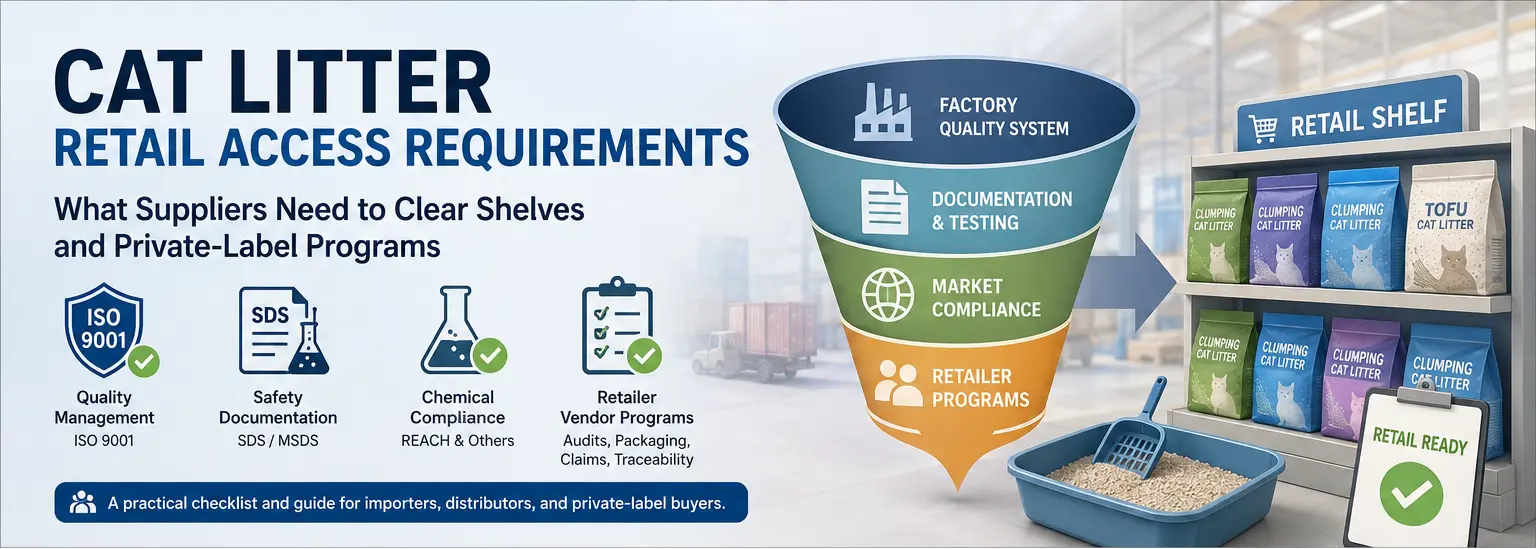
For distributors, importers, and brand owners, getting a cat litter SKU approved for retail or a private-label program involves more than shipping the product. There is no single global certification that guarantees retail acceptance: requirements typically combine product safety evidence, quality-management controls, destination-market regulations, packaging and labeling rules, and retailer-specific vendor requirements. A missing document or unsupported claim can delay approval, so buyers should define the required evidence package before production and confirm it against the target market and retailer.
Quick answer: Cat litter retail requirements usually combine four layers: quality-management controls such as ISO 9001 where required by the buyer, product-safety and composition evidence such as applicable SDS and laboratory reports, destination-market regulations such as EU REACH where relevant, and retailer-specific vendor requirements covering audits, packaging, labeling, claims, and traceability. For private-label programs, buyers should request a documented specification and evidence package from the supplier and verify each requirement against the destination market and retailer rather than assuming one universal standard applies everywhere.
Why Retail Access Is a Specification, Not a Formality
A retailer’s shelf is its own brand risk. Buyers protect it by requiring evidence before a product earns a listing, and the evidence differs by channel: a mass-merchandiser, a pet-specialty chain, and a cross-border e-commerce marketplace each apply overlapping but distinct checklists. Treating retail access as a paperwork step at the end of development is a common cause of delayed launches.
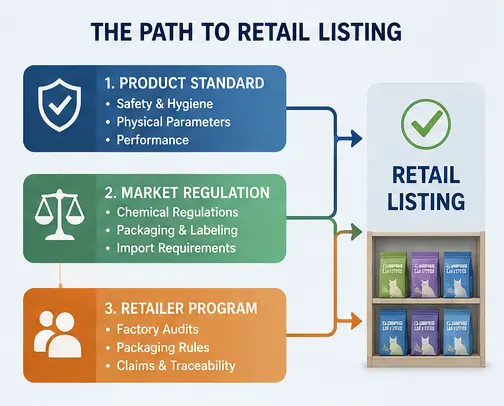
Three layers sit underneath the term “retail requirements,” and they should not be treated as interchangeable:
- Product requirements define the litter’s composition, safety, physical properties, hygiene, and performance.
- Market regulations are the legal requirements that apply where the product is imported, marketed, and sold, including chemical, packaging, labeling, and import rules.
- Retailer programs are additional commercial requirements imposed by the buyer, such as supplier audits, documentation, packaging artwork, traceability, and claim substantiation.
Supplier certifications and quality-management records, such as ISO 9001, support the evidence required across these layers but do not replace product testing or destination-market compliance.
For importers, this is the cat litter import compliance layer: the documents and rules needed to legally import, label, and place the product on the target market.
All three can block a listing. Our cat litter quality standard guide covers the product-side parameters; this article focuses on the vendor and channel layer that sits on top of it.
Cat Litter Supplier Certifications and Management Systems
A documented quality system is commonly one of the first things a buyer asks about. The expectation is steady, auditable production—not a one-off good batch.
Quality Management — ISO 9001
ISO 9001 is a widely recognized quality-management standard and may be requested by retailers, distributors, or private-label programs as evidence that a supplier operates controlled and repeatable processes. It is not specific to cat litter and is not a universal legal requirement for selling cat litter. Buyers may use an ISO 9001 certificate alongside product specifications, laboratory reports, supplier audits, and production records when evaluating manufacturing capability. A certificate by itself does not prove product performance or destination-market compliance. The official standard overview is maintained by ISO (ISO 9001 — Quality management).
Product Safety Documentation — SDS and Laboratory Reports
Buyers commonly request a documented safety and testing package covering the finished litter and, where relevant, its raw materials or chemical inputs. The exact documents depend on the product formulation and destination market.
- Safety Data Sheet (SDS) where required for the product or applicable chemical substances and mixtures under the destination market’s hazard-communication rules.
- Heavy-metal and contaminant testing for substances such as lead, arsenic, mercury, or other parameters where relevant to the product and market.
- Microbiological testing where the raw material, manufacturing process, or formulation creates a relevant microbiological risk, particularly for plant-based products or products containing biological additives.
- Aflatoxin and mycotoxin testing where appropriate for plant-derived raw materials and where required by the buyer or destination-market risk assessment.
The goal is not to collect every possible certificate, but to build an evidence package that matches the actual formulation, intended claims, and destination-market requirements.
For products manufactured or sold in China, buyers should also check the applicable Chinese national and industry standards for companion-animal products and cat litter, including GB/T 43839-2024, which sets safety, physical, chemical, and hygienic parameters relevant to cat litter. The applicable standard should be confirmed against the product category and intended market rather than assumed to apply universally to export products.
Market-Specific Chemical Rules — REACH and Equivalents
Where the litter or its additives fall within the scope of chemical regulation, the destination market’s rules apply. In the EU, REACH (Regulation (EC) No 1907/2006) establishes requirements covering the registration, evaluation, authorization, and restriction of chemical substances. Its relevance to a particular cat litter depends on the product’s ingredients, additives, intended use, and supply-chain role. Other markets have their own chemical frameworks, so buyers should assess the actual formulation against the rules of the destination market rather than rely on a single global compliance standard. The official regulation is maintained by the European Chemicals Agency (EU REACH regulation).
Private-Label Cat Litter Requirements and Vendor Programs
Beyond law and basic standards, large buyers run their own supplier programs. These are commercial requirements, not legal mandates, but they are usually non-negotiable for the channel.
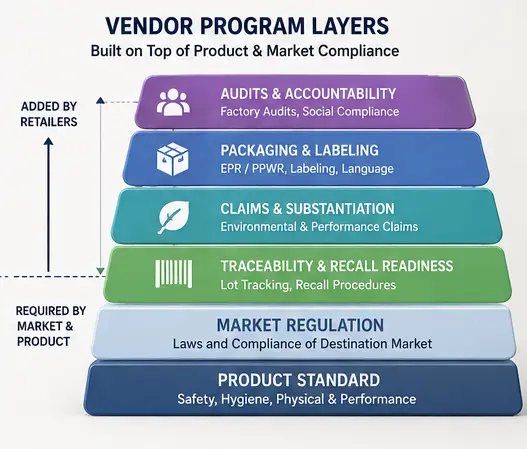
- Vendor onboarding and factory audits. Private-label and large-retail programs may require buyer-led or third-party audits covering production controls, workplace conditions, hygiene, traceability, and social-compliance criteria. Frameworks such as amfori BSCI or Sedex may be used by buyers as part of their supplier-assessment processes, but they are not universal legal requirements for cat litter.
- Packaging and labeling compliance. Destination-market packaging rules, including applicable EU Packaging and Packaging Waste Regulation (PPWR) requirements and extended producer responsibility (EPR) schemes, can create additional obligations for packaging placed on the market. Language, mandatory information, recycling marks, and claim requirements may also apply. A product can therefore meet its product-safety requirements while its packaging still needs changes before retail approval.
- Claim substantiation. Environmental and performance claims such as “natural,” “biodegradable,” “compostable,” or “low dust” should be supported by appropriate evidence and reviewed against the rules of the destination market. ISO 14021 provides principles for self-declared environmental claims.
- Traceability and recall readiness. Buyers may require lot or batch identification, retained production records, complaint handling, and a documented procedure for investigating and managing quality or safety incidents.
Product Specifications That Influence Retail Acceptance
Documentation clears the gate, but the product still has to perform on the shelf and in the home. The specifications retailers and buyers scrutinize most:
- Clump integrity and dust level — define the test method, measurement conditions, and acceptable range rather than relying only on descriptive claims.
- Moisture content — specify the target range because moisture can affect storage stability, odor control, and clumping performance.
- Particle size and uniformity — define the particle-size range and allowable variation to control dosing, tracking, spillage, and batch consistency.
- Odor-control performance — establish a repeatable buyer or laboratory protocol because odor performance does not have one universal test method across all litter types.
- Bulk density and packaging weight — useful for filling accuracy, freight planning, and consistent pack specifications.
For a deeper look at how odor is built into a formula and what to specify, see our private-label cat litter manufacturing capability overview, where these parameters are handled as manufacturing specs rather than marketing claims.
Document Checklist for Retail Entry
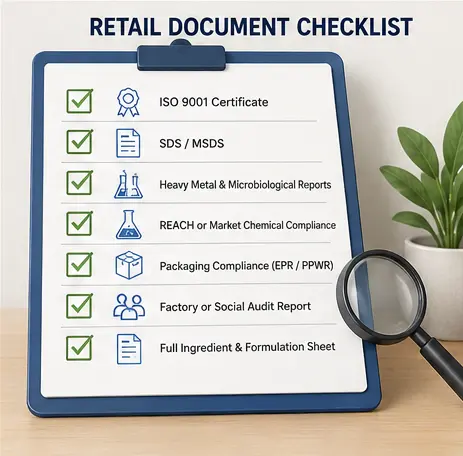
Use the table below as a starting point. The “typically requested by” column is a procurement benchmark, not a legal rule—always confirm against the specific buyer and destination market.
| Document | What it covers | Typically requested by |
|---|---|---|
| ISO 9001 certificate | Quality-management system and process control | Retailers or private-label programs where supplier certification is required |
| SDS | Hazard classification and safe handling where applicable | Buyers, logistics providers, and markets where an SDS is required |
| Heavy-metal and contaminant reports | Product safety and applicable chemical limits | Retailers, importers, and destination markets where relevant |
| Microbiological reports | Applicable hygiene and microbiological parameters | Buyers and markets where relevant to the product |
| REACH or other market chemical compliance | Applicable substance restrictions, registrations, or notifications | EU-bound and other regulated markets where applicable |
| Packaging compliance documentation | Packaging, labeling, EPR, and applicable PPWR obligations | Retailers, importers, and regulated markets |
| Factory or social-compliance audit | Production controls, workplace conditions, hygiene, and accountability | Private-label and larger retail programs where required |
| Ingredient and formulation information | Composition, claims review, and product compliance checks | Private-label buyers and retailers where required |
| Product specification and test reports | Physical, chemical, performance, and quality parameters | Retailers, distributors, and private-label buyers |
The table reflects common procurement practice across retailers and is not a substitute for the specific requirements of any individual buyer or the laws of the destination market.
How a Manufacturing Partner Helps You Clear Retail Access
A manufacturing partner with more than 20 years in cat litter manufacturing and OEM/ODM programs across 80+ country markets, and with established quality controls, documented specifications, batch testing, and export experience, can shorten the preparation stage for a retail or private-label launch. Instead of assembling the compliance package from scratch, buyers can request the supplier’s existing certificates, laboratory reports, specifications, traceability records, and market-specific documentation, then identify any remaining gaps before production. Our tofu cat litter programs are developed under the same documentation and specification framework described in this guide.
Common Pitfalls That Block Retail Listing
- Assuming one standard fits every market and discovering a missing notification, label requirement, or packaging obligation late in the launch process.
- Arriving without the SDS or current laboratory reports requested by the buyer, which can delay supplier or SKU approval.
- Making environmental or performance claims that the available test evidence cannot substantiate under the destination market’s rules.
- Treating packaging compliance as a shipping detail rather than reviewing it during product and artwork approval.
- Choosing a supplier that cannot provide consistent batch records, agreed product specifications, traceability data, or a documented procedure for handling quality issues.
Retail Readiness Checklist for Cat Litter Buyers
- Define the product specification and acceptance criteria.
- Identify the destination-market regulatory requirements.
- Confirm whether an SDS and specific laboratory reports are applicable.
- Verify chemical, packaging, labeling, and EPR obligations.
- Request the supplier’s quality-management certificates and audit records.
- Confirm claim substantiation for environmental and performance claims.
- Establish batch traceability and complaint or recall procedures.
- Obtain the retailer’s final vendor and private-label checklist before production.
Conclusion
Cat litter retail requirements are not defined by one universal certificate. Retail approval typically depends on three layers: product requirements, destination-market regulations, and retailer-specific vendor requirements. For a private-label or import program, the practical starting point is to define the product specification, identify the applicable market rules, prepare the requested quality and safety evidence, and confirm the retailer’s audit, packaging, labeling, claim, and traceability requirements before production. A supplier with established documentation and testing systems can help reduce gaps, but the final compliance checklist should always be confirmed against the specific product, market, and buyer.
Frequently Asked Questions
There is no single universal certification for selling cat litter to retailers. Depending on the buyer and destination market, a supplier may need to provide a quality-management certificate such as ISO 9001, applicable product-safety and laboratory reports, chemical compliance documentation, packaging and labeling evidence, and retailer-specific audit records. The exact checklist should be confirmed with the retailer and destination market.
ISO 9001 is not a legal requirement for cat litter, but it may be requested by retailers and private-label programs as evidence of controlled, repeatable manufacturing. A certificate alone does not prove product performance or destination-market compliance, so buyers usually pair it with product test reports and other evidence.
REACH can apply where the litter or its additives are within the scope of EU chemical regulation—for example fragrances, preservatives, or treated minerals. Whether a specific substance triggers obligations depends on the formulation, the supply-chain role, and the destination market, so the question is best answered against the actual ingredient list and the market where the product is sold.
A private-label buyer typically wants an ISO 9001 certificate, an SDS where required, heavy-metal and microbiological test reports, a full ingredient and formulation sheet, and evidence of packaging and market compliance. Larger programs may also require a factory or social-accountability audit.
Not necessarily. A factory audit is not a universal legal requirement for cat litter, but private-label, big-box, and other structured retail programs may require a buyer-led or third-party audit before supplier approval. Smaller or regional retailers may use a different onboarding process, such as reviewing certificates, test reports, specifications, and production documentation instead.
Packaging rules such as EPR and applicable PPWR requirements, plus labeling-language and claim requirements, determine whether a pack is shelf-ready. A litter can be compliant as a product yet still be rejected if its packaging paperwork or artwork does not meet the destination market’s rules.
Often yes. A contract manufacturer with established quality systems, batch testing, and export experience can supply the evidence package a retailer expects, letting a smaller brand reach shelves without building that infrastructure alone. The buyer should still verify which documents the specific retailer requires.
Product standards define what the litter is and how it performs; market regulations are the laws that apply where it is sold; retailer requirements are the additional vendor rules a buyer imposes. All three can block a listing, so a complete retail strategy addresses each layer separately.