




Quick Answer
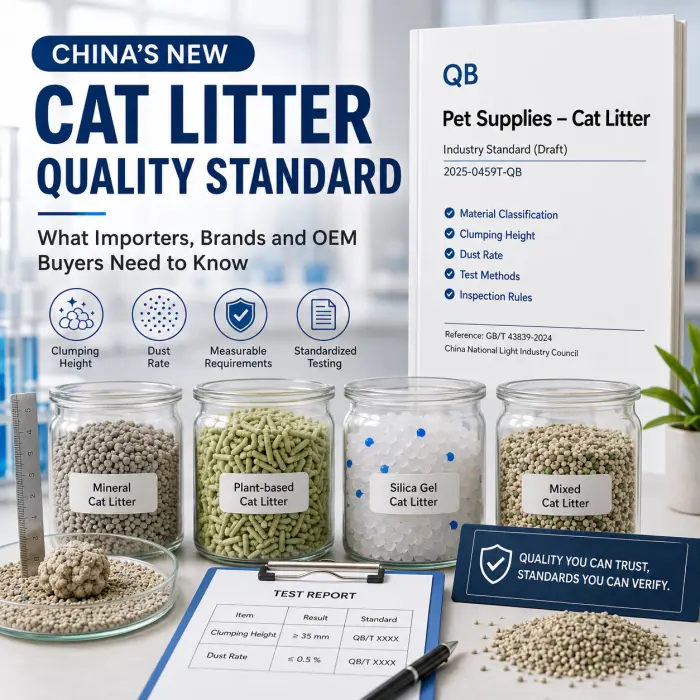
A specialized cat litter quality standard is moving from draft to formal release in China, giving importers and brands a neutral, measurable yardstick for evaluating suppliers. The light-industry standard Pet Supplies — Cat Litter (plan no. 2025-0459T-QB) classifies cat litter by material — mineral, plant, silica gel, and mixed — and sets testable requirements for the two metrics buyers care about most: clumping height and dust rate. It also references the national safety standard GB/T 43839-2024. For B2B buyers, understanding the new cat litter quality standards helps establish objective procurement specifications and use the same measurable standards to compare suppliers, rather than relying on marketing claims such as “99% dust-free”.
| Item | Summary |
|---|---|
| Standard | Pet Supplies — Cat Litter (Plan No. 2025-0459T-QB) |
| Status | Draft completed, official release expected in 2026 |
| Applies to | Mineral, Plant-based, Silica Gel and Mixed Cat Litter |
| Main Quality Metrics | Clumping Height and Dust Rate |
| Safety Reference | GB/T 43839-2024 |
| Recommended for | Importers, OEM buyers, distributors and private label brands |
Why a Dedicated Cat Litter Standard Matters Now
For years, cat litter produced in China was covered only by generic pet-product safety rules and a patchwork of group standards. The new QB industry standard is the first document written specifically for cat litter as a product category. That shift matters because it replaces vague, supplier-defined claims with a shared, written specification that buyers and factories can both point to.
It also signals market maturity. When a category gets its own standard, export buyers gain a common language for sampling, contracting, and quality control — which reduces disputes and speeds up onboarding for new supplier relationships.
What the New Standard Covers
The draft-for-comment was completed in February 2026, and its public consultation closed on 3 April 2026. Formal issuance is expected later in 2026. The document is proposed and governed by the China National Light Industry Council (CNLIC) and drafted by China Light Industry Paper Products Inspection & Certification Co., Ltd. The full draft is published by CNLIC in the official draft PDF.
The scope is cat litter used to handle cat urine and feces. It explicitly does not apply to paper cat litter; other pet sands may follow it by reference. The standard specifies:
- Terms and definitions
- Product classification
- Performance requirements
- Test methods
- Inspection rules
- Marking, packaging, transport, and storage
Several normative references anchor the standard to broader requirements. The most important for buyers is GB/T 43839-2024, China’s first national safety standard for companion-animal (pet) products, which took effect on 1 October 2024. Others include GB/T 6682 (laboratory water), GB/T 45369 (odor-elimination evaluation), NY/T 2071 (mycotoxin testing), and JJF 1070 (net-content verification).
A broader signal sits behind this: the secretariat of the ISO technical committee for pet products is now based in China, and the first international pet-product standards are expected within two to three years. Aligning with the Chinese draft early positions buyers and suppliers for the international rules that will likely follow.
How the Standard Classifies Cat Litter
The draft defines four material-based categories. This is the section most useful to buyers building a spec sheet, because it removes ambiguity about what a supplier means by “plant-based” or “mixed.”
| Category | Base material (per draft) | Buyer note |
|---|---|---|
| Mineral cat litter | Mainly bentonite, zeolite, and similar minerals | Dominant global category; clumping performance depends on grade and processing. |
| Plant-based cat litter | Plant fiber, starch, guar gum; most common is tofu litter (soybean or pea fiber) | “Plant-based” is not one product — base fiber changes performance and price. |
| Silica gel cat litter | Mainly silicon dioxide | Crystal/ silica type; different absorption mechanism from clumping litters. |
| Mixed cat litter | Two or more materials blended by ratio | Commonly bentonite + tofu; ratio must be specified to control performance. |
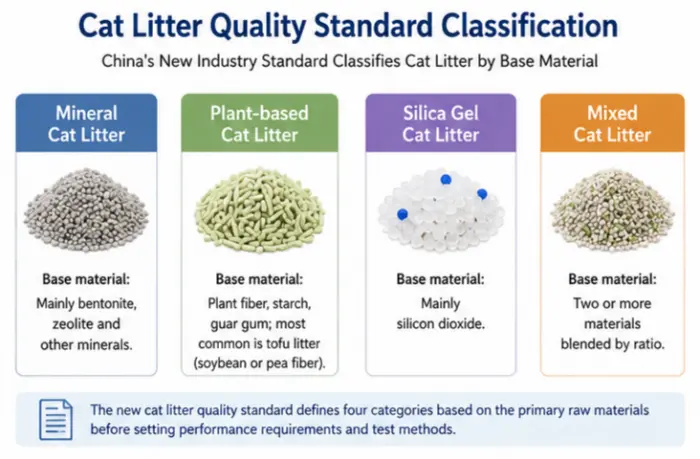
Understanding these definitions helps when comparing supplier quotes. Two “tofu” samples can differ sharply if one uses soybean fiber and another uses pea fiber, yet both sit under the same plant-based label. See our breakdown of cat litter types by material for the sourcing implications of each group.
The Two Metrics That Matter Most to Buyers
Of everything in the draft, two quantified metrics deserve the most attention from importers and brands, because they are the ones most often hidden behind marketing language.
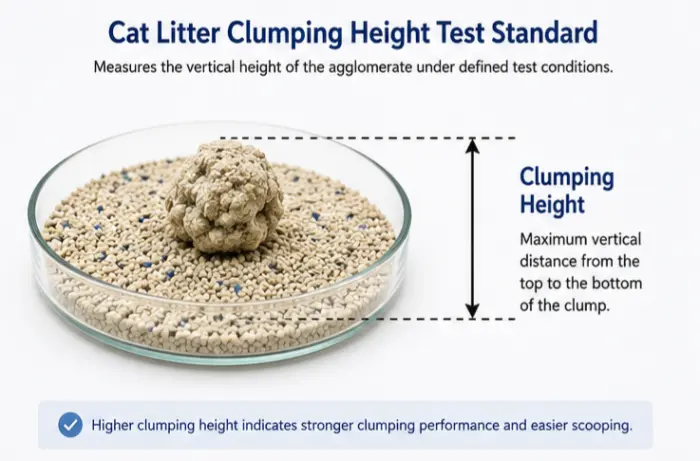
Clumping Height
Clumping height is defined as the maximum vertical distance from the top to the bottom of a clump formed under specified test conditions. In plain terms, it measures how tall and cohesive a clump becomes when the litter meets liquid.
Why it matters: a stable, well-formed clump is easier to scoop, produces less waste, and reduces how much litter a cat consumes per cycle. Weak clumping leaves residue that breaks apart during scooping and forces more frequent full changes.
What to ask a supplier: request the reported clumping height and the exact test method, then compare samples at a consistent liquid volume and temperature. A number without a method is not comparable across factories.
Dust Rate
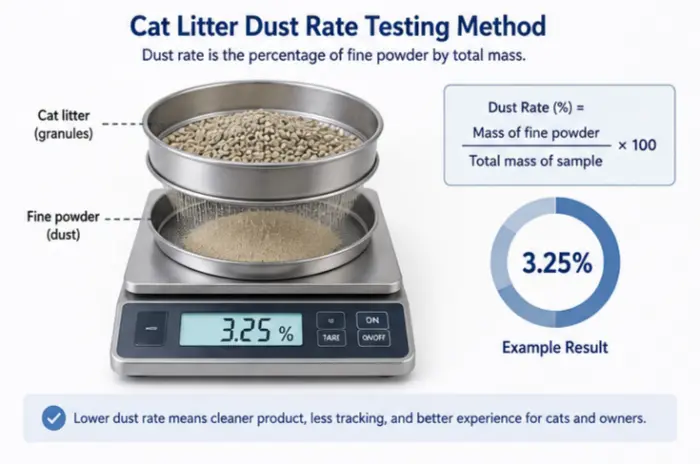
Dust rate is defined as the mass percentage of fine powder in the total mass of the litter. It is the single most abused claim in the category: “low dust” and “99% dust-free” appear on packaging with no stated measurement behind them.
Why it matters: airborne dust affects respiratory health for both cats and the people who scoop, drives tracking around the home, and undermines premium positioning if the reality does not match the label. For low dust clumping cat litter programs, a measured dust rate is the only claim that survives scrutiny.
What to ask a supplier: request the dust-rate percentage from an in-house or third-party lab report and write an acceptance threshold into the contract. Treat any “dust-free” claim without a number as unverified.
Besides requesting a dust-rate report, buyers should confirm whether the result comes from internal laboratory testing or an independent third-party laboratory. Consistent batch testing provides much stronger evidence of long-term manufacturing quality than a single sample report.
Marking, Packaging, Transport, and Storage
The draft also sets rules for labeling, packaging, transport, and storage. For importers, this is where the standard meets destination-market compliance. Carton markings, weight statements, and any safety or warning language should align with the requirements of the market you sell into — not just the factory’s usual export format.
Buyers who specify marking and packaging expectations up front avoid costly relabeling at the port of entry and keep batches consistent across repeat orders.
Why This Standard Matters for Importers and Brands
The core value is a neutral third-party yardstick. For procurement teams, this standard also creates a common technical language that makes supplier qualification, quotation comparison, factory audits, and long-term quality control significantly easier. A supplier’s “our dust is the lowest” is an opinion; a dust rate measured by a defined method is evidence. The draft gives buyers a way to:
- Compare factories on the same basis, not on competing marketing language.
- Reduce the risk of false “natural” or “dust-free” claims reaching your customers.
- Hold consistent quality across shipments with a written acceptance criterion.
When a category has a written standard, “good quality” stops being a feeling and becomes a number you can put in a contract.
How OEM and Private Label Buyers Can Use the Standard
For OEM and private-label programs, the draft is a shortcut for technical communication. Instead of a long email thread describing what you want, reference the classification and the two key metrics directly in your spec sheet:
- State the material category (for example, “mixed cat litter, bentonite + tofu, per the QB draft”).
- Set target clumping height and maximum dust rate.
- Reference GB/T 43839-2024 for safety requirements.
- Ask for a batch test report using the draft’s methods before mass production.
This approach shortens sampling cycles and reduces back-and-forth, because the factory knows exactly which numbers to hit. Our OEM and private label cat litter process builds the spec from these same measurable parameters.
How to Verify a Supplier Against the New Cat Litter Quality Standard
Understanding the standard is only the first step. To reduce sourcing risks, importers and private label brands should use it as a practical supplier evaluation checklist rather than treating it as a technical document. A reliable supplier should be able to explain not only what the standard requires, but also how each production batch is tested and documented.
Before approving a supplier, ask for evidence that demonstrates consistent compliance rather than relying on marketing claims or a single successful sample. The following checkpoints can help buyers compare factories using objective quality criteria.
- Verify the product classification. Confirm whether the product is classified as mineral, plant-based, silica gel, or mixed cat litter, and ensure the declared raw materials match the actual formulation.
- Request batch test reports. Ask for recent laboratory reports showing measured clumping height and dust rate. The reports should clearly state the testing method and production batch.
- Review batch-to-batch consistency. One excellent sample does not guarantee stable production. Ask suppliers to provide quality records from multiple production lots to demonstrate consistent manufacturing performance.
- Confirm raw material traceability. Reliable manufacturers should maintain records for major raw materials, including suppliers, incoming inspections, and production dates. Traceability helps identify and resolve quality issues quickly.
- Evaluate quality control procedures. Ask how often clumping height and dust rate are tested, whether inspections are performed during production, and whether products are rechecked before shipment.
- Check packaging and labeling compliance. Verify that packaging specifications, language, barcode requirements, and shipping marks can be customized for your destination market before mass production begins.
Using this verification process allows buyers to compare suppliers based on measurable evidence instead of promotional claims. Over time, it also helps establish more stable supply chains, reduces quality disputes, and improves consistency across repeat orders.
Supplier Verification Checklist
- Product classification confirmed
- Raw materials verified
- Clumping-height report reviewed
- Dust-rate report reviewed
- Batch consistency verified
- Quality control process audited
- Packaging specifications confirmed
How Pet Horizon Supports Standards-Aligned Sourcing
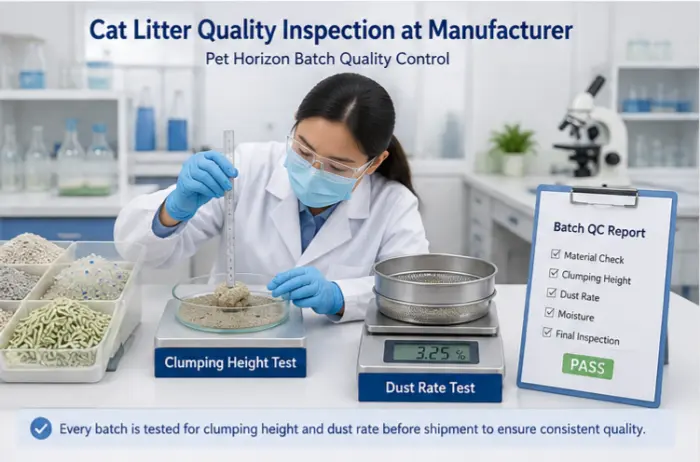
Pet Horizon’s manufacturing team runs batch checks for clumping height and dust rate using methods consistent with the emerging QB draft and the safety requirements of GB/T 43839-2024. For each production lot we can provide a certificate of analysis and a batch test report, so the numbers on your spec sheet match the numbers in the container.
With more than 20 years in the cat litter industry, over 10 years of OEM and ODM experience, and products shipped to more than 80 country markets, we treat the new standard as a buying tool rather than a formality. When you sample with us, the classification, clumping-height target, and dust-rate threshold are documented up front — which is exactly how a reliable cat litter manufacturer should operate.
Each production batch should be assigned a traceable lot number and documented with its raw material source, production date, dust-rate result, clumping-height result, and final inspection record. This documentation helps importers maintain consistent product quality across repeat orders.
Common Mistakes Buyers Make When Verifying Cat Litter Quality
- Accepting a “99% dust-free” claim with no stated test method or number.
- Comparing clumping performance across samples tested at different liquid volumes or temperatures.
- Treating all “plant-based” or “tofu” litter as identical, ignoring the base fiber.
- Forgetting that “mixed” litter performance depends on the blend ratio, which must be specified.
- Leaving carton markings and packaging language to the factory’s default instead of the destination market.
- Skipping batch-to-batch consistency checks after the first approved sample.
- Choosing a supplier based only on a single approved sample without reviewing batch-to-batch consistency records.
Conclusion
China’s first dedicated cat litter industry standard turns quality from a vague promise into a set of measurable values. For importers, brands, and OEM buyers, the takeaway is simple: build your spec sheet around the draft’s material classification and its two quantified metrics — clumping height and dust rate — and ask for batch reports that follow the methods. That discipline protects your customers and your margins. To go deeper on supplier selection, read our guide on how to choose a reliable cat litter manufacturer, and explore how batch testing is built into our cat litter manufacturing process.
Frequently Asked Questions
It is the light-industry standard Pet Supplies — Cat Litter (plan no. 2025-0459T-QB), the first written specifically for cat litter as a product category. The draft was completed in February 2026 and its public comment period closed on 3 April 2026, with formal issuance expected later in 2026.
No. GB/T 43839-2024 is China’s first national safety standard for companion-animal (pet) products, in force since 1 October 2024. The new cat litter standard is a product-specific industry standard that normatively references GB/T 43839-2024 for safety requirements.
Clumping height is the maximum vertical distance from top to bottom of a clump formed under specified test conditions. It indicates how well the litter holds together when wet, which affects scooping ease and waste volume.
Dust rate is defined as the mass percentage of fine powder in the total mass of the litter. A credible result comes from a defined test method and a lab report; a “low dust” label without a number is not verifiable.
No. The draft explicitly excludes paper cat litter. It applies to cat litter used for handling cat urine and feces, and other pet sands may follow it by reference.
Ask each supplier for a batch test report that states clumping height and dust rate using the draft’s methods, then compare factories on the same basis. Put your acceptance thresholds in the contract so quality is consistent across shipments.
State the material category (mineral, plant-based, silica gel, or mixed), the target clumping height, the maximum dust rate, and the safety reference to GB/T 43839-2024. Request a batch test report before mass production to confirm the numbers.
The draft-for-comment was completed in February 2026 and public consultation closed on 3 April 2026. Formal issuance is expected later in 2026, though the exact publication date depends on the CNLIC review and approval process.
A professional supplier should be able to provide product specifications, batch test reports, certificates of analysis (COA), safety documentation where required, packaging specifications, and quality inspection records. These documents help buyers verify product consistency before shipment.