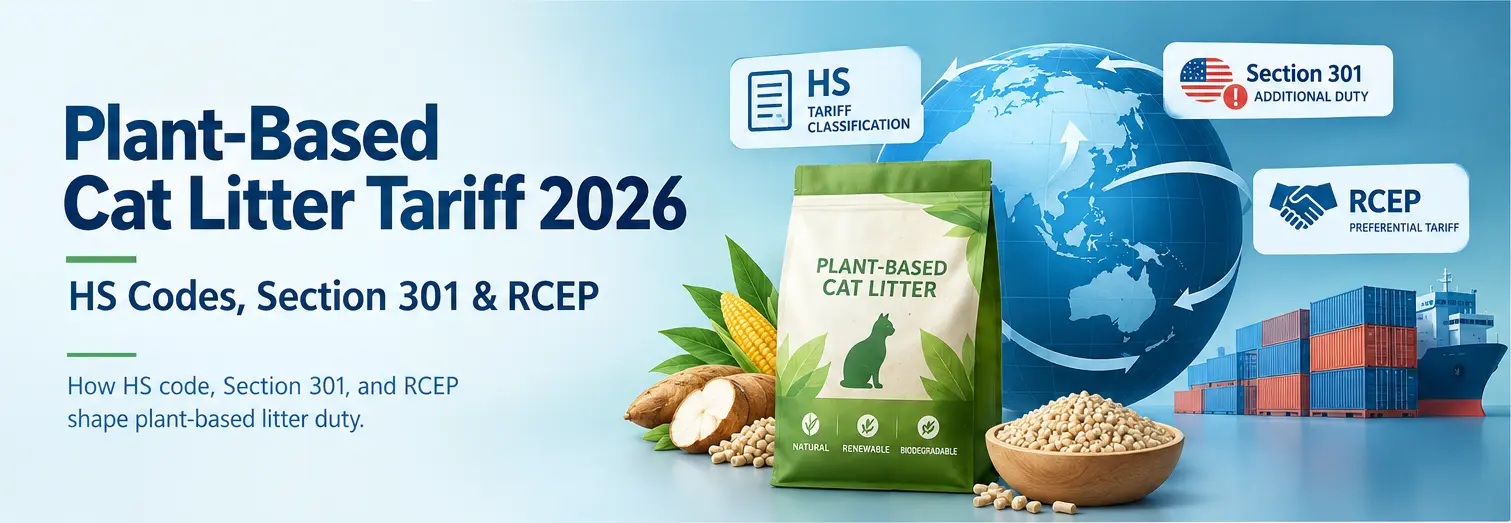


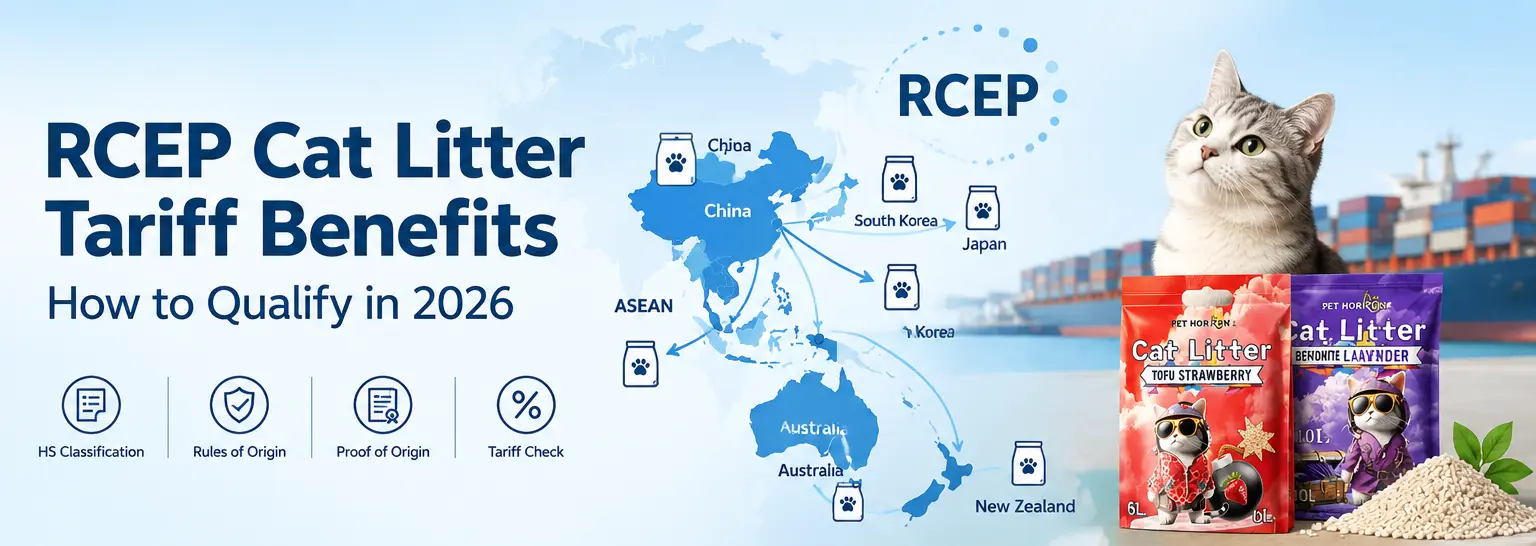
RCEP cat litter tariff preferences may reduce import duties on qualifying shipments between participating economies, but the benefit depends on the destination market, the product’s tariff classification, its originating status, and the applicable tariff schedule. For importers sourcing tofu, bentonite, pine, or blended cat litter from China, the first step is to confirm whether the destination offers an RCEP preferential rate for the declared HS code. This guide explains how to check tariff eligibility, assess origin requirements, and prepare supporting documents before shipment.
RCEP may provide preferential import duty on qualifying cat litter traded between participating economies. Eligibility depends on the destination tariff schedule, the product’s HS classification, and the applicable product-specific rule of origin. Depending on that rule, qualification may involve regional value content (RVC), a change in tariff classification, or another permitted criterion. Importers must also provide acceptable proof of origin and meet the destination’s claim procedures.
In this guide, “RCEP cat litter tariff” refers to the preferential duty treatment that may apply to cat litter qualifying under the Regional Comprehensive Economic Partnership agreement. It does not cover non-participant markets such as the United States or the European Union, which follow separate trade frameworks.
How RCEP Tariff Preferences Work for Cat Litter
The Agreement in One Paragraph
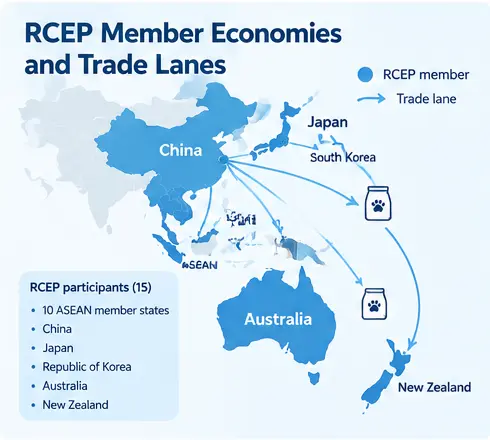
The Regional Comprehensive Economic Partnership (RCEP) is a free trade agreement signed by 15 economies: the ten ASEAN member states and Australia, China, Japan, the Republic of Korea, and New Zealand. Its tariff commitments and rules of origin determine whether an eligible product can receive preferential treatment. Before making a shipment-specific claim, confirm that the agreement is in force for the relevant trading parties, that the destination’s tariff schedule provides a preference for the product’s classification, and that the goods satisfy the applicable origin and documentary requirements. The full agreement text and product-specific rules are published by the participating economies’ authorities, including Australia’s Department of Foreign Affairs and Trade (DFAT RCEP agreement page).
Why the Benefit Is a Tariff Preference, Not a Fixed Discount
A recurring error is treating “RCEP” as a guaranteed percentage off the duty. The RCEP rate is the preferential tariff rate listed by the importing economy for eligible goods under the agreement. Whether it reduces duty compared with the applicable MFN rate, and by how much, must be verified against the tariff line and rate schedule for the relevant year. The preference is not a fixed percentage discount, and the applicable rate may still be above zero.
A duty rate is also only one component of landed cost; freight, insurance, handling, and non-tariff charges remain payable. Frame RCEP as a potential reduction whose value you confirm per shipment rather than a fixed saving.
HS Classification Drives the RCEP Treatment
The tariff classification of cat litter must be determined from the product’s actual composition, processing, and the importing economy’s tariff nomenclature. The following headings are research starting points, not confirmed classifications for every product in a material family. Do not quote an RCEP duty rate until the applicable national tariff line and its corresponding preferential schedule have been checked.
| Product type | Research starting point | What to confirm |
|---|---|---|
| Bentonite (mineral clay) litter | HS 2508.10 may be relevant | Whether it meets the heading’s description for bentonite and the destination’s subheading |
| Tofu, cassava, or other plant-based litter | Determined by material nature, processing, and classification rules | Cannot be assigned HS 1404.90 solely because it is “plant-based” |
| Pine or wood litter | Confirm wood form, processing, and relevant headings | Cannot default to a single plant-product code |
| Mixed or compounded litter | Determined by actual formulation and tariff rules | Not automatically HS 3824.99 merely because it contains a binder or additive |
HS 2508.10, 1404.90, and 3824.99 should be treated as classification leads to investigate, not as a universal code map for cat litter. Products made from bentonite, plant-based materials, wood, or mixed formulations may require different analyses depending on their objective characteristics and the destination’s tariff nomenclature.
Confirm the Classification Before Quoting a Rate
Before relying on an RCEP rate, obtain the full product specification, ingredient list, processing description, and intended use, then confirm the classification under the importing economy’s rules. Where uncertainty could materially affect duty or origin eligibility, seek a formal advance or binding ruling from the competent customs authority when available. When comparing classification options, use the importing economy’s national tariff nomenclature and explanatory materials, and check whether the proposed code is consistent with the product’s actual ingredients, physical form, processing, and intended use. Do not select a code solely because it appears in a supplier’s previous invoice or another country’s tariff database.
How to Check an RCEP Cat Litter Tariff Before Importing
- Identify the destination market. Confirm that RCEP applies to the relevant trade and that the agreement is in force for the parties involved.
- Confirm the tariff classification. Use the product’s actual composition and processing details to determine the applicable national tariff line.
- Compare the tariff rates. Check the destination’s current RCEP schedule and the standard rate for the same tariff line.
- Verify origin eligibility. Identify the product-specific rule and determine whether the goods satisfy its requirements.
- Confirm proof of origin. Check which certificate or declaration the importing economy accepts and who is eligible to provide it.
- Reconcile the shipment records. Ensure that the product description, value, classification, origin evidence, and supporting documents are consistent before filing the import declaration.
The result should be a shipment-specific duty assessment, not a blanket assumption that cat litter from an RCEP economy enters duty-free.
Record the Tariff Check for Each Product and Destination
For each cat litter SKU and destination market, keep a tariff verification record with the following fields:
- Product name and formulation
- Confirmed national tariff code
- Importing economy and applicable RCEP tariff schedule
- RCEP rate and MFN rate for the relevant year
- Applicable product-specific rule of origin
- Origin criterion used and supporting records available
- Accepted proof-of-origin method and responsible party
- Date the tariff and origin requirements were checked
Use a separate record for each destination and materially different formulation. If the formula, processing method, or destination changes, review the classification and origin assessment again before quoting landed cost.
Rules of Origin: RVC 40% and FORM RCEP
A product qualifies for the preference only when it meets the applicable RCEP rules of origin. The qualification route depends on the product-specific rule for the declared HS subheading; it may rely on regional value content, a change in tariff classification, or another permitted criterion, supported by acceptable proof of origin. The full agreement text, including Annex 3A product-specific rules, is available through the DFAT RCEP agreement page.
Regional Value Content of at Least 40%
Regional Value Content (RVC) is one possible way to meet an RCEP product-specific rule of origin. A 40% threshold applies where the relevant rule specifies RVC 40; it should not be assumed to be the only qualification route for every cat litter product. Depending on the applicable HS subheading and product-specific rule, a change in tariff classification or another permitted criterion may also establish originating status.
For a blended litter containing imported clumping agents, plant-based materials, minerals, or other additives, the exporter should first identify the applicable product-specific rule and then collect the evidence needed to test it. Where RVC is the selected criterion, use the calculation method and valuation basis prescribed by the agreement. Retain the bill of materials, supplier origin declarations, input values, and production records needed to substantiate the claim. Meeting a value threshold alone does not establish eligibility if other applicable requirements are not met.
The FORM RCEP Certificate of Origin
RCEP preferential claims require acceptable proof of origin under the importing economy’s procedures. Depending on the destination and the applicable certification system, this may be a certificate of origin issued by an authorized body or an eligible declaration of origin. FORM RCEP refers to the prescribed certificate used under the third-party certification system; it should not be described as the only proof-of-origin route for every destination.
Before shipment, the exporter, producer, and importer should confirm which proof-of-origin method is accepted, who may prepare or issue it, and what supporting records must be retained. The product description, declared HS code, origin criterion, invoice details, and supporting origin records should be consistent with the applicable requirements. For one economy’s step-by-step procedures, Japan Customs publishes an RCEP preferential tariff guide, though its specific filing steps apply to imports into Japan.

Which Lanes Benefit
RCEP tariff treatment must be assessed by trade lane rather than assumed for an entire region. For cat litter exported from China to an RCEP participating economy, the importer should confirm the destination’s tariff schedule for the product’s classification and the relevant year, then verify that the shipment meets the applicable origin and proof-of-origin requirements. Compare the RCEP rate with the applicable MFN rate before estimating any duty saving; the RCEP rate may be zero or positive, and a reduction should not be assumed without checking the schedule.
China to ASEAN
For cat litter shipped from China to an ASEAN member economy, verify the destination country’s RCEP tariff schedule for the product’s confirmed tariff classification and the relevant year. Then check the applicable product-specific rule of origin and the destination’s proof-of-origin procedures. Do not assume that the same rate or origin test applies across all ASEAN destinations.
China to Japan, Republic of Korea, Australia, and New Zealand
For shipments from China to Japan, the Republic of Korea, Australia, or New Zealand, check each destination’s own RCEP tariff schedule rather than assuming a common regional rate. Confirm the applicable tariff line, the rate for the relevant year, the product-specific rule of origin, and the accepted proof-of-origin method before estimating duty savings.
Other Lanes and Origin Scenarios
Where another free trade agreement may also apply, compare its tariff schedule and origin rules with those under RCEP before selecting a preference. The importer and exporter must establish eligibility under the specific agreement claimed and comply with its proof-of-origin and import procedures. Non-originating inputs should be reviewed against the selected agreement’s rules rather than assumed to disqualify or qualify the product automatically.
| Lane | Typical benefit | What to verify |
|---|---|---|
| China to ASEAN | Rate depends on the destination’s RCEP schedule and the shipment’s eligibility | HS subheading, applicable origin rule, proof of origin |
| China to Japan, Korea, Australia, New Zealand | Preferential rate per each economy’s schedule | Destination tariff schedule, origin proof |
| ASEAN origin to other RCEP parties | May use RCEP or another applicable agreement | Compare applicable agreements, verify origin eligibility, and use the required proof of origin |
Documents Checklist for a Clean Claim
Assemble the following before the goods reach the border, and keep each item consistent with the others:
- Commercial invoice and packing list
- Bill of lading or airway bill
- Applicable RCEP proof of origin, such as FORM RCEP or an accepted declaration of origin
- Product specification and composition statement supporting classification
- HS classification advice or a customs ruling, where available or necessary
- Bill of materials, supplier origin declarations, and production records supporting the origin criterion
- Certificate of Analysis (COA), where relevant to the product specification or requested by the buyer or authority
Before shipment, cross-check the product description, declared tariff code, invoice value, origin criterion, and proof-of-origin details. Keep the supporting material and production records available in case customs requests verification. Missing documents, inconsistent declarations, an incorrect classification, or failure to satisfy the applicable origin rule can all prevent preferential treatment or lead to additional customs review.

Common Claim Mistakes to Avoid
- Assuming one HS code fits every litter; classification follows composition.
- Shipping without acceptable proof of origin or with a document that contradicts the invoice.
- Skipping the origin assessment when non-originating materials are present.
- Quoting a duty rate without checking the destination tariff schedule.
- Treating the preference as landed-cost certainty rather than a tariff component.
- Relying on a marketing claim such as “low dust” to support a classification.
What Cat Litter Manufacturers Can Provide for Origin Verification
For importers sourcing cat litter from China, the manufacturer can support the review by providing product specifications, formulation or ingredient information, relevant production details, and available supplier records for the specific SKU. For tofu, bentonite, pine, and blended litters, keep the records product-specific rather than relying on one general description for the entire product range.
These materials can help the importer, customs broker, or compliance team assess tariff classification and the applicable RCEP origin rule. They do not, by themselves, guarantee originating status or preferential treatment. The final assessment must follow the relevant product-specific rule, the importing economy’s procedures, and the evidence required for the claim.
Complementary Reading
RCEP treatment interacts with classification and destination rules, so pairing this guide with the right references prevents errors. For plant-based products specifically, our plant-based cat litter tariff guide covers that material family in depth. The cat litter HS code guide explains how subheadings are assigned, and the broader cat litter import tariffs by market overview maps rates across destinations. For end-to-end import compliance, see our cat litter export compliance guide.
Plant-based cat litter tariff guide
Cat litter import tariffs by market
Cat litter export compliance guide
Conclusion
RCEP cat litter tariff preferences depend on the destination’s tariff commitments, correct HS classification, compliance with the applicable product-specific rule of origin, and acceptable proof of origin. RVC 40% is relevant where the governing rule specifies that threshold, but it is not a universal requirement for every cat litter formulation. Importers should verify the current tariff schedule and origin procedure before shipment, and coordinate with their supplier to obtain consistent product, material, and origin records.
Frequently Asked Questions
RCEP covers its 15 member economies, but a preferential rate is not automatic for every member destination. Eligibility still depends on the product’s HS classification, the destination’s tariff schedule, and compliance with the applicable rule of origin and proof-of-origin procedure. Confirm the specific rate and requirements for the destination before relying on the preference.
HS classification follows the product’s actual composition, processing, and the importing economy’s nomenclature. Bentonite litter may fall under HS 2508.10, plant-based litters are assessed on their material and processing rather than assigned HS 1404.90 by default, and mixed formulations are classified on their facts. Obtain the product specification and ingredient list, then confirm the subheading with the destination customs authority or a binding ruling before quoting a rate.
The applicable RCEP product-specific rule depends on the product’s HS classification. It may specify a regional value content threshold, a change in tariff classification, or another permitted criterion. Confirm the rule for the declared subheading in Annex 3A and retain the records needed to demonstrate compliance.
Proof of origin may be a certificate issued by an authorized body in the exporting economy or an eligible declaration of origin, depending on the destination’s certification system. FORM RCEP is the prescribed certificate under the third-party certification route; it is not the only route for every destination. Confirm which method the importing economy accepts and who may prepare or issue it.
Check the destination economy’s RCEP tariff schedule, which shows the applicable rate for the specific HS subheading and the transition year. Rates phase in under each economy’s commitment calendar, so verify the current rate per shipment rather than assuming a fixed percentage.
No. The applicable RCEP rate depends on the destination’s tariff schedule, the product’s tariff classification, and the relevant year. It may be zero or a positive rate, and the duty saving compared with the MFN rate must be calculated from the two applicable rates. The importer must also meet the origin and claim requirements to receive the preference.