




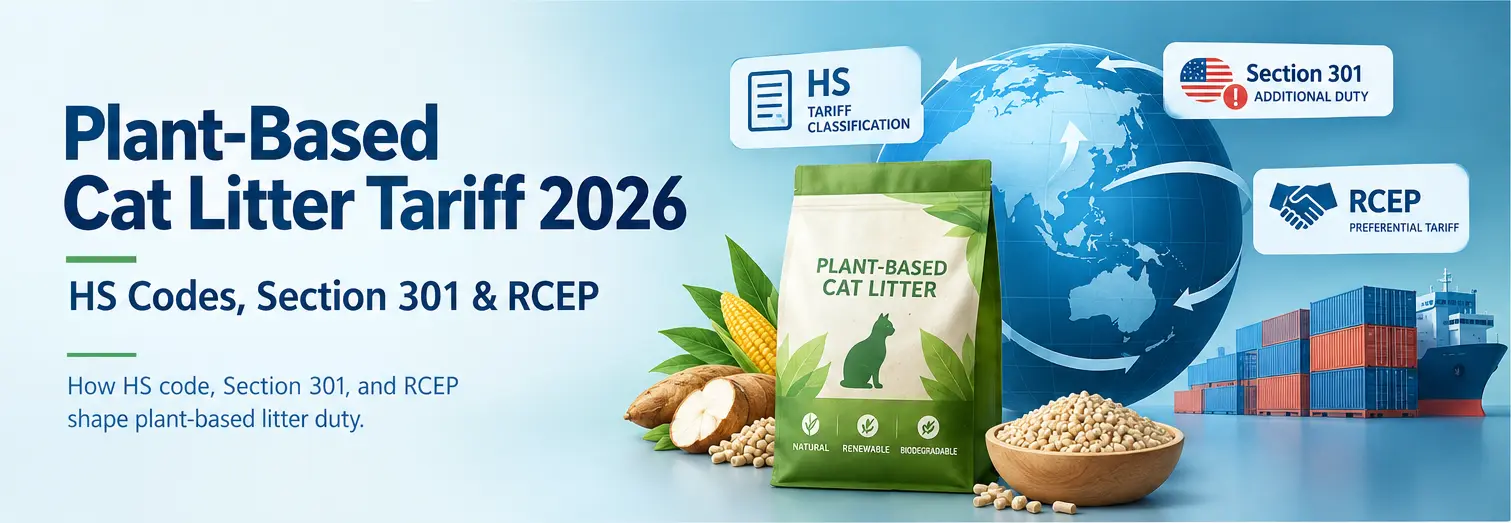
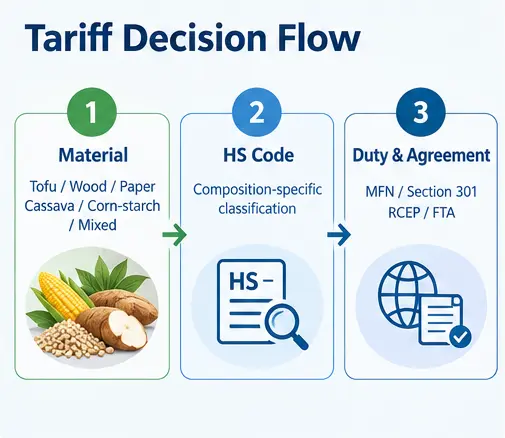
Plant-based cat litter — including tofu, wood, paper, cassava, and corn-starch formulations — does not have one universal tariff classification. For B2B buyers and exporters, the key questions are which HS or HTS code applies to the actual composition, whether additional duties such as US Section 301 apply, and whether the product qualifies for preferential treatment under an applicable trade agreement. This guide provides a 2026 framework for classification, duty, and origin checks; exact treatment must be confirmed for the destination country, product composition, and shipment date.
HS Classification by Material
Tariff classification starts with the product’s actual composition and manufacturing process, not the marketing term “plant-based.” Tofu, wood, paper, cassava, corn-starch, and mixed litters can fall under different HS or national tariff subheadings depending on the substrate, processing, additives, and the importing country’s tariff schedule. HS 1404.90 may be relevant to certain vegetable-product formulations, while wood, paper, chemical, or other classifications may apply to other formulations. Mixed or additive-bearing products also require product-specific review rather than an automatic assignment to HS 3824.99. Buyers should obtain the applicable national tariff classification before using any duty rate for landed-cost calculations.
| Material | Indicative classification | Duty treatment | Buyer action |
|---|---|---|---|
| Clay / bentonite | Product-specific; e.g. US HTS 2508.10 for bentonite | Check current tariff line | Confirm the mineral composition and applicable national tariff classification |
| Silica gel | Often within HS 2811.22 | Check current tariff line | Confirm product-specific classification |
| Plant-based formulations | Composition-specific | Classification and duty vary by substrate and destination | Review the actual formulation, processing, additives, and national tariff schedule |
| Mixed / additive formulations | Composition-specific | Classification and duty vary by formulation | Do not assume HS 3824.99 without a tariff-classification review |
Data scope: Clay and bentonite litter are included only as comparison points. Plant-based litter requires product-specific classification because the applicable tariff line can change with the substrate, processing, additives, and destination market. The duty should therefore be verified against the final national tariff line rather than inferred from the general “plant-based” category.
MFN Duty Rates for Plant-Based Litter
For comparison, bentonite and other clay products may fall under different tariff lines depending on the product and destination. In the United States, bentonite is classified under the HTS framework, while the European Union applies the CN/TARIC system. Plant-based and mixed litters are also composition-specific, so the applicable duty must be confirmed against the exact national tariff line. In Japan, Korea, Australia, and other RCEP markets, preferential rates may be available when the product satisfies the applicable tariff and origin requirements. Buyers should check the destination country’s current tariff schedule and preferential program for the exact product and shipment date.
Section 301 Risk for China Origin
The key US tariff issue for China-origin cat litter is whether the product’s specific HTS subheading is covered by an active Section 301 action. Section 301 treatment is determined at the applicable HTS subheading level, so a China-origin product should not be assumed to carry the same additional duty merely because it is cat litter or plant-based. Importers and exporters should check the current USTR Section 301 product search and the applicable HTS provisions for the shipment date before calculating US landed cost.
RCEP and the China-ASEAN Free Trade Area
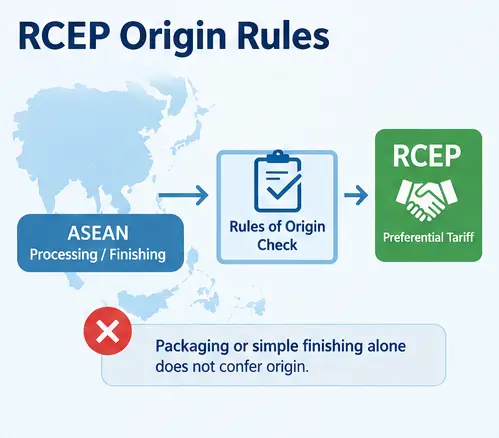
RCEP and the China-ASEAN trade framework can create preferential-tariff opportunities, but an ASEAN finishing or packaging operation does not automatically change the country of origin. Under RCEP rules, packaging and other minimal operations are insufficient by themselves to confer originating status. A plant-based litter produced in an RCEP member must satisfy the applicable originating-good and product-specific rules, which may depend on the materials used, tariff classification, and qualifying processing. Buyers should therefore verify the applicable preferential schedule and origin requirements for the finished formulation rather than assuming that a particular HS heading or processing location automatically produces a preferential rate.
Flushable and Biodegradable Claim Compliance
Beyond tariffs, exporters should separately review environmental and product-performance claims such as “flushable” and “biodegradable.” In Australia, environmental and sustainability claims must be accurate and supported by reasonable grounds under the Australian Consumer Law. The ACCC has published guidance on environmental and sustainability claims, including the need for businesses to substantiate representations they make to consumers. Requirements vary by market and claim, so exporters should verify applicable local rules and retain relevant test evidence before using such claims on packaging or marketing materials.
Sourcing Implications
For buyers, the practical sequence is to confirm the HS classification and duty before comparing plant-based quotes, then evaluate country-of-origin eligibility, preferential treatment, documentation, and any product claims that require substantiation. Pet Horizon supplies tofu cat litter and mixed cat litter formats, while cassava and other starch-based variants are discussed here as comparative product categories. The cat litter tariff guide provides a broader reference for HS classification and duty checks.
Risks and Constraints
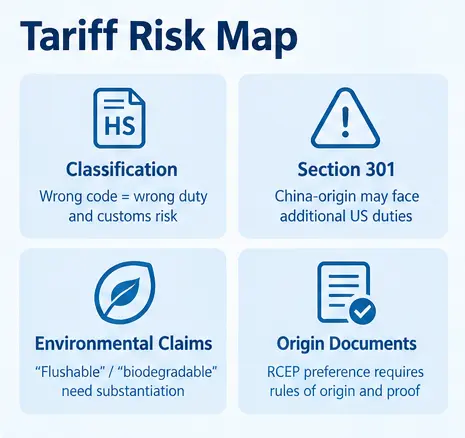
- Misclassification: “plant-based” spans multiple HS chapters; an incorrect code produces the wrong duty and customs risk.
- Section 301 exposure: China-origin goods may face additional US duties when the applicable HTS subheading is covered; confirm the current treatment for the shipment date.
- Environmental claims: “Flushable” and “biodegradable” claims should be supported by evidence appropriate to the destination market; unsupported claims can create consumer-law, labeling, corrective-action, or enforcement risk.
- Origin documentation: RCEP preference requires the product to satisfy the applicable rules of origin and the importing country’s certification or proof-of-origin requirements; missing or incorrect evidence can prevent preferential treatment from being granted.
Conclusion
Plant-based cat litter tariffs in 2026 depend on the product’s actual composition, tariff classification, country of origin, destination market, and applicable trade agreement. Unlike the broad “plant-based” marketing category, the relevant HS or HTS code must be established from the formulation and manufacturing process. For China-origin goods entering the US, Section 301 exposure should be checked at the applicable HTS subheading level. RCEP and other preferential agreements may reduce duty when the product satisfies the relevant tariff and rules-of-origin requirements, but simple packaging or finishing does not automatically change origin. Buyers should confirm classification, duty, origin eligibility, documentation, and any environmental claims before using the quotation to calculate landed cost or committing volume.
Frequently Asked Questions
There is no single HS code for all plant-based cat litter. Tofu, wood, paper, cassava, corn-starch, and mixed formulations may be classified differently depending on their composition, processing, additives, and the importing country’s tariff schedule. HS 1404.90 may apply to some vegetable-product formulations, but the exact tariff line must be confirmed for the finished product.
There is no single duty rate for all plant-based cat litter. The applicable rate depends on the national tariff classification, destination country, origin, and any preferential or additional tariff measures. In the US, China-origin goods may also be subject to Section 301 duties when the applicable HTS subheading is covered. Buyers should verify the current tariff line and any additional measures for the specific product and shipment date.
Section 301 treatment is determined at the applicable HTS subheading level, so a China-origin product should not be assumed to carry the same additional duty merely because it is cat litter or plant-based. Confirm the current USTR listing for the specific subheading and shipment date.
RCEP can provide preferential tariff treatment for qualifying goods, but the applicable rate depends on the exact tariff line, importing country, import year, and compliance with the relevant rules of origin. ASEAN processing may contribute to originating status when the applicable product-specific rule is satisfied, but packaging or simple finishing alone is not sufficient to change origin.
Regulators scrutinize flushability and biodegradability claims because cat litter can damage septic and wastewater systems. In Australia, the ACCC requires environmental claims to be accurate and supported by reasonable grounds; unsubstantiated claims can create enforcement or corrective-action risk.
Cassava and tofu cat litter are both plant-based products, but they should not be assumed to have the same tariff classification. The applicable code depends on the actual substrate, processing, additives, and destination country’s tariff schedule. Buyers should classify each finished formulation separately rather than using “plant-based” or the product name as the tariff basis.
Preferential treatment requires the product to meet the applicable rules of origin and the importing country’s proof-of-origin or certification requirements. If the required evidence is missing, incorrect, or does not support the preference claim, preferential treatment may not be granted.
Confirm the HS code and resulting duty, check Section 301 exposure for China origin, verify RCEP or FTA eligibility and documents, and ensure any flushable or biodegradable claim is substantiated. Comparing quotes without these checks risks an incorrect landed-cost estimate.