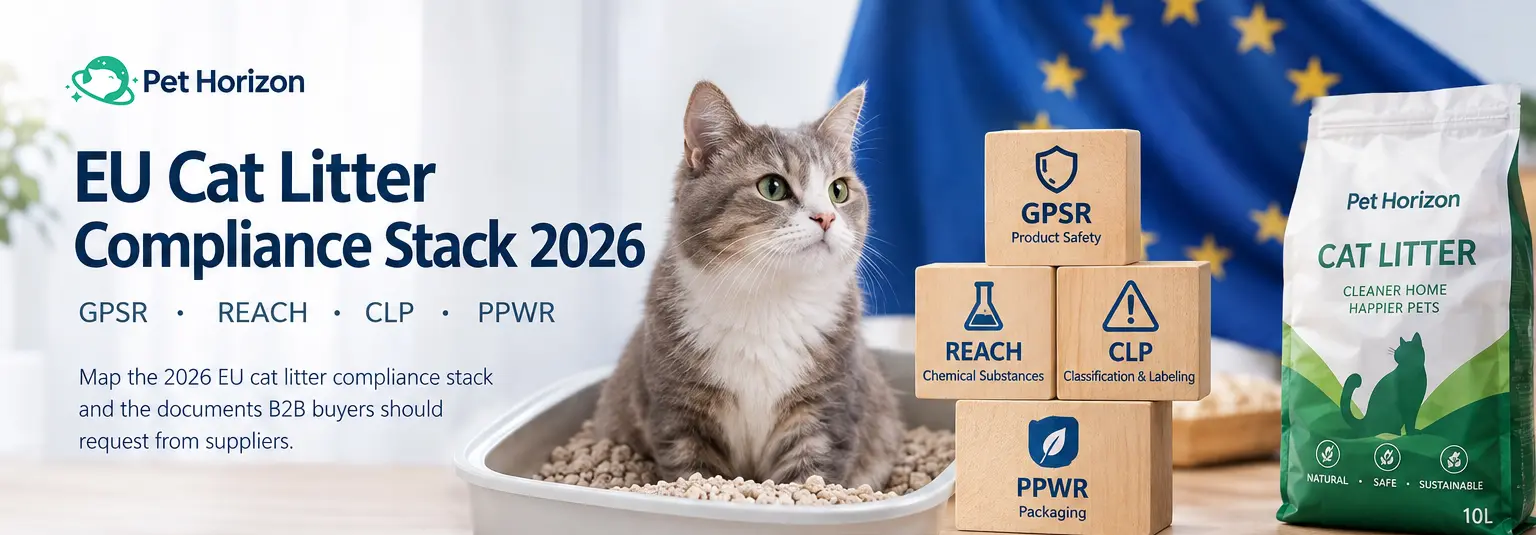






Wood- and pine-based cat litter can fall within the EU Deforestation Regulation (EUDR) when the product is covered by Annex I and contains or is made using wood covered by the Regulation. From 30 December 2026, the rules generally apply to large and medium operators, while micro and small operators already covered by the EU Timber Regulation also move to the EUDR framework on that date. For affected wood products, the operator placing the product on the EU market bears the due-diligence obligation, while buyers are responsible for verifying that their suppliers can provide plot-level traceability, evidence of legal production, and proof that the wood was produced without deforestation or forest degradation after 31 December 2020.
Quick Answer: The EU Deforestation Regulation (Regulation (EU) 2023/1115, as amended by Regulation (EU) 2025/2650) can apply to wood-based cat litter where the product falls within Annex I and is made using covered wood products. Large and medium operators generally face the 30 December 2026 application date, while micro and small operators already covered by the EU Timber Regulation also fall under the EUDR from 30 December 2026; other micro and small operators generally have until 30 June 2027. Compliance for relevant wood products requires evidence of legal production and deforestation-free status, including the wood-specific forest-degradation requirement, together with the required information in the EUDR Information System. Micro and small primary operators may use the one-time simplified declaration regime where eligible.
In this article, “EUDR-ready wood litter” means a product whose covered wood raw material can be traced to the relevant production plots, shown to have been legally produced, and demonstrated to meet the EUDR’s deforestation-free requirement and, for wood, the applicable forest-degradation requirement after 31 December 2020. Voluntary certification may support the evidence file but does not replace the EUDR obligations.
Why EUDR Applies to Wood-Based Cat Litter
EUDR scope is determined by the product’s classification under Annex I and its use of covered wood, rather than by the material name alone. Wood products under heading 4401 include wood in chips or particles, sawdust, wood waste and scrap, and wood pellets, making the heading particularly relevant when assessing wood-based litter and its raw materials. The exact CN classification should be confirmed for the finished product and import transaction rather than assumed from the term “wood cat litter.” The European Commission’s EU Deforestation Regulation (EU) 2023/1115 materials provide the governing scope and implementation information.
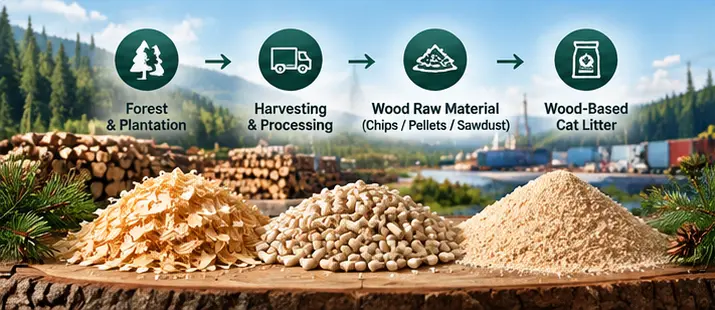
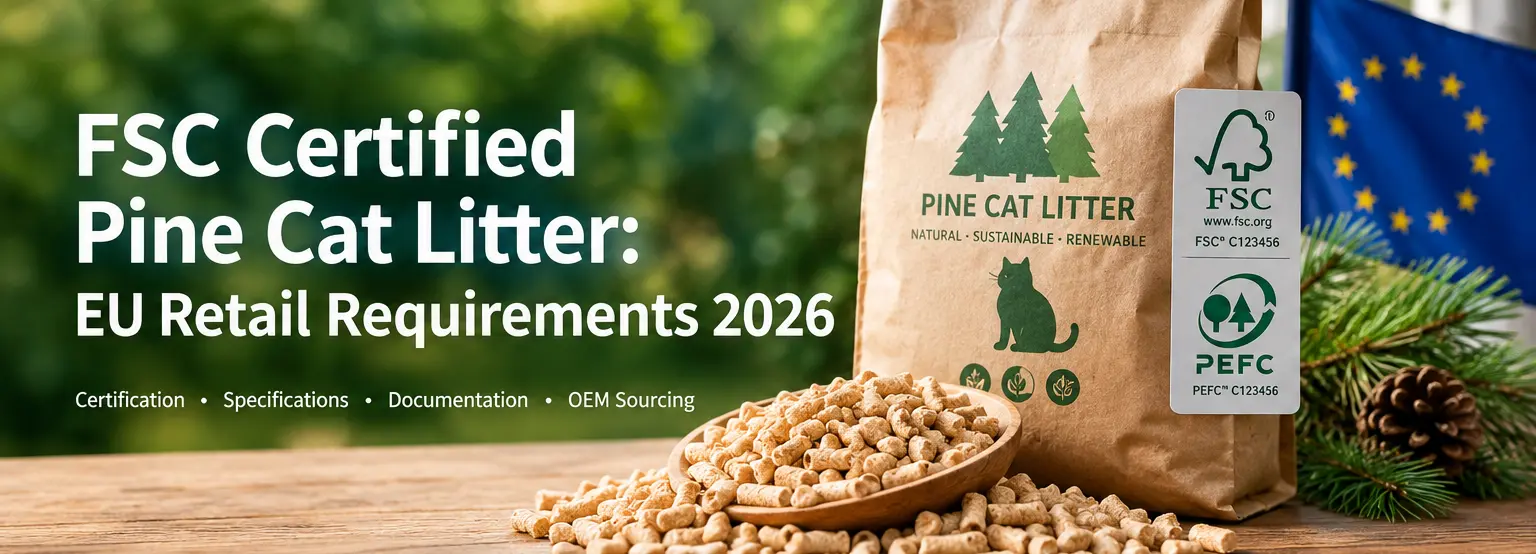
This matters for Pet Horizon’s pine line and for any OEM customer shipping wood-based cat litter into the EU. A voluntary certificate such as FSC or PEFC can support the evidence file, but it does not by itself satisfy EUDR. EUDR requires its own due diligence statement; voluntary certification can support the evidence file but does not substitute for the required filing.
Key Compliance Dates for 2026 to 2027
| Operator type | Applies from | Note |
|---|---|---|
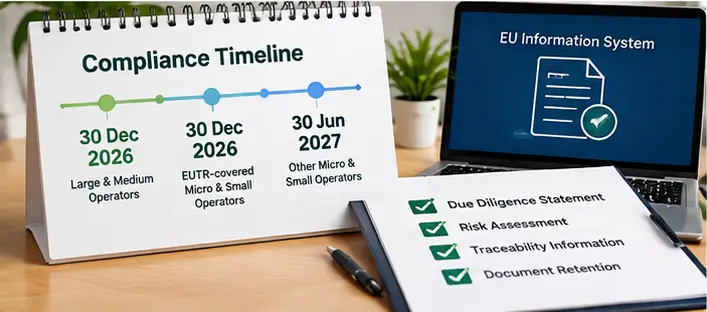
| Large and medium operators | 30 December 2026 | Conducts due diligence and files the due diligence statement |
| Micro and small operators for wood (EUTR-covered products) | 30 December 2026 | Already under the EU Timber Regulation; transitions to EUDR on 30 Dec 2026 |
| Other micro and small operators | 30 June 2027 | Delayed six months versus the general date |
EU customers may demand proof earlier than the legal deadline through supply contracts, so buyers should treat 2026 as the practical preparation year even where the letter of the law allows more time.
Large and Medium Operators
If you are an operator placing relevant wood-based products on the EU market, you must exercise due diligence before placing them on the market or exporting them. For large and medium operators, this generally means collecting the required information, assessing and mitigating non-negligible risks, and submitting the required due diligence statement through the EU Information System before the relevant transaction.
Micro and Small Operators
Micro and small operators already covered by the EU Timber Regulation are subject to the EUDR from 30 December 2026. Where a micro or small business qualifies as a micro or small primary operator, it can use the EUDR’s one-time simplified declaration regime rather than the standard due diligence statement, subject to the conditions in Article 4a. Other micro and small operators generally have until 30 June 2027.
The Three Due-Diligence Conditions
For relevant products, EUDR compliance depends on three core conditions:
- Deforestation-free and forest-degradation compliant: the wood must not have been produced on land that was deforested after 31 December 2020, and wood must also meet the EUDR requirement concerning forest degradation after that date.
- Legally produced: harvesting and production must comply with the relevant legislation of the country of production.
- Due diligence completed and documented: the relevant product must be covered by the applicable due diligence statement or, where the simplified regime applies, the required simplified declaration in the EU Information System.
Geolocation Requirement
For standard EUDR due diligence, operators must collect geolocation information for the plots of land where the relevant wood was produced; country- or region-level information alone is not sufficient. For eligible micro or small primary operators using the simplified declaration regime, the Regulation provides a limited alternative under which the postal address of the plots or producing establishment may be used instead of the standard geolocation data.
Due Diligence Statement in the EU Information System
The due diligence statement is submitted electronically through the EU Information System under the EUDR and its implementing rules, including Commission Implementing Regulation (EU) 2026/1565. Eligible micro and small primary operators use the simplified declaration regime instead. Downstream operators and traders generally do not submit their own due diligence statements under the rules amended by Regulation (EU) 2025/2650.
What Wood Cat Litter Manufacturers and OEM Buyers Must Do
For a pine or wood-based cat litter program, compliance is a sourcing-system change, not a sticker:
- Map the covered wood raw material supply back to the relevant production plots and suppliers.
- Require suppliers to provide evidence supporting legal production and deforestation-free and forest-degradation compliance.
- Treat FSC or PEFC as supporting evidence, not as a replacement for the applicable EUDR filing and traceability requirements.
- Keep the required EUDR records for at least five years and review the due diligence system at least annually.
- If an EU-based authorised representative is used, appoint that representative under Article 6 with a written mandate; appointment of an authorised representative is not a blanket requirement for every non-EU operator.
Sourcing and Documentation Checklist for EU-Bound Wood-Based Cat Litter
| Evidence item | Why it matters |
|---|---|
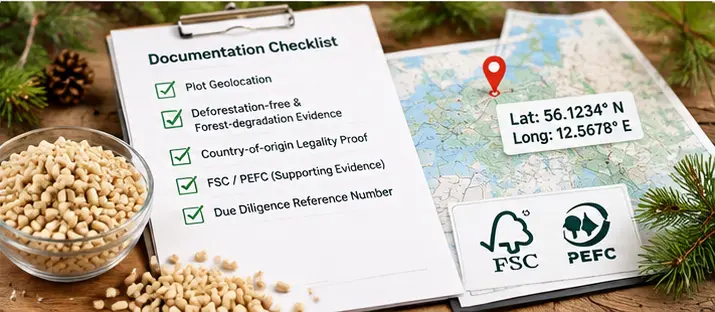
| Plot geolocation (lat/long) | Core EUDR identifier for standard due diligence; country-level is not enough. Eligible simplified-declaration operators may use the plot or establishment postal address instead. |
| Deforestation-free and forest-degradation evidence | Supports the required proof that covered wood meets the EUDR’s deforestation-free and wood-specific forest-degradation conditions after 31 Dec 2020 |
| Country-of-origin legality proof | Satisfies the “produced per relevant legislation” condition |
| FSC or PEFC certificates (if held) | Supporting evidence only; not a substitute |
| Due diligence statement reference number | Used for customs checks and to reference the operator’s statement; downstream traders generally do not file their own. |
Common Pitfalls to Avoid
- Assuming FSC or PEFC certification equals EUDR compliance, which it does not.
- Assuming every micro or small operator has until 30 June 2027, when those already under the EU Timber Regulation move to EUDR on 30 December 2026.
- Recording only country or region instead of plot coordinates (or, for eligible simplified-regime operators, the postal address the rules accept).
- Waiting for the legal deadline instead of meeting earlier customer-contract demands.
Conclusion
EUDR turns wood cat litter into a traceability and due-diligence issue for affected EU-bound products. Manufacturers and OEM buyers should build production-plot traceability, legality evidence, deforestation-free and forest-degradation checks, and the applicable EUDR filing process into their pine programs before 30 December 2026. Relying on FSC or PEFC certification alone is not enough to replace the applicable EUDR requirements. For the broader export picture, pair this with the cat litter export compliance framework and review the wood cat litter import rules that apply before the product reaches the EU border. Our pine cat litter range is relevant to buyers evaluating documented and traceable wood sourcing.
Frequently Asked Questions
Potentially. Wood is a covered commodity under Regulation (EU) 2023/1115, so pine shavings, pine pellets, and sawdust-based litters can fall within scope when placed on the EU market, but the exact CN classification and product scope must be confirmed.
Large and medium operators generally fall under the EUDR from 30 December 2026. Micro and small operators already covered by the EU Timber Regulation also move to the EUDR framework on 30 December 2026, while other micro and small operators generally have until 30 June 2027. Eligible micro and small primary operators use the one-time simplified declaration regime rather than the standard due diligence statement.
The exact CN/HS classification depends on the product and its form. Heading 4401 is particularly relevant to wood in chips or particles, sawdust, wood waste and scrap, and wood pellets, all of which are listed in the EUDR’s wood scope. Do not assume that every finished wood-based cat litter product has the same tariff classification; confirm the applicable CN code for the specific product and transaction.
No. FSC and PEFC are voluntary schemes that can support the evidence file, but EUDR requires its own due diligence statement and geolocation proof. Certification is evidence, not a substitute.
Operators must collect plot-level latitude and longitude for the land where the wood was produced; country- or region-level information is not sufficient. For eligible micro or small primary operators using the simplified declaration regime, the postal address of the plots or producing establishment may be used instead of standard geolocation data.
The operator responsible for placing the relevant product on the EU market or exporting it submits the applicable due diligence statement. Eligible micro and small primary operators instead use a one-time simplified declaration. Downstream operators and traders generally do not submit their own due diligence statements; the first downstream operator or trader has specific traceability and record-keeping responsibilities, while obligations for later downstream actors depend on their role and company size.
Yes, where the product is within EUDR scope. A non-EU operator can have obligations under the EUDR when placing relevant products on the EU market, while the first EU-established person making those products available can also be deemed an operator under Article 7. An EU-based authorised representative may be appointed under Article 6 to perform specified filing tasks, but appointing one is not a blanket requirement for every non-EU operator.
Write EUDR readiness into the purchase specification: require supplier plot geolocation (or, for eligible simplified-regime suppliers, the accepted postal address), a deforestation-free declaration, country-of-origin legality proof, and the due diligence statement reference number as acceptance criteria before the first production run.