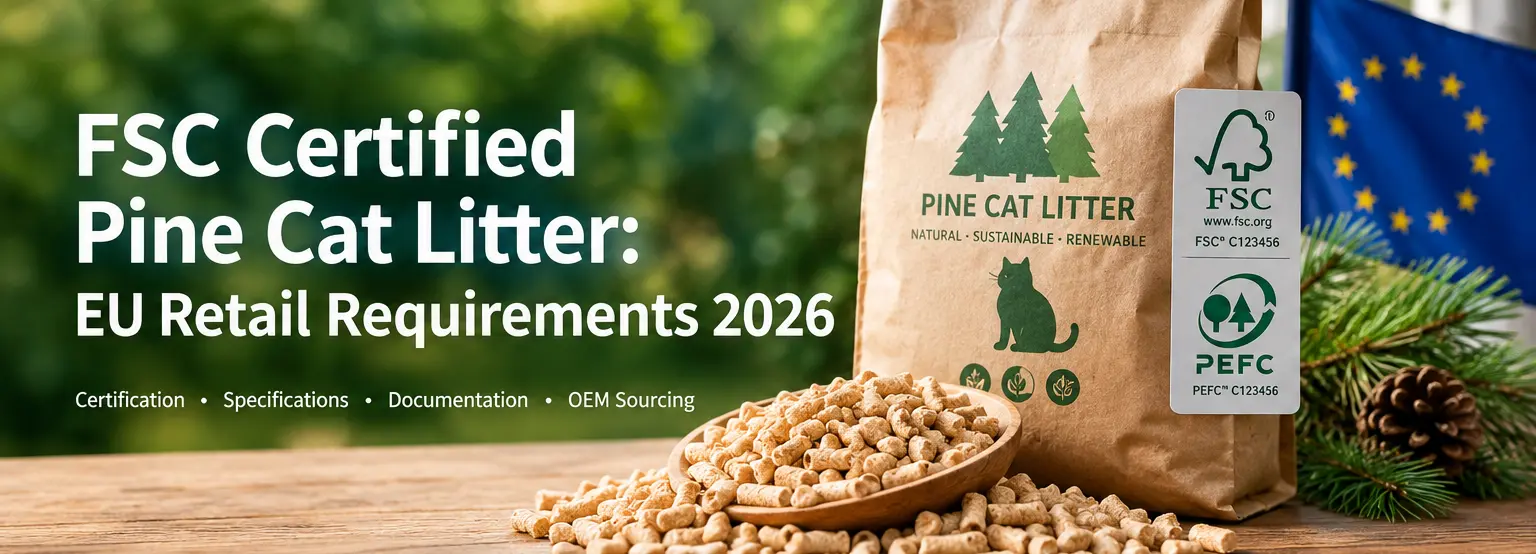





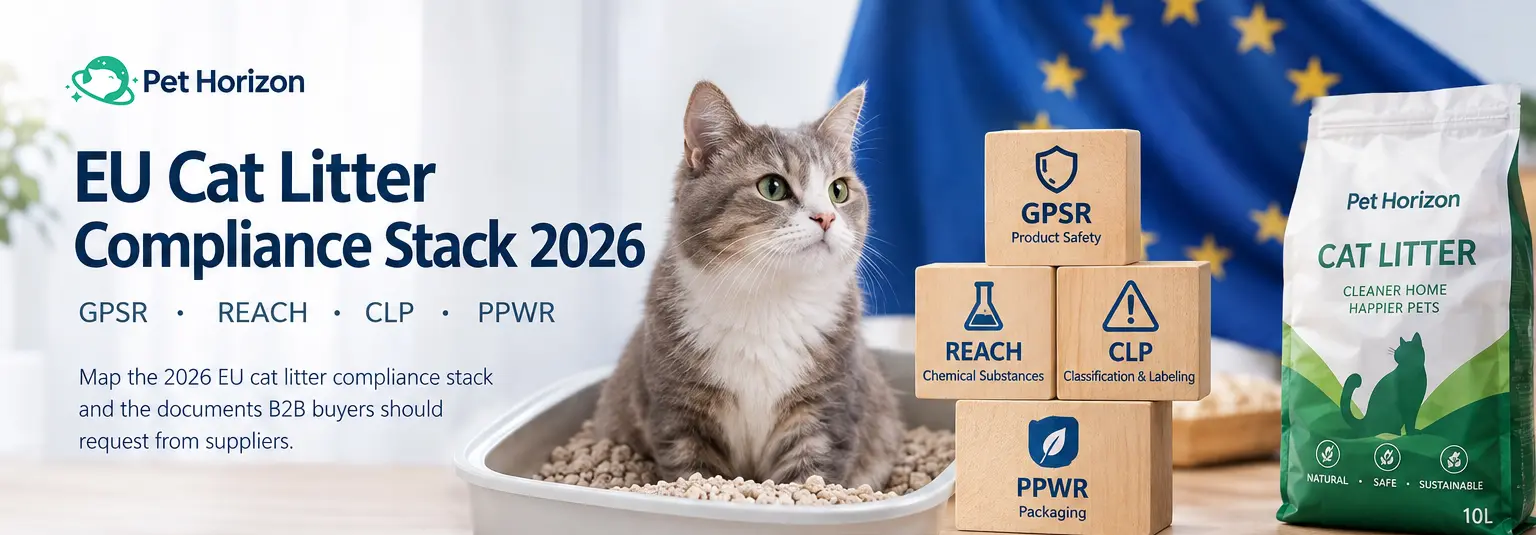
Selling cat litter into the EU is not a single-certificate exercise. Different regulatory layers address product safety, chemical substances, hazardous mixtures, and packaging, with the exact obligations depending on the product and supply-chain role. This guide maps the 2026 EU cat litter compliance stack and the documents importers, distributors, and OEM buyers should request from suppliers.

Quick Answer: The EU cat litter compliance stack in 2026 can involve the General Product Safety Regulation (GPSR, Regulation (EU) 2023/988), REACH and its SVHC Candidate List, the CLP Regulation for substances and mixtures that meet its classification criteria, and packaging requirements under the PPWR. GPSR has applied since 13 December 2024, while PPWR applies from 12 August 2026. For B2B buyers, the key is to verify which obligations apply to the specific litter formulation, packaging format, and sales model rather than treating every product as subject to identical labeling requirements.
“Compliance stack” means the set of EU regulatory requirements that may apply to one product category at the same time. For cat litter, the applicable obligations depend on the product formulation, packaging, intended use, and supply-chain role, so buyers should assess each regulatory layer separately rather than rely on a single certificate.
GPSR: General Product Safety
The General Product Safety Regulation (Regulation (EU) 2023/988) has applied since 13 December 2024 and covers consumer products placed on the EU market, including relevant pet-care products sold to consumers. It requires products to be safe under normal or reasonably foreseeable conditions of use and requires economic operators to maintain appropriate risk assessment and technical documentation supporting product safety.
Under GPSR, economic operators must maintain the required technical and traceability information, including product identification and relevant supply-chain details, and retain required documentation for the applicable periods. Where the manufacturer is established outside the EU, the EU-established responsible person (authorised representative) must be designated. Online marketplaces also have specific obligations under the regulation.
The full text is published by the European Commission as the General Product Safety Regulation (EU) 2023/988.
What GPSR Means for Cat Litter
For litter, the relevant safety questions are dust inhalation, mechanical hazards from packaging, and clear usage instructions. A supplier’s GPSR file should document the risk assessment and the supporting evidence, including any test methods used, not just a statement of conformity.
REACH and the SVHC List
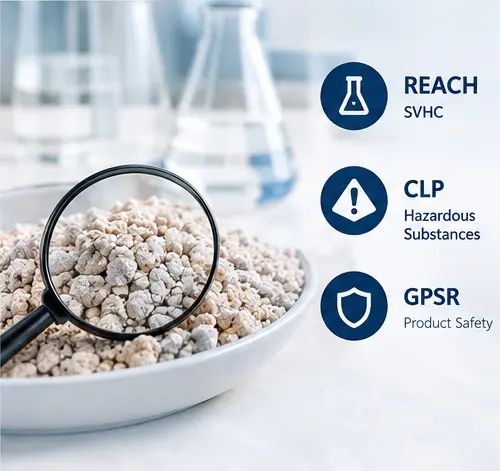
REACH (Regulation (EC) No 1907/2006) governs the registration, evaluation, authorisation, and restriction of chemical substances in the EU. Its Substances of Very High Concern (SVHC) Candidate List is updated periodically; ECHA’s current Candidate List contains 253 entries as of 2026. The authoritative list is maintained by ECHA.
When an article contains an SVHC from the Candidate List above 0.1% weight by weight, REACH can trigger supply-chain information duties, and additional notification or SCIP obligations may apply depending on the product and annual quantities. For scented litters, buyers should assess the actual substances in the formulation rather than assume that common fragrance ingredients such as limonene or linalool are automatically SVHCs.
SVHC Communication Obligations
Communication is a supply-chain duty, not a one-time certificate. Buyers should ask for the current SVHC information and the specific substances present above the threshold, with the concentration range, so the information stays valid as the list changes.
CLP: Classification, Labelling and Packaging
The Classification, Labelling and Packaging Regulation (Regulation (EC) No 1272/2008) applies to substances and mixtures that fall within its scope. For cat litter, a fragranced formulation should be assessed based on the classification of its ingredients and the concentration of relevant hazardous substances in the finished mixture. If the finished product meets CLP classification criteria, the required hazard labels, statements, pictograms, and packaging provisions must be applied.
Unscented formulations can reduce the number of fragrance-related hazards that need to be assessed, which is why some B2B buyers specify unscented cat litter for the EU market; they do not, however, automatically remove all CLP considerations. Buyers should request the fragrance or ingredient safety information needed to verify the classification of the finished formulation before finalizing an EU label.
Packaging and Labeling: PPWR and Member-State Notes
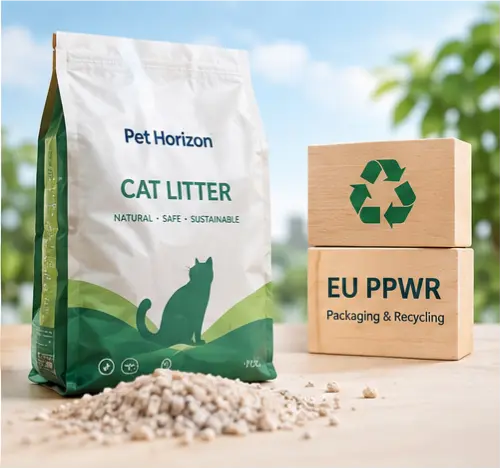
The EU Packaging and Packaging Waste Regulation (Regulation (EU) 2025/40) applies from 12 August 2026 and establishes EU-wide requirements covering packaging design, waste prevention, recyclability, labeling, and related information. For cat litter, the relevant obligations depend on the packaging material, format, market placement, and any environmental claims made on the packaging.
Verify before claiming: Sources in trade media sometimes state that Germany requires cat litter packaging to carry a biodegradability-certification label from 2026. This is not a single, EU-wide cat-litter mandate. Germany implements packaging law through its national act (VerpackG) alongside the EU framework, and requirements shift. Buyers should confirm current German and EU packaging-label rules with their importer or legal advisor rather than treating any single trade-article claim as fixed.
For the packaging-specific layer, see our EU PPWR packaging compliance guide, and for the broader export picture our cat litter export compliance framework.
Building a Compliance Dossier for EU-Bound Cat Litter
| Regulation | Buyer action |
|---|---|
| GPSR (EU) 2023/988 | Request technical file, risk assessment, batch traceability, EU-established responsible person |
| REACH SVHC | Request current SVHC information; substances above 0.1% with concentration |
| CLP (EC) 1272/2008 | Assess the finished formulation under CLP; obtain ingredient and fragrance safety data where relevant |
| PPWR (EU) 2025/40 | Confirm packaging label and recyclability data with importer |
Common Documentation Gaps
- A conformity statement with no underlying test method or risk assessment.
- An SVHC declaration dated years ago, ignoring list updates.
- Fragranced products shipped without checking the finished formulation against applicable CLP classification and labeling requirements.
- Packaging labels copied from another market without PPWR alignment.
Conclusion
The 2026 EU cat litter compliance stack is layered: GPSR for product safety, REACH SVHC for chemical content, CLP for classification and labeling of hazardous substances or mixtures, and PPWR for packaging. The exact obligations depend on the formulation, packaging, and supply-chain role, and member-state packaging rules must be verified locally rather than assumed. Buyers who request a structured compliance dossier, with test methods, current declarations, and an EU responsible person, turn a confusing stack into a manageable supplier qualification step.
Frequently Asked Questions
The main ones are GPSR for product safety, REACH for chemical content (including the SVHC list), CLP for classification and labeling of hazardous substances and mixtures, and the PPWR for packaging.
Yes. GPSR has applied to consumer products placed on the EU market since 13 December 2024, and pet-care products sold to consumers fall within its scope.
Communication is required when an SVHC from the Candidate List is present above 0.1% weight by weight, and additional notification or SCIP obligations may apply depending on the product and annual quantities. ECHA’s Candidate List contains 253 entries as of 2026 and is updated periodically, so the SVHC information must be kept current.
If a fragranced litter meets CLP classification criteria for hazardous substances or mixtures, the required labels, statements, and pictograms must be applied. Choosing an unscented formulation can reduce the fragrance-related hazards to assess, but buyers should still verify the finished formulation’s classification. Confirm details with the supplier’s safety data.
Not as a single EU-wide cat-litter rule. Trade-media claims about a German 2026 label requirement should be verified against current German and EU packaging law; do not treat them as fixed until confirmed with an importer or legal advisor.
Potentially, for wood-based products, but not simply because the litter contains wood. EUDR scope depends on whether the specific product falls within the relevant commodity and product classifications listed in Annex I of Regulation (EU) 2023/1115. Buyers should verify the applicable CN code and product scope before assuming that a wood-based cat litter is covered.
No. The responsible person coordinates compliance and acts as the contact point; the underlying testing, risk assessment, and documentation still must be done and kept on file.
Request a structured dossier: GPSR technical file and risk assessment, a current REACH SVHC declaration, CLP assessment for the finished formulation, and PPWR packaging-label information, with an EU-established responsible person (authorised representative) named.