


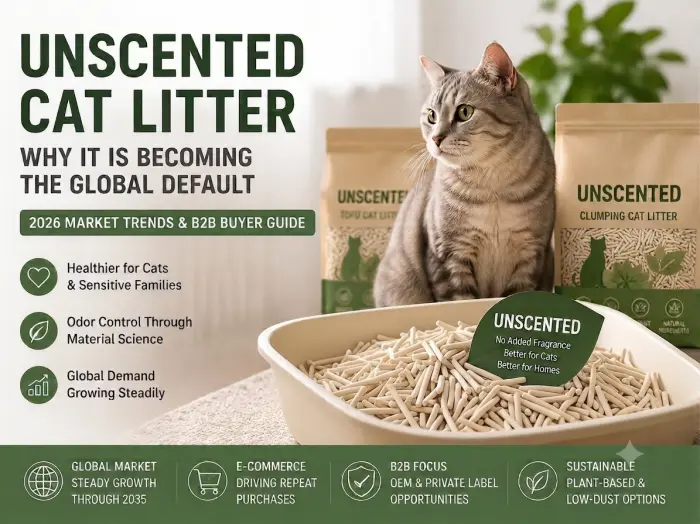
Unscented cat litter is moving from a niche preference to a mainstream category default. Across the United States, France and China, fragrance-free formulas are gaining share as buyers prioritize feline respiratory health, allergy avoidance and verifiable odor control over scent masking. For B2B buyers, the shift changes how litter is specified, manufactured and private-labeled.
For manufacturers, importers and private-label brands, this shift creates a clear product opportunity: fragrance-free formulas with reliable odor control, low dust performance and customizable specifications are becoming a preferred starting point for new cat litter lines.
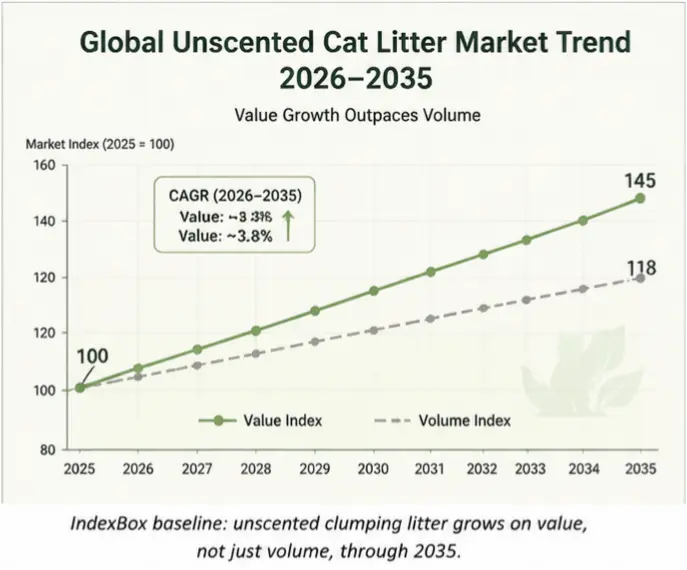
Quick answer: Unscented cat litter is growing faster than the broader category because health-conscious owners treat added fragrance as a risk rather than a benefit. IndexBox projects the global unscented clumping litter market to expand at roughly 3.8% CAGR through 2035, with value growth outpacing volume as premium, dust-free and plant-based variants trade up. France already sources over half its litter from unscented SKUs, and China’s unscented share has climbed from the low-20s to roughly 30–35%.
What Is Unscented Cat Litter?
Unscented cat litter is any clumping or non-clumping substrate formulated without added synthetic fragrance, essential oils or scent-encapsulation systems. Odor is managed through the material’s physical structure — mineral microporosity, activated carbon adsorption or plant-fiber absorption — rather than by covering ammonia with perfume.
Unscented does not mean odorless. It means the product makes no fragrance claim and controls smell through absorption and adsorption chemistry instead of masking scent.
This distinction matters for B2B spec sheets: “no added fragrance” is a measurable, defensible claim, whereas “fresh scent” invites both allergen complaints and green-claim scrutiny under frameworks such as the UK CMA Green Claims Code and the EU EmpCo directive.
Market Trajectory: Steady Value Growth Through 2035
According to IndexBox, the global unscented clumping cat litter market is set to grow at about 3.8% per year from 2026 to 2035, reaching a market index of 145 by 2035 (base 100 in 2025). An adjacent “unscented cat litter box” report projects a slightly higher 4.2% CAGR for the same window.
Why Value Outpaces Volume
Two forces push revenue ahead of tonnage. First, premiumization: buyers trade up to dust-free, lightweight and biodegradable unscented formats that carry higher per-kg prices. Second, channel mix: e-commerce and subscription models solve the heavy-lifting problem of a bulky consumable, and they capture a growing share of repeat purchases. IndexBox expects e-commerce penetration of the category to exceed 40% by 2035, up from about 25% in 2025.
E-commerce and Subscription: The Distribution Tailwind
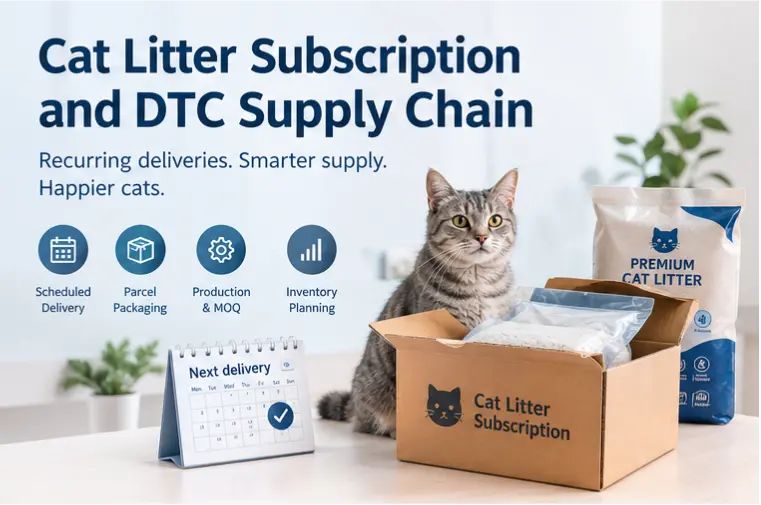
The bulky, heavy nature of cat litter makes it a poor fit for traditional retail logistics but an excellent fit for direct-to-consumer replenishment. Subscription models convert the product’s weight disadvantage into a convenience advantage: buyers accept automatic delivery of a heavy consumable they would otherwise haul home. For exporters, this favors regional warehousing and concentrated formulas — lighter, more compact products that cut last-mile cost. It also rewards suppliers who can support retailer and D2C private-label programs with stable, documented formulations, exactly the capability an established manufacturer brings to an import partnership.
The Regional Signal: Three Markets, One Direction
The same direction shows up in three very different markets, which is what makes the trend durable rather than a single-country fad.
United States — Unscented Leads E-Commerce
Marketplace sales data shows that leading US e-commerce cat litter rankings are increasingly dominated by unscented clumping products, demonstrating strong consumer preference for fragrance-free formulas.
France — Over Half the Category
IndexBox store data places France’s unscented segment at roughly 50–55% of national cat litter retail value, with the share forecast to reach 65–70% by 2035. France is the clearest example of “unscented plus plant-based” converging, a point reinforced by the Southern Europe market analysis that follows it.
China — Fastest Share Gain
China’s unscented share has moved from about 20–25% in 2020 to an estimated 30–35% in 2026, growing 9–13% annually and outpacing the category. Urban apartment living, younger owners and landlord pet policies citing shared-ventilation complaints are all pushing fragrance-free as the default.
Scented vs Unscented: What B2B Buyers Should Know
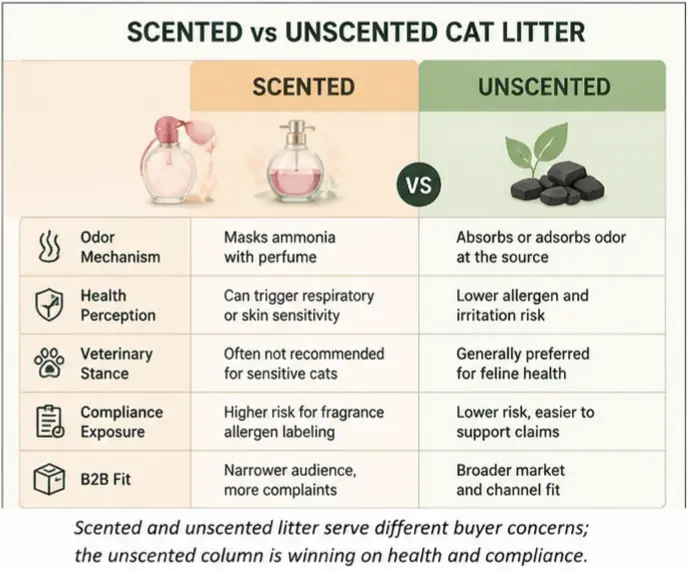
| Dimension | Scented litter | Unscented litter |
|---|---|---|
| Odor mechanism | Masks ammonia with perfume | Absorbs or adsorbs odor at the source |
| Health perception | Can trigger respiratory or skin sensitivity | Lower allergen and irritation risk |
| Veterinary stance | Often discouraged for kittens and asthmatic cats | Routinely recommended for sensitive cats |
| Compliance exposure | Higher green-claim and fragrance-label scrutiny | Defensible “no added fragrance” claim |
| B2B fit | Impulse and value-tier shelves | Premium, private-label and institutional channels |
The frequently asked question “is scented litter bad for cats” is answered by veterinary and respiratory evidence: added fragrance is not toxic, but it is a documented irritant for cats with asthma, kittens with immature systems and owners with sensitivities. Unscented is the lower-risk default for those groups.
Formulation Shift: From Fragrance Masking to Physical Odor Control
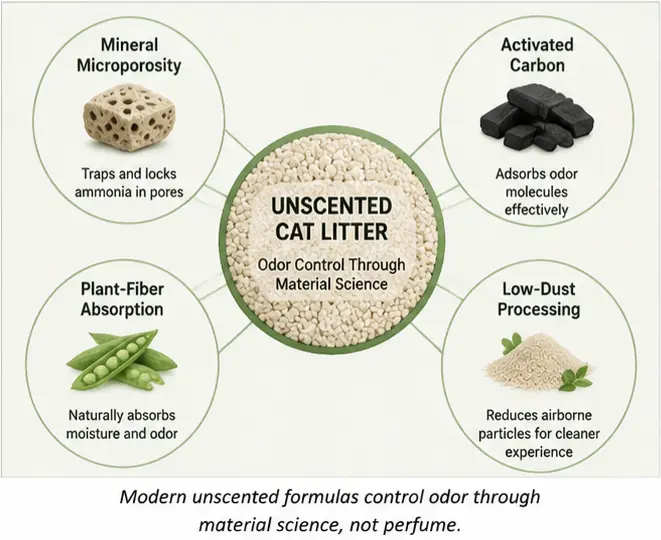
For manufacturers, the unscented trend is a formulation brief, not just a label change. The work moves to physical odor control:
- Mineral microporosity — bentonite and silica structures trap ammonia in pore networks.
- Activated carbon — high-surface-area adsorption binds odor molecules.
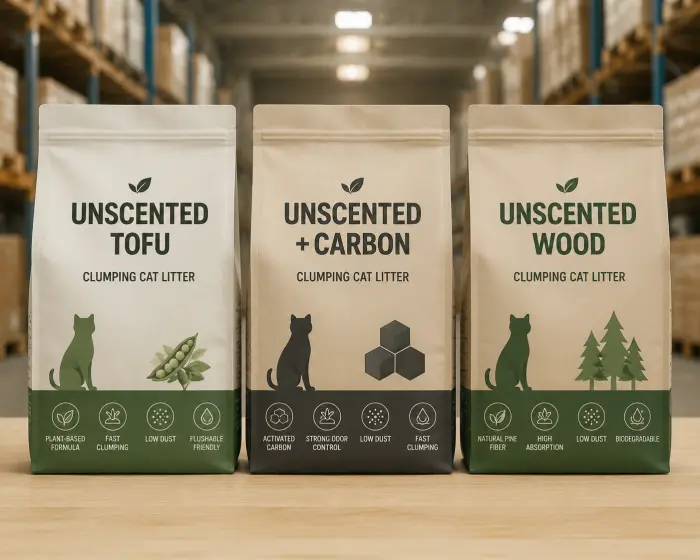
- Plant-fiber absorption — tofu, wood and corn substrates absorb liquid and reduce ammonia release.
- Low-dust processing — sieving and dedusting cut the airborne particles that carry both scent and irritants.
This is where a tofu cat litter production line fits naturally: plant-based substrates are inherently fragrance-free and pair well with carbon addition for buyers who want verifiable odor performance.
Choosing an Unscented Cat Litter Manufacturer
Choosing an unscented cat litter manufacturer requires evaluating more than whether a product contains added fragrance. A reliable supplier should demonstrate consistent raw material sourcing, stable production processes, dust-control capability and the ability to customize formulas for different markets.
For importers and private-label brands, the key factors include substrate selection, particle size control, clumping performance, packaging flexibility and quality consistency across bulk orders.
Manufacturing Considerations for Unscented Cat Litter
Producing high-performance unscented cat litter requires precise control throughout the manufacturing process. Without fragrance additives to mask odor, manufacturers must rely on material performance and process optimization.
- Raw material consistency
Bentonite, tofu, wood and other substrates require stable moisture and particle-size control. - Dust reduction processing
Screening, dedusting and quality inspection help maintain low-dust performance. - Odor-control engineering
Activated carbon, mineral adsorption and plant-fiber absorption can improve odor management without fragrance. - OEM customization capability
Different markets may require adjustments in granule size, packaging format, clumping speed and product positioning.
What the Trend Means for Each B2B Role
For Cat Litter Manufacturers
Default to an unscented SKU in every substrate line. Build odor control into the formula through adsorption rather than masking, and keep a dust-test record — low-dust plus unscented is the combination most often requested by European and North Asian buyers.
For Importers and Distributors
Treat “no added fragrance” as a standard specification line, not an optional variant. Unscented SKUs show lower return and negative-review risk on Western shelves because fragrance complaints disappear from the feedback loop.
For Brand Owners
Unscented is a low-cost, high-perception differentiator. It binds naturally to “hypoallergenic,” “vet-recommended” and “fragrance-free” messaging without requiring new raw materials, making it an efficient entry position for new brands.
For OEM and Private-Label Buyers
Unscented formulas are low-risk first orders: customization is mainly about granule size, clumping speed and carbon loading rather than fragrance systems. A private-label buyer can launch with a defensible, compliant product and expand the line later. See our OEM cat litter capabilities for formulation options.
Sourcing and Buying Considerations
When specifying unscented litter for import or private label, prioritize three attributes that survive scrutiny:
- Verifiable low dust — request a dust-test method, not just a claim.
- Plant-based or mineral clarity — know the substrate and its sourcing for EU and UK green-claim compliance.
- Stable clumping — unscented buyers still expect fast, firm clumps; odor control must not compromise clumping.
Review the full range of cat litter types before locking a formulation, since substrate choice drives both odor performance and shipping density.
Conclusion
Unscented cat litter is no longer a specialty shelf; it is becoming the category default in the world’s largest and fastest-shifting markets. The implication for B2B is clear — specify, manufacture and private-label for fragrance-free by default, and invest odor-control engineering in material science rather than perfume. Buyers who align now capture the premium, lower-complaint segment as it scales through 2035.
Frequently Asked Questions
Added fragrance is not acutely toxic, but it is a known irritant for asthmatic cats, kittens and scent-sensitive owners. Veterinary guidance generally favors unscented litter for those groups, which is why unscented is gaining share.
Three drivers: rising awareness of feline respiratory sensitivity, allergy avoidance, and a shift toward verifiable odor control. Buyers also trust “no added fragrance” claims more than scent masks that can attract green-claim scrutiny.
Well-formulated unscented litter controls odor at the source through mineral microporosity, activated carbon and plant-fiber absorption. Scented litter only masks ammonia; it does not remove it. Performance depends on formula quality, not on fragrance.
Yes for most cases. Kittens have immature respiratory and digestive systems and are more likely to ingest litter; unscented, low-dust, non-clumping formulas are the standard veterinary recommendation for young cats.
Yes. Unscented is one of the easiest private-label starting points because customization centers on granule size, clumping speed and carbon loading rather than fragrance systems, lowering formulation risk for a first order.
France leads among major markets at roughly 50–55% of category value, with China the fastest gainer (about 30–35% in 2026, up from the low-20s in 2020). The United States shows unscented at the top of e-commerce best-seller lists.
Premium unscented variants command higher per-kg prices, but value-tier unscented exists too. The broader trend is value growth outpacing volume because buyers trade up to dust-free and plant-based unscented formats.
Request a dust-test method, confirm the substrate and its sourcing for green-claim compliance, and verify clumping stability. “No added fragrance” should be a documented specification, not a marketing line.
Fragrance free cat litter is often preferred for sensitive cats because it removes added perfumes that may irritate cats or owners with respiratory sensitivity. For sensitive households, low dust performance is equally important because airborne particles can contribute to discomfort.