


Introduction
The global cat litter market has experienced steady growth over the past decade, driven by rising pet ownership, premium pet care trends, and increasing consumer demand for convenient, high-performance litter products.
Today, cat litter is no longer viewed as a basic pet supply. Consumers are actively seeking products that offer stronger odor control, better clumping performance, lower dust levels, and environmentally friendly materials. As a result, categories such as tofu cat litter, bentonite cat litter, flushable cat litter, and other premium solutions continue to gain market share across North America, Europe, and emerging markets.
For entrepreneurs, distributors, wholesalers, retailers, and e-commerce sellers, cat litter represents an attractive business opportunity due to its recurring purchase cycle and growing global demand.
However, one critical decision must be made before launching a brand or expanding a product portfolio:
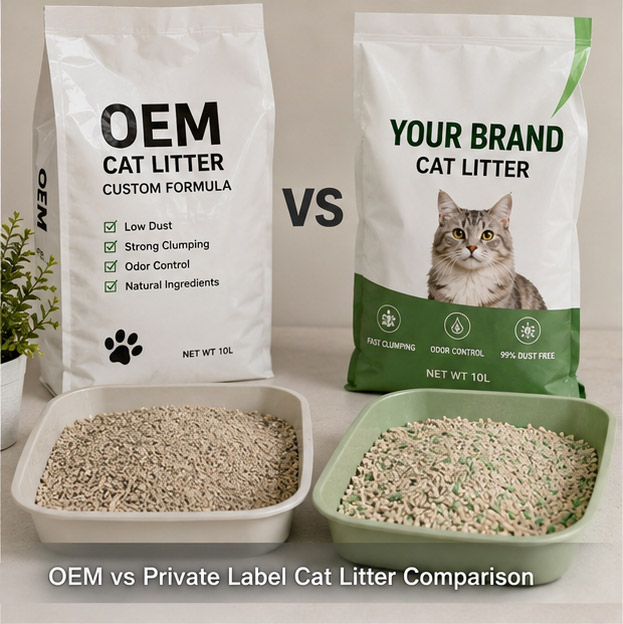
Should you choose OEM cat litter or Private Label cat litter?
Both manufacturing models allow businesses to sell cat litter under their own brand, but they differ significantly in terms of product customization, ownership, investment requirements, lead times, and long-term growth potential.
Choosing the right model can influence everything from startup costs and product differentiation to profitability and brand competitiveness.
In this guide, we compare OEM vs Private Label cat litter in detail, helping you understand the advantages, limitations, and ideal applications of each approach so you can make an informed business decision.
OEM vs Private Label Cat Litter: Quick Comparison
Before diving into the details, the table below summarizes the main differences between the two models.
| Factor | OEM Cat Litter | Private Label Cat Litter |
|---|---|---|
| Formula Ownership | Brand-Owned | Factory-Owned |
| Product Customization | High | Limited |
| Packaging Customization | Full | Basic |
| MOQ | Higher | Lower |
| Development Time | Longer | Shorter |
| Initial Investment | Higher | Lower |
| Market Differentiation | Strong | Limited |
| Intellectual Property | Brand-Owned | Factory-Owned |
| Suitable For | Established Brands | Startups & Market Testing |
| Profit Potential | Higher Long-Term | Moderate |
While Private Label offers a faster and lower-risk entry into the market, OEM provides greater opportunities for brand differentiation and long-term profitability.
What Is OEM Cat Litter?
OEM stands for Original Equipment Manufacturer.
In the cat litter industry, OEM refers to a manufacturing model where the brand develops or specifies the product while the factory produces it according to the brand’s requirements.
Under an OEM partnership, the brand has significant control over the product and can customize nearly every aspect of the final solution.
These elements may include:
- Raw material selection
- Formula composition
- Particle size
- Fragrance options
- Dust control standards
- Clumping performance
- Packaging design
- Product specifications
- Quality standards
In simple terms:
The brand creates the product concept, and the manufacturer brings it to life.
For example, a brand may want:
- Ultra-low dust bentonite cat litter
- Lavender-scented tofu cat litter
- Flushable cat litter for premium markets
- Eco-friendly plant-based formulas
- Custom particle sizes for long-haired cats
The manufacturer then develops and produces the product according to these requirements.
As a result, the finished product becomes unique to the brand.
Advantages of OEM Cat Litter
Complete Product Customization
OEM allows brands to create truly differentiated products.
Instead of selling the same formula used by multiple competitors, businesses can develop exclusive features and specifications tailored to their target customers.
Examples include:
- Stronger clumping formulas
- Improved odor control
- Lower dust content
- Customized fragrances
- Premium eco-friendly ingredients
This flexibility is particularly valuable in highly competitive markets.
Exclusive Product Ownership
One of the biggest advantages of OEM manufacturing is ownership.
The brand owns:
- Product specifications
- Custom formulas
- Packaging designs
- Product positioning
In most cases, manufacturers cannot legally provide the same customized product to competing brands.
This creates a significant competitive advantage and helps establish long-term market differentiation.
Stronger Brand Identity
Consumers increasingly prefer brands with unique value propositions.
OEM products allow businesses to build stronger brand identities through:
- Unique product features
- Customized packaging
- Exclusive selling points
- Higher perceived value
This often results in higher customer loyalty and stronger pricing power.
Higher Long-Term Profit Potential
Although OEM products typically require greater upfront investment, they often generate higher profit margins over time.
Brands can avoid direct price competition and focus on delivering unique value to customers.
As a result, many successful pet brands eventually transition from Private Label products to OEM solutions as their business grows.
What Is Private Label Cat Litter?
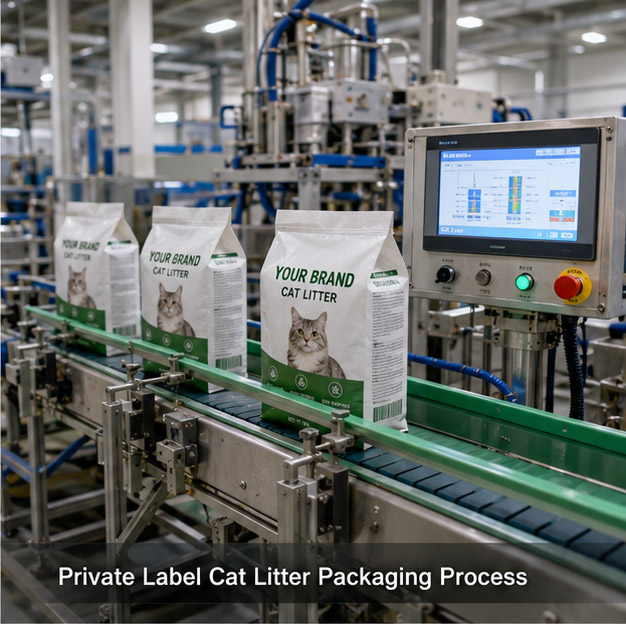
Private Label cat litter is a manufacturing model where the factory already has finished products and the brand simply adds its own logo and packaging.
Unlike OEM manufacturing, the brand does not develop a unique formula.
Instead, it selects existing products from the manufacturer’s catalog and sells them under its own brand name.
This model has become extremely popular among startups and first-time sellers because it reduces both complexity and financial risk.
Typical products available through Private Label programs include:
- Tofu cat litter
- Bentonite cat litter
- Mixed cat litter
- Flushable cat litter
- Dust-free cat litter
The factory handles product development, testing, and production while the brand focuses on marketing and sales.
Advantages of Private Label Cat Litter
Faster Market Entry
One of the most significant advantages of Private Label manufacturing is speed.
Since the product already exists, businesses can launch much faster.
In many cases:
- Product selection takes only a few days
- Packaging approval takes several days
- Production and shipment can begin immediately
This allows brands to enter the market quickly and capitalize on emerging trends.
Lower Startup Costs
Private Label eliminates many expenses associated with product development.
Businesses generally avoid:
- Formula development costs
- Product testing expenses
- Mold development costs
- R&D investments
This significantly lowers the financial barrier to entry.
Lower Minimum Order Quantities
Many manufacturers offer smaller MOQ requirements for Private Label programs.
This makes it easier to:
- Test demand
- Validate product-market fit
- Launch new product lines
- Manage inventory risk
For new businesses, lower MOQ requirements can dramatically reduce operational risk.
Simplified Supply Chain Management
Since the factory already produces and tests the product, sellers can focus on:
- Branding
- Marketing
- Customer acquisition
- Distribution
This simplicity makes Private Label an attractive option for entrepreneurs entering the pet products industry for the first time.
OEM vs Private Label Cat Litter: Product Customization
Customization is often the most important factor when comparing OEM and Private Label solutions.
With OEM manufacturing, brands can customize nearly every aspect of the product.
Examples include:
- Formula composition
- Clumping performance
- Dust levels
- Fragrance profiles
- Particle shape
- Color variations
- Packaging materials
- Product specifications
This flexibility enables brands to develop products that closely match customer preferences.
By contrast, Private Label customization is generally limited to:
- Brand logos
- Product names
- Packaging graphics
- Marketing copy
The underlying product typically remains unchanged.
For businesses seeking a unique market position, OEM offers a significant advantage.
OEM vs Private Label Cat Litter: Product Differentiation
One of the biggest challenges in the cat litter industry is product homogenization.
Many products on the market share similar formulas and performance characteristics.
With OEM manufacturing, businesses can create differentiated products based on specific customer needs.
For example:
- Premium low-dust litter for apartment owners
- High-performance odor control formulas for multi-cat households
- Eco-friendly products for environmentally conscious consumers
- Specialized litter designed for kittens or senior cats
These unique features help brands stand out from competitors.
Private Label products, however, often rely on the same factory formulas used by multiple brands.
As a result, differentiation is primarily limited to packaging and branding.
When consumers compare products, price frequently becomes the deciding factor.
This can create significant pressure on profit margins.
OEM vs Private Label Cat Litter: Cost Structure
Cost is often one of the most important considerations when selecting a manufacturing model.
However, businesses should evaluate both short-term and long-term costs.
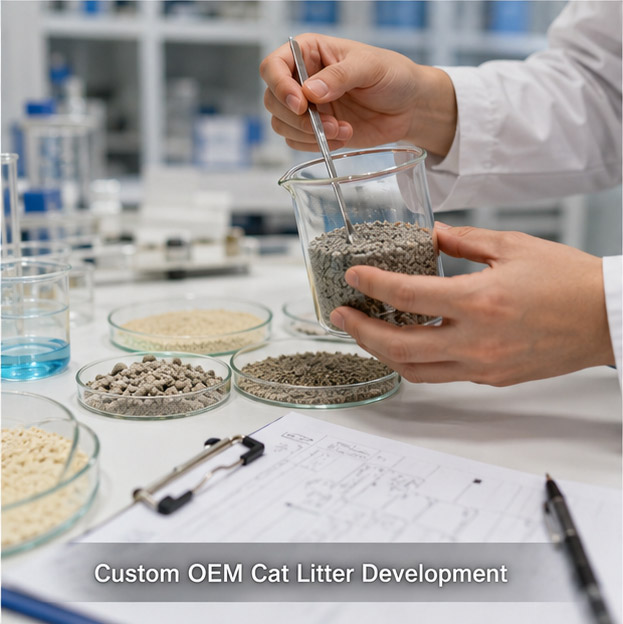
OEM manufacturing typically involves:
- Product development expenses
- Formula testing
- Packaging customization
- Production setup costs
- Higher minimum order quantities
The upfront investment is larger, but the resulting product may generate stronger margins and greater brand value.
Private Label manufacturing generally requires:
- Packaging design costs
- Labeling expenses
- Initial inventory purchases
Because the product already exists, startup costs are substantially lower.
For businesses with limited budgets, Private Label often provides the fastest path to market.
OEM vs Private Label Cat Litter: MOQ, Intellectual Property, and Profitability
OEM vs Private Label Cat Litter: MOQ and Production Lead Time
Minimum order quantity (MOQ) and production lead time can significantly affect inventory management, cash flow, and business risk.
These factors are especially important for startups and growing brands.
OEM Cat Litter MOQ and Lead Time
OEM cat litter projects usually require:
- Formula development
- Product testing
- Sample approval
- Packaging customization
- Production line setup
Because the manufacturer must allocate resources specifically for your product, OEM projects typically require larger production runs.
Depending on the product and customization level, MOQ requirements may range from several thousand to tens of thousands of bags.
Lead times are also longer.
A typical OEM project may require:
- 7–15 days for sample development
- 7–15 days for revisions and approval
- 10–20 days for production
The entire process often takes between 20 and 45 days.
For highly customized products, development cycles can be even longer.
Private Label MOQ and Lead Time
Private Label products are already developed and production-ready.
As a result:
- No formula development is required
- No extensive testing is required
- Production lines are already optimized
Many manufacturers offer significantly lower MOQ requirements for Private Label programs.
This allows businesses to:
- Test new markets
- Launch quickly
- Reduce inventory pressure
- Minimize financial risk
In many cases, products can be prepared and shipped within 3–7 days after packaging approval.
For first-time sellers, this speed can be a major advantage.
OEM vs Private Label Cat Litter: Intellectual Property and Product Ownership
Many new businesses focus primarily on product costs while overlooking intellectual property rights.
However, intellectual property often determines long-term competitiveness.
OEM Product Ownership
Under an OEM agreement, brands generally own the customized aspects of the product.
These may include:
- Proprietary formulas
- Custom packaging
- Product positioning
- Brand-specific specifications
As a result, competitors cannot easily replicate the same product.
This creates long-term value and helps protect market share.
For brands planning to build a sustainable business, product ownership can become one of the most important strategic assets.
Private Label Product Ownership
Private Label products operate differently.
The manufacturer typically owns:
- Product formulas
- Production processes
- Technical specifications
Multiple brands may purchase and sell the same product under different labels.
Although this model provides convenience and lower costs, it also creates limitations.
Businesses have less control over:
- Product improvements
- Formula adjustments
- Feature differentiation
As competition increases, it becomes more difficult to stand out.
OEM vs Private Label Cat Litter: Market Differentiation and Competitive Advantage
One of the biggest challenges facing cat litter brands today is market saturation.
Consumers have access to thousands of similar products across online and offline channels.
The ability to differentiate becomes increasingly important.
How OEM Supports Brand Differentiation
OEM manufacturing allows businesses to create products that solve specific customer problems.
For example:
Multi-Cat Households
A brand may develop:
- Enhanced odor control
- Faster clumping performance
- Extended freshness
Premium Pet Owners
A brand may focus on:
- Ultra-low dust formulas
- Natural ingredients
- Eco-friendly packaging
International Markets
Businesses targeting Europe or North America may require:
- Biodegradable materials
- Sustainable sourcing
- Specific regulatory compliance
OEM customization enables brands to align products closely with these requirements.
This often supports premium pricing and stronger customer loyalty.
Challenges of Differentiating Private Label Products
Private Label products can still be successful.
However, differentiation opportunities are generally more limited.
Because multiple brands may sell the same factory formula, competition often shifts toward:
- Pricing
- Advertising
- Distribution
- Customer service
While these factors are important, they may not create sustainable competitive advantages.
For this reason, many successful brands eventually move toward OEM solutions after establishing initial market traction.
Which Model Should You Choose?
The answer depends on your business objectives, budget, and growth strategy.
Neither model is inherently better.
Each serves different business needs.
Choose Private Label Cat Litter If:
- You are new to the cat litter industry
- You want to test demand quickly
- You have limited startup capital
- You prefer lower inventory risk
- You need a faster launch timeline
- You are validating a new market
Private Label is often the fastest and lowest-risk entry point for startups.
Many successful brands begin with Private Label products before transitioning to custom solutions.
Choose OEM Cat Litter If:
- You want exclusive products
- You plan to build a long-term brand
- You need differentiated formulas
- You want greater control over quality standards
- You target premium customer segments
- You seek stronger profit margins
OEM requires greater investment but provides more opportunities for sustainable growth.
What We Have Learned From Working With OEM and Private Label Customers
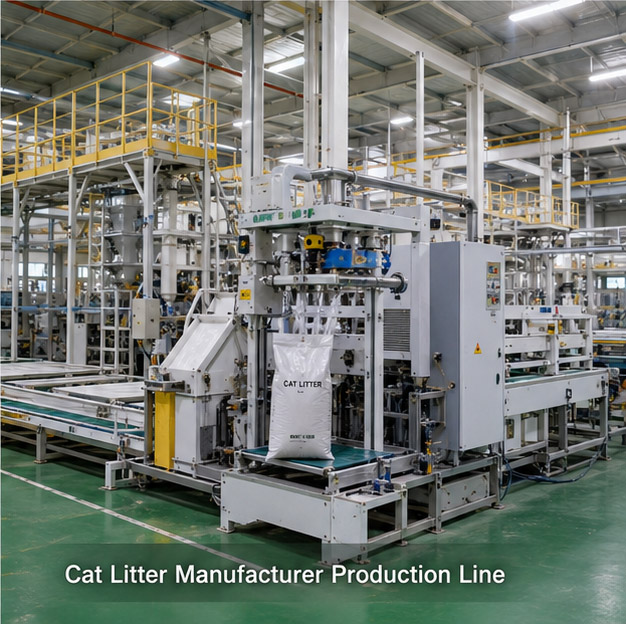
As a cat litter manufacturer serving both OEM and private-label customers, we have observed several common patterns.
Many successful businesses begin with Private Label products because they allow rapid market entry and lower risk.
Once demand is validated and sales channels become stable, these businesses often transition toward OEM development.
The reason is simple:
As competition increases, differentiation becomes more important.
Exclusive formulas, unique product features, and stronger branding often help businesses achieve higher margins and build customer loyalty.
For brands focused on long-term growth, OEM manufacturing frequently becomes the next step after initial market validation.
How to Select a Reliable Cat Litter Manufacturer
Choosing the right manufacturing model is only part of the decision-making process.
The quality and capabilities of your manufacturing partner are equally important.
Before selecting a supplier, businesses should evaluate:
- Manufacturing capacity
- Quality control systems
- Product consistency
- OEM capabilities
- Export experience
- Packaging options
- Supply chain reliability
If you’re evaluating potential suppliers, our guide on How to Choose a Reliable Cat Litter Manufacturer provides a detailed framework for factory audits and supplier selection.
Understanding the underlying cat litter manufacturing process can also help buyers assess production quality and identify reliable manufacturing partners.
Final Thoughts
When comparing OEM vs Private Label cat litter, there is no one-size-fits-all answer.
Private Label offers:
- Lower startup costs
- Faster product launches
- Smaller MOQ requirements
- Reduced risk
OEM offers:
- Product exclusivity
- Stronger differentiation
- Intellectual property ownership
- Greater long-term profitability
For startups and market testing, Private Label is often the most practical solution.
For businesses focused on brand building and long-term growth, OEM manufacturing typically provides greater strategic advantages.
The most successful cat litter brands often use both models at different stages of their development.
They start with Private Label to validate market demand and later transition to OEM products as they build brand recognition and customer loyalty.
Frequently Asked Questions
What is the difference between OEM and Private Label cat litter?
OEM cat litter is developed according to the brand’s specifications, while Private Label cat litter uses existing factory products with customized branding and packaging.
Which option is better for startups?
Private Label is generally better for startups because it requires lower investment, smaller MOQ requirements, and faster market entry.
Is OEM cat litter more profitable?
OEM products often achieve higher long-term profit margins because they offer stronger differentiation and reduced direct competition.
Can I switch from Private Label to OEM later?
Yes. Many successful brands begin with Private Label products and transition to OEM manufacturing after validating market demand.
Does OEM require higher MOQ?
In most cases, yes. OEM manufacturing usually involves larger production runs due to customization and production setup requirements.
Which model is better for building a brand?
OEM is generally better for long-term brand building because it provides exclusive products, intellectual property ownership, and stronger differentiation.