

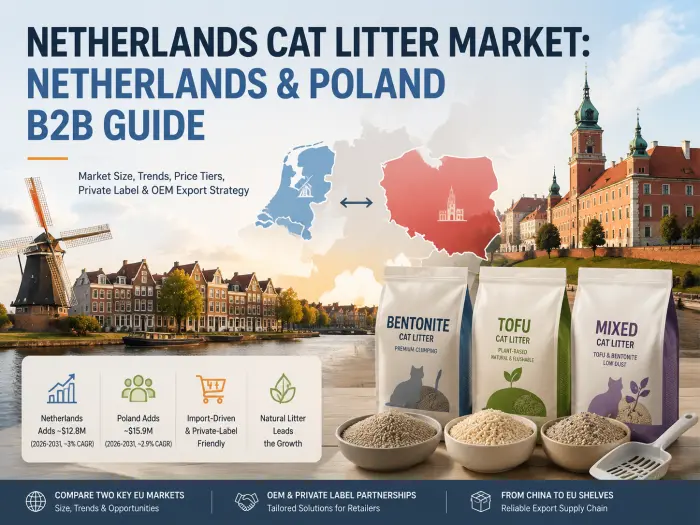
The Netherlands and Poland sit at opposite ends of the Central European cat litter map, yet both belong to the same story that makes the cat litter market in europe by country worth mapping separately: import dependence and a structural openness to Chinese OEM supply. This country-cluster guide treats the Netherlands cat litter market first, then Poland, and closes with a side-by-side comparison and a B2B sourcing checklist for importers, distributors, and private-label buyers.
Quick Answer
The Netherlands cat litter market is set to add about US$12.8 million in value between 2026 and 2031 at a ~3% CAGR, while Poland adds roughly US$15.9 million at ~2.9%. Both are import-driven, private-label-friendly, and shifting toward natural litter—Netherlands toward premium plant-based formats, Poland toward high-volume bentonite and basic tofu. For the wider regional picture, our France and Italy market breakdown covers the cat litter market in europe by country alongside the Benelux and Southern clusters.
Data note: Market figures in this article are directional estimates compiled from category research and should be validated with customs statistics, retailer data, and supplier quotations before investment decisions.Netherlands Cat Litter Market at a Glance
The Dutch market is small in absolute terms but high in value per kilogram and rich in private-label penetration. Independent market research estimates the Netherlands will add roughly US$12.8 million in retail value from 2026 to 2031, compounding at about 3% a year. Growth is modest in volume but positive in price, which is why the category rewards suppliers who can defend margin rather than chase the lowest cost per tonne.
These figures derive from single-source market reports, so treat the precise dollar add as an indicative range and cross-check against additional trade data before committing to a business case. The directional signals—steady value growth, stagnant clay, rising naturals—are consistent across category coverage.
| Metric | Netherlands 2026–2031 |
|---|---|
| Net value added | ~US$12.8 million |
| Value CAGR | ~3% |
| Clay litter share | 55–60% (stagnant) |
| Natural / biodegradable growth | +8–12% per year (lead segment) |
| Private label | 20–25% of value |
| Average retail price | €2.10–2.20/kg (up from €1.80/kg in 2020) |
| Bentonite input cost | 50–60% of clay-litter cost (HS 253010) |
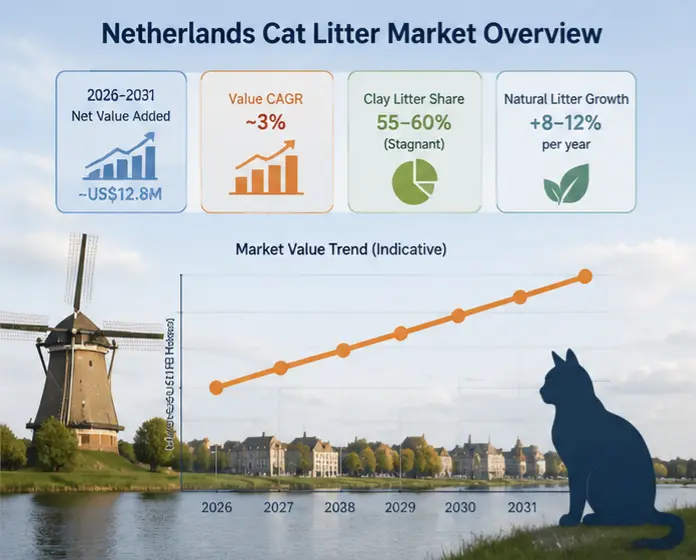
Netherlands Segment Mix: Clay Stagnant, Naturals Lead
Clay litter still accounts for an estimated 55–60% of the Dutch category, but that share is stagnant. The segment that actually pulls the market forward is natural and biodegradable litter, growing at roughly 8–12% per year—the fastest of any format. Tofu, mixed plant-mineral blends, and wood-based substrates gain shelf space as consumers trade up from conventional bentonite toward lower-dust, compostable options.
For a supplier, the implication is clear: volume tenders for plain clay are defensive, while the margin and growth sit in plant-based private-label and branded natural lines. Bentonite (HS 253010) remains the cost anchor of clay products—raw material alone is 50–60% of clay-litter cost—so any price pressure in the clay segment lands directly on thin manufacturing margins.
Market Drivers Behind Netherlands Cat Litter Growth
Three factors shape the Netherlands cat litter market: premiumization, sustainability demand, and private-label expansion. Consumers increasingly choose low-dust and biodegradable products, while retailers use private-label litter to improve category margin.
- Premiumization: Higher willingness to pay for low-dust and plant-based litter.
- Sustainability: Demand for biodegradable materials such as tofu, wood, and mixed plant formulas.
- Retail private label: Grocery and pet retailers expand their own-brand litter ranges.
Netherlands Price Tiers and the Cat Litter Price per kg Europe Benchmark
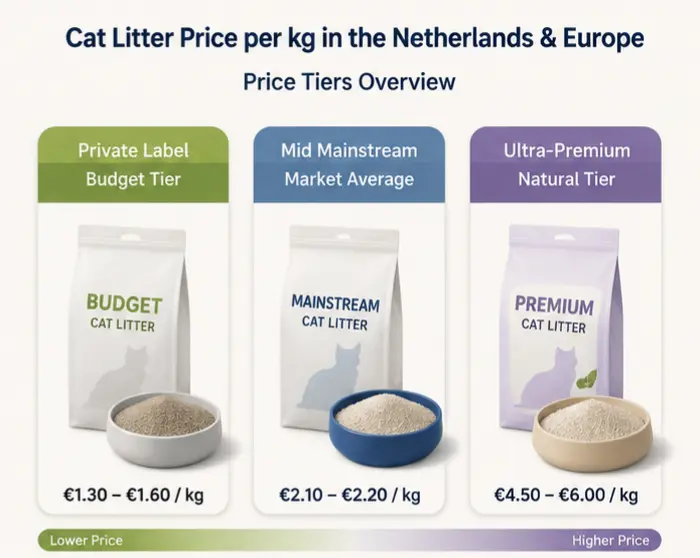
The Dutch market is a useful reference point for the broader cat litter price per kg europe question. Average retail price rose from about €1.80/kg in 2020 to €2.10–2.20/kg today, a steady climb driven by natural formulations and packaging compliance costs rather than raw clay inflation. That upward drift is visible across Western Europe, where sustainability surcharges and freight-sensitive logistics lift per-kilogram prices.
Within the Netherlands, the spread between tiers is wide:
- Private label: €1.30–1.60/kg—value-oriented, clay-heavy, price-stable.
- Mid mainstream: €2.10–2.20/kg—the market average, mixed natural and clay.
- Ultra-premium: €4.50–6.00/kg—plant-based, dust-free, often certified compostable.
Private Label Cat Litter Netherlands: The Retailer Window
Private label already represents an estimated 20–25% of category value in the Netherlands, and grocery and drugstore chains treat own-brand litter as a recurring, high-traffic line. For an overseas manufacturer, the realistic entry route is a private label cat litter Netherlands partnership rather than a consumer brand launch. Retailers specify formula, pack size, certification, and landed price; the supplier delivers batch-to-batch consistency.
Because the Dutch lead segment is premium plant-based, the OEM sweet spot is tofu and mixed (tofu-plus-bentonite or tofu-plus-corn) litter at a dust-controlled, low-odour specification. Single-source category data on the Netherlands is available from independent trackers such as the StrategyHelix Netherlands cat litter report, which is worth cross-referencing against customs and retail-panel data.
Poland Cat Litter Market at a Glance
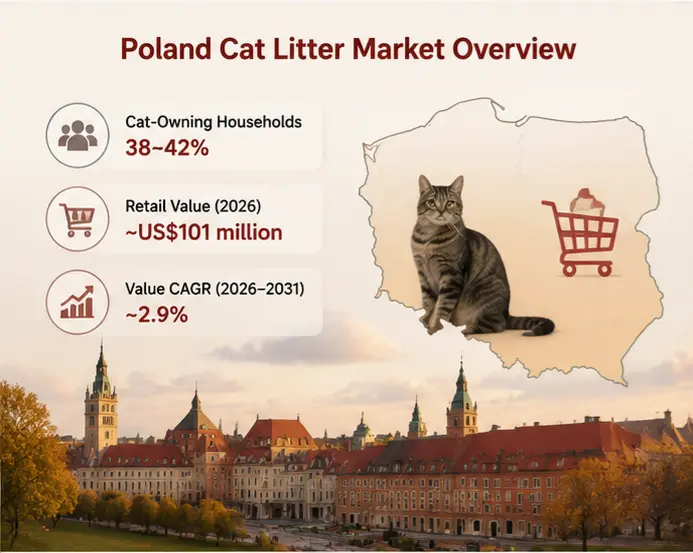
Poland is the larger growth story of the two. Market research estimates the country will add roughly US$15.9 million in retail value from 2026 to 2031 at a ~2.9% CAGR—a bigger absolute add than the Netherlands despite a lower growth rate, reflecting a larger and younger cat population. Cat-owning households sit at an estimated 38–42% of homes, among the highest in Central Europe, and total retail value is approximately PLN 1.2–1.5 billion.
As with the Netherlands, the headline dollar figure is a single-source estimate; treat it as indicative and validate against additional trade statistics. The structural takeaway is robust regardless: Poland combines high penetration with rising spend, a favorable base for imported volume.
Poland Segment Mix: Only Natural Gains Share
Poland is unusual in the region because natural litter is the only format gaining share year after year, climbing about 1.5–2.5 percentage points annually. Conventional clay still dominates by volume, but its relative position erodes slowly while plant-based and biodegradable lines expand. E-commerce and subscription are the fastest-growing channels, mirroring the broader Central European shift toward online recurring delivery of heavy, bulky pet supplies.
For buyers, this means the long-term bet is a natural SKU that can sit alongside a value clay line. The near-term volume, however, is still bentonite—Polish consumers are price-sensitive and buy in larger, cheaper packs than their Dutch counterparts.
Export Cat Litter to Poland: Import and OEM Implications
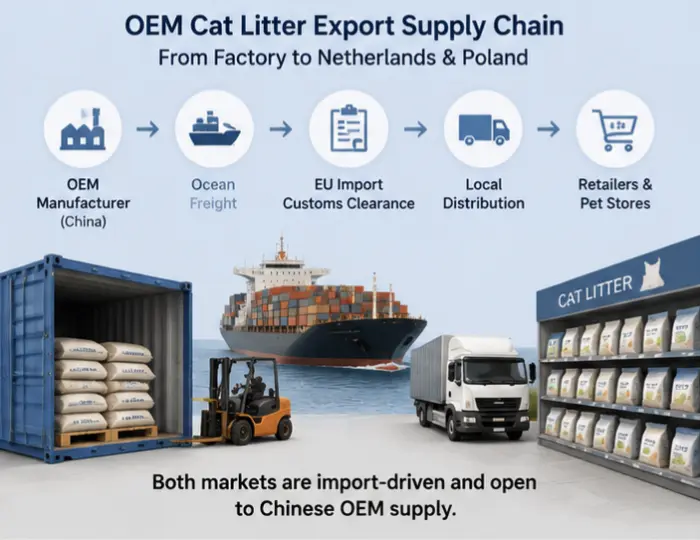
To export cat litter to Poland profitably, suppliers should plan around an import-driven market that already accepts Chinese OEM as standard. Poland’s price sensitivity and high volume favor bentonite and basic tofu rather than ultra-premium plant formats. Landed cost, freight efficiency, and right-sized packaging matter more than eco-certification at the entry tier, though a natural line protects future share as the segment grows.
Before quoting, map the full cat litter export compliance requirements for the EU, since Poland applies the same bloc-level framework as the Netherlands: REACH for chemical safety, the EU PPWR for packaging design, and substantiation rules for environmental claims. Independent coverage of the Polish category is available from the StrategyHelix Poland cat litter report.
Key Differences Between Netherlands and Poland Cat Litter Markets
The Netherlands and Poland differ mainly in purchasing priorities. The Netherlands is a premium-value market focused on plant-based private label products, while Poland is a volume-driven market where bentonite and affordable tofu litter dominate.
- Netherlands: Higher retail price, stronger sustainability demand, premium private-label opportunity.
- Poland: Larger volume opportunity, stronger price sensitivity, bentonite-led demand.
- Shared opportunity: Both markets rely heavily on imports and are open to OEM cat litter suppliers.
Netherlands vs Poland: Side-by-Side Comparison
The two markets reward different OEM strategies. The Netherlands pays more per kilogram and favors premium plant-based private label; Poland buys more volume at lower price points and leads with bentonite. Germany remains the largest single market in the region, so our Germany cat litter market analysis is the useful benchmark when sizing the broader cluster.
| Metric | Netherlands | Poland |
|---|---|---|
| 2026–2031 net value added | ~US$12.8 million | ~US$15.9 million |
| Value CAGR | ~3% | ~2.9% |
| Cat-owning households | High (exact share not quoted in source) | 38–42% (C. Europe high) |
| Lead segment | Natural / biodegradable (+8–12%/yr) | Natural, only type gaining share (+1.5–2.5 pts/yr) |
| Price tier | Private label €1.30–1.60/kg; ultra-premium €4.50–6.00/kg | Price-sensitive, lower per-kg; volume bentonite |
| OEM fit | Premium plant-based (tofu / mixed) | High-volume bentonite & basic tofu |
Common Mistakes B2B Buyers Make in These Markets
Importers and brand owners repeatedly trip on the same points when entering the Netherlands and Poland:
- Chasing clay volume only. Clay is stagnant in the Netherlands and eroding in Poland; the growth is in natural formats.
- Mis-pricing the tier. Dutch buyers pay for premium plant-based quality; Polish buyers demand the lowest sustainable landed cost.
- Ignoring packaging compliance. EU PPWR and REACH apply to both markets and must be settled before the first shipment.
- Underestimating freight weight. Clay is heavy and freight-sensitive; lightweight tofu and mixed formulas protect margin.
- Treating the two as one. A single SKU rarely fits both; the OEM mix should differ by market.
- Skipping certification evidence. Eco-claims need test data; unsubstantiated labels draw regulatory action.
How Pet Horizon Supports Netherlands & Poland Importers
Pet Horizon is a B2B cat litter manufacturer with over 20 years of industry experience and more than 10 years in OEM and ODM supply. We export to 80+ countries and run low-dust tofu, bentonite, mixed, and wood-based litter under private-label and OEM programs, with quality control on dust, clump strength, and heavy metals.
Based on our experience supplying international distributors and private-label brands, purchasing priorities differ significantly between Western and Central European markets. For the Netherlands, we support premium plant-based private-label lines at a dust-controlled, low-odour specification. For Poland, we supply high-volume bentonite and basic tofu at a competitive landed cost, with packaging and documentation aligned to EU import rules. We do not claim certifications we do not hold; we provide real test data and material declarations so buyers can complete their own compliance review.
Conclusion
The Netherlands cat litter market and the Poland cat litter market are both import-driven, private-label-friendly, and tilting toward natural litter—but they buy differently. The Netherlands rewards premium plant-based private label at higher per-kilogram prices; Poland rewards high-volume bentonite and basic tofu at the lowest sustainable cost. Suppliers that tailor the OEM mix to each market, clear EU compliance early, and partner with an experienced manufacturer can capture recurring demand across the cluster. For a single-market benchmark, see our Germany cat litter market analysis, and for the Southern European view, our France and Italy market breakdown.
Frequently Asked Questions
The Netherlands cat litter market is estimated to add about US$12.8 million in retail value from 2026 to 2031, growing at roughly 3% per year. The figure is a single-source estimate and should be cross-checked against trade data.
Poland is forecast to add roughly US$15.9 million in retail value between 2026 and 2031 at about 2.9% CAGR, with cat-owning households at 38–42% and total retail around PLN 1.2–1.5 billion.
Private label represents an estimated 20–25% of category value in the Netherlands. Grocery and drugstore own-brands treat litter as a recurring line, making a private-label or OEM partnership the most realistic entry route for overseas suppliers.
Plan around an import-driven, price-sensitive market that already accepts Chinese OEM. Favor high-volume bentonite and basic tofu, secure EU compliance (REACH, PPWR) before shipping, and protect margin with right-sized, freight-efficient packaging.
In the Netherlands, average retail price rose from €1.80/kg in 2020 to €2.10–2.20/kg today, with private label at €1.30–1.60/kg and ultra-premium natural at €4.50–6.00/kg. The Dutch range is a useful Western European benchmark for per-kilogram pricing.
In the Netherlands, natural and biodegradable litter grows about 8–12% per year; in Poland it is the only format gaining share, up 1.5–2.5 points annually. Consumer preference for low-dust, compostable options and EU packaging pressure drive the shift.
Pet Horizon sets minimum order quantity at one 20-foot container, and MOQ is negotiable depending on program, formula, and repeat-order commitment. This baseline suits both the Netherlands premium line and the Poland volume line.
Cat litter must meet REACH for chemical safety, the EU PPWR for packaging design and recycled content, and substantiation rules for environmental claims such as “compostable.” Suppliers should provide material declarations and heavy-metal test data; specific eco-certificates depend on the claim made.
The Netherlands fits premium plant-based tofu and mixed litter for private label; Poland fits high-volume bentonite and basic tofu for price-sensitive consumers. A single SKU rarely serves both, so the OEM mix should differ by market.
For European export, tofu and mixed plant-based litter offer the strongest growth potential, while bentonite remains important for price-sensitive markets such as Poland. The ideal product depends on retailer positioning, freight cost, and target consumer segment.