




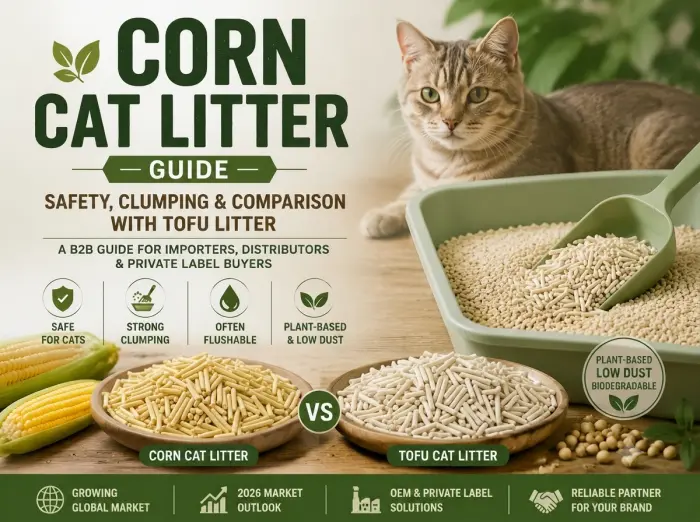
Corn cat litter has moved from a niche natural product to a recognized segment of the plant-based cat litter market. For importers, distributors, and private-label buyers, understanding how corn litter performs and how it compares to tofu and bentonite is now a practical sourcing question rather than a curiosity. This guide covers clumping performance, safety, flushability, market scale, and OEM sourcing considerations from a manufacturer’s perspective.
Quick answer: Corn cat litter is a plant-based, usually clumping litter made from corn kernels, corncob, or corn starch. It is generally safe for adult cats, low in dust, and often marketed as flushable. Clumping types dominate the category at roughly 74% of value. It competes most directly with tofu litter on price, supply chain, and flushability, and most Chinese plant-based OEM factories supply tofu or mixed formats rather than corn.
What Is Corn Cat Litter?
Corn cat litter is produced from corn by-products, most commonly whole-kernel corn, corncob granules, or fermented corn starch. The material is processed into granules or pellets and, in most commercial formulas, treated to form clumps when wet.
Corn cat litter is a plant-derived, typically clumping cat litter made from corn kernels, corncob, or corn starch, positioned as a biodegradable alternative to clay and silica litters.
Two formats dominate: clumping corn litter (the mainstream, about 74% of the category by value) and non-clumping pellets used mainly for kittens, post-surgical cats, or low-traffic boxes.
Is Corn Cat Litter Safe for Cats?
For healthy adult cats, corn litter is broadly considered safe. The main safety discussion concerns ingestion: cats occasionally taste litter, and kittens are more likely to eat it. Corn is digestible and far less hazardous than sodium bentonite, which can swell and cause intestinal blockage if ingested in quantity.
Corn Litter and Kittens
Because kittens explore with their mouths, non-clumping formulas are the safer choice until roughly 8 to 12 weeks of age. The veterinary consensus referenced by independent pet retailers is that clumping bentonite poses the higher risk of intestinal obstruction, while plant-based litters such as corn or tofu are the lower-risk options. For a plant-based alternative also suited to sensitive cats, see our guide to tofu cat litter.
Clumping Performance and Dust Control
Modern clumping corn litter forms firm, scoopable clumps, though typically slightly softer than bentonite. Dust is naturally low because corn granules are heavier and less brittle than clay. For B2B buyers, the practical takeaway is that corn litter ships well and presents few dust-complaint risks at the retail level. Odor control depends on additives and the proportion of fresh granules, so specification matters more than the raw material alone.
Is Corn Cat Litter Flushable?
Many corn formulas are marketed as flushable because corn is biodegradable and breaks down in water. However, flushability depends on local sewage rules and the presence of binders or additives. Buyers should verify claims against target-market regulations rather than assume every corn litter is sewer-safe, especially in markets with strict wastewater guidance.
Corn Cat Litter vs Tofu Cat Litter
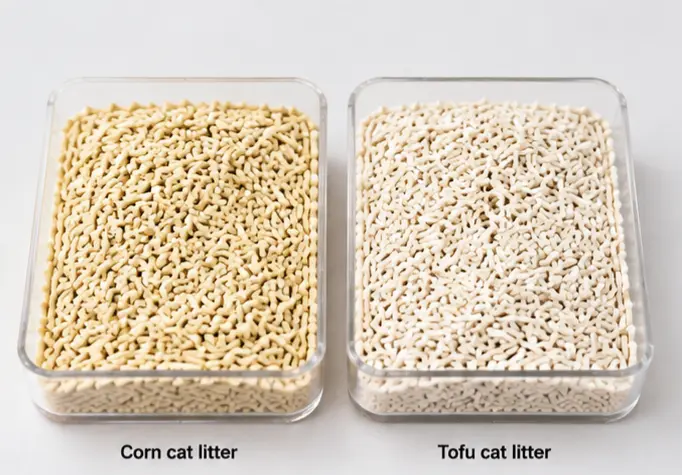
Tofu litter is the closest plant-based competitor and the format most Chinese OEM factories actually produce. The two overlap on flushability and low dust but differ on supply maturity and formulation control.
| Factor | Corn Cat Litter | Tofu Cat Litter |
|---|---|---|
| Raw material | Corn kernel, cob, or starch | Soybean residue (tofu by-product) |
| Clumping | Strong (clumping type) | Strong |
| Dust level | Low | Low to very low |
| Flushable | Often yes | Often yes |
| OEM availability in China | Limited to specialist lines | Wide, mature supply |
| Price band | Mid to premium | Mid to premium |
Corn Cat Litter vs Bentonite Cat Litter
Bentonite remains the global volume leader on price and clumping hardness. Corn litter wins on biodegradability, weight, and dust, but costs more and clumps less rigidly. For private-label programs targeting eco-conscious retail, corn or tofu formats differentiate from clay without abandoning clumping performance that shoppers expect.
The Corn Cat Litter Market in 2026
Independent market research published in 2025 to 2026 frames the category as a fast-growing plant-based segment, though total-size estimates vary by scope:
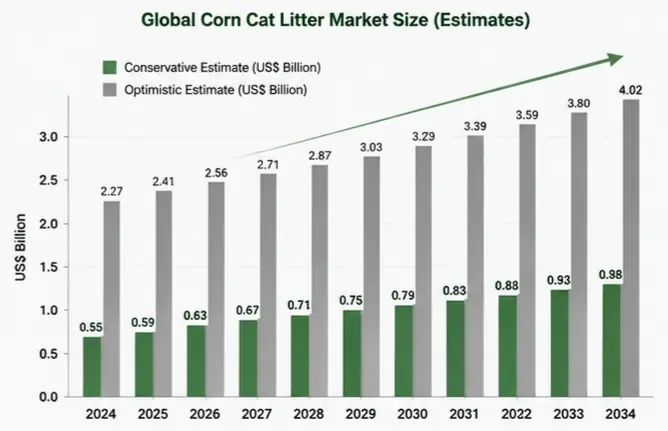
- One research house estimates the clumping corn segment at about US$410 million in 2025, roughly 74% of the corn-litter category, with online retail accounting for about 44.6% of channel sales.
- Another puts the total global corn cat litter market at US$2.27 billion in 2024, rising to US$2.41 billion in 2026 and US$3.42 billion by 2034 (CAGR about 6.2%), led by North America.
Because methodologies differ, a realistic planning range for the global market is about US$0.55 billion to US$2.4 billion. The direction of travel is consistent: steady growth, e-commerce-friendly, and increasingly supplied through Chinese OEM and private-label factories for volume and white-label programs.
Corn Input Costs and the 2026 Pricing Window
Corn is an agricultural commodity, so litter pricing tracks corn and fertilizer costs. Analysts noted in 2026 that rising input costs pressures the raw-material side of plant-based litters. For importers, this means contract timing matters: locking formulas and volumes ahead of peak agricultural pricing protects margin better than spot buying. The same logic applies to tofu and mixed plant-based litters, where soybean and pea-fiber costs move on their own cycles.
Sourcing Corn Cat Litter: OEM and Private Label Considerations
If you plan to launch a corn or corn-blend litter line, the manufacturing questions are the same as for any plant-based litter: raw-material origin, clumping-agent chemistry, dust specification, fragrance and particle-size customization, and export documentation. A capable plant-based OEM will walk you through formula adjustment and multi-language packaging.
Pet Horizon is a dedicated cat litter factory near Dalian Port with 10+ years of manufacturing experience and products shipped to 80+ markets. We produce tofu, pine, and mixed plant-based litters and support full OEM and private-label programs. For buyers comparing plant-based options, our team can advise on how corn, tofu, and mixed formulations differ on cost, supply, and market fit. You can review the full range of cat litter types we work with before discussing a program.
For a manufacturing partnership, the practical next step is a sample request and formula discussion with an OEM cat litter supplier that can show consistent batch quality and export readiness.
Conclusion
Corn cat litter is a credible, growing plant-based segment defined by clumping performance, low dust, and flushability claims. It competes closest with tofu litter on positioning and supply. For B2B buyers, the decision is less “corn versus clay” and more “which plant-based format fits my market, my margin, and my supplier’s capability.” A clear specification and a transparent OEM partner matter more than the raw material alone.
Frequently Asked Questions
Non-clumping corn litter is the safer choice for kittens under about 8 to 12 weeks because clumping formulas can be ingested. Plant-based litters are lower-risk than sodium bentonite, which can cause blockage if eaten.
Many formulas are marketed as flushable, but verify against local sewage regulations and check for additives. Do not assume every corn litter is sewer-safe.
They overlap on flushability and low dust. Tofu has a wider, more mature OEM supply in China; corn is strong in North American natural branding. Choice depends on market and supplier capability.
Clumping corn litter forms firm, scoopable clumps, typically slightly softer than bentonite. It is the dominant format, about 74% of the category.
Yes. Corn granules are heavier and less brittle than clay, so dust is naturally low, a selling point for dust-sensitive households and retail complaint reduction.
Yes, several Chinese OEM factories supply corn and corn-blend litters for private label. If you prefer a more established plant-based supply, tofu and mixed formats are widely available. Pet Horizon OEMs tofu, pine, and mixed, not corn.
Independent estimates range from about US$0.55 billion to US$2.4 billion globally, depending on scope; growth is steady at roughly 6% CAGR per the more conservative forecasts.
Yes. As a plant-derived product, corn litter is biodegradable and generally compostable where local facilities accept pet waste, unlike clay or silica.