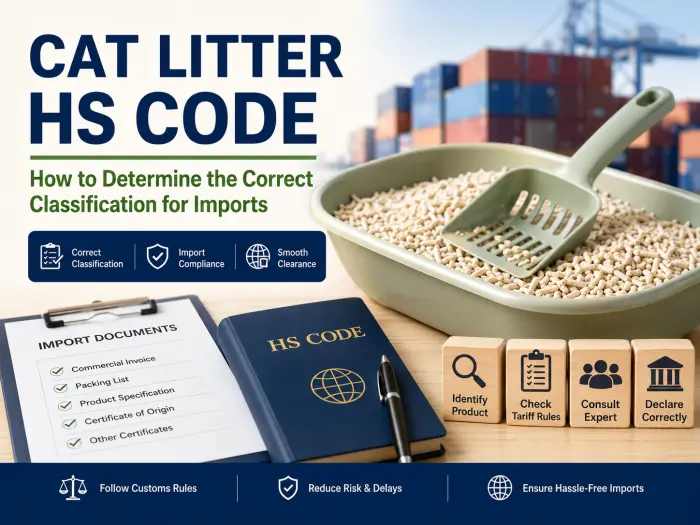





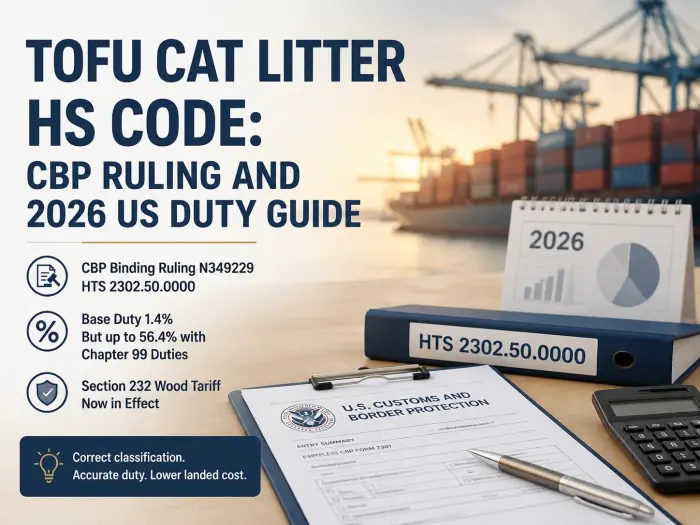
Most cat litter quotations still treat customs classification as an afterthought, and that habit has become expensive. A binding ruling issued by U.S. Customs and Border Protection has settled the question of where tofu cat litter belongs in the tariff schedule, and the answer is not the code that much of the industry has been declaring. This guide explains the correct tofu cat litter HS code, why the base rate of 1.4% is nowhere near the rate you actually pay, and how the classification changes completely once the base material changes from soy fibre to wood or bentonite.
Importers searching for the HS code for tofu cat litter usually need more than a tariff number — they need the correct US customs classification and the actual landed duty exposure.
Quick Answer
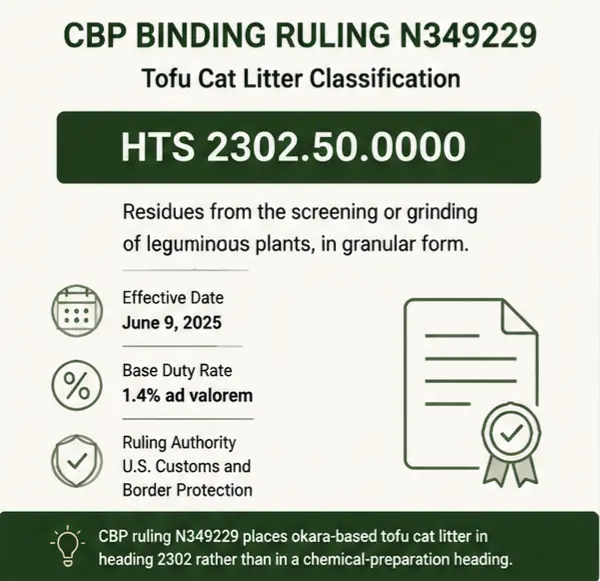
Tofu cat litter is classified under HTS 2302.50.0000 — residues from the screening and grinding of leguminous plants, in granular form — under CBP binding ruling N349229, effective 9 June 2025. The base duty is 1.4% ad valorem. That figure is not the landed rate. Chapter 99 additional duties are declared on top and can add 20%, 10% and 25% respectively.
Inside CBP Ruling N349229
Binding rulings are the highest-value classification evidence available to an importer, because they are issued by CBP itself and are legally binding on the agency for identical merchandise. Ruling N349229 is the first widely applicable ruling to address a modern plant-based clumping litter of Chinese origin, which is why it matters far beyond the single importer who requested it.
The Product CBP Examined
The merchandise described in the ruling is a granular cat litter whose principal component is okara — the insoluble soybean residue left after soy milk and tofu production. The formulation also included corn starch and guar gum as binders and activated carbon for odour control. In other words, it is the standard commercial recipe used across the tofu litter category, not an unusual specification. That is precisely what makes the ruling portable to other suppliers and other buyers.
HTS 2302.50.0000 covers bran, sharps and other residues, whether or not in the form of pellets, derived from the sifting, milling or other working of leguminous plants. Soybean processing residue such as okara falls squarely within this description, and the granular pressed form does not remove it from the heading.
Why the Applicant’s Proposed Codes Were Rejected
The applicant argued for two alternatives, and CBP rejected both.
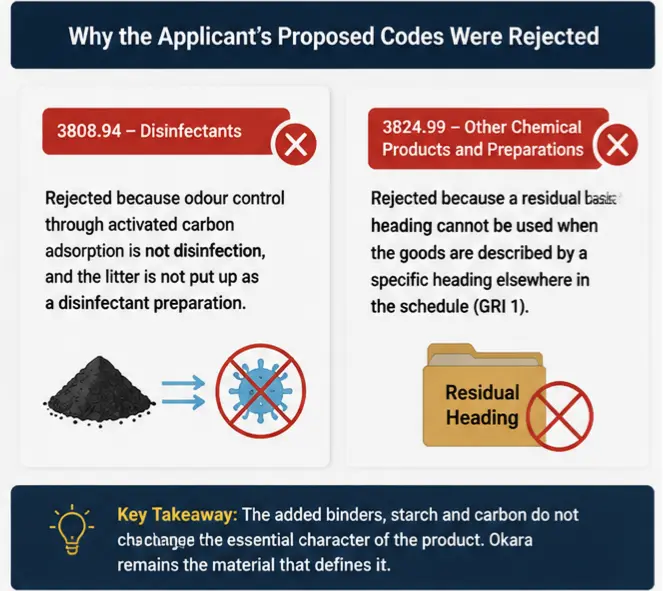
- 3808.94 — disinfectants. Rejected because odour control through activated carbon adsorption is not disinfection, and the litter is not put up as a disinfectant preparation.
- 3824.99 — chemical products and preparations not elsewhere specified. Rejected because a residual basket heading cannot be used when the goods are described by a specific heading elsewhere in the schedule.
The second rejection is the one that should concern purchasing teams. Declaring tofu litter under 3824.99 has been common practice, and CBP has now characterised that approach as misuse of a residual provision. Where a specific heading exists, General Rule of Interpretation 1 requires it to be used.
Key takeaway: the added binders, starch and carbon do not change the essential character of the product. Okara remains the material that defines it, so the goods stay in Chapter 23.
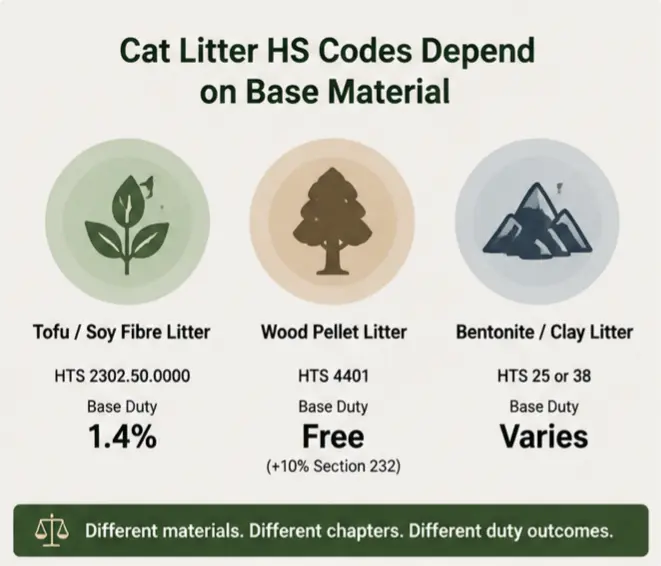
Cat Litter HS Codes Split by Base Material, Not by Product Name
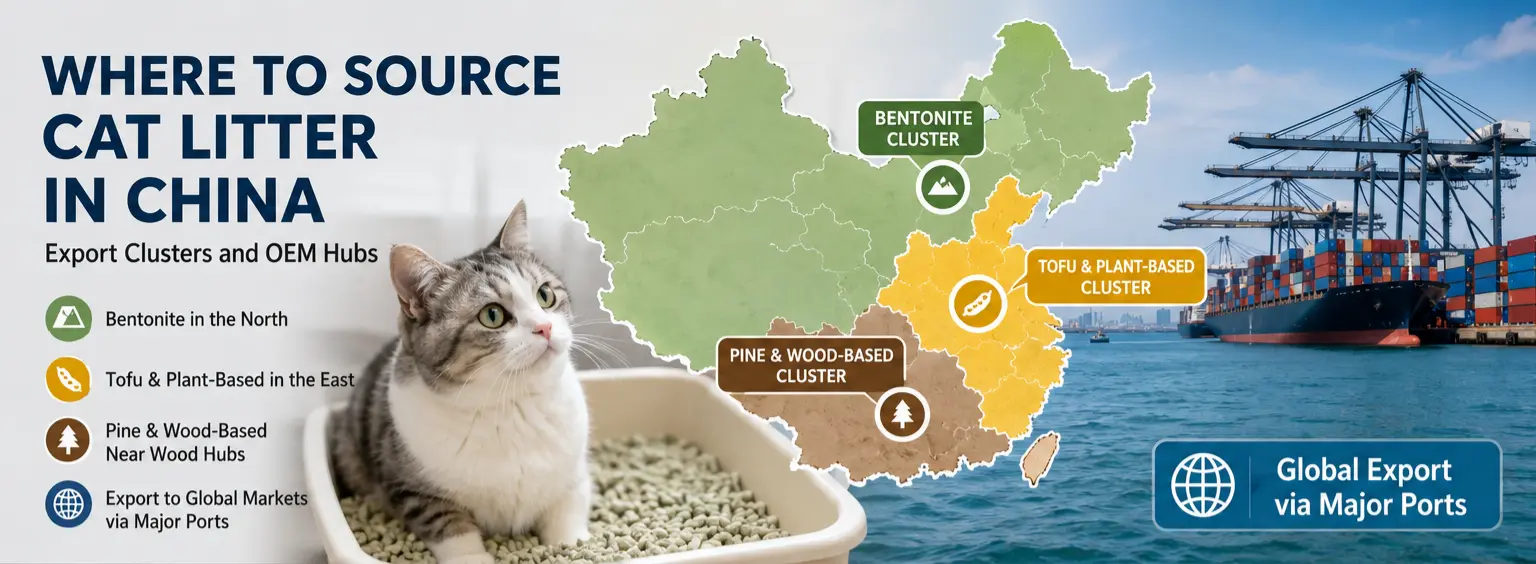
There is no single tariff line for cat litter. Classification follows the constituent material, which means three products sitting side by side on the same retail shelf can be declared under three unrelated chapters with three different duty profiles. Our broader cat litter HS code overview maps the full category; this article focuses on the tofu ruling and the chapters that surround it.
| Cat Litter Type | Typical HTS Chapter | Base Duty |
|---|---|---|
| Tofu / Soy fibre | 2302 | 1.4% |
| Wood pellet | 4401 | Free |
| Bentonite clay | Chapter 25 | Depends |
Tofu and Soy-Fibre Litter: Chapter 23
Okara-based products follow N349229 into 2302.50.0000 at a 1.4% base rate. Pea-fibre and other leguminous residues generally follow the same logic because the heading is written around the plant family rather than around a single crop. Formulations that shift the essential character away from the plant residue — for example a product where a synthetic superabsorbent, not the soy fibre, performs the clumping function — may fall elsewhere, which is why the composition breakdown matters more than the marketing name.
Wood, Sawdust and Pellet Litter: Chapter 44
Pressed sawdust and wood-fibre litter has long been handled under Chapter 44. Earlier CBP ruling D87515 classified a pure compressed wood-fibre litter under heading 4401, where the base rate is duty-free. On paper this is the most favourable base rate in the category. In practice, wood pellet cat litter customs classification has become the riskiest position in 2026, for reasons set out in the Section 232 discussion below.
Bentonite and Clay Litter: Chapters 25 and 38
Bentonite litter is generally handled in Chapter 25 as a mineral product, and certain treated or blended presentations can be argued into Chapter 38. Clay litter therefore carries a classification question of its own: the more processing, surface treatment or additive content a clay product carries, the more likely a customs officer is to test whether it has moved beyond a simple mineral.
Section 232 Lumber Tariffs Now Sit on Top of Wood Pellet Cat Litter
The duty-free base rate in Chapter 44 has been overtaken by trade-remedy action. A Section 232 tariff on timber, lumber and derivative products took effect on 14 October 2025, applying a 10% ad valorem duty to softwood logs and lumber and covering a substantial block of Chapter 44 tariff lines. A subsequent presidential proclamation issued on 31 December 2025 delayed the scheduled escalation for furniture and cabinet categories to 1 January 2027 while leaving the 10% wood rate unchanged.
For a buyer comparing base rates alone, wood litter looks free and tofu litter looks taxed. Once Section 232 exposure is priced in, that ranking can invert. The practical questions for anyone importing pellet litter are narrow and answerable:
- Does the specific eight-digit line fall inside the Section 232 derivative product list as amended?
- Is the wood input softwood, and can the supplier evidence the species?
- Does the entry stack Section 232 with Chapter 99 additional duties, or is one excluded?
Important note: Section 232 coverage lists have been amended more than once. Verify the current annex against the entry date rather than against the date the purchase order was signed.
How Chapter 99 Duties Stack on the Base Rate
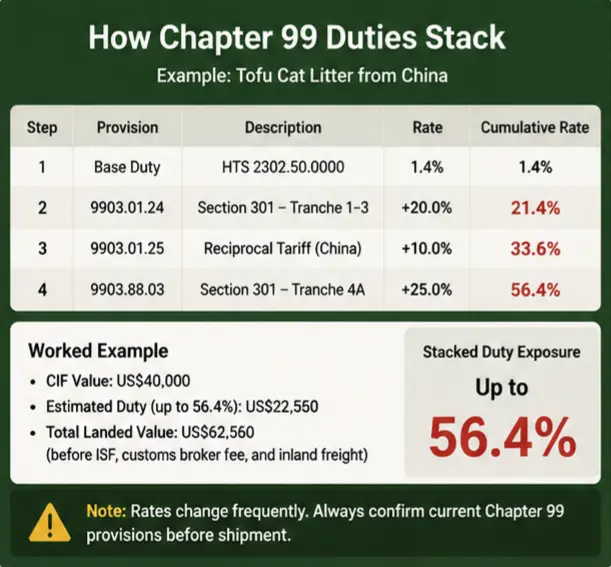
The single most common costing error in this category is quoting the base rate as if it were the final rate. Chapter 99 of the HTSUS carries temporary trade-remedy provisions that are declared in addition to the Chapter 1 to 97 classification. They do not replace the base rate — they accumulate on it.
A Worked Stack for Tofu Cat Litter from China
| Layer | Provision | Rate |
|---|---|---|
| Base classification | HTS 2302.50.0000 | 1.4% |
| Additional duty | 9903.01.24 | +20% |
| Reciprocal additional duty | 9903.01.25 | +10% |
| Section 301 remedy | 9903.88.03 | +25% |
| Stacked ad valorem exposure | All layers applied | Up to ~56.4% |
A shipment valued at US$40,000 therefore attracts roughly US$560 in base duty but can attract more than US$22,000 once every applicable Chapter 99 line is declared. That difference is the entire margin on a container of value-tier litter. Any DDP quotation that has not modelled the stack is not a DDP quotation.
What Changed on 24 July 2026
The reciprocal additional duty established under Section 122 lapsed on 24 July 2026. Several importers read that expiry as a broad reduction in landed cost. It was not. A forced-labour Section 301 action moved into the gap for roughly sixty economies, so for many origins the total burden was rebalanced rather than removed. The section 301 tariff cat litter from china exposure in particular has not disappeared, and the 9903.88.03 line remains the layer most likely to dominate the calculation.
Best practice: rebuild the duty stack at the point of entry, not at the point of order. Chapter 99 provisions change on effective dates that rarely align with production and sailing schedules.
What the Ruling Means for Four Types of Buyer
Manufacturers
A factory that cannot explain the tariff position of its own product is a weaker negotiating partner. Classification errors do not stay with the importer — retroactive duty assessments, interest and compliance findings tend to be shared across the relationship, and they poison repeat business. A supplier able to hand over a composition statement, a suggested HTS heading and the relevant ruling number is providing something a spot quotation cannot match.
Importers
This is where the money is. The gap between a specific heading at 1.4% and a residual chemical heading, and the difference between Chapter 44 and Chapter 23 exposure, are recoverable amounts. The prerequisite is knowing exactly which Chapter 99 provisions attach to your own eight-digit line, because that determines cat litter import duty USA 2026 far more than the base rate does.
Brand Owners
Formulation is a tariff decision. Whether a product is a pressed plant residue, a bound composite or a chemically treated preparation changes the heading and therefore the duty. That belongs in the product development brief, not in a customs broker’s email three days before arrival. Documentation practice for the wider category is covered in our cat litter export compliance guide.
OEM and Private Label Buyers
Tariff classification has quietly become an OEM selection criterion. A factory that supplies the ruling number, an ingredient breakdown by weight and a defensible HTS suggestion reduces the buyer’s compliance workload and makes long-term programmes easier to defend internally. Pet Horizon manufactures tofu, bentonite, pine and mixed litter, with more than twenty years in the industry and over ten years of OEM and ODM production, exporting to more than eighty countries from Dalian. Specifications for our tofu cat litter line, including composition data usable in a classification file, are available on request, and the minimum order quantity is one 20ft container, negotiable.
Decision Table: Base Material, Classification and Duty Exposure
| Base material | Typical HTS position | Base duty | Principal additional exposure |
|---|---|---|---|
| Tofu / okara / soy fibre | 2302.50.0000 (ruling N349229) | 1.4% | Chapter 99 stack including Section 301 |
| Pea fibre and other legume residues | Heading 2302, subject to review | 1.4% indicative | Chapter 99 stack |
| Compressed sawdust / wood fibre | Heading 4401 (ruling D87515) | Free | Section 232 lumber 10% plus Chapter 99 |
| Pine pellet | Chapter 44, line-specific | Free indicative | Section 232 lumber, species evidence required |
| Bentonite / clay | Chapter 25, some cases Chapter 38 | Line-specific | Chapter 99 stack |
| Mixed plant and mineral | Determined by essential character | Line-specific | Depends on the governing chapter |
How to Obtain Your Own Binding Ruling
Relying on someone else’s ruling is reasonable for planning and unreasonable for certainty. A binding ruling protects the party named in it for the merchandise described in it. If your formulation differs — a different binder, a mineral blend, a different fibre source — the safest route is to request your own.
- Assemble a full composition statement with each component expressed as a percentage by weight.
- Describe the manufacturing process, including how the granule is formed and dried.
- State the intended commercial use and retail presentation.
- Identify the headings you consider applicable and explain why competing headings do not apply.
- Submit the request to CBP through the electronic ruling system and reference prior rulings such as N349229 and D87515.
Factories can support this process without giving away proprietary formulations, because the level of detail CBP requires is compositional rather than procedural.
Classification Limits and Disclaimer
This article summarises published CBP rulings, the HTSUS and official presidential actions as a general reference for professional buyers. It is not customs advice. Classification depends on the actual composition and condition of the goods as imported and on CBP’s final determination at the port of entry. Duty rates, Chapter 99 provisions and Section 232 coverage lists change on their own effective dates. Buyers should verify the current HTSUS text, engage a licensed customs broker and obtain their own binding ruling before relying on any rate quoted here.
Conclusion
The correct tofu cat litter HS code is 2302.50.0000, confirmed by CBP binding ruling N349229 effective 9 June 2025, at a base rate of 1.4%. The number that determines profitability, however, is the stacked rate: Chapter 99 provisions can lift total ad valorem exposure past fifty percent, and the expiry of the reciprocal duty in July 2026 did not deliver the relief many importers assumed. Wood-based litter faces the mirror-image problem, with a duty-free base rate now shadowed by Section 232 lumber tariffs. Buyers who model classification and stacking at the formulation stage — and who source from suppliers willing to document composition — convert a compliance burden into a pricing advantage.
Frequently Asked Questions
HTS 2302.50.0000, covering residues from the screening and grinding of leguminous plants. CBP confirmed this classification in binding ruling N349229, effective 9 June 2025, for an okara-based granular litter containing corn starch, guar gum and activated carbon.
No. 1.4% is the base ad valorem rate for the classification. Chapter 99 additional duties are declared separately and accumulate on top, including provisions at 20%, 10% and 25%. Total exposure for Chinese-origin goods has reached roughly 56% in the stacked scenario.
Heading 3824.99 is a residual provision for chemical products not specified elsewhere. Because heading 2302 specifically describes leguminous plant residues, the specific heading prevails. CBP treated the residual heading as inapplicable rather than merely less suitable.
Compressed sawdust and wood-fibre litter is generally handled in Chapter 44, and CBP ruling D87515 placed such a product under heading 4401 at a duty-free base rate. Since 14 October 2025 many Chapter 44 lines have also carried a 10% Section 232 lumber duty.
Usually not by as much as expected. The reciprocal additional duty lapsed, but a forced-labour Section 301 action extended coverage to roughly sixty economies. Section 301 exposure on Chinese-origin litter is unchanged, so recalculate rather than assume a reduction.
Not directly. A binding ruling protects the requesting party for the merchandise described. It is strong persuasive evidence for identical goods, but if your formulation differs in any material way you should file your own request with CBP.
The heading follows the material that gives the product its essential character. A litter that clumps through soy fibre stays in Chapter 23; one where a synthetic absorbent performs that function may be argued into a chemical heading, and a mineral blend can shift the analysis to Chapter 25 or 38.
Request a component breakdown by percentage weight, a process description covering granulation and drying, the supplier’s suggested HTS heading with reasoning, and any relevant ruling references. Without those inputs, a DDP price is an estimate rather than a commitment.