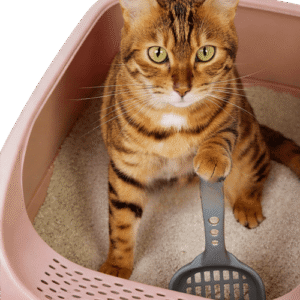





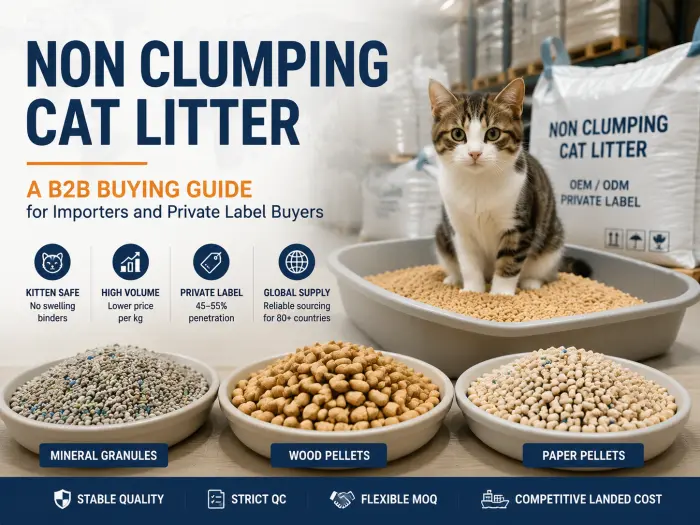
Most sourcing conversations in this category open with clumping strength, and that habit has pushed non clumping cat litter into the background of supplier catalogues. The retail data tells a different story. Non clumping litter still moves a large share of the physical volume that crosses a distributor’s warehouse, represents a significant share of retailer own-brand programmes, and holds one use case that clumping products are not designed to replace: litter boxes used by very young kittens.
This guide is written for importers, distributors, wholesalers, OEM buyers and purchasing managers who need to decide whether a non clumping line belongs in their assortment, and on what terms. It covers how the format works, where it differs from clumping litter in application rather than in quality, what the retail structure looks like, and which manufacturing and landed-cost variables actually decide profitability. Our reference point throughout is the site’s broader overview of cat litter types, which maps the full category; this article goes one level deeper into a single format.
Quick Answer
Non clumping cat litter absorbs urine into the substrate instead of forming a removable clump. Liquid disperses through the bed, solids are removed daily, and the full litter bed is replaced on a regular cycle. It is commonly selected for kitten-focused channels, shelters, post-surgical recovery environments and price-led retail programmes. It is not a weaker version of clumping litter; it is a different maintenance model with a different cost profile.
What Non Clumping Cat Litter Is and How It Works
Non clumping cat litter is any litter substrate that absorbs and retains liquid waste throughout the bed rather than binding it into a solid, scoopable mass. Maintenance is based on removing solids daily and replacing the entire bed periodically, instead of removing clumps.
The distinction is mechanical, not qualitative. Clumping litters rely on a material that swells and agglomerates on contact with liquid, most commonly sodium bentonite or a plant fibre with a natural or added binder. Non clumping litters skip agglomeration entirely and rely on absorption capacity plus odour management within the bed.
The Two Absorption Mechanisms
Non clumping products fall into two engineering families, and buyers should know which one they are quoting:
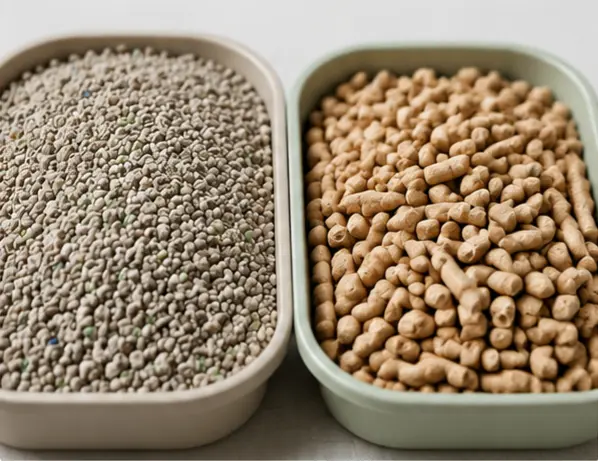
- Porous mineral absorption. Non-swelling clays such as sepiolite, attapulgite and calcined clay hold liquid inside a porous structure. Granule hardness and pore volume determine how long a bed lasts before saturation.
- Fibre absorption and pellet breakdown. Wood, pine, paper and wheat substrates absorb into the fibre itself. Compressed pellets typically disintegrate into a damp sawdust or pulp layer that settles to the bottom of the tray, which is why sifting boxes are common in this segment.
A third format, silica gel crystal litter, absorbs moisture and allows the remainder to evaporate. It is technically non clumping but occupies a premium price band and behaves differently in freight terms because of its very low bulk density.
Base Materials Used in Non Clumping Formats
- Non-swelling clay grades, including sepiolite, attapulgite and calcined clay
- Recycled paper pellets and paper granules
- Wood and pine pellets from sawdust or wood fibre
- Wheat and other grain-fibre substrates
- Silica gel crystals
Key takeaway: the format is defined by the maintenance model, not by the raw material. Several base materials appear in both clumping and non clumping product lines, and the processing route decides which one you get.
Clumping vs Non Clumping Cat Litter: Two Different Jobs
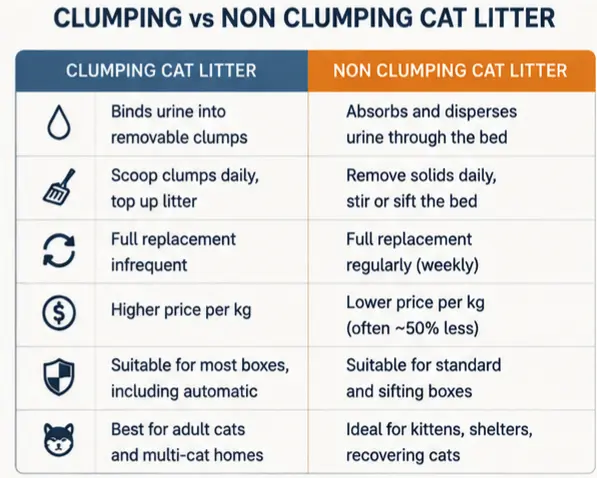
The clumping vs non clumping cat litter comparison is usually framed as a quality ranking. That framing is commercially unhelpful, because the two formats serve different households, different box types and different price positions. A distributor carrying both is not selling a good product and a compromised one; it is covering two demand pockets.
| Dimension | Clumping cat litter | Non clumping litter |
|---|---|---|
| Liquid handling | Binds urine into a removable solid clump | Absorbs and disperses urine through the bed |
| Daily routine | Scoop clumps and solids, top up substrate | Scoop solids, stir or sift the bed |
| Full replacement | Infrequent; bed is topped up rather than emptied | Regular full change, typically weekly for a single cat |
| Typical shelf price | Higher per kilogram; premium and mid tiers | Frequently around half the price per kilogram |
| Box compatibility | Standard trays, hooded boxes, most automatic boxes | Standard trays and sifting trays; generally unsuitable for automatic raking boxes |
| Ingestion risk profile | Swelling materials are a concern for kittens that eat litter | No swelling binder, which is why it is the default for young kittens |
| Core end user | Adult cats, multi-cat homes, convenience-led buyers | Kittens, shelters, recovering cats, price-led buyers |
| Retail role | Margin driver and premium innovation platform | Volume driver and own-brand entry price point |
Key takeaway: clumping litter optimises for convenience per day. Non clumping litter optimises for cost per kilogram and for safety in specific animal populations. Assortment decisions should follow the end use, not a general verdict on which format is better.
Kitten Safety: The Use Case Non Clumping Litter Owns
The strongest structural argument for keeping a non clumping line is not price. It is the specific requirement of kitten-focused channels. Some veterinarians and animal welfare organisations recommend avoiding clumping litter for very young kittens because kittens explore by mouth and may ingest litter while digging or grooming. Non clumping substrates are often selected for these situations because they absorb moisture without forming swelling clumps.
That guidance creates a demand pocket that cannot be substituted away. Breeders, rescue organisations, shelters and veterinary practices need a litter that will not agglomerate if swallowed, and non clumping paper, wood and non-swelling mineral substrates are the standard answer. The same logic extends to cats recovering from surgery, where clinics often specify a dust-free, non-adhering substrate so that granules do not stick to incision sites or paw wounds.
For buyers building a kitten or shelter SKU, the material-level detail matters more than the marketing claim. Our companion article on cat litter types to avoid for kittens sets out which substrates carry real risk and why, and it is worth reading before finalising a specification for this channel.
- Breeders and catteries buy in bulk and repurchase on a predictable cycle tied to litter sizes.
- Shelters and rescues are among the most price-sensitive institutional buyers in the category, and they buy heavy formats without hesitation.
- Veterinary clinics buy small volumes but influence retail recommendations well beyond their own purchase value.
Retail Structure: Private Label and Volume Positioning
The United Kingdom has the most complete published breakdown of this sub-category, and it is useful precisely because it separates value share from volume share. The figures below are single-country UK data and should not be read as global.
| Metric (UK, 2026 basis) | Indicative range | What it means for buyers |
|---|---|---|
| Retail value of non clumping litter | GBP 70 to 90 million | A substantial standalone sub-category, not a residual segment |
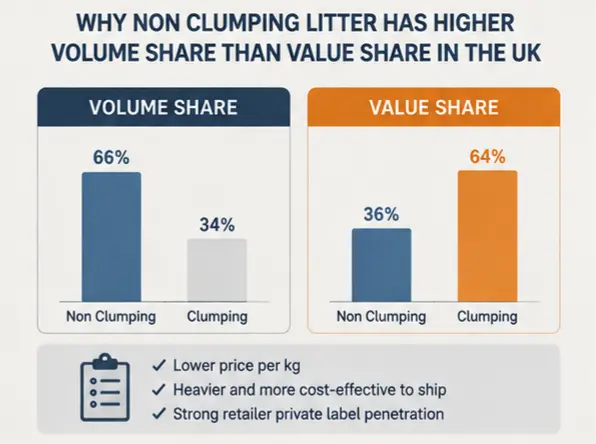
| Share of category value | 25 to 30 percent | Lower value share reflects a lower average price per kilogram |
| Share of category volume | 35 to 40 percent | Physical throughput is materially higher than the value share suggests |
| Private label penetration | 45 to 55 percent | Retailer own-brand is the dominant route to market |
| Volume growth | 0 to 1 percent CAGR | A stable, mature base rather than a growth story |
| Plant-based and dust-free share | 15 to 20 percent, growing at low double digits | Where the value uplift inside the sub-category is happening |
The gap between value share and volume share is the single most important number in the table. Unit price in non clumping formats is often around half that of comparable clumping products, so the same shelf space converts into far more tonnage. For a distributor, that changes warehouse planning, pallet configuration and freight budgeting far more than it changes revenue. Detail on the UK sub-category is available in the IndexBox United Kingdom non-clumping litter market analysis.
Cross-Checking the Global Picture
There is no equally granular global figure for non clumping litter, so the share has to be inferred. Multiple global market studies place clumping litter at roughly 65 to 69 percent of the category, including the Business Research Insights global cat litter market report. Working backwards, non clumping formats account for approximately 31 to 35 percent of the global category.
That number should be treated as a reverse-inferred interval rather than a measured value. It is useful mainly because it sits close to the UK volume range, which suggests the UK structure is not an outlier. It should not be quoted as a directly researched global statistic.
Plant-Based Non Clumping Litter Is Where the Value Is Moving
Total non clumping volume is flat, but the mix inside it is not. Wheat, paper, pine and wood substrates have been taking share from conventional clay at low double-digit growth rates, from a base of roughly 15 to 20 percent of the sub-category. Two drivers explain most of that shift.
The first is dust. Dust control moved from a premium feature to a baseline expectation, and plant-based substrates make that specification easier to hit consistently. The second is weight and disposal. Lower bulk density reduces the physical burden on the household and on the retailer’s replenishment cycle, and biodegradable substrates align with packaging and waste positioning that European and UK retailers now expect from own-brand ranges.
- Pine and wood pellets combine low dust with natural odour suppression and a very simple production route.
- Paper pellets are the standard specification for kitten and post-surgical use because of their softness and low adhesion.
- Wheat and grain fibre substrates sit between the two on price and are more exposed to agricultural input volatility.
Key takeaway: a non clumping programme that is entirely clay-based is exposed to the flat part of the segment. Adding a plant-based tier is the practical way to capture the growing share without leaving the format.
Purchasing and B2B Considerations
Landed Cost Is Dominated by Freight, Not Formula
Non clumping litter is a heavy, low-value good. Freight and handling therefore represent a higher proportion of landed cost than they do for clumping products, and a change in ocean rates can wipe out a margin that looked comfortable at the FOB stage. Two habits protect the position:
- Run the landed-cost calculation separately for non clumping SKUs rather than applying the ratio used for clumping lines.
- Model the sourcing radius explicitly. A shorter shipping lane can outperform a lower unit price once weight is factored in.
Dust and Quality Documentation
Because the category is highly commoditised, documentation is one of the few genuine differentiators between suppliers. Buyers evaluating a factory for a non clumping programme should ask for:
- Dust content test results by production batch, not a single sample report
- Moisture content and absorption rate ranges, with the test method stated
- Granule size distribution and hardness data, which govern tracking and bed life
- Batch traceability from raw material intake to finished pallet
- Written confirmation of the substrate composition, which matters for kitten-channel claims
Packaging and Re-Labelling Speed
With private label penetration around 45 to 55 percent in the UK, most non clumping demand reaches shelves under a retailer’s own brand. That makes artwork turnaround, multi-language labelling and pack-format flexibility operational requirements rather than nice-to-have services. A supplier that can move from approved artwork to production within a normal order cycle is worth more to a private label buyer than one offering a marginally lower unit price.
MOQ, Container Planning and Supplier Fit
Non clumping orders are large in weight and modest in value, which suits container-level planning. Pet Horizon works to a minimum order quantity of one 20ft container, negotiable depending on the programme, and produces tofu, bentonite, pine and mixed cat litter from its base in Dalian. Of those four lines, pine pellets are the natural fit for a non clumping specification. The company has more than 20 years in the industry, over 10 years of OEM and ODM production, and exports to more than 80 countries.
Buyers structuring a first order should read the practical terms alongside our cat litter wholesale guide, which sets out order structures, packaging options and container loading in more detail.
Conclusion
Non clumping cat litter is best understood as a parallel format rather than an inferior one. It carries a disproportionate share of physical volume, it is the backbone of retailer own-brand ranges, and it holds a use case in kitten and shelter channels that clumping products cannot safely take. The commercial trade-off is clear: thin margins per kilogram, high tonnage, and a cost structure driven by freight and documentation rather than by formulation.
For importers and private label buyers, the practical conclusion is to treat non clumping as a deliberate assortment decision with its own cost model, its own QC requirements and its own target channels. Adding a plant-based tier captures the one part of the sub-category that is still growing, while a clay-only range remains tied to a flat base.
Frequently Asked Questions
Non clumping litter is commonly selected for young kittens because it does not form swelling clumps when exposed to moisture. Paper and wood pellets are frequently specified for kitten-focused channels because they provide a soft, low-adhesion substrate. Suitability still depends on the kitten’s age, behaviour and the specific litter material.
Clumping litter binds urine into a solid mass that is scooped out. Non clumping litter absorbs urine into the bed, so solids are removed daily and the whole bed is replaced on a cycle. The difference is a maintenance model, not a quality gap.
Remove solid waste daily and stir the bed so damp material is distributed rather than concentrated in one area. Replace the full bed and wash the tray on a regular cycle, typically weekly for one cat and more often in multi-cat households. Sifting trays make the full change faster with pellet substrates.
Because it fills a different role. In the UK it accounts for roughly 35 to 40 percent of category volume while representing 25 to 30 percent of value, which makes it the entry price point that protects a retailer against price-led competitors and anchors own-brand ranges.
Container-level ordering is standard because the product is heavy and low in unit value. Pet Horizon works to one 20ft container as a minimum order quantity, negotiable depending on the programme, packaging complexity and whether multiple SKUs are combined in the same shipment.
Odour performance depends on the substrate and on the replacement cycle rather than on the format itself. Pine and wood substrates suppress odour naturally, and non-swelling mineral grades rely on pore structure. Because saturated material stays in the bed, odour control is more sensitive to how often the bed is fully changed.
Non-swelling clay grades give the lowest cost per kilogram, paper pellets suit kitten and veterinary channels, and pine or wood pellets offer the best balance of low dust, natural odour control and a straightforward production route. Most private label ranges combine an economy clay tier with one plant-based tier.
Volume is broadly flat rather than declining, at around 0 to 1 percent annual growth in the UK. The mix is changing, however: plant-based and low-dust formulations are growing at low double-digit rates from a base of 15 to 20 percent of the sub-category, which is lifting average value even where tonnage is static.
Most automatic litter boxes are designed for clumping litter because the mechanism removes formed clumps. Non clumping litter usually does not separate in the same way, although some specialised systems may support alternative substrates.