




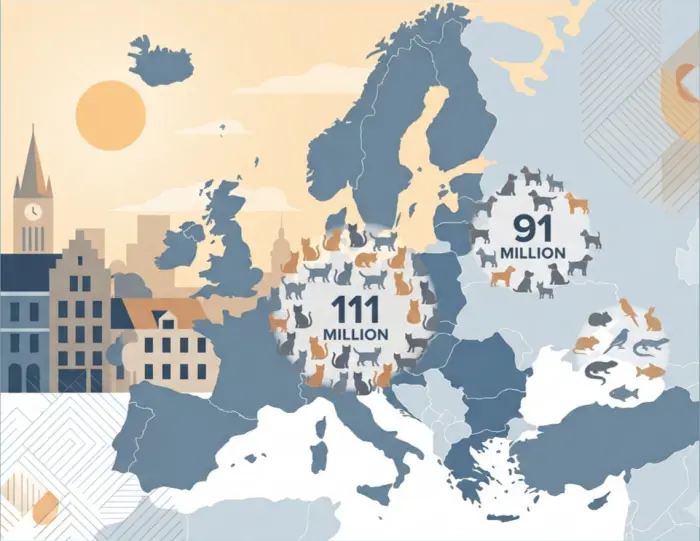
Europe’s cat population is the foundational benchmark for any B2B buyer sizing the regional litter market. This data pillar breaks down the latest FEDIAF figures and translates them into practical implications for importers, distributors, wholesalers, and private-label sourcing teams.
- Cats: 111 million
- Dogs: 91 million
- Total pets: 306 million
- Pet-owning households: 140 million
- Source: FEDIAF Annual Report 2026
What the FEDIAF 2026 Annual Report Measures
The FEDIAF Facts & Figures are built on a two-year reporting lag. The 2026 edition reports data from the 2024 calendar year. Figures were compiled by Soulor Consulting from 15 national pet associations and cover 41 of the 48 European Commission countries; Russia is excluded. FEDIAF explicitly advises against direct year-on-year comparisons because methodologies shift between editions.
The primary source for this article is the industry federation’s published data set, the FEDIAF Annual Report 2026 (PDF).
Total Pet and Cat Population in Europe
Europe’s total pet population stands at 306 million, or 278 million when aquatic pets are excluded. Within that total, cats are the single largest companion-animal category at approximately 111 million, ahead of dogs at 91 million. The remaining population spans small mammals, birds, reptiles, and aquatics.
Household Ownership and Country Ranking
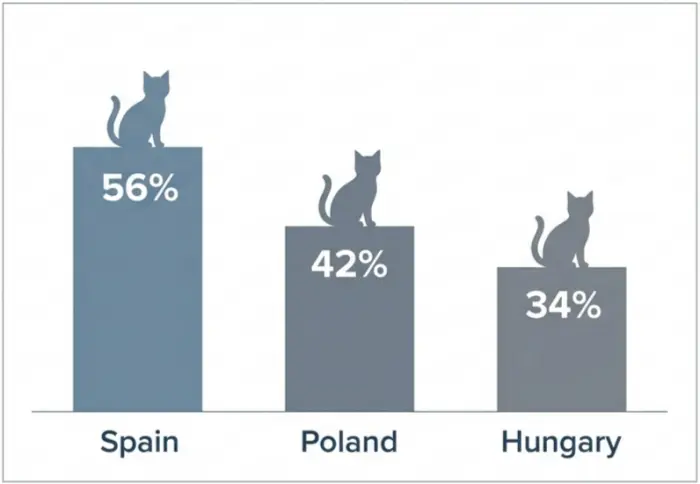
Approximately 140 million European households — about 49% of all EU households — own at least one pet. Among the countries where FEDIAF reports household cat-ownership rates, Spain leads at 56%, followed by Poland at 42% and Hungary at 34%. These percentages measure the share of households owning cats, not absolute cat counts.
Value vs. Volume: Where Cats Lead
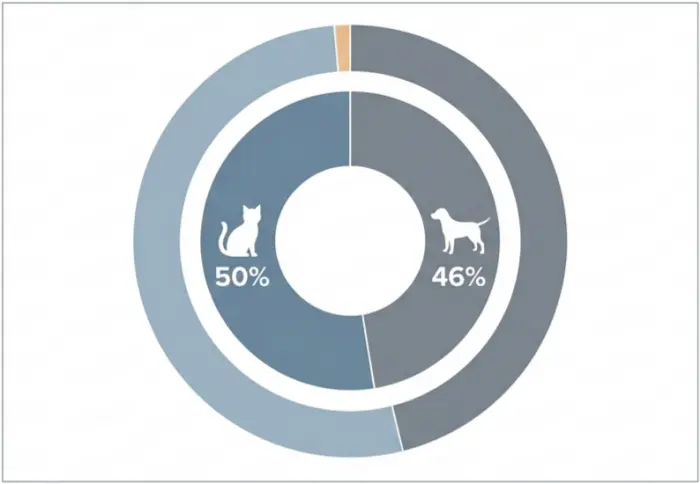
The pet food sector reports annual sales of approximately €29.4 billion and production of about 8.6 million tonnes, spanning 400-plus companies. By volume, dogs account for 58% and cats 41% of pet food. By value, the split flips: cats represent 50% and dogs 46%. In other words, cat owners spend a larger share of pet food euros than their share of volume implies.
A data note for analysts: the report preface cites 9.1 million tonnes and €29.3 billion, while the Facts & Figures table shows 8.6 million tonnes and €29.4 billion. This article uses the table figures and labels them “approximately.” Also note that pet food sales (€29.4 billion) and the cat litter market are separate statistical scopes and must not be conflated.
A secondary industry overview corroborates overall market growth trajectories in the period Pet Worldwide market growth report.
Why This Matters for Cat Litter Demand
An installed base of approximately 111 million cats represents recurring, non-discretionary litter consumption: each cat drives steady, repeat wholesale volume. For buyers, that scale supports container-level importing and long production runs. Understanding the types of cat litter available — from tofu to bentonite, pine, and mixed formats — helps match product mix to regional preferences and price tiers.
Implications for EU Importers and Private-Label Buyers
The table below converts the headline figures into sourcing implications for European buyers.
| Finding | Figure | Implication for Buyers |
|---|---|---|
| Cat population | ~111 million | Large, recurring base load for wholesale and private-label litter programs. |
| Pet-owning households | 140 million (49% of EU) | Broad, evenly distributed retail and distribution demand across the EU. |
| Cat share by value | 50% of pet food value | Premiumization room; cat categories out-earn their volume share. |
| Country concentration | Spain 56%, Poland 42%, Hungary 34% | Prioritize Iberian and Central European distribution footprints. |
| Data scope | 41 of 48 EC countries | Treat as a European baseline; validate local figures per market. |
Sourcing Cat Litter for the European Market
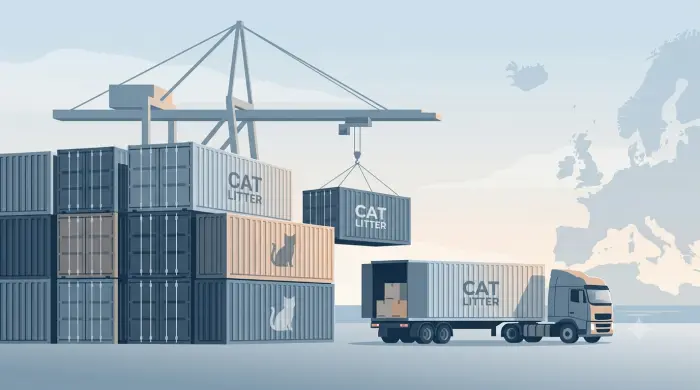
Pet Horizon is a China-based cat litter manufacturer with more than 20 years of industry experience and over 10 years of OEM/ODM factory operation, exporting to 80-plus countries. The factory supports private-label and wholesale programs with a negotiable minimum order quantity of one 20-foot container. Review our tofu cat litter product line and our guidance on cat litter export compliance before planning an EU shipment.
Conclusion
With approximately 111 million cats, Europe represents the world’s largest consolidated companion-cat market and an essential benchmark for cat litter manufacturers, importers, and distributors.
While country-level demand varies, FEDIAF’s data provides a reliable baseline for estimating regional litter consumption, evaluating market opportunities, and prioritizing sourcing strategies across Europe.
Frequently Asked Questions
Approximately 111 million cats live in Europe, based on the FEDIAF Annual Report 2026 using 2024 data. This makes cats the largest companion-animal category ahead of dogs at 91 million.
The report does not rank countries by absolute cat numbers. It reports household cat-ownership rates for selected markets, with Spain highest at 56%, followed by Poland at 42% and Hungary at 34%. The highest ownership rate is not the same as the highest total cat count.
Europe has approximately 111 million cats and 91 million dogs. By pet food volume, dogs lead at 58% versus cats at 41%; by value, cats lead at 50% versus dogs at 46%.
FEDIAF reports approximately €29.4 billion in annual pet food sales and about 8.6 million tonnes of production across 400-plus companies. These are pet food figures and represent a different statistical scope from the cat litter market.
The report covers 41 of the 48 European Commission countries and explicitly excludes Russia. The figures cited here do not enumerate the UK separately, so confirm the UK’s inclusion in the full FEDIAF PDF before quoting a UK-specific number.
FEDIAF applies a two-year reporting lag. The 2026 edition compiles data from the 2024 calendar year, gathered by Soulor Consulting from 15 national associations. FEDIAF also advises against direct year-on-year comparisons across editions.
With roughly 111 million cats, Europe represents a large, recurring litter market. Demand supports container-scale wholesale importing and private-label programs, with premiumization potential given cats’ 50% share of pet food value.
Europe’s total pet population is approximately 306 million, or 278 million excluding aquatic pets. Cats (111 million) and dogs (91 million) are the two largest categories.
Europe is one of the world’s largest cat-owning regions, with approximately 111 million cats according to FEDIAF 2026. However, global comparisons vary because different organizations use different methodologies and reporting periods.