




Hemp cat litter has moved from a curiosity in specialist stores to a recognised line item in plant-based litter assortments across North America and Europe. For importers, distributors and private-label brand owners, the practical questions are narrower than the marketing narrative: what the material actually is, which performance figures are measured and which are simply asserted, whether the environmental claims survive regulatory scrutiny, and whether the raw material base can support repeatable container-level supply.
This article answers those questions from a manufacturing and sourcing perspective, and compares hemp against the plant-based litter category that dominates real production volume today.
Quick Answer: What Is Hemp Cat Litter?
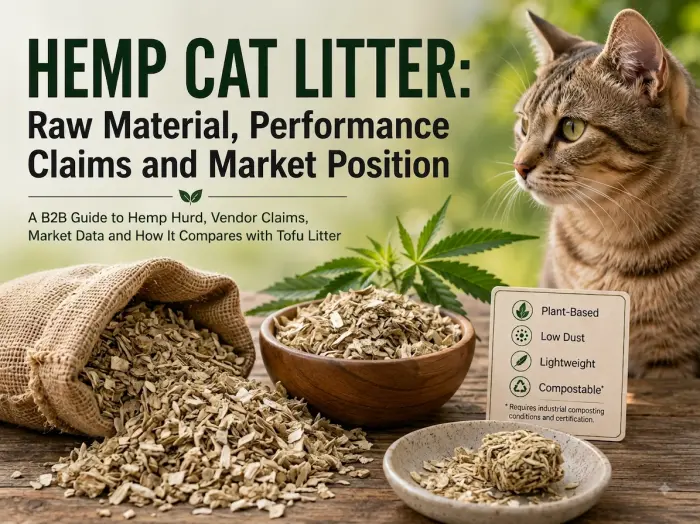
Hemp cat litter is a plant-based litter made primarily from hemp hurd, the woody inner core of the industrial hemp stalk, processed into loose granules or pellets.
Hemp cat litter is lightweight and can be low-dust after proper dedusting, while clumping performance varies substantially by processing and binder formulation. It is generally positioned as a plant-based alternative, but cat tolerance depends on particle size, formulation, binders, additives and dust control in the finished product. As with any new litter substrate, buyers should evaluate the finished formulation rather than the raw material alone.
Key takeaway: hemp is better positioned as a differentiated plant-based niche than as a high-volume replacement for established clumping litters. Its main constraint is supply scalability: hemp hurd depends on fibre cultivation, regional processing capacity and regulated cultivation systems.
Raw Material: Why Hemp Hurd Determines Everything
Every meaningful property of a plant-based litter traces back to the substrate. Hemp litter is not made from the fibre used in textiles or rope; it is made from the fraction left behind after that fibre is removed. Understanding that distinction explains both the material’s absorbency and its supply problem. Buyers building a full assortment will also want to see how hemp compares with the other substrates covered in our overview of cat litter types.
The Hurd Fraction of the Hemp Stalk
An industrial hemp stalk separates into two commercial streams. The outer bast fibre is long, strong and destined for textiles, composites and paper. The inner core, called hurd or shiv, is short, porous and woody, and is composed largely of lignin and cellulose. That porous cell structure is what gives hurd its liquid-holding capacity, and it is the reason hurd found a second life first as animal bedding and then as cat litter.
Because hurd is a by-product of fibre processing, its availability is tied to the volume of hemp grown for fibre in the first place. A litter programme cannot simply order more hurd; the upstream crop has to exist.
From Hurd to Finished Granule
The conversion route is short and mechanically simple, which is one reason small regional processors can enter the category:
- Decortication separates bast fibre from the woody hurd core.
- The hurd is cleaned and dedusted to remove field debris and fine particulate.
- Material is screened to a target particle size distribution.
- Drying reduces moisture to a level that supports storage and absorbency.
- The hurd is either packed loose as a granular substrate or compressed into pellets; clumping variants are extrusion-formed, sometimes with a plant-derived binder.
Early hemp litter was almost entirely non-clumping, and weak clump integrity was its most cited weakness. Extrusion and binder work have narrowed that gap, and clumping formats now account for a rising share of the sub-category. Clump strength still varies widely between processors, which is precisely why sample testing matters more here than in mature substrates.
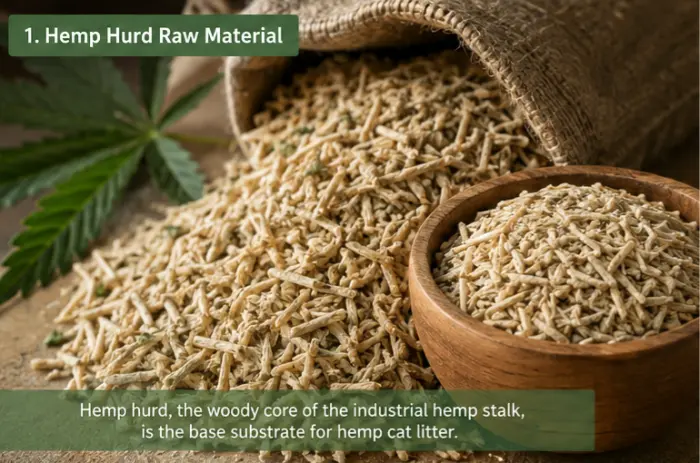
Key takeaway: hemp litter quality is decided at the decortication and screening stage. Two products described identically on a label can behave very differently depending on how thoroughly the hurd was cleaned and graded.
Vendor-Claimed Performance: Reading the Spec Sheet Correctly
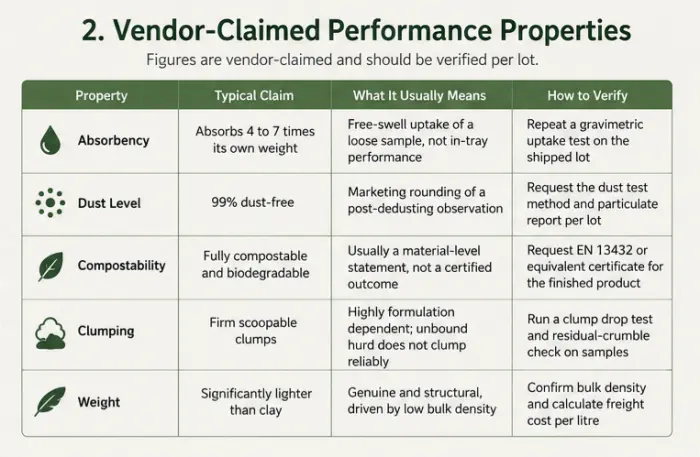
The performance figures circulating in this category come almost entirely from product pages and processor literature, not from independent laboratory programmes. They should be treated as vendor-claimed positioning until a buyer has test data in hand. The table below separates the claim from what a purchasing manager can actually verify.
| Vendor-claimed property | Typical wording | What it usually means | How a buyer verifies it |
|---|---|---|---|
| Absorbency | Absorbs 4 to 7 times its own weight; some sellers claim several times more than clay | Free-swell liquid uptake of a loose sample, not in-tray performance over a full change cycle | Request the test method and repeat a gravimetric uptake test on the shipped lot |
| Dust level | 99 percent dust-free | A marketing rounding of a post-dedusting observation; no single global dust standard is cited | Ask which dust test method was used and request a particulate report per production lot |
| Compostability | Fully compostable and biodegradable | Usually a material-level statement about lignocellulose, not a certified disposal outcome | Request an EN 13432 or equivalent certificate covering the finished product, not the raw fibre |
| Clumping | Firm scoopable clumps | Highly formulation dependent; unbound hurd does not clump reliably | Run a clump drop test and a residual-crumble check on retained samples |
| Weight | Significantly lighter than clay | Genuine and structural, driven by low bulk density | Confirm bulk density, then recalculate volumetric freight cost per litre |
Absorbency Compared With Clay
The absorbency comparison that drives most hemp marketing is a free-swell measurement: a weighed sample takes up liquid until saturation, and the ratio is reported. Sodium bentonite works differently. It swells and binds liquid into a scoopable mass, so a litter box holding clay may be maintained longer even where the raw uptake ratio is lower. A high absorbency multiple is therefore not the same as a longer usable service life, and buyers who quote one figure as proof of the other will eventually face a consumer complaint they cannot answer.
Dust and Respirable Particulate
Low dust is one of hemp’s more credible advantages, because the dedusting step removes the fine fraction before packing and because lignocellulosic dust behaves differently from crystalline mineral dust. The number attached to it, however, is not standardised. A supplier who can state the measurement method has a stronger position than one who only repeats the percentage.
Important note: all absorbency, dust and compostability figures in this section are vendor-claimed. None should be reproduced on retail packaging without documentation that would survive a regulator’s request.
Hemp Cat Litter Market Size and Growth
Market coverage of this sub-category is thin. At the time of writing, the most complete public dataset comes from a single research house, which means the figures should be read as directional rather than settled. Where a category has only one published estimate, prudent practice is to quote it as an approximation, state the base year, and avoid building a business case on the decimal places.
According to Growth Market Reports, the global hemp lignocellulose cat litter market was worth approximately US$433 million in the 2024 base year, with a projected CAGR of 8.9 percent over 2025 to 2033 and a forecast value of roughly US$927 million by 2033.
These figures refer specifically to the hemp lignocellulose cat litter market as defined by that research source, not to the entire plant-based or natural cat litter market.
| Metric | Reported value | Reading guidance |
|---|---|---|
| Market value, 2024 base year | Approximately US$433 million | Single-source estimate; treat as an order of magnitude |
| Forecast CAGR, 2025 to 2033 | 8.9 percent | Above the broader litter category, below the strongest plant-based sub-segments |
| Forecast value, 2033 | Approximately US$927 million | Roughly a doubling over nine years |
| North America plus Europe share | More than 62 percent combined | Demand is concentrated in mature premium retail markets |
| Fastest-growing region | Asia-Pacific at 11.2 percent CAGR | High growth from a small base |
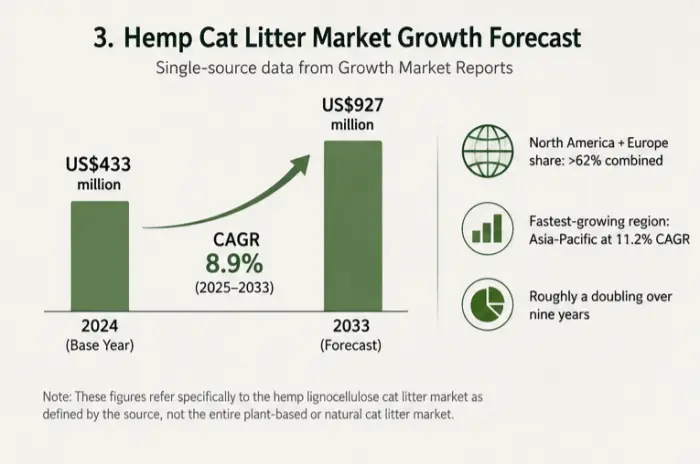
Two conclusions follow. First, hemp is a real category rather than a fad, and its growth rate is respectable. Second, at under half a billion US dollars globally it remains a fraction of the total cat litter market, and the regional concentration confirms that it sells where consumers pay a premium for provenance rather than where volume is won on price.
Hemp vs Tofu Cat Litter: A Practical Comparison
The comparison buyers ask for most often is hemp against tofu, because both are plant-based, both carry biodegradability messaging, and both compete for the same shelf position. They are not equivalent propositions.
| Dimension | Hemp cat litter | Tofu cat litter |
|---|---|---|
| Base material | Hemp hurd, a by-product of fibre decortication | Plant-based fibre or residue combined with a starch-based binder, depending on formulation |
| Clumping | Variable; strong clumping requires extrusion and binders | Generally consistent in established clumping formats; formulation still affects performance |
| Dust | Low after dedusting; vendor-claimed at 99 percent dust-free | Low; dust control is an established process parameter in mass production |
| Odour control | Mechanical absorption; activated carbon sometimes added | Absorption plus widely used activated carbon and enzymatic variants |
| Flushability | Generally not positioned as flushable | Some products are marketed as flushable, subject to local rules and product instructions |
| Raw material availability | Constrained by hemp cultivation licensing and fibre demand | Generally more established than hemp, with broader processing infrastructure |
| Cost position | Premium; limited scale keeps unit cost high | Competitive; mature supply chains and large-scale lines |
| Container-level supply stability | Difficult to guarantee across seasons | Routine for established production lines |
| Typical role in an assortment | High-margin niche SKU with a strong story | Volume driver and private-label backbone |
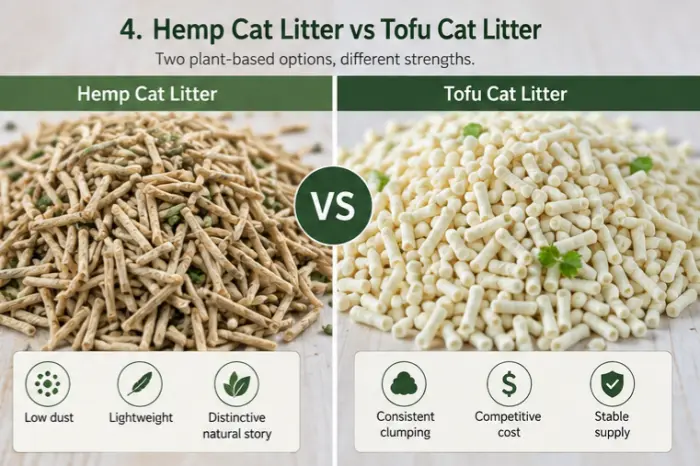
For a distributor building a plant-based range, the sensible reading is that hemp earns a place as a differentiated premium listing while tofu cat litter carries the volume. Tofu delivers the clumping consistency, the cost structure and the production scale that retail programmes depend on, and it satisfies the same plant-based, biodegradable brief that draws buyers to hemp in the first place.
Key takeaway: hemp and tofu are complements, not substitutes. Treating hemp as a volume replacement for tofu almost always produces a supply gap; treating it as a halo SKU alongside tofu usually works.
Is Hemp Cat Litter Right for Your Assortment?
A short decision check helps place hemp without over-engineering the category. The table maps common buyer priorities to how well hemp fits.
| Buyer priority | Hemp cat litter fit |
|---|---|
| Premium plant-based positioning | Strong |
| Lowest landed cost | Weak |
| Consistent container-level supply | Moderate to weak |
| Differentiated shelf story | Strong |
| Highly consistent clumping | Product-dependent |
| Simple compostability claim | Requires documentation |
| Large-volume private label | Higher supply risk |
Key takeaway: hemp earns its place where the brief values a distinctive plant-based story and margin, not where the brief is won on the lowest cost per litre or the largest repeatable volume.
Compliance: Compostable Claims Require Evidence
The environmental narrative is hemp’s strongest selling point and its largest regulatory exposure. The most relevant regulatory and standards considerations for anyone placing product in Western Europe or the United Kingdom include:
- UK Green Claims Code. The Competition and Markets Authority requires environmental claims to be truthful, unambiguous and substantiated. Words such as compostable and biodegradable must be qualified by the conditions under which they hold true.
- EU Empowering Consumers for the Green Transition Directive. This directive introduces stricter rules on generic environmental claims and unsubstantiated sustainability messaging on consumer packaging, with the relevant provisions applying from September 2026.
- EN 13432. The European standard for industrial compostability of packaging and materials.
EN 13432. A European standard relevant to industrial compostability of packaging and materials. Where an industrial compostability claim relies on this standard, the finished product and applicable disposal conditions should be supported by appropriate evidence.
A material can be compostable in principle while the finished product still fails a compliance review, because the certificate must cover the product as sold, including binders, additives and any scent system.
The practical documentation set a brand owner should hold before printing a compostability claim includes the finished-product test report, a full ingredient declaration, the conditions under which the claim applies, and a statement of whether household composting or industrial facilities are required. Where municipal composting infrastructure will not accept used litter, an unqualified compostable claim invites an advertising complaint even when the material itself would pass.
Supply Constraints and Realistic Positioning
Hemp litter’s supply picture is unusual in the litter category because the bottleneck is legal rather than industrial.
Cultivation Is Licence-Restricted
Industrial hemp is regulated separately from other fibre crops in most jurisdictions. In the United States, the 2018 Farm Bill legalised industrial hemp cultivation subject to THC thresholds and a licensing framework administered through state and federal programmes. In Australia, cultivation operates under state legislation including the Industrial Hemp Act 2004. Comparable licensing regimes apply across European producing countries.
The consequence is that hemp acreage cannot expand freely in response to litter demand. Growers need permits, processors need decortication capacity near the crop because raw stalk is expensive to transport, and litter competes for hurd with the animal bedding, construction and horticulture sectors. The result is a supply base that can be less responsive to sudden increases in litter demand, which can support a premium price position but also limit scale.
What This Means for Sourcing Decisions
- Geographic concentration. Supply is clustered around a small number of producing regions in North America, Australia and parts of Europe, which lengthens lead times for buyers outside those areas.
- Freight economics. Low bulk density means containers cube out before they weigh out, so landed cost per litre is driven by volume, not tonnage.
- Seasonality. Hurd availability follows the fibre harvest, so annual contracts need seasonal buffers written in.
- Assortment strategy. The workable model is a small high-margin hemp listing supported by a plant-based volume line that can absorb promotional demand.
Key takeaway: before committing to a hemp programme, confirm annual hurd availability, processor capacity, bulk density and seasonal lead-time buffers rather than relying on catalogue availability.
Pet Horizon’s Plant-Based OEM Program
Our plant-based OEM and ODM program covers tofu, pine and mixed clumping litter. These are the formats supported by our production lines, quality control procedures and export experience, and they address the same plant-based, low-dust, biodegradable brief that brings many buyers to hemp.
With more than 20 years in the cat litter industry, more than 10 years of OEM and ODM production since building our own factory, and exports to more than 80 countries, Pet Horizon supports container-level private-label programmes from its Dalian manufacturing base close to the port. MOQ is one 20ft container, with room for negotiation on trial programmes. Buyers comparing plant-based substrates often start with our pine cat litter for a wood-fibre profile or tofu for the clumping benchmark.
Where a buyer’s brief centres on hemp, we discuss how it compares with tofu, pine and mixed plant-based litter rather than presenting hemp as a product we manufacture. Where the underlying requirement is consistent clumping, documented dust control and reliable container supply, these established plant-based formats provide practical alternatives.
Conclusion
Hemp cat litter is a genuine plant-based category with a coherent technical story: a porous lignocellulosic substrate, low dust after dedusting, light weight, and an environmental narrative that resonates in premium Western retail. Its published market data, though drawn from a single source, points to steady growth from a base of roughly US$433 million in 2024.
The limitations are equally clear. Performance figures are vendor-claimed rather than independently verified, compostability claims require documentary evidence for applicable claims in the United Kingdom and European Union, and licence-restricted cultivation can make raw material supply less responsive to sudden increases in demand. For buyers, that combination argues for hemp as a deliberate niche listing rather than a volume platform, with a scalable plant-based clumping litter such as tofu carrying the core of the assortment.
Frequently Asked Questions
Hemp cat litter can be a suitable plant-based option for many cats, but tolerance depends on the finished product rather than hemp hurd alone. Particle size, dust level, binders, fragrance and other additives can affect acceptance. Buyers should assess the finished formulation and introduce any new litter gradually.
Some hemp sellers claim absorption of four to seven times the material’s own weight. This is a free-swell figure rather than an in-tray service-life measurement. Bentonite works through swelling and clump formation, so a direct comparison of the two numbers does not predict litter-box service life. Treat both figures as vendor-claimed until tested on the delivered lot.
Neither is universally better. Hemp offers a distinctive raw material story and low dust; tofu offers more consistent clumping, a lower cost position and far more reliable supply at container volumes. Most assortments perform best with tofu as the volume line and hemp as a premium niche listing.
Processors commonly describe hemp hurd litter as biodegradable or compostable, but that is a vendor claim about the raw material, not a certified disposal outcome. Depending on the market and the exact claim, a brand may need finished-product evidence against the applicable compostability or biodegradability standard, with EN 13432 relevant where industrial compostability is asserted. Any claim should state the disposal conditions required.
Loose hemp hurd clumps poorly. Clumping variants are extrusion-formed and often use a plant-derived binder, and clump strength varies significantly between processors. Any buyer evaluating a clumping hemp product should run drop and crumble tests on retained samples rather than relying on the product description.
Hurd availability depends on industrial hemp acreage, which is licence-restricted in most producing countries, and litter competes for that hurd with animal bedding, construction and horticulture. Limited scale, regional processing capacity and low bulk density in freight all push the landed cost above substrates such as tofu or pine.
It is generally not positioned as flushable. Even where a material breaks down in water, local wastewater rules and veterinary guidance on parasite transmission apply, and some jurisdictions prohibit flushing cat waste outright. Flushability should always be confirmed against the destination market’s regulations rather than assumed from biodegradability.
Industrial hemp cultivation requires licensing under frameworks such as the 2018 Farm Bill in the United States and the Industrial Hemp Act 2004 in Australia, so acreage cannot expand quickly in response to demand. Processing is also concentrated near growing regions because raw stalk is costly to transport. These constraints can make hemp litter supply less responsive than more established litter substrates, which is why it is better treated as a specialty line than a commodity.