




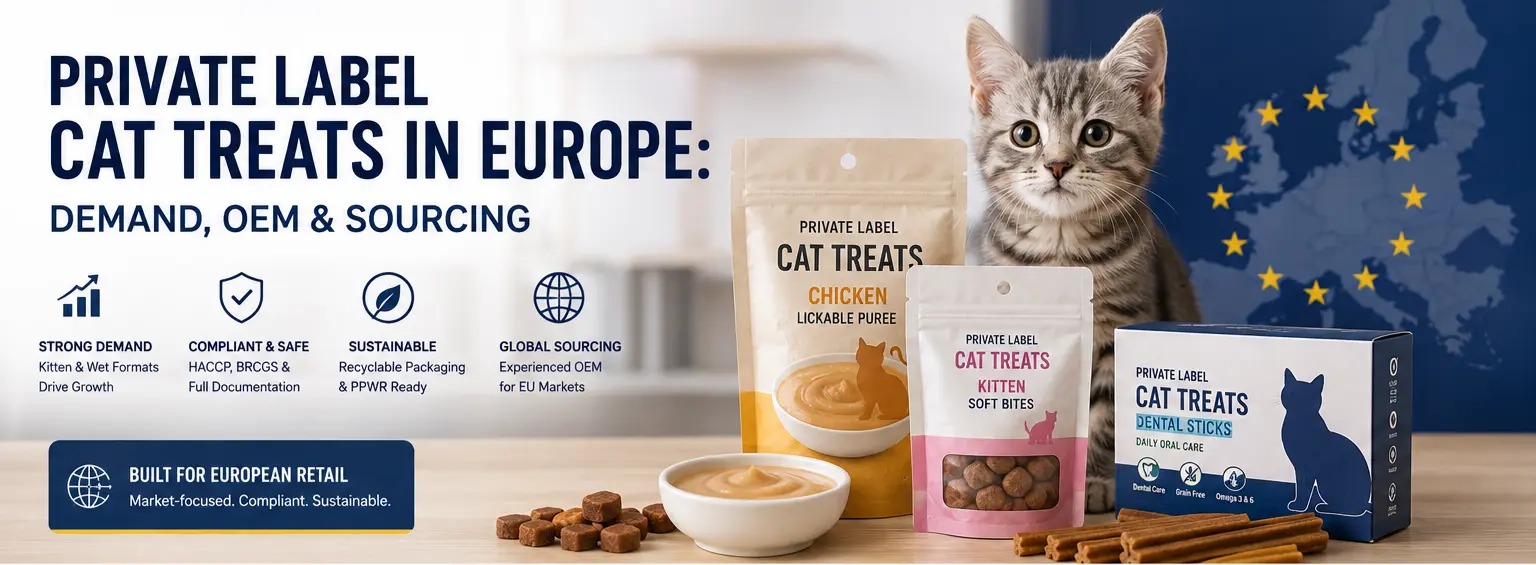
Europe is one of the most attractive regions for private-label cat treats, but buyer requirements can be demanding. Retailers and pet-specialist banners increasingly evaluate product differentiation, packaging specifications, food-safety controls, and regulatory documentation, while expectations vary by country, retailer, category, and product type. For importers and brand owners, the opportunity is real, but it rewards suppliers who plan for compliance, product development, and lead time from the start.
Quick Answer
European private-label cat treats are showing strong demand in kitten and wet/lickable formats, while private-label penetration varies by country, retailer, and product type. For EU-focused buyers, supplier qualification increasingly involves documented food-safety systems, compliant formulations, packaging-material data, and realistic packaging lead times. Recyclability and functional positioning can strengthen retail propositions, but specific requirements depend on the market, retailer, product, and claim.
Key Buyer Takeaways
- Fast-moving opportunities: kitten and wet/lickable treat formats are important growth areas.
- Private-label strategy: differentiation increasingly comes from formulation, function, texture, packaging, and positioning.
- Packaging: EU packaging rules and retailer requirements make material documentation increasingly important.
- Supplier qualification: buyers should review food-safety systems, formulation documentation, traceability, packaging data, and claim support.
- MOQ: there is no single Europe-wide MOQ; requirements depend on the supplier, SKU, packaging, and order program.
Why Private Label Cat Treats Are Growing in Europe
Private label — retailer-owned brands produced by contract manufacturers — has matured from a value play into a quality tier in its own right. Three forces are accelerating cat-treat private label specifically.
Kitten Treats Outpacing Cat Food
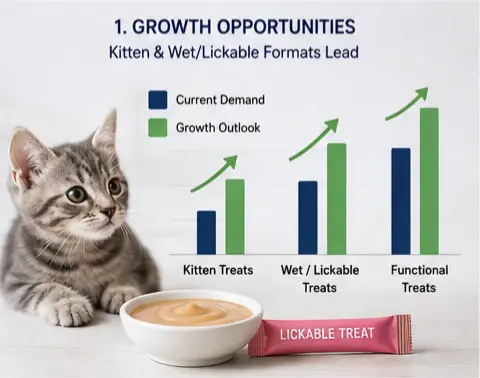
European market forecasts indicate that kitten treats are expected to grow faster than mature mainstream cat-food categories, although the exact CAGR varies by source, country, product definition, and forecast period. For private-label buyers, the more actionable signal is continued demand for age-specific and function-oriented treat formats rather than a single market-wide growth rate.
Wet and Lickable Formats
European market analysis points to continued growth in wet and lickable cat treat formats, including meat pastes, soups, and squeeze-up products. For private-label buyers, these formats are attractive because they offer clear differentiation through texture, ingredients, portioning, and functional positioning.
Functional and Wellness Positioning
Functional and wellness positioning is increasingly common in European cat treats, including concepts related to hairballs, urinary health, skin and coat, and dental care. For private-label buyers, these claims should be matched to the product formulation, supporting evidence, and applicable labelling requirements rather than treated as a universal requirement for every SKU.
Private-Label Cat Treat Market Signals (Directional)
Private-label penetration varies significantly by country, retailer, category, and product format, so the points below are directional buyer considerations rather than precise market figures.
| Market signal | What buyers should consider | Evidence level |
|---|---|---|
| Private-label penetration | Varies significantly by country, retailer, category, and product format. | Directional |
| Kitten treats | Age-specific positioning is an active opportunity for differentiated private-label ranges. | Market trend |
| Wet and lickable treats | Texture, portion format, ingredients, and functional positioning create differentiation opportunities. | Market trend |
| Functional positioning | Claims should be supported by the formulation, evidence, and applicable labelling requirements. | Buyer consideration |
Key takeaway: private-label demand can create recurring order opportunities for contract manufacturers, but the opportunity varies substantially by country, retailer, category, and product format. Buyers should evaluate actual retailer requirements and category data rather than apply one Europe-wide private-label rate.
European Packaging and Sustainability Requirements
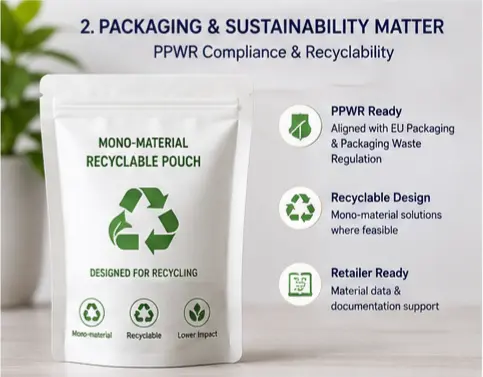
European packaging requirements are becoming more important for private-label pet-food programs. Regulation (EU) 2025/40, the Packaging and Packaging Waste Regulation (PPWR), entered into force in February 2025 and applies from 12 August 2026. For cat-treat suppliers, this makes packaging material composition, recyclability information, documentation, and market-specific packaging requirements increasingly important during buyer qualification. However, the exact obligations and timing depend on the packaging type and applicable PPWR provisions.
Note: Europe and the European Union are not interchangeable terms. This article uses “Europe” for the broader market discussion and “EU” when referring specifically to European Union regulations and compliance requirements. The UK is treated separately where relevant.
Practical implications for suppliers:
- Offer mono-material pouches where technically feasible, with refill or bulk options for private-label programs.
- Prepare recyclability documentation and material-composition data for retailer onboarding.
- Treat packaging compliance as a selling point, not an afterthought.
Supply-Chain Constraints Importers Must Plan For
Two practical constraints can affect European private-label economics.
- Ingredient costs, particularly for meat and fish-based inputs, can change materially and affect margins.
- Packaging availability and custom pouch production can also add significant lead time, especially for new artwork, special materials, or lower-volume SKUs.
Importers should therefore confirm ingredient pricing validity, packaging lead times, MOQ, and reorder conditions before committing to launch dates.
Sourcing Private-Label Cat Treats for the EU
A capable cat stick treats and fish fillet treats OEM partner can absorb much of this complexity. Look for a manufacturer with HACCP and BRC-aligned systems, export experience across 80+ country markets, and the formulation range to build functional recipes. A partner with a dedicated cat treats OEM program can support European private-label programs from recipe development through compliant export documentation.
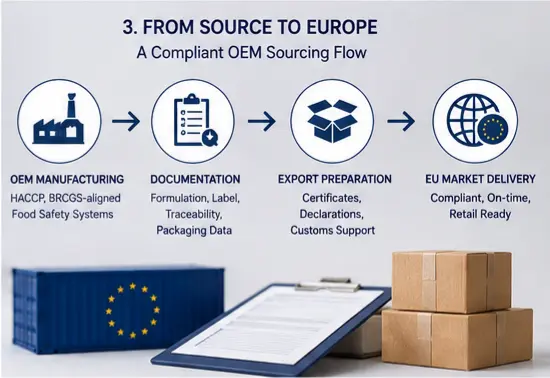
Private-Label Cat Treat Supplier Qualification Checklist
- Food-safety system: documented controls such as HACCP, with relevant third-party certification (for example BRCGS) where required by the buyer.
- Formulation and nutritional documentation: FEDIAF-referenced nutritional formulation, applicable EU feed-hygiene requirements, traceability documentation, and product-specific labelling evidence.
- Ingredient traceability: records that support sourcing, batch identity, and recall readiness.
- Functional-claim evidence: formulation, supporting evidence, and applicable labelling for any hairball, urinary, skin-and-coat, or dental positioning.
- Packaging material documentation: composition, recyclability information, and PPWR-relevant data for market-specific requirements.
- MOQ and production capacity: confirm the minimum order at the quotation stage, because it can vary by formulation, SKU count, packaging format, production setup, and repeat-order commitment.
- Export documentation: the certificates, declarations, and records needed for the destination market.
- EU market references: verifiable experience supplying or exporting to European buyers, plus a site audit before volume commitments.
For dental-positioned products, buyers may also evaluate supporting efficacy evidence and, where commercially relevant, voluntary dental programs such as the VOHC Seal of Acceptance. VOHC acceptance should not be presented as an EU regulatory requirement.
Conclusion
European private-label cat treats offer a durable, high-repeat order pool — especially in kitten and wet/lickable segments — but only for suppliers who meet functional, packaging, and compliance expectations. Importers and brand owners who qualify an experienced OEM partner early, buffer for packaging lead times, and build sustainability into the spec will capture the segment’s growth most reliably.
Frequently Asked Questions
There is no single Europe-wide private-label rate. Private-label penetration varies significantly by country, retailer, category, and product format, so buyers should evaluate actual retailer requirements and category data rather than a single market-wide figure.
Kitten treats and wet/lickable formats are important growth areas, and market forecasts indicate kitten treats are expected to grow faster than mature mainstream cat-food categories. The exact rate varies by source, country, product definition, and forecast period.
There is no single packaging format required across Europe. Buyers increasingly evaluate recyclability, material composition, documentation, shelf-life performance, and retailer-specific packaging specifications — especially under the EU PPWR framework.
Buyers should typically review the manufacturer’s food-safety system, HACCP-based controls, relevant third-party certification such as BRCGS where required by the buyer, formulation and labelling documentation, traceability records, and evidence supporting any functional or dental claims. FEDIAF guidelines can be used as an important nutritional reference, while VOHC is a voluntary dental-product acceptance program rather than an EU legal requirement.
Custom pouch production can add significant lead time, especially for new artwork, special materials, or lower-volume SKUs. Confirm packaging lead times and pricing validity before committing to launch dates rather than relying on a fixed figure.
Functional and wellness positioning is increasingly common, but it is not a universal requirement for every SKU. Claims should be matched to the formulation, supporting evidence, and applicable labelling requirements.
There is no single Europe-wide MOQ. Private-label minimums vary by formulation, packaging format, SKU count, factory setup, and order commitment. Buyers should request an SKU-level MOQ and container-loading estimate before finalizing the program.
Request the food-safety system and certification evidence, FEDIAF-referenced formulation documentation, ingredient traceability records, packaging-material and recyclability data, and EU export references. A site audit should precede volume commitments.