




Wood shavings and pine-based cat litter are increasingly relevant to B2B buyers looking for plant-based, low-dust, and renewable litter formats. Commercial products range from compressed pine pellets to wood-fiber clumping litter and screened loose shavings. For importers, the key compliance distinction is between the litter itself and the wood packaging used to transport it: product-level plant-health requirements depend on the destination market, wood species, processing method, and origin, while pallets, crates, and dunnage may be subject to ISPM-15 requirements. Retail buyers may also request FSC or PEFC chain-of-custody documentation when certified-material sourcing or sustainability claims form part of the commercial specification.
This guide covers what B2B buyers need to know to source wood shavings and pine cat litter commercially: material types, key technical specifications, sustainability and phytosanitary certifications, moisture and dust testing standards, container loading, and a practical supplier evaluation checklist.
Quick Answer
Successful B2B sourcing requires three things: (1) written product specifications covering wood species, drying process, moisture target, particle-size distribution, dust or fines limits, and the applicable test methods; (2) destination-specific plant-health and wood-packaging documentation, including phytosanitary requirements where applicable and ISPM-15-compliant wood packaging where required; and (3) supplier evaluation at batch level, with verifiable test reports and production samples rather than relying on generic claims such as “low dust” or “sustainable.”
Key takeaway: ISPM-15 applies to qualifying wood packaging, not automatically to the cat litter itself. Product-level phytosanitary requirements depend on the destination market, wood species, processing level, and country of origin.
1. Why Wood-Based Cat Litter Is a 2026 B2B Opportunity
Wood-based cat litter is a growing segment within the broader plant-based litter category for three structural reasons.
Plant-based substrate momentum. Plant-based cat litter overall — tofu, corn, pine, paper, and blends — is among the faster-growing material segments in the global market, supported by demand for renewable, biodegradable substrates. Within plant-based, pine and wood-fiber formats combine a natural deodorization profile, a long usage cycle per unit, and an established sustainability story.
Natural aroma and odor positioning. Wood-based litter contains lignocellulosic material and naturally occurring extractives that influence its aroma and moisture-absorption behaviour. Pine formats are often positioned around a recognisable wood aroma and natural-material story, but buyers should distinguish sensory positioning from verified odor-control or antimicrobial performance. Any antibacterial, antimicrobial, or odor-reduction claim should be supported by product-specific test evidence.
Sustainability positioning. Wood is renewable, biodegradable, and (when FSC or PEFC certified) sourced from responsibly managed forests. For retail buyers in Europe and North America, FSC and PEFC chain-of-custody documentation can strengthen sustainability claims and may be required by particular retailers, brands, or private-label programmes, though neither is a general legal import requirement.
For buyers evaluating pine cat litter B2B supply, the commercial decision is less about the word “natural” and more about repeatable specifications, documented raw-material sourcing, packaging compliance, freight efficiency, and batch-level quality control.
The trade-off is real: wood shavings are lower-density, higher-volume cargo than many mineral litters, which can increase per-container freight cost. They also require closer attention to moisture control and, depending on the destination market, wood-product plant-health and packaging requirements. These risks are manageable when the supplier, importer, and logistics partners define the applicable requirements before shipment.
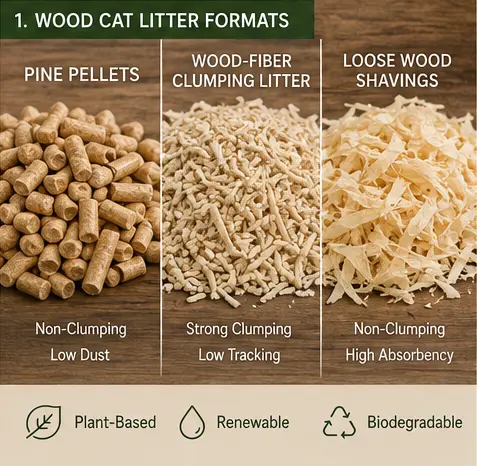
Wood-based cat litter is a category of litter made primarily from processed wood materials such as pine sawdust, wood fiber, or screened shavings. Commercial formats include compressed pellets, clumping wood fiber, and loose shavings. Performance depends on particle size, processing, moisture, binders, screening, and packaging rather than wood species alone.
2. Material Types and Format Comparison
Wood-based cat litter is not a single product. The four main commercial formats each have different performance, cost, and supply-chain implications.
| Format | Raw material | Typical clumping | Dust profile | Best for | Supply chain notes |
|---|---|---|---|---|---|
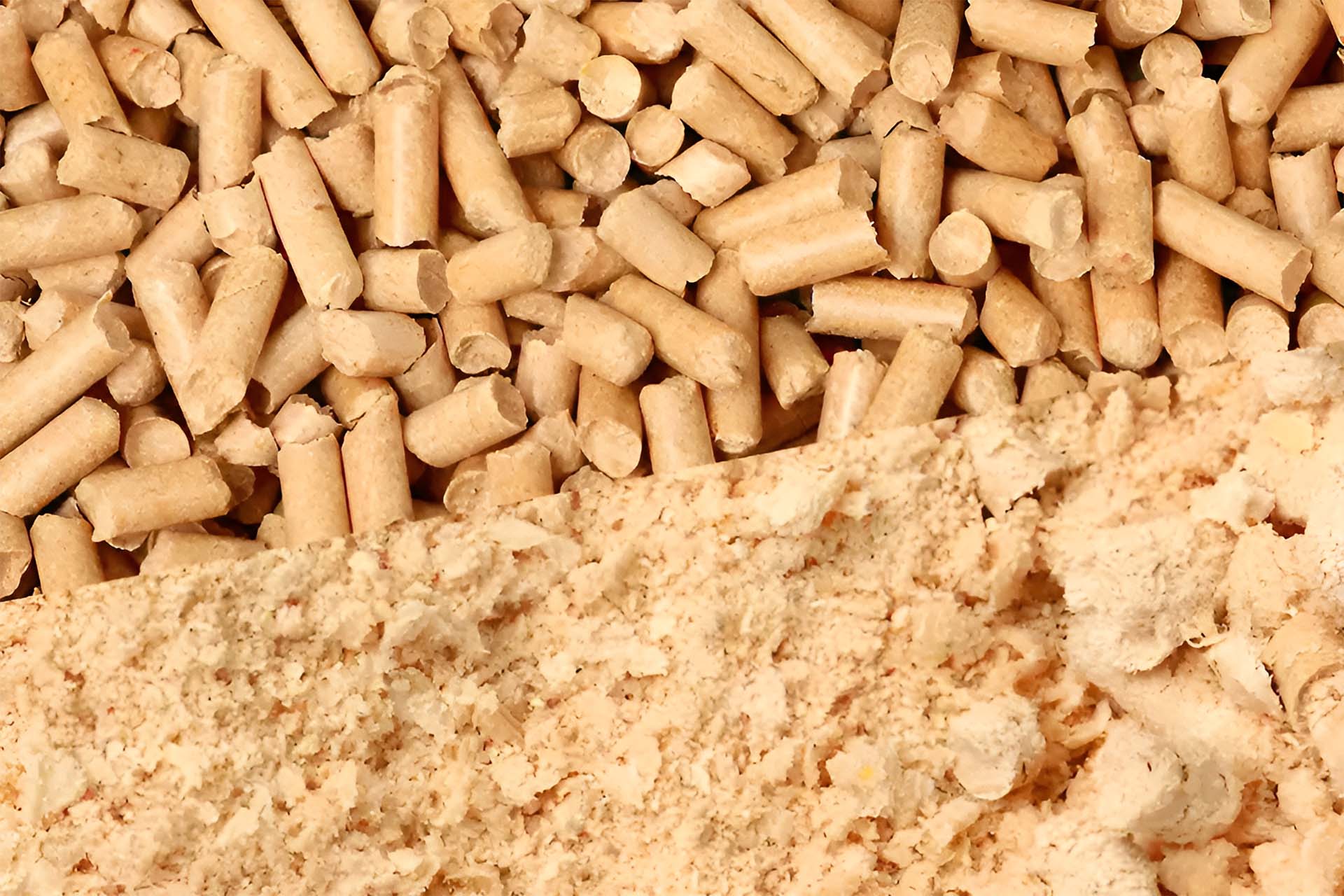
| Compressed pine pellets | Pine sawdust, kiln-dried and compressed | Disintegrates (non-clumping or low-clumping) | Low if fines controlled | Single-cat households, long usage cycle, eco-positioned retail | Established pellet-processing route; raw-material availability depends on regional sawmill and wood-processing supply |
| Wood-fiber clumping litter | Fine wood fiber (often pine, sometimes beech or birch), binder added | Clumping with natural binders (guar gum, CMC) | Low to moderate, depending on fines removal | Multi-cat households, premium natural-positioned retail | Requires precision grinding and dust classification; more capital-intensive than pellet production |
| Mixed wood + bentonite / tofu | Wood fiber blended with mineral or plant substrate | Clumping (from the bentonite / tofu component) | Low if fines controlled | Buyers wanting a balance of clumping performance and sustainability | See our mixed cat litter product page for formulation options |
| Loose wood shavings | Screened and dried pine or other suitable softwood shavings produced to a defined litter specification | Non-clumping | Highly formulation- and screening-dependent | Value-oriented or non-clumping channels | Requires tighter raw-material controls than generic animal bedding; confirm species, additives, screening, moisture, and contamination controls |
For B2B buyers, the format choice has direct commercial consequences. Compressed pine pellets can offer efficient large-scale production and relatively simple processing, but they generally do not provide the same clumping experience as wood-fiber clumping litter. Wood-fiber clumping litter can support a more premium positioning, but it requires tighter control of particle size, dust removal, binder integration, and finished-product consistency.
Wood Species in Commercial Use
Pine is widely used in commercial wood-based cat litter because of its availability, established sawmill supply chains, familiar processing characteristics, and recognisable wood aroma. Some manufacturers use beech or birch — hardwoods with different aromatic profiles — while aspen and other lower-resin species also appear in selected formulations. The commercially relevant choice depends on raw-material availability, processing requirements, product positioning, and destination-market specifications.
When evaluating a supplier, ask directly: which wood species, what kiln-drying process, and what treatment and quality controls apply. If a wood processor cannot describe its process and controls in detail, that is a due-diligence red flag — the buyer should require documented process and finished-product information before qualifying the supplier for cat-litter use.
3. Technical Specifications: Moisture, Dust, and Phenolic Compounds
Wood is hygroscopic, dust-prone, and contains volatile compounds. Three specifications determine whether a wood-based cat litter is commercially viable.
Moisture Content and Test Method
Moisture content is an important quality-control variable for wood-based litter because it affects storage stability, granule strength, dust generation, bulk density, and absorbency. ASTM D4442 provides standardized methods for measuring moisture content in wood and wood-based materials, but it does not establish a universal moisture specification for cat litter. The acceptable range should therefore be defined for the specific product format and validated through production and storage testing.
When qualifying a supplier, specify the target moisture range, sampling point, sample preparation, test method, and batch acceptance criteria in the purchase specification. If ASTM D4442 is used, identify the applicable method and record the test result on the supplier’s quality report. ASTM D4442 provides moisture-measurement methods for wood and wood-based materials; it does not establish a mandatory moisture percentage for cat litter. Method A is the primary oven-drying method, while Method B is a secondary method with generally lower precision.
For buyers specifying ASTM D4442 wood moisture testing, the purchase specification should state the target moisture range, sampling procedure, applicable D4442 method, and batch acceptance criteria.
Moisture content should be treated as a product-specific QC specification, not as a universal cat-litter standard. The strongest purchasing specification identifies the target range, test method, sampling procedure, and batch acceptance criteria.
Dust and Fines Content
Dust performance is strongly influenced by particle-size distribution, granule strength, screening efficiency, dedusting, drying, packaging, and handling. There is no single universal “low-dust” or fines limit that makes every wood-based cat litter commercially acceptable. For B2B procurement, the important point is to define the measurement method, mesh or particle-size threshold where applicable, sample preparation, maximum acceptable fines level, and batch acceptance procedure in the product specification.
When evaluating a supplier, request production-line samples rather than showroom samples and compare them using the same defined test method. Ask the supplier to document screening and dedusting controls and provide batch-level results. This approach is more defensible than accepting a generic “dust-free” claim or comparing unsupported percentages between suppliers.
Wood Extractives, Aroma, and Finished-Product Safety
Pine and other wood species contain naturally occurring extractives that can influence aroma and the sensory profile of the finished litter. Their concentration varies by species, raw-material source, processing conditions, and formulation. Buyers should therefore avoid treating “natural pine scent” or “phenolic removal” as a universal safety specification. Instead, define the finished-product safety requirements that apply in the destination market and request composition information, treatment records, and relevant third-party test reports where a specific substance or claim is material to the product specification.
For pine-based products, ask the supplier to identify the wood species, drying and processing conditions, additives or binders, and any available finished-product safety testing. If a buyer has a specific concern about volatile compounds or fragrance, the requirement should be translated into a named analytical method and acceptance limit rather than a generic request for “phenolic removal.”
Buyer Specification Matrix
| Specification | What the buyer should define |
|---|---|
| Wood species | Exact species and permitted alternatives |
| Raw-material source | Sawmill residue, processed wood fibre, or other stream |
| Moisture | Target range plus test method |
| Particle size | Defined distribution or mesh threshold |
| Dust / fines | Test method plus maximum limit |
| Binders / additives | Identity and permitted range |
| Packaging | Material, liner, and abrasion resistance |
| Batch control | Sampling and acceptance criteria |
4. Sustainability Certifications: FSC and PEFC
For European and North American retail buyers, FSC and PEFC chain-of-custody certification can strengthen the substantiation of responsible-forestry claims and may be required by particular retailers, brands, or private-label programmes. Neither certification is a general legal requirement for importing wood-based cat litter. Buyers should therefore treat FSC or PEFC status as a commercial sourcing requirement where the target channel requires it, and verify that the certificate scope covers the relevant material and product flow.
| Certification | Scope | What it verifies | How to verify |
|---|---|---|---|
| FSC Chain of Custody (CoC) | Global, multiple product categories including wood-based consumer products | Wood fiber traced from forest source through every supply chain entity to the finished product | Search the FSC public certificate database by supplier name or certificate number |
| PEFC Chain of Custody | Global forest and tree-based product supply chains, with national forest certification systems endorsed by PEFC | Documented control and traceability of PEFC-certified or controlled material through the defined supply chain | Verify the supplier’s certificate number, scope, status, and product coverage through the PEFC certification system or the relevant certification body |
For a supplier to make a certified FSC or PEFC chain-of-custody claim, the supplier’s certification status, product scope, material flow, and claim or trademark-use requirements must be valid for the specific transaction. Ask for the certificate number, certification scope, issuing or certification body, and validity status, then verify the information through the relevant certification system before using the claim in product or marketing materials.
For B2B buyers comparing FSC PEFC cat litter sourcing options, the key issue is not simply whether a supplier displays a logo, but whether the certification scope covers the relevant material, product flow, and commercial claim.
Importer Note: FSC and PEFC are separate, independent certification systems and are not automatically interchangeable. For a new supplier, ask for the certificate number, the issuing auditor, the certificate scope (does it cover the specific product format and material flow?), and the expiry date — and verify all of it in the public database before signing a purchase contract.
What Sustainability Certification Does Not Cover
FSC and PEFC certify forest management and chain of custody. They do not certify cat litter performance, dust content, phenolic removal, or clumping behavior. Those are technical specifications, covered in Section 3 above. Sustainability certification and product performance are complementary — both are required for a credible B2B offering.

5. ISPM-15, Phytosanitary Requirements, and the Shipping Process
Importers should separate two different compliance questions: plant-health requirements for the wood-based litter itself, and ISPM-15 requirements for wood packaging material used to transport the shipment. ISPM-15 applies to qualifying wood packaging material such as pallets, crates, and dunnage; it does not by itself establish that the cat litter product requires a phytosanitary certificate. Product-level plant-health requirements must be checked against the destination market, commodity classification, wood species, processing method, and country of origin.
ISPM-15: The Wood Packaging Standard
ISPM-15 (International Standards for Phytosanitary Measures No. 15) is the international standard for wood packaging material (WPM) used in international trade. Administered by the IPPC (International Plant Protection Convention) under the FAO, the standard aims to prevent the spread of invasive pests that can devastate forest ecosystems in importing countries.
ISPM-15 covers qualifying raw-wood packaging material used in international trade, including pallets, crates, and dunnage. The standard provides exemptions for certain materials, including wood 6 mm thick or less and certain processed wood products such as plywood, OSB, and veneer. Where it applies, the wood packaging must be debarked and treated by an approved method — most commonly Heat Treatment (HT) to a minimum wood-core temperature of 56°C for at least 30 minutes — and display the official IPPC mark showing the IPPC logo, ISO country code, facility number, and treatment code. Methyl bromide (MB) fumigation is permitted only where the relevant regulatory framework allows it; buyers should verify the accepted treatment codes against the destination country’s current plant-health rules.
For U.S. imports, USDA APHIS and CBP resumed enforcement of the ISPM-15 hyphen requirement on January 1, 2026, after the temporary suspension ended on December 31, 2025. The official mark must include the required hyphen separating the two-letter country code from the producer or facility code. Importers should inspect the actual packaging mark before loading because non-compliant wood packaging can be refused entry and may require corrective action such as treatment or re-export.
Phytosanitary Certificate for the Product Itself
A phytosanitary certificate may be required when wood shavings or other wood-based material are imported as the cargo, but the requirement is destination- and commodity-specific. The applicable rules can depend on the wood species, country of origin, degree of processing, commodity classification, and the importing country’s plant-health regulations. Importers should therefore check the destination NPPO or official import database before assuming that a certificate is required or not required.
For example, EU plant-health rules impose specific requirements on certain wood, chips, particles, shavings, and sawdust combinations depending on species and origin. The correct compliance workflow is therefore to identify the exact commodity and origin first, then confirm whether a phytosanitary certificate, treatment, additional declaration, or exemption applies.
The United States, European Union, Canada, Japan, and other markets each operate their own plant-health import requirements. The specific documentation and treatment conditions must be checked against the destination market and commodity rather than assumed to be identical across countries.
The financial impact of non-compliance can include inspection, treatment, storage, demurrage, re-export, destruction, or other corrective-action costs, depending on the destination country’s procedures and the nature of the violation. Because these costs vary substantially by market and shipment, buyers should not rely on a universal per-container estimate when budgeting compliance risk.
The Shipment Itself
For B2B importers of wood-based cat litter, the document checklist is:
- Commercial invoice with the applicable HS classification, country of origin, and transaction value.
- Packing list identifying the packaging configuration and any applicable ISPM-15-compliant wood packaging.
- Phytosanitary certificate or other plant-health documentation if required for the specific wood commodity, species, origin, processing level, and destination market.
- Bill of lading with the freight forwarder and vessel information.
- FSC or PEFC chain-of-custody documentation where certified-material sourcing or a related claim is part of the commercial specification.
- ISPM-15 mark verification on qualifying wood packaging where the destination market requires it; the mark should be legible, durable, visible, and compliant with the applicable marking rules.
- Test reports for moisture content, particle size, fines or dust performance, and any other supplier-claimed specification included in the purchase specification.
For the full import workflow, see our Cat Litter Import Guide for classification and tariff setup.
6. Logistics and Container Loading: Managing Moisture and Freight Cost
Wood shavings are low-density, high-volume cargo. Every logistics decision is a decision about how efficiently you can move air, protect a moisture-sensitive product, and split risk with the supplier.
Volumetric Optimization for 40ft HC Containers
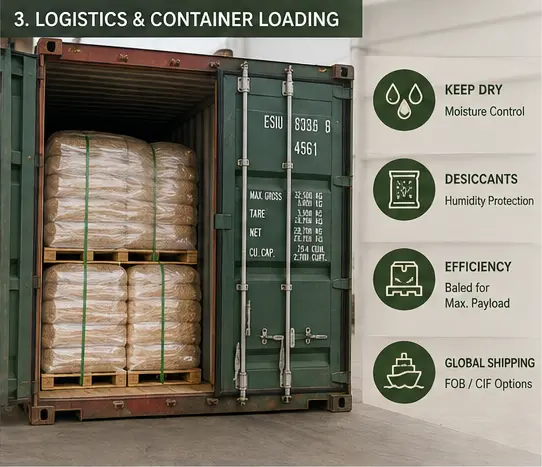
A standard 40-foot high-cube container hits its volumetric limit long before its weight limit. Uncompressed wood shavings ship as air. To bring per-container economics into range, exporters use industrial baling — vertical or horizontal balers that compress shavings to a fraction of their loose volume. Common commercial bale sizes range from approximately 40 lb retail-ready bales up to 250–300 kg high-density bales for wholesale volumes. Actual payload varies with bale density, packaging format, palletisation, product bulk density, and the carrier’s weight limits; buyers should contract a target net payload based on an actual loading plan rather than rely on a generic tonnage figure.
Buyers should insist on a target payload per container in the contract, since a supplier who under-fills the container transfers freight cost inefficiency directly to the buyer.
Container Rain and Moisture Risk
“Container rain” — condensation formed when a sealed container passes through varying climate zones — is an important moisture risk on ocean routes. Warm humid air trapped at loading can condense on the container roof and walls as the vessel enters cooler conditions, then drip onto the cargo. For wood shavings, poor moisture control can contribute to mold, caking, packaging damage, and unsalable product on arrival.
Moisture control during ocean transit should be treated as a shipment-specific logistics specification rather than a universal humidity threshold. The main controls are dry loading, a dry container floor and interior, suitable moisture-barrier packaging where appropriate, and an adequately sized desiccant programme based on route, season, container condition, cargo moisture, and packaging configuration. For long or humid routes, buyers should agree the loading conditions, packaging configuration, and moisture-control procedure with the supplier and forwarder before shipment.
Incoterm Selection (FOB vs CIF)
The choice between Free On Board (FOB) and Cost, Insurance and Freight (CIF) is the most consequential commercial decision after the product spec. Under FOB, the seller delivers the goods on board the vessel at the named port of shipment; the buyer assumes freight, insurance, and risk from that point. Under CIF, the seller also arranges and pays for freight and insurance to the destination port.
For first-time buyers, FOB can be attractive when the importer already has a preferred forwarder, freight contract, or insurance arrangement and wants direct control over the main-carriage cost. CIF may be more practical when the supplier has stronger freight access or the buyer wants a simpler origin-to-port quotation. The better choice depends on freight purchasing power, insurance arrangements, destination port costs, and the buyer’s ability to manage the shipment.
For a full Incoterm comparison, see our Cat Litter Shipping & Logistics Guide.
7. Supplier Evaluation Checklist for B2B Buyers
For B2B buyers evaluating a wood-based cat litter supplier, the following checklist separates credible processors from generic wood mills. Each item is a question to ask before signing a purchase contract, and each is verifiable.
Material and Process
- Which wood species is used? Pine, beech, birch, aspen, mixed?
- What is the kiln-drying process — temperature, duration, and any post-drying treatment?
- What wood-species and extractive controls apply, and can the supplier provide composition or finished-product safety information for the target market?
- What grinding, pelletizing, and dust-classification equipment is used?
- Where does the wood originate, and is it a primary wood product, sawmill residue, or another processed residue stream?
- Are any preservatives, coatings, fragrances, binders, or other additives used in the raw material or finished litter?
- What is the finished-product fines content, and what test method, particle-size threshold, and batch acceptance limit are used?
Documentation and Certification
- FSC or PEFC chain-of-custody certificate number, scope, and validity. Verify in the public database.
- Moisture content data per ASTM D4442 (Method A or B), with batch-level certificates.
- Phytosanitary certificate support — can the supplier coordinate with the local NPPO?
- ISPM-15 capability for outgoing wood packaging, including the 2026 U.S. hyphen requirement.
- Available third-party test reports (SGS, TÜV, Bureau Veritas) for moisture, dust, phenolic content, and any biodegradable or compostable claims.
Commercial and Logistics
- Production capacity (tons per month) and minimum order quantity (MOQ).
- Lead time for first order and repeat orders, including raw material sourcing seasonality.
- Packaging options (retail-ready bales, big bags, bulk) and printed private-label capability.
- Reference customers in your target destination market (with permission to contact).
- Sample policy — can you receive a 5–10 kg production-line sample (not showroom sample) for testing before placing a purchase order?
For OEM and private label buyers, request capability, MOQ, and lead time documentation directly from the manufacturer before placing a production order.
Conclusion
Wood shavings and pine cat litter can be a viable B2B category when buyers treat the product as a specification-driven wood material rather than a generic “natural” litter. The critical controls are product-specific moisture and particle specifications, defined dust or fines testing, clear formulation and additive disclosure, appropriate plant-health documentation for the destination market, and compliant wood packaging where ISPM-15 applies.
The importers who win in this category are not the ones paying the lowest per-ton price. They are the ones whose suppliers can document quality on every shipment, whose freight contracts protect against moisture loss, and whose retail buyers can substantiate the sustainability claim when the consumer asks.
For material specifications and OEM options on the pine side, see our pine cat litter product page. For the complete import workflow, refer to the Cat Litter Import Guide referenced earlier in this article.
Frequently Asked Questions
Safety depends on the finished formulation, wood species, processing, additives, contamination controls, dust performance, and the requirements applicable in the destination market. Buyers should not treat a single moisture or fines value as proof of feline safety. For commercial sourcing, request the finished-product specification, ingredient or additive information, relevant safety testing, and batch-control documentation from the supplier.
Pine pellets are compressed sawdust that disintegrates on contact with moisture — they are generally non-clumping or low-clumping. Wood-fiber clumping litter is finely ground wood fiber combined with natural binders (such as guar gum or carboxymethylcellulose) to form clumps when wet. Wood-fiber clumping litter commands premium pricing and is closer in user experience to mineral clumping litter, while pine pellets are positioned as a longer-cycle, lower-tracking option for buyers who prioritize natural materials over clumping performance.
Not legally — FSC and PEFC chain-of-custody certification is not a regulatory requirement for import in most markets. It can, however, strengthen sustainability claims and may be required by particular retailers, brands, or private-label programmes in Europe and increasingly in North America. If you are selling into independent pet stores or DTC only, the commercial case is weaker, but FSC or PEFC documentation still improves the brand position where certified-material sourcing is part of the specification.
ISPM-15 is the international standard for wood packaging material (pallets, crates, dunnage) used in international trade, administered by the IPPC under the FAO. It covers qualifying raw-wood packaging — with exemptions for material 6 mm thick or less and certain processed wood products such as plywood, OSB, and veneer — and where it applies, the wood packaging must be debarked and treated (most commonly Heat Treatment to a minimum wood-core temperature of 56°C for at least 30 minutes; methyl bromide is permitted only where the regulatory framework allows it) and display the official IPPC mark. For U.S. imports, USDA APHIS began fully enforcing a mandatory hyphen in the IPPC mark on January 1, 2026 (e.g., CN-12345 HT). Non-compliant wood packaging can be refused entry and may require corrective action such as treatment or re-export.
There is no single universal moisture percentage established by ASTM D4442 for cat litter. ASTM D4442 provides methods for measuring moisture in wood and wood-based materials, while the acceptable moisture range should be set for the specific litter formulation and validated through production and storage testing. In a purchase specification, define the target range, test method, sampling procedure, and batch acceptance criteria.
The most effective prevention is to treat moisture control as a shipment-specific specification rather than a fixed humidity threshold, using dry loading, a dry container floor and interior, suitable moisture-barrier packaging, and an adequately sized desiccant programme sized for the route, season, container condition, cargo moisture, and packaging. Loading in rain or on a wet container floor raises humidity to damaging levels within days regardless of desiccant quantity. Procurement contracts for long tropical routes should specify desiccant quantity, liner type, and dry-loading requirements.
EU import requirements depend on the exact wood commodity, species, country of origin, processing level, and applicable plant-health rules. Some wood, chips, particles, shavings, and sawdust combinations are subject to specific phytosanitary conditions, while other processed materials may be exempt. Buyers should check the EU plant-health requirements for the exact commodity and origin before shipment rather than assuming that every wood-based litter requires the same certificate. Separately, non-EU wood packaging and dunnage used for transport generally must meet EU ISPM-15 requirements unless an exemption applies. For retail sale, products must also comply with applicable EU product, labelling, packaging, and environmental-claim requirements.
MOQ depends on the litter format, packaging method, artwork requirements, formula customisation, and supplier production schedule. Container-scale orders are common for established export programmes, while custom printed packaging or new formulations may require a separate MOQ per SKU. Ask the manufacturer to quote MOQ, lead time, packaging setup cost, and trial-order conditions together so the real launch requirement is clear.
Wood and tofu are both plant-based substrates, but they differ in material characteristics, freight economics, and regulatory considerations. Tofu litter may offer a more compact product format, while loose wood shavings can require more container volume. Wood shipments may also require additional plant-health documentation depending on the commodity and destination, while qualifying wood packaging may be subject to ISPM-15 requirements. Buyers should compare the exact product specification, packaging configuration, destination rules, freight cost, and claim requirements rather than treating either category as having a universally simpler regulatory profile.