



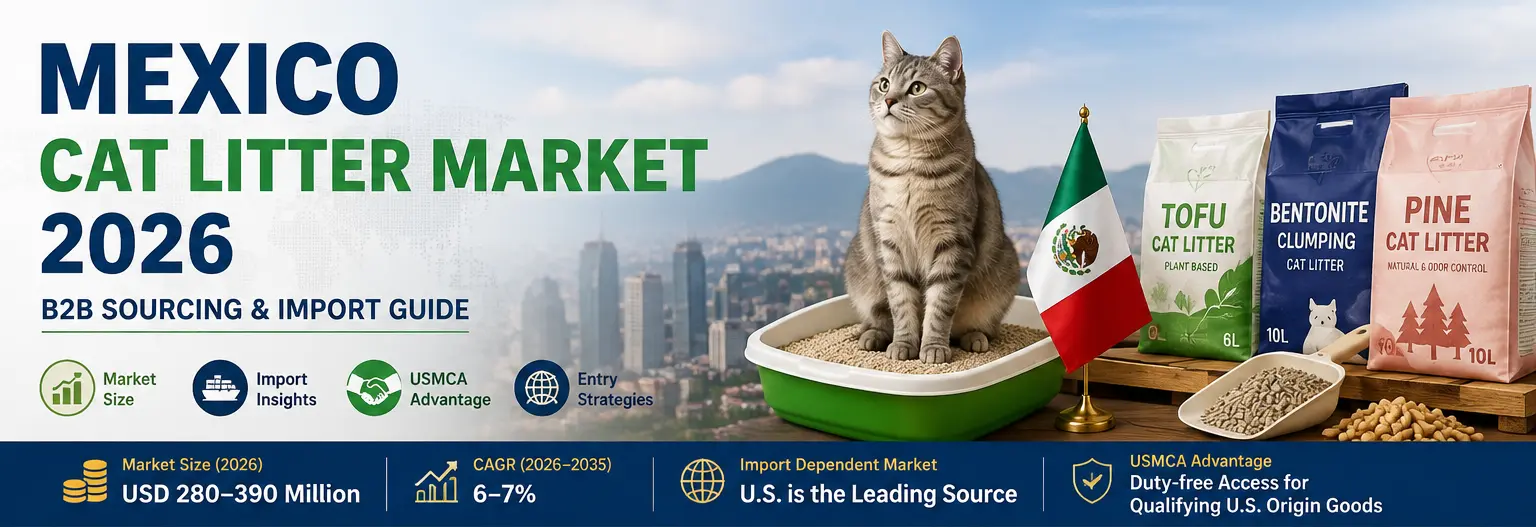
Mexico’s cat litter market is one of Latin America’s more actionable near-term sourcing opportunities for importers, private-label buyers, and distributors. Two independent 2026 market research reports size the market in the USD 280–390 million range, with mid-single-digit CAGR projections through 2035. Imports are an important part of Mexico’s cat litter supply, with the United States playing a major role in cross-border supply because of geographic proximity and established North American trade links, with the US–Mexico–Canada Agreement (USMCA) offering duty-free access for qualifying U.S.-origin goods. For non-U.S. exporters — Chinese, Brazilian, or European brands evaluating Mexico as a North American bridge — the same import-dependent structure creates entry, but with a more layered compliance and channel-building path.
This guide covers what B2B buyers need to know about the Mexico cat litter market in 2026: market size, growth drivers, distribution channels, regulation, country-of-origin impact on landed cost, and the practical steps for entering the market through wholesale, private label, or direct import.
Quick Answer
Mexico’s 2026 cat litter market is in the USD 280–390 million range with a 6–7% CAGR outlook through 2035, driven by urban cat ownership in Mexico City, Guadalajara, and Monterrey, premiumization, and e-commerce growth. Imports are an important part of Mexico’s cat litter supply, with the United States playing a major role in cross-border supply because of geographic proximity and established North American trade links, and USMCA providing duty-free access for qualifying U.S.-origin goods. For B2B buyers, the main entry paths are private label, modern retail, pet specialty, and e-commerce, with HS classification, country of origin, Spanish labeling, and landed cost as the key commercial variables.
Mexico Cat Litter Market at a Glance: 2026 Snapshot
| Indicator | 2026 reading | Source / Notes |
|---|---|---|
| Market size range (two independent reports) | USD 284.6–385.5 million | MarkWide Research 2026 estimate; Morgan Reed Insights 2026 estimate — spread reflects different product-scope definitions |
| Projected 2035 value | USD 510–697 million | MarkWide and Morgan Reed ten-year forecasts |
| Implied CAGR 2026–2035 | 6–7% | Both reports, rounded to the whole-number range |
| Import dependence | Substantial; U.S. is a major foreign supplier | Import dependence is a structural feature of the market. The exact share varies by product definition, so confirm against a single consistent methodology before financial planning. |
| Leading import source | United States | USMCA offers duty-free access for qualifying U.S.-origin goods; tariff treatment depends on the product’s actual HS classification and rules of origin. |
| Top distribution channels | Modern retail leads; e-commerce fast-growing | Channels overlap (retailer online stores and subscription sit within e-commerce); shares are directional, not mutually exclusive. See Section 3. |
1. Why Mexico Matters for Cat Litter Importers in 2026
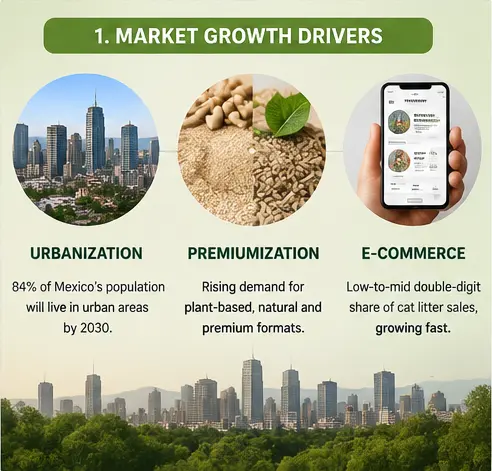
Three structural forces are driving Mexico’s cat litter market forward in 2026. Together they explain why distributors, brand owners, and private-label buyers across the Americas are paying attention.
Urbanization and the indoor cat mainstream. Mexico’s urban population is projected to reach 84% by 2030 (UN-DESA urbanization outlook, cited in independent 2026 market reports). The Mexican middle class — concentrated in Mexico City, Guadalajara, and Monterrey — increasingly treats cats as family members rather than utilitarian animals. This directly expands the addressable market for cat litter, since indoor cats need litter every day, and recurring demand supports steady, predictable replenishment for suppliers.
Premiumization and the biodegradable / plant-based tilt. The premium segment — plant-based, natural, ultra-premium direct-to-consumer — is forecast to grow its share of Mexican value through 2035, eroding basic clay-based dominance. This mirrors what Mexican consumers are doing in adjacent categories: paying more for products that perform better on clumping, dust, and odor, and that align with environmental values. Mexican environmental and consumer-protection oversight of labeling and biodegradability claims is tightening, which favors established manufacturers with proper documentation.
E-commerce and DTC acceleration. Mercado Libre and Amazon Mexico have reshaped distribution, enabling niche and overseas brands to reach consumers beyond the traditional supermarket and pet specialty channels. Digital retail is especially strong for first-time kitten owners, who research and purchase online, and for subscription auto-replenishment models. E-commerce has become an important cat litter channel in Mexico, and subscription represents a growing model within it rather than a separate standalone channel.
For B2B buyers evaluating Mexico as a market or a manufacturing base, the directional read is clear: the country is structurally import-dependent, the consumer base is urban and increasingly premium-oriented, and the regulatory framework is tightening in ways that favor documented, certified supply.
2. Mexico Cat Litter Market Size 2026: Two Sources, One Direction
Two 2026-published independent market research reports size the Mexican cat litter market differently, but the directional consensus is identical: steady mid-single-digit growth, driven by urban premiumization.
- MarkWide Research (2026): USD 385.5 million in 2026, forecast to USD 696.89 million by 2035, a 6.80% CAGR. Scope is Mexico-specific with explicit product segmentation across clumping, biodegradable, crystal, and silica gel formats.
- Morgan Reed Insights (2026): USD 284.6 million in 2026, forecast to USD 510.17 million by 2035, a 6.7% CAGR. Scope emphasizes material composition (clay, silica gel, biodegradable / natural) and Mexican regulatory frameworks including SEMARNAT and NOM standards.
The roughly USD 100 million gap between the two estimates reflects differences in product and market-scope definitions. MarkWide and Morgan Reed use different segmentation approaches, so the figures should not be combined into a single point estimate. For B2B planning, the more useful takeaway is the direction of growth and the concentration of demand in major urban markets, rather than treating either estimate as a definitive measure of total Mexican cat litter consumption.
Two independent 2026 market research reports converge on a mid-single-digit CAGR for Mexico’s cat litter market but differ on absolute size by roughly USD 100 million. The spread is scope, not contradiction — and importers should plan against a range, not a single number.
For B2B planning, model both ends of the range. The lower end (USD 285M) is a conservative entry case; the upper end (USD 385M) reflects the broader premium-and-specialty inclusion. The growth projection in both reports is the same magnitude, and the three structural drivers — urbanization, premiumization, and e-commerce — are reflected across both reports’ coverage.
Where the Growth Concentrates
The strongest commercial opportunities are concentrated in Mexico’s largest metropolitan areas, particularly Mexico City, Guadalajara, and Monterrey, where organized retail, pet-specialty distribution, and e-commerce are most developed:
- Mexico City, Guadalajara, Monterrey — the three metropolitan areas that are the most important demand centers for organized pet retail and e-commerce volume.
- Millennial and Gen Z cat owners — an increasingly relevant audience for premium and sustainable formats, more likely to purchase online.
- Multi-cat households — driving larger pack sizes (10–20 kg) and stronger brand loyalty to products that perform on clumping and odor.
These are the entry wedges for new brands. The Mexican market rewards suppliers who can serve the urban premium segment with documented clumping, low-dust, and biodegradable credentials — not generic bulk clay at the lowest possible price.
3. Mexico Cat Litter Distribution Channels and Buyer Segments
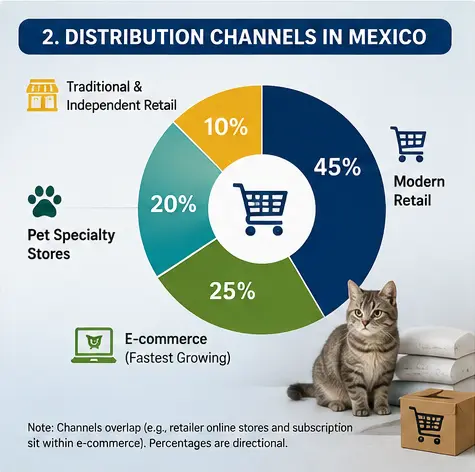
Mexico’s cat litter distribution landscape spans modern retail, traditional retail, pet-specialty stores, and e-commerce. Because these channels overlap — for example, a retailer may operate both physical stores and an online marketplace — channel percentages should be treated as directional rather than added together as mutually exclusive shares.
Modern Retail
Large-format retailers and supermarkets are the largest volume channel for mainstream and private-label cat litter. Mass retail chains — Walmart, Soriana, Chedraui, La Comer — are important volume channels with category buyers who plan 3–6 months ahead and who work on slotting-fee plus promotional-allowance economics. For a private-label program targeting this channel, the path is a contract-manufacturer relationship with a Mexican co-packer or an established U.S. co-packer that already serves U.S. private-label programs for these retailers.
Traditional Retail and Independent Pet Stores
Independent stores and smaller regional retailers remain relevant outside the largest organized retail networks. This channel can provide a lower-barrier route for regional distributors and entry-level products, although order volumes and geographic coverage vary considerably by buyer.
E-commerce
E-commerce is an important growth channel because cat litter is heavy and repetitive to purchase, making home delivery and subscription-style replenishment commercially attractive. Online sales are an important and growing share of Mexico’s cat litter market in 2026, though definitions vary by source. Mercado Libre and Amazon Mexico are important online marketplaces for brands testing direct or distributor-led e-commerce.
Private Label and DTC
Private label can provide a route into retail without requiring a new consumer brand to build national awareness from zero. DTC and subscription models are better viewed as e-commerce business models rather than a completely separate channel, and they can be used to test premium formulas, packaging sizes, and repeat-purchase propositions before expanding into physical retail.
Who Buys Cat Litter in Mexico
Mexico’s cat litter buyer base is predominantly individual household cat owners, with multi-cat homes favoring larger pack sizes (10–20 kg) and promotional pricing a meaningful factor in brand switching among price-sensitive buyers. For B2B buyers building a private-label program or evaluating a distribution partnership, this channel-and-buyer mix is the most important structural fact: a successful entry plan must address modern retail, e-commerce, and pet specialty in parallel — not as alternatives, but as complementary acquisition and retention paths.
4. Mexico Cat Litter Regulation and Compliance: What Importers Need to Know
Mexico’s cat litter regulatory framework is layered across consumer safety, environmental claims, packaging, and labeling. There is no single product-specific NOM standard for cat litter performance, but the cross-cutting requirements are real and enforced. Importers should confirm the exact applicable requirements with Mexican counsel or a customs broker before finalizing packaging and marketing copy.
Labeling and Consumer Protection
- NOM-050-SCFI-2004 governs general commercial labeling and is the baseline for product information presented to Mexican consumers.
- Cat litter should not be treated as a food product under NOM-051-SCFI/SSA1-2010; that standard applies to prepackaged foods and non-alcoholic beverages, not to cat litter.
- Claims such as “low dust,” “non-toxic,” and “biodegradable” fall under Mexico’s Federal Consumer Protection Law and must be substantiated. The exact Spanish-language labeling requirements should be confirmed against the product’s classification, packaging format, and applicable commercial regulations.
Environmental and Biodegradable Claims
- SEMARNAT (Secretaría de Medio Ambiente y Recursos Naturales) sets the broader environmental compliance framework for sustainability-related claims.
- PROFEPA (Procuraduría Federal de Protección al Ambiente) is the enforcement body for environmental claims, including biodegradability assertions.
- Mexican environmental standards and consumer-protection rules may become relevant to a “biodegradable” or “eco” claim depending on the specific material and claim, but importers should not assume that a voluntary Mexican standard automatically creates a product-specific mandatory certification requirement for cat litter. Test reports and claim substantiation should be prepared before the packaging and marketing copy are finalized.
Packaging
Cat litter packaging should be reviewed for general commercial-labeling, consumer-protection, waste-management, and any material-specific requirements that apply to the packaging used. Do not treat NOM-241 as a cat litter packaging standard; NOM-241-SSA1 concerns good manufacturing practices for medical devices. For private-label programs, importers should confirm the applicable packaging, labeling, recycling, and environmental requirements with Mexican counsel, a customs broker, or the relevant authority before finalizing packaging artwork.
Product Registration
Cat litter should not be treated as a food or therapeutic product simply because it is used by pets, and the applicable Mexican authority depends on the product’s composition, intended use, claims, and tariff classification. Importers should confirm whether any registration, permit, sanitary, environmental, or customs documentation applies before shipment rather than assuming that all cat litter follows the same compliance pathway. Voluntary certifications such as FSC or USDA Organic may support a commercial positioning strategy when relevant to the product, but they should not be presented as mandatory Mexican requirements.
Importer Note: Mexico has no product-specific NOM standard for cat litter performance or safety, but claims like “low dust,” “non-toxic,” and “biodegradable” must be substantiated under the Federal Consumer Protection Law. Get your substantiation documentation (test method, results, certification) ready before the marketing copy is written, not after.
Trade & Phytosanitary Requirements
Plant- and wood-based cat litter requires a separate import-compliance check because phytosanitary requirements can depend on the botanical material, degree of processing, product presentation, and country of origin. For products containing wood, plant fiber, corn, wheat, or other agricultural materials, the importer should confirm the applicable SENASICA requirements before shipment rather than assuming that a phytosanitary certificate is either always required or always exempt.
5. Tariff and Country-of-Origin Impact on Mexico-Bound Cat Litter
Tariff treatment is one of the largest variables in the landed-cost model for Mexico-bound cat litter. The same product can carry materially different duty rates depending on the HS subheading and the country of origin.
Cat litter is not classified as pet food: HS 2309.10 covers dog or cat food put up for retail sale, so it does not apply to cat litter. A product’s Mexican HS classification depends on its composition — mineral clays typically fall under mineral chapters, while some formulations fall under chemical headings — and the correct line should be confirmed with a customs broker before pricing.
| Origin scenario | Typical tariff treatment | Notes for importers |
|---|---|---|
| U.S.-origin cat litter (USMCA qualifying) | Preferential or zero duty may apply when goods qualify | USMCA treatment depends on the actual tariff classification and rules of origin. Do not assume all cat litter qualifies automatically. |
| China-origin cat litter | MFN / general import duty may apply | The applicable rate depends on the final Mexican tariff classification and product composition. |
| EU-origin cat litter | Preferential treatment may be available under Mexico–EU terms | Verify the current tariff schedule, origin rules, and implementation status for the specific HS classification. |
| Brazil / other Latin American origins | Preferential treatment may apply under a relevant trade agreement | Confirm the specific agreement, origin rule, tariff line, and current Mexican schedule before quoting landed cost. |
How to look up the rate: Use the Tarifa General de Importación (TIGIE) via the SAT / VUCEM portal. Search by the HS subheading from the cat litter HS code guide, then read the rate applicable to your country of origin. Always model duty into landed cost before quoting a customer.
For U.S. exporters, USMCA qualification can be an important landed-cost advantage because qualifying originating goods may receive preferential tariff treatment in Mexico. The commercial benefit depends on the product’s tariff classification, customs value, rules of origin, and the applicable Mexican tariff rate — a duty saving is a tariff saving, not a proportional reduction in total landed cost. Non-U.S. suppliers therefore need to compare the full landed cost—not duty alone—including product cost, freight, customs charges, taxes, brokerage, and inland distribution.
For non-U.S. exporters, the trade-off is clear: the Mexican market is reachable from China, the EU, or Brazil, but the landed-cost model must absorb the duty differential, longer transit times, and the additional documentation work that comes with non-USMCA origin. Products that compete on premium credentials — plant-based, certified-sustainable, ultra-low-dust — are better positioned to absorb that differential than commodity clumping clay.
What This Means for B2B Buyers
For U.S. suppliers, the key advantage is proximity plus potential USMCA tariff preference when origin requirements are met. For Chinese, European, and Brazilian suppliers, the key question is whether product differentiation and freight economics can offset any tariff disadvantage. For all origins, the first commercial checks should be HS classification, country of origin, Spanish labeling, claim substantiation, phytosanitary requirements where applicable, and the target distribution model.
6. How to Enter the Mexico Cat Litter Market: Practical Steps for B2B Buyers
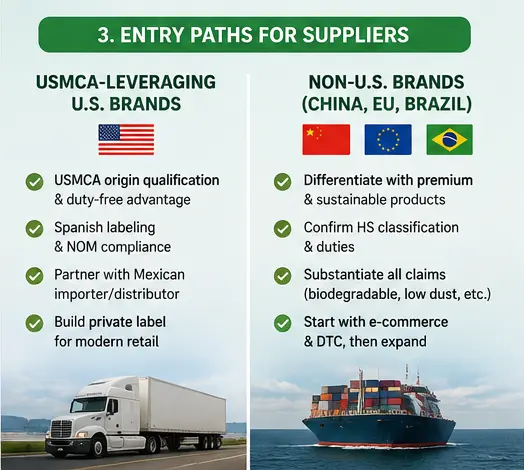
For brand owners, distributors, and private-label buyers evaluating Mexico in 2026, the practical entry path depends on whether you are a U.S. brand leveraging USMCA or a non-U.S. brand entering on a premium / differentiated proposition.
Path 1: U.S. Brand Leveraging USMCA (Lowest Friction)
- Confirm USMCA origin qualification for the specific tariff classification. The importer, exporter, or producer may need to provide the required USMCA certification of origin information, so the origin analysis should be completed before pricing and shipment planning.
- Prepare NOM-compliant Spanish labeling in advance — product name, quantity, manufacturer / importer information, country of origin, and care / use instructions. Many U.S. brands underestimate the time and cost of the Spanish-language artwork revision.
- Engage a Mexican import broker or distributor with relationships in modern retail (Walmart, Soriana, Chedraui) and e-commerce (Mercado Libre, Amazon Mexico). The modern-retail category buyers plan 3–6 months ahead, so lead time is the limiting factor.
- Build a private-label offering for the major retailers’ store-brand programs. Private label is the fastest path to volume without the slotting-fee economics of branded entry.
Path 2: Non-U.S. Brand (China, EU, Brazil) Entering on a Premium or Differentiated Proposition
- Define the differentiated proposition — plant-based tofu litter, certified-sustainable pine, ultra-low-dust, or a specific format advantage (crystal, mixed-clumping). Without a clear premium positioning, the duty differential to U.S. brands will erode the margin.
- Confirm HS classification and origin-specific duty in the TIGIE. Build the duty into the landed-cost model before pricing.
- Substantiate all marketing claims — “biodegradable,” “low dust,” “non-toxic,” “flushable” — under the Federal Consumer Protection Law, with independent third-party test reports as the most defensible documentation. Confirm whether any environmental standard applies to the specific claim and material rather than assuming a single mandatory certification.
- Start in e-commerce and DTC via Mercado Libre and Amazon Mexico before committing to physical retail. The online channel has higher category penetration for cat litter than for the general pet category, and the cost of entry is materially lower than slotting fees in modern retail.
- Build a staged retail-entry timeline based on regulatory preparation, product registration or permit requirements where applicable, Spanish labeling, distributor onboarding, retailer qualification, and initial sales performance. The actual timeline varies substantially by channel, buyer, and product category.
For both paths, the practical gating items are: regulatory substantiation, Spanish-language labeling, and channel relationships. Brands that get these three right before they enter the market are the ones that scale.
Conclusion
Mexico’s cat litter market in 2026 is a USD 280–390 million import-dependent opportunity, growing at 6–7% CAGR, with an urban premium segment that is structurally underserved by U.S.-origin product alone. For U.S. brands, USMCA provides a duty-free entry path that is the lowest-friction option in Latin America. For non-U.S. brands — Chinese, Brazilian, European — the market is reachable on a premium or differentiated proposition, with regulatory substantiation and channel-building as the gating steps.
The commercial opportunity is therefore less about simply finding demand and more about building a workable landed-cost and market-entry model. Buyers should validate the tariff classification and origin treatment first, prepare Spanish-language packaging and claim substantiation, and then select the right combination of distributor, retail, pet-specialty, and e-commerce channels.
For the full import workflow from a manufacturer’s perspective, see our cat litter import guide for B2B buyers. For pine and other wood-based variants, see our pine cat litter product page for material specifications and OEM options.
Frequently Asked Questions
Published market estimates vary because research firms use different product and channel definitions. Two independent 2026 reports size it differently: MarkWide Research values it at USD 385.5 million in 2026 (forecast USD 696.89 million by 2035, 6.80% CAGR), while Morgan Reed Insights values it at USD 284.6 million in 2026 (forecast USD 510.17 million by 2035, 6.7% CAGR). The spread reflects different product-scope definitions, not contradictory fundamentals. For B2B planning, buyers should use one consistent market definition rather than combining estimates from different methodologies.
Imports are an important part of Mexico’s cat litter supply, with the United States playing a major role in cross-border supply because of geographic proximity and established North American trade links. U.S. suppliers benefit from the preferential treatment available to qualifying U.S.-origin goods under USMCA. Non-U.S. suppliers — including Chinese, Brazilian, and European — remain relevant, particularly for plant-based and specialty formats, but should plan around the duty differential versus U.S. product.
There is no single duty rate for all cat litter entering Mexico. The applicable tariff depends on the product’s composition, final Mexican tariff classification, and country of origin. Qualifying U.S.-origin goods may receive preferential treatment under USMCA, while products from non-preferential origins are generally subject to the applicable Mexican general import duty. Cat litter is not classified as pet food (HS 2309.10 covers dog or cat food), so its classification should be confirmed against the actual product. Importers should confirm the exact tariff line and current rate before calculating landed cost.
Mexico’s cat litter market is distributed across modern retail, traditional and independent pet retail, pet-specialty channels, and e-commerce. Modern retail is the largest volume channel, while e-commerce is the fastest-growing incremental channel. Because retailer online stores and subscription programs can overlap with physical retail or broader e-commerce, channel percentages should not be treated as mutually exclusive without a clearly defined methodology.
Cat litter should not be treated as a food product under NOM-051-SCFI/SSA1-2010, which applies to prepackaged foods and non-alcoholic beverages. General commercial-labeling requirements under NOM-050-SCFI-2004 may be relevant depending on the product and its scope, while additional requirements can depend on composition, claims, packaging, and import classification. Importers should verify the exact requirements with Mexican counsel or a customs broker before finalizing Spanish-language packaging.
Biodegradable claims should be supported by evidence appropriate to the specific product and claim and should not be presented in a misleading way. Environmental and consumer-protection requirements can apply depending on the claim and product composition, but importers should not assume that a single Mexican standard creates a mandatory product-specific certification requirement for all biodegradable cat litter. Test reports and claim substantiation should be prepared before the packaging and marketing copy are finalized.
Yes. Chinese cat litter can be imported into Mexico, but the applicable tariff treatment depends on the product’s final Mexican HS classification and origin. Plant-based and specialty products may also require additional import-compliance checks depending on their botanical materials and degree of processing. Importers should confirm tariff classification, Spanish labeling, customs documentation, and any applicable SENASICA requirements before shipment.
Both 2026-published reports forecast mid-single-digit CAGR through 2035, with the market reaching USD 510–697 million by 2035. The premium segment (plant-based, natural, ultra-premium DTC) is forecast to grow its share of value through 2035, eroding basic clay-based dominance. Growth concentrates in Mexico City, Guadalajara, and Monterrey, driven by younger urban cat owners.