




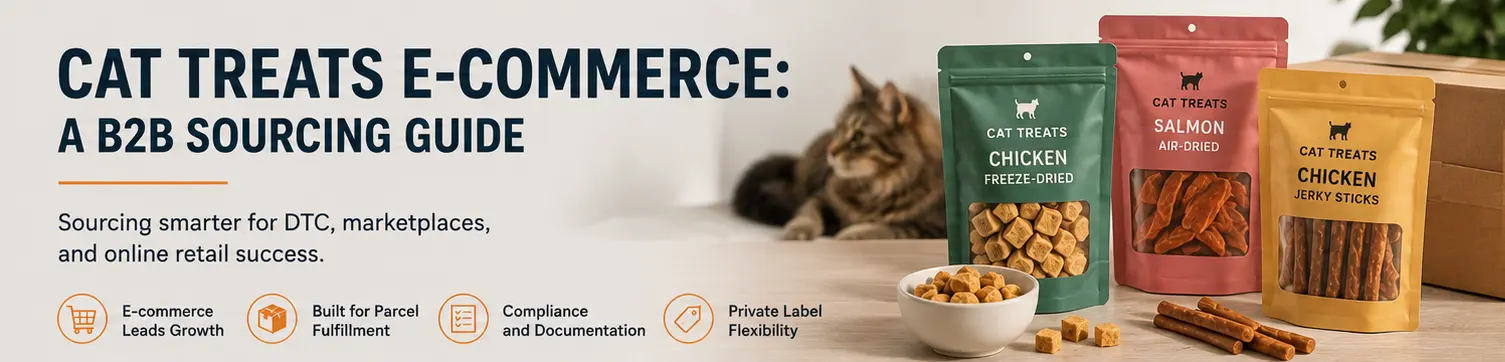
E-commerce is expected to account for about 37% of the global pet treats market by distribution channel in 2026, according to MarketsandMarkets. For cat treat brands, marketplace sellers, and private-label buyers, this growth makes pack format, parcel durability, shelf life, documentation, and destination-market compliance important sourcing considerations. This guide explains how to build a cat treats ecommerce program for DTC and online retail without treating broader pet-treat market data as cat-specific market share.
Quick Answer
E-commerce is expected to be the largest distribution channel for the global pet treats market in 2026, with a projected share of about 37%, according to MarketsandMarkets. The same report projects the overall pet treats market to grow from USD 38.40 billion in 2026 to USD 58.71 billion by 2031 at a CAGR of 8.9%. For buyers sourcing cat treats for e-commerce, the sourcing priorities are practical: choose pack formats suited to parcel fulfillment, verify destination-market labeling and feed requirements before launch, and confirm that the manufacturer can support consistent recipes, documentation, and private-label production. MarketsandMarkets provides the underlying pet treats market forecast and channel segmentation.
Why E-commerce Matters for Cat Treat Brands
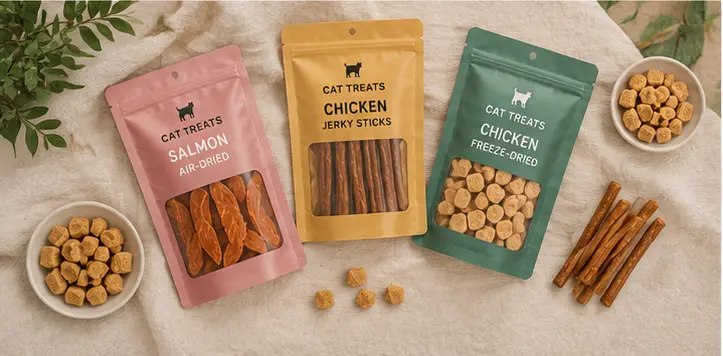
E-commerce is an important distribution channel for pet treats, and its projected 2026 share makes online retail relevant to cat treat sourcing decisions. Subscription and auto-replenishment can suit consumable products, while marketplaces give brands access to broad product selection and customer demand. For B2B buyers, the practical question is not whether every cat treat sells better online, but whether the product format, packaging, shelf life, documentation, and fulfillment economics fit the intended e-commerce channel. Pet Horizon’s cat sticks and fish fillets provide examples of cat treat formats that buyers can evaluate for their intended product program.
What DTC Means for Cat Treat Brands
Direct-to-consumer (DTC) selling changes the sourcing brief because products must work economically at small pack sizes and through parcel fulfillment. Buyers should evaluate pack size, resealability, shelf life, breakage resistance, shipping weight, and packaging presentation alongside the recipe itself. Premium, single-protein, functional, air-dried, and freeze-dried formats may support differentiated positioning, but their commercial suitability should be validated against target customers, price points, product claims, and shipping economics rather than assumed from the format alone.
| Sourcing factor | What e-commerce buyers should check |
|---|---|
| Pack size | Unit economics, shipping weight, trial size, and subscription cadence |
| Packaging | Seal integrity, resealability, moisture protection, and parcel durability |
| Shelf life | Remaining shelf life at shipment and expected subscription cycle |
| Recipe | Ingredient specification, approved formulation, and repeat-batch consistency |
| Product testing | Moisture, texture, breakage, seal integrity, shelf-life performance, and SKU-level acceptance criteria |
| Compliance | Destination-market labeling, claims, registration, and feed requirements |
| Private label | MOQ, packaging customization, lead time, documentation, and formulation flexibility |
Marketplace Compliance for Online Cat Treats
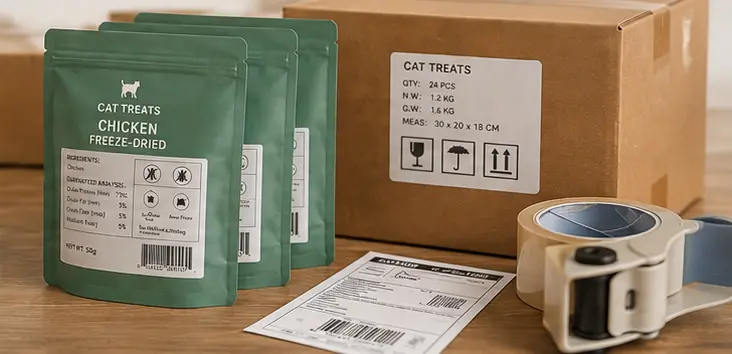
Selling cat treats through marketplaces does not remove destination-market feed, food-safety, or labeling requirements. Before listing, buyers should verify the applicable product identity, net quantity, manufacturer or distributor information, ingredient declaration, required claims, and any state or country-specific registration or labeling rules. Requirements vary by market, so compliance should be treated as a product and packaging specification agreed with the manufacturer before production rather than a marketplace listing task completed afterward.
Subscription and Repeat Purchase Models
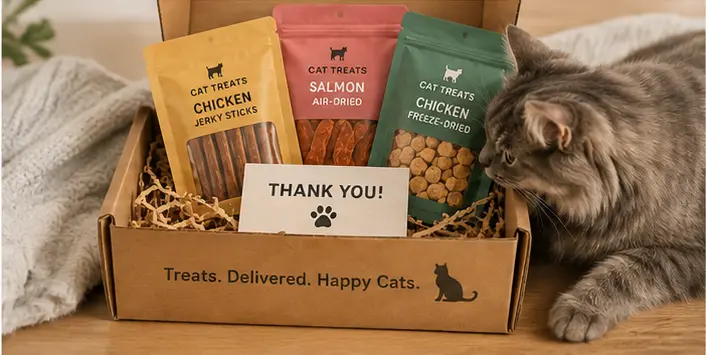
Cat treats subscription and auto-replenishment programs can fit because treats are consumable products with potential for repeat purchasing. For B2B buyers, the key sourcing requirements are consistent batch quality, sufficient remaining shelf life at shipment, stable packaging specifications, and traceable ingredient and production documentation. Subscription suitability should be evaluated against the planned consumption rate, pack size, shipping frequency, and destination-market requirements rather than assumed for every treat format. Buyers can review the cat snacks category to compare formats suited to both one-time and subscription listings.
Private Label for Online-First Brands
Private label cat treats allow online-first brands to outsource production while controlling their own brand, packaging, and product positioning. Buyers should evaluate more than recipe availability: confirm minimum order quantities, formulation flexibility, ingredient specifications, shelf-life targets, packaging options, lead times, batch documentation, and whether the manufacturer can maintain the approved sample and production specification across repeat orders. Online testing can be useful for validating pack sizes and product positioning before expanding into broader retail, but the production specification should be fixed before scale-up.
Packaging and Shipping for E-commerce
E-commerce packaging should be evaluated for the actual parcel-shipping environment rather than only for pallet transport. Buyers should check resistance to crushing and seal failure, moisture protection, reseal performance, pack dimensions, shipping weight, label durability, and compatibility with the selected filling and sealing process. Smaller packs can improve trial and subscription flexibility but may increase packaging cost per unit, so pack size should be evaluated together with product cost, freight, shelf life, and expected order value.
Conclusion
Cat treats ecommerce programs require sourcing decisions that account for the online fulfillment model from the beginning. Buyers should select pack formats that work for parcel shipping and repeat purchasing, confirm destination-market labeling and feed requirements before production, and choose manufacturers that can maintain approved recipes, packaging specifications, shelf life, and batch documentation. The global pet treats market is projected to grow from USD 38.40 billion in 2026 to USD 58.71 billion by 2031, while e-commerce is expected to represent about 37% of distribution in 2026; these figures describe the broader pet treats market rather than cat treats specifically. Treating e-commerce requirements as part of the sourcing specification creates a stronger foundation for DTC and marketplace programs.
Frequently Asked Questions
MarketsandMarkets projects the e-commerce segment to account for about 37% of the global pet treats market by distribution channel in 2026. This figure applies to the broader pet treats market, not specifically to cat treats ecommerce.
MarketsandMarkets projects the pet treats market to grow from USD 38.40 billion in 2026 to USD 58.71 billion by 2031, at a CAGR of 8.9% over the period.
Cat treats can suit subscription and auto-replenishment models because they are consumable products that may be purchased repeatedly. For buyers, subscription suitability depends on consumption rate, pack size, shelf life, shipping frequency, and consistent product availability rather than on the treat category alone.
Yes. Selling through a marketplace does not remove food-safety, labeling, or destination-market obligations. Brands should confirm the applicable requirements before production and listing so that packaging, product information, and claims are aligned with the intended market and marketplace requirements.
Yes. Private label lets a brand launch without owning production, using a manufacturer’s recipes and capacity under its own packaging, and is well suited to testing formats online before wider retail.
Packaging should resist crushing, seal failure, moisture exposure, and damage during parcel shipping while maintaining reseal performance and label readability. Small packs may improve trial flexibility but can increase packaging cost per unit. Buyers should compare pack dimensions, product weight, shelf life, and shipping economics and, where practical, evaluate packaging samples before approving the final SKU.
Suitable formats depend on the target customer, price point, shipping method, shelf-life requirement, and desired product positioning. Buyers should compare freeze-dried, air-dried, meat-based, functional, and other formats based on product stability, packaging requirements, shipping economics, claims, and target-market compliance rather than assuming one format will perform best online.
Buyers should confirm minimum order quantities, formulation flexibility, ingredient specifications, shelf-life targets, packaging options, lead times, batch documentation, and whether the manufacturer can maintain the approved sample and production specification across repeat orders. Private label works best when the production specification is fixed before scale-up rather than adjusted after launch.