


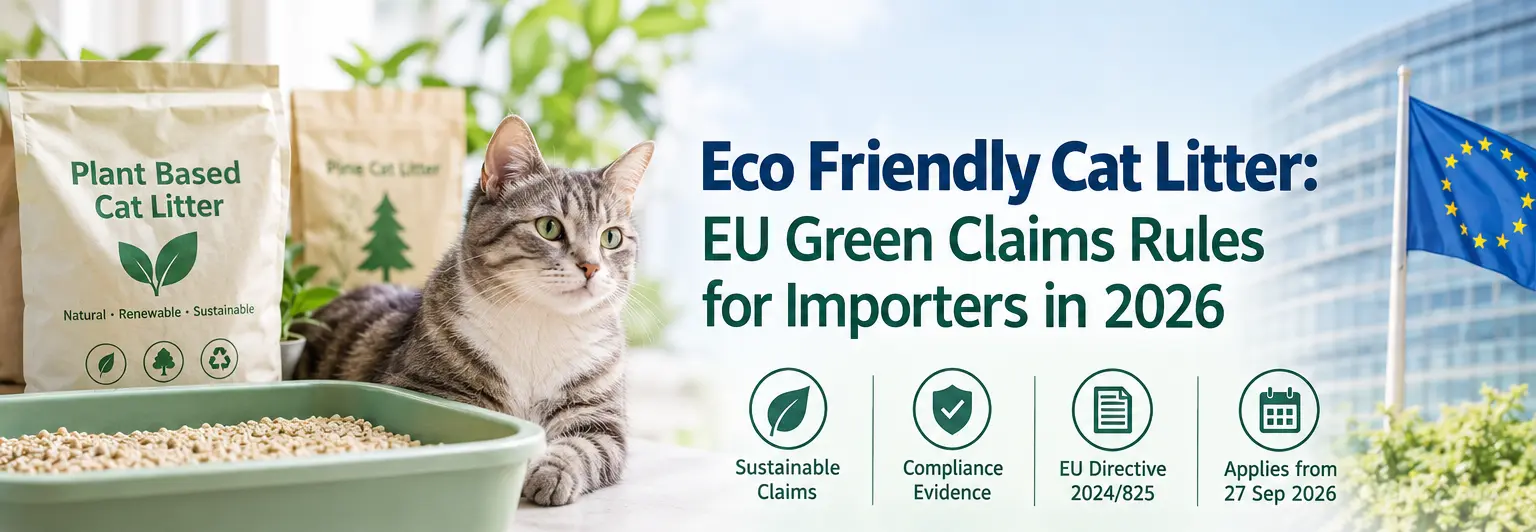
Eco friendly cat litter has become a priority procurement category for European buyers, yet a new consumer-protection directive is changing how suppliers may describe plant-based and biodegradable products. Directive (EU) 2024/825 required EU member states to transpose it by 27 March 2026 and makes the strengthened rules applicable from 27 September 2026. Brands that export tofu, pine, or mixed litter to the EU should therefore review environmental claims used in consumer-facing packaging, websites, listings, and advertising, and keep appropriate evidence showing how each claim is substantiated.
Quick Answer
From 27 September 2026, the EU’s strengthened green-claims rules will restrict certain vague environmental claims in consumer-facing commercial communications, including generic claims that cannot be supported by recognised excellent environmental performance relevant to the claim. Importers should review terms such as “eco-friendly”, “green”, “biodegradable”, and “climate neutral” on packaging, websites, and product listings, and maintain a per-SKU file showing the evidence and methodology behind each environmental claim.
What Directive (EU) 2024/825 Changes for Cat Litter Claims
Directive (EU) 2024/825 amends the Unfair Commercial Practices Directive (2005/29/EC) and the Consumer Rights Directive (2011/83/EU) to strengthen protection against greenwashing. It adds specific environmental practices to the EU blacklist of unfair commercial practices, including certain generic environmental claims that are not supported by recognised excellent environmental performance and sustainability labels that do not meet the applicable requirements for certification schemes or public-authority schemes. The text is published on the EUR-Lex portal of the European Union.
For cat litter exporters, the practical effect is that environmental language used in consumer-facing packaging, websites, listings, and advertising should be defensible. B2B specification sheets and buyer documentation should also remain consistent with the evidence supporting any environmental claims that may appear in consumer-facing communications.
Importers evaluating EU market access should also review our cat litter export compliance guide, which maps the broader regulatory stack for shipping into the bloc.
Environmental Claims That Require Careful Substantiation
Generic Environmental Claims
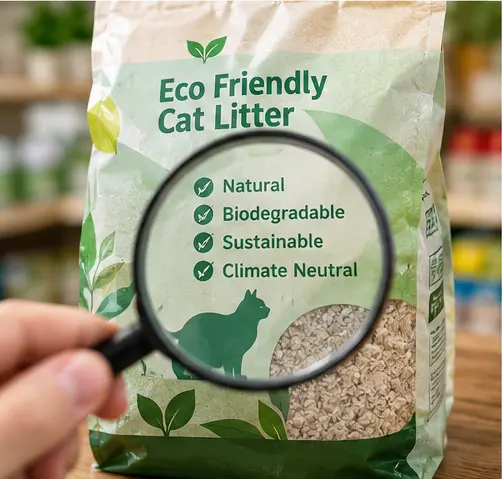
The new rules target vague or insufficiently qualified environmental claims rather than creating a simple banned-word list. Expressions such as “environmentally friendly”, “green”, “eco-friendly”, “biodegradable”, “compostable”, and “climate neutral” can create compliance risk when they imply an environmental benefit without clearly explaining the basis for that claim. Terms such as “natural” or “sustainable” should also be reviewed in context, particularly where they communicate an environmental advantage to consumers. For cat litter, importers should link each environmental statement to a specific product characteristic, methodology, standard, certification, or other appropriate evidence rather than relying on a broad environmental adjective alone.
Self-Created Sustainability Labels
A sustainability label created by a company itself can create compliance risk if it is not based on a qualifying certification scheme or established by a public authority. Separately, claims that a product has a neutral, reduced, or positive environmental impact in terms of greenhouse-gas emissions based on offsetting are subject to a specific prohibition. Importers should therefore distinguish between sustainability labels and environmental claims when reviewing EU-facing packaging and marketing materials.
How to Substantiate Eco Friendly Cat Litter Claims
Substantiation means linking each environmental claim to appropriate supporting evidence that can be identified, reviewed, and matched to the product and claim conditions. Two practical evidence routes are especially relevant to plant-based cat litter: certification or conformity evidence, and product carbon-footprint or climate-related evidence.
Certification-Based Claims (FSC, PEFC, EN 13432)
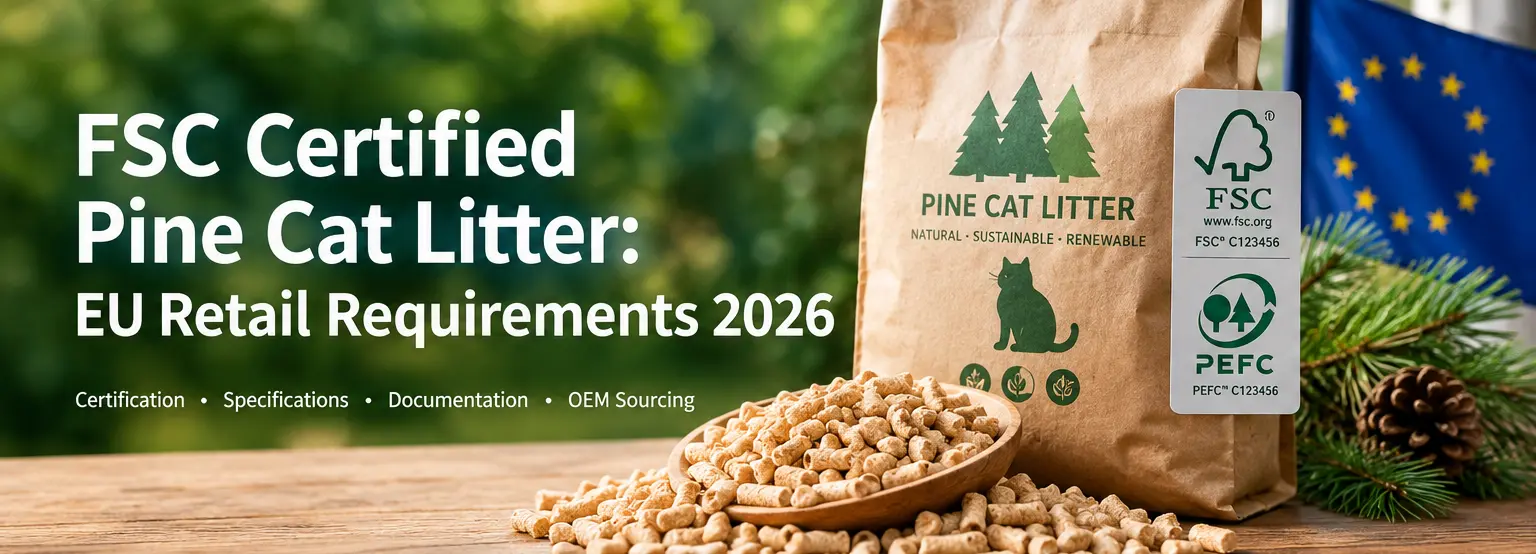
For wood and pine litter, an FSC or PEFC chain-of-custody certification can support a specific responsible-sourcing or certified-material claim when the certificate covers the relevant material and product scope. For products marketed as industrially compostable, conformity with EN 13432 can support a compostability claim when the applicable requirements and certification or conformity evidence are met. These credentials should be matched to the exact wording of the environmental claim rather than presented as automatic proof that the entire product is “eco-friendly”. Our biodegradable cat litter EU regulation guide explains how EN 13432 and the related standards apply to litter formats.
Carbon Footprint and Climate Claims
For product carbon-footprint claims, an ISO 14067 assessment can provide a structured methodology for quantifying greenhouse-gas emissions attributable to a product. However, an ISO 14067 assessment does not by itself establish that a product is “climate neutral”. Claims about climate neutrality require separate scrutiny of the claim wording, calculation boundaries, reduction measures, and any use of carbon offsets. Importers should therefore keep the carbon-footprint methodology and supporting evidence aligned with the exact environmental claim used in EU-facing consumer communications.
A Per-SKU Claim Substantiation Checklist for Importers
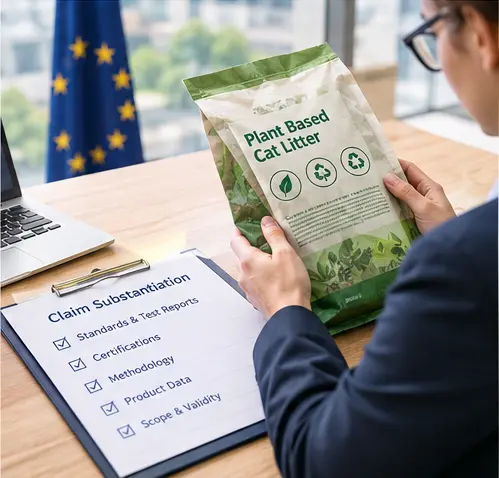
A per-SKU claim substantiation sheet is a product-level record that maps every environmental claim to its exact evidence, test method, certification, scope, and source. Importers can reduce compliance risk with a simple per-SKU worksheet:
- List every environmental claim on the pack and the landing page.
- Attach the applicable standard, test method, certification, methodology, or other supporting evidence for each claim.
- For certification-based claims, confirm that the certificate is valid, within scope, and searchable in the issuer’s verification system where one is provided.
- Remove or rephrase any claim that lacks a citable basis.
- Keep the substantiation file available for buyer and authority requests.
Common Mistakes That Trigger Enforcement
The most frequent errors are loose adjectives in product names, offset-only “carbon neutral” badges, and certification numbers that cannot be verified in a public registry. National authorities will enforce the rules through the national measures adopted by each EU Member State. Available penalties can include fines and other corrective measures, with the Directive setting minimum penalty requirements for certain serious cross-border infringements. The exact enforcement approach and penalty level therefore depend on the applicable national rules and the circumstances of the infringement.
How Pet Horizon Supports Compliant OEM Cat Litter
Pet Horizon manufactures tofu, pine, and mixed cat litter for private label and OEM programs with documentation prepared for EU buyers. Our tofu cat litter product page shows the plant-based range, and our team can supply claim substantiation files per SKU on request.
Conclusion
Eco friendly cat litter remains a relevant category for the EU, but importers and suppliers should review consumer-facing environmental claims before the strengthened rules apply on 27 September 2026. Plant-based materials, certifications, test results, and carbon-footprint data can support specific claims when they match the product and the wording used. Building a per-SKU substantiation file now can help reduce unsupported environmental claims and compliance risk under the national rules implementing Directive (EU) 2024/825.
Frequently Asked Questions
The directive required transposition by 27 March 2026 and the new rules apply from 27 September 2026 across the EU.
Potentially, but the claim should be supported by evidence that matches the exact product, material, and conditions described or implied by the claim. EN 13432 is primarily a standard for the industrial compostability and biodegradation of packaging and should not automatically be treated as proof that a cat litter product is biodegradable in general. Importers should identify the specific biodegradation or compostability claim being made and retain evidence that directly supports that claim under the stated conditions.
It depends on how the term is used and what environmental benefit it communicates or implies. A standalone “natural” claim can create greenwashing risk when it suggests an environmental advantage without a clear qualification or supporting basis. Importers should review the wording in its full packaging, website, or advertising context and substantiate any environmental benefit being communicated.
It is a product-level document that lists each environmental claim for a specific SKU and maps it to the relevant evidence, such as a test report, standard, certification, methodology, product data, or other supporting source, including the applicable scope and validity where relevant.
It can apply when environmental claims are used in commercial communications directed at consumers in the EU, including consumer-facing websites, product listings, packaging, and advertising. For B2B importers and suppliers, the exact scope depends on how the communication and product are marketed, so consumer-facing claims should be reviewed carefully against the applicable national implementation of Directive (EU) 2024/825.
An FSC or PEFC chain-of-custody certificate with a verifiable number supports a responsible-sourcing claim for wood-based litter.
If an environmental claim cannot be adequately substantiated, the applicable national rules implementing the Directive may allow authorities to treat the practice as unfair and require corrective action. Depending on the infringement, jurisdiction, and enforcement circumstances, penalties can also include fines.
Yes. OEM agreements should define responsibility for environmental claims, supporting evidence, approvals, and updates to product documentation so that unsupported supplier claims do not create compliance risk for the brand owner.