




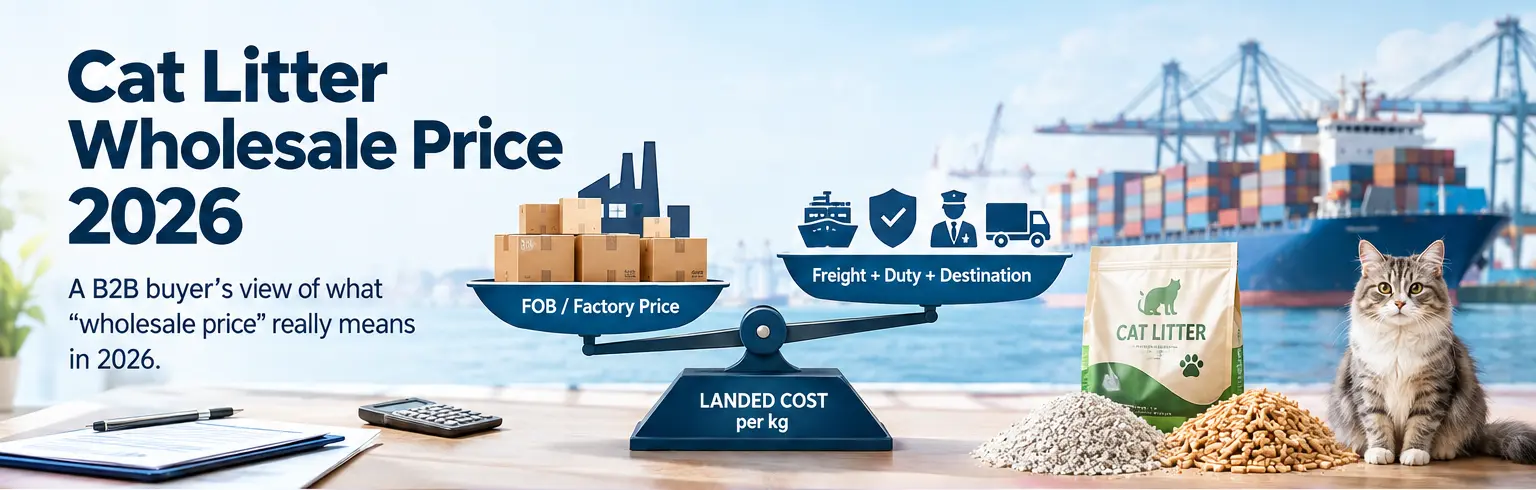
Quick Answer: The most useful cat litter wholesale price benchmark is landed cost per usable kilogram, not the supplier’s FOB or carton price alone. Buyers should normalize the quotation by Incoterm, freight, duty, destination charges, packaging, and expected product loss, then verify the exact HS or CN/TARIC classification for the shipment.
For B2B importers, brands, and private-label program managers, the final cost of cat litter depends on more than the supplier’s quoted unit price. In 2026, formulation, packaging, freight, tariff treatment, destination charges, and product loss can materially change the cost per usable kilogram. This guide explains how to compare supplier quotations and build a shipment-specific landed-cost benchmark.
Why the Headline Wholesale Price Misleads
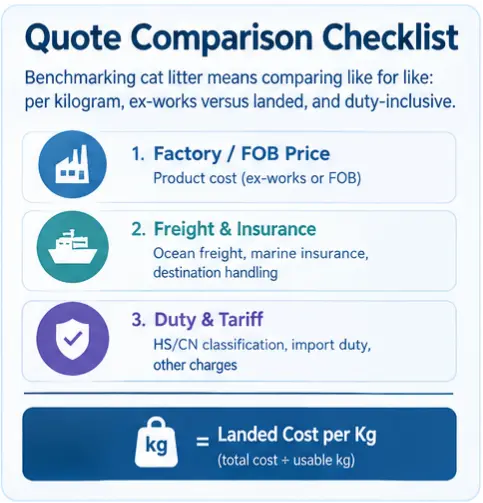
A cat litter quote usually shows a factory or FOB price. That figure excludes ocean freight, insurance, destination handling, import duty, and last-mile delivery. Two suppliers quoting the same “wholesale price” can land at very different costs once those layers are added, especially when formulation, packaging format, and origin differ. The practical rule for buyers is to normalize every quote to cost per usable kilogram delivered to the warehouse, and to confirm which Incoterm the price assumes.
Incoterms That Change the Number
Most bulk cat litter from Asia trades on FOB (Free On Board), where the seller covers factory-to-port trucking, export clearance, and loading, and the buyer owns ocean freight, insurance, and import-side costs from that point. CIF (Cost, Insurance and Freight) includes the seller’s ocean freight and minimum insurance to the named port of destination. DDP (Delivered Duty Paid) places substantially more delivery, import-clearance, and duty responsibility on the seller. For an apples-to-apples comparison, request the Incoterm, named place, quotation validity, and included charges in writing before comparing unit prices.
HS Classification Sets the Duty
HS classification is a starting point for estimating duty, but the correct code depends on the product’s composition, processing, and destination-country tariff rules. In the United States, bentonite is listed under HTS 2508.10, while other clays are covered by 2508.40; silica-gel litter may fall under 2811.22, including specific silica-gel cat-litter classifications seen in U.S. Customs rulings. Plant-based and mixed litters require product-specific classification rather than a single universal HS code. For EU imports, buyers should confirm the applicable CN/TARIC code and third-country duty for the exact formulation before using any rate in a landed-cost model.
| Material / indicative classification | US duty reference | EU duty reference | Buyer action |
|---|---|---|---|
| Bentonite (US HTS 2508.10); other clays (2508.40) | Free for the listed HTS lines; verify current tariff treatment | Check applicable CN/TARIC line | Confirm exact composition and classification |
| Silica gel (US HTS 2811.22; synthetic silica gel 2811.22.10) | 3.7% for 2811.22.10 under the listed general rate | Check applicable CN/TARIC line | Confirm product-specific classification |
| Plant-based litter | Composition-specific | Composition-specific | Confirm CN/HTS classification before costing |
| Mixed / formulated litter | Composition-specific | Composition-specific | Obtain a classification confirmation before costing |
Data scope: HS references are classification starting points rather than universal cat-litter codes. Duty should be calculated from the exact tariff line, origin, and import date applicable to the shipment; buyers should verify the current US HTS or EU TARIC record before using a rate in a landed-cost model.
Reference Market Prices From Published Data
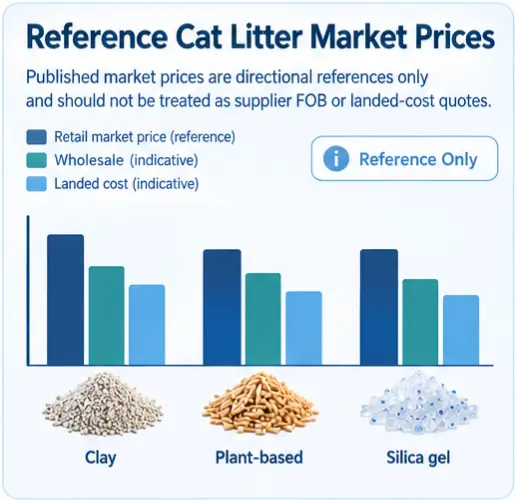
Published market data can provide useful directional reference points, but buyers should distinguish retail prices from supplier quotations and import or export unit values. Current IndexBox Australia market data, for example, places standard clumping clay at roughly AUD 1.20 to 1.80 per kilogram at retail. This is a consumer-market reference rather than a verified wholesale, FOB, or importer landed-cost benchmark. For B2B sourcing, the more defensible benchmark is the supplier quotation plus freight, duty, handling, and expected product loss calculated on a usable-kilogram basis.
Cost Drivers Buyers Should Model
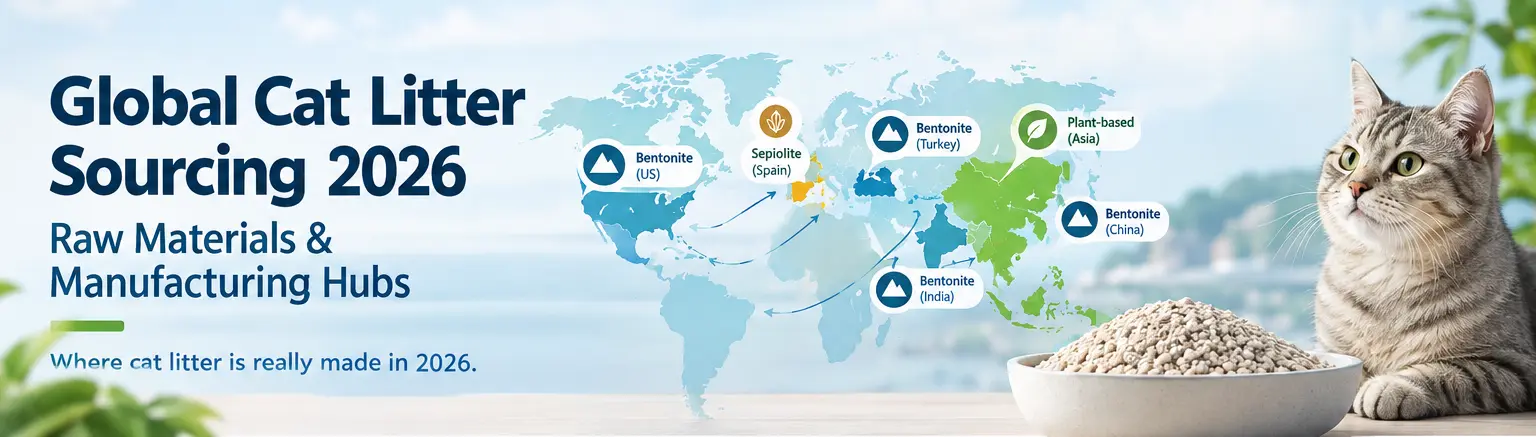
Four layers explain most of the gap between a quote and a landed cost. Raw material is the first: USGS Mineral Commodity Summaries 2026 estimates 2025 world bentonite mine production at roughly 20 million tonnes, with U.S. production estimated at about 4.1 million tonnes, illustrating the scale of the mineral supply base. Plant-based litters instead track vegetable-starch and wood-fiber markets. Packaging (woven bags, stand-up pouches, zippered flat-bottom bags) is a separate, often underestimated layer. Ocean freight is the most volatile: published 2026 freight indications for China-to-US West Coast FCL shipments vary by container size, carrier, season, surcharge structure, and booking date, so buyers should use a route-specific forwarder quotation rather than a single annual benchmark. Finally, duty and any additional tariff measures on China-origin goods can add cost that a FOB quote never shows.
How to Benchmark a Supplier Quote
A disciplined buyer normalizes every quote to delivered cost per kilogram, confirms the Incoterm, verifies the HS code and applicable duty, models freight from the load port, and requests product specifications (fill rate, dust, moisture, clump time) so comparisons are like-for-like. Requesting batch records and third-party test reports at the quoting stage also prevents the false economy of a low carton price hiding a high defect or rework rate. For broader context on duty and landed-cost math, our cat litter tariff guide breaks down HS codes and import exposure.
How to Calculate Cat Litter Landed Cost Per Kg
For a practical B2B benchmark, calculate landed cost on the usable quantity rather than the quoted shipment weight:
Landed cost per usable kg = (product cost + freight + insurance + duty + customs and destination charges + inland delivery) ÷ usable kg received
If moisture, breakage, leakage, contamination, or handling losses reduce the quantity that can actually be sold or used, include those losses in the denominator rather than comparing the supplier’s nominal shipment weight. This produces a more meaningful cost comparison between suppliers, pack formats, and formulations.
What This Means for Pet Horizon Buyers
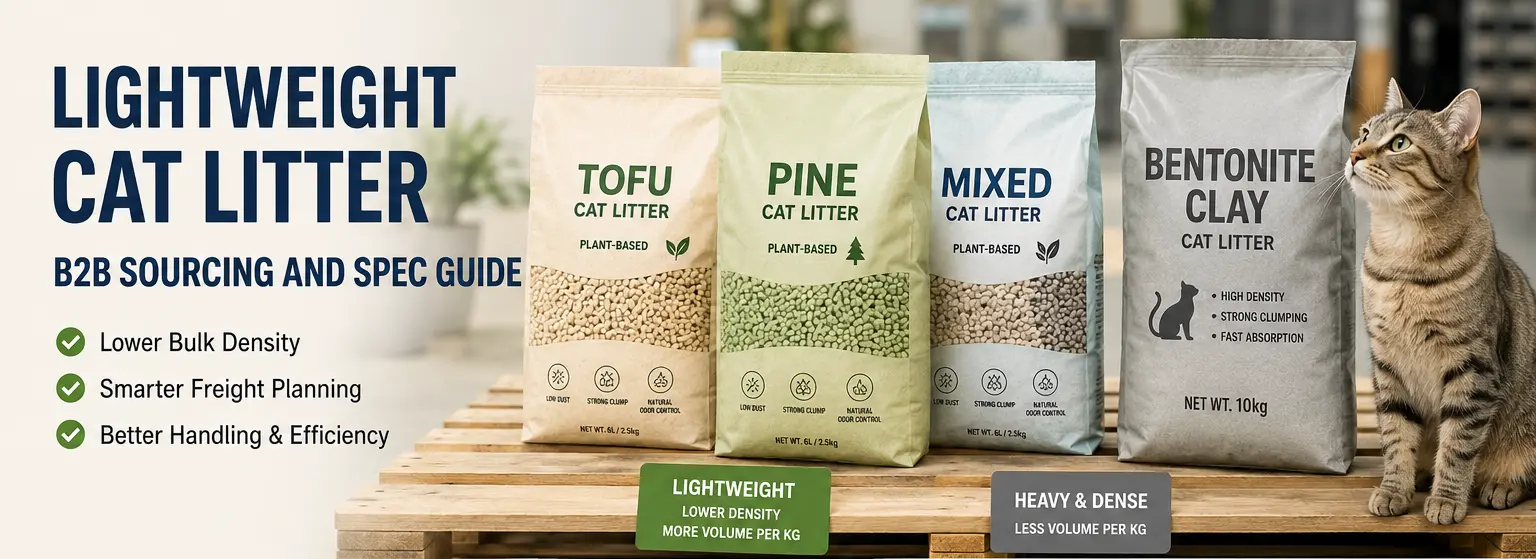
For buyers evaluating Pet Horizon as a cat litter supplier, the same landed-cost framework should be applied to the quotation: confirm the Incoterm, shipment volume, packaging format, product specifications, freight assumptions, tariff classification, and destination charges before comparing the final per-kilogram cost. Pet Horizon supplies tofu, bentonite, pine, and mixed cat litter for wholesale, OEM, and private-label programs and provides product specifications and export documentation for buyer review. Buyers comparing a bulk cat litter program or a bentonite cat litter wholesale option should request the shipment-specific quotation and the applicable compliance documents before committing volume.
Risks and Constraints
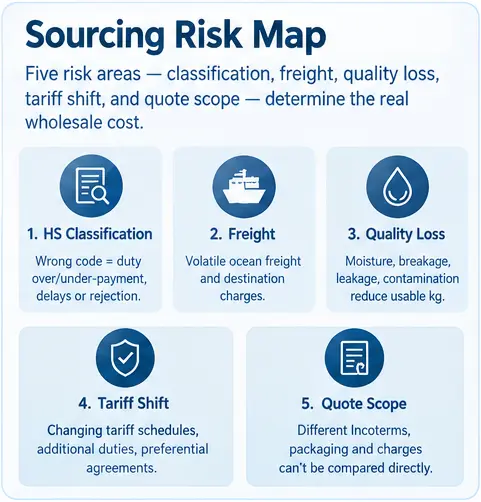
- HS misclassification: an incorrect code can trigger duty over- or under-payment, customs delays, or rejection at the border.
- Hidden freight: FOB quotes exclude the most volatile layer; always model ocean and destination handling separately.
- Moisture and breakage: high moisture or poor palletization raises real cost per usable kilogram after losses.
- Tariff shift: tariff schedules, additional duties, and preferential arrangements can change; confirm the complete tariff treatment for the shipment date and country of origin.
- Quote-scope mismatch: two suppliers may quote the same unit price under different Incoterms or with different packaging, freight, and destination charges included.
Conclusion
The cat litter wholesale price that matters in 2026 is the landed cost per usable kilogram, not the headline FOB or carton number. Buyers should compare supplier quotes on the same Incoterm, confirm the exact HS or CN/TARIC classification, model freight and destination charges, and account for duty, tariffs, packaging, moisture, breakage, and other product losses. Published market and trade data can provide directional benchmarks, but the most defensible sourcing decision comes from a shipment-specific landed-cost model based on the actual formulation, origin, destination, volume, and quotation date.
Frequently Asked Questions
There is no single wholesale price because cat litter varies by material, formulation, packaging, origin, order volume, and destination. For B2B sourcing, compare suppliers using landed cost per usable kilogram rather than a headline FOB or carton price.
Request FOB or ex-works pricing and model freight, duty, and last-mile yourself. FOB shows the factory-side price clearly, while CIF bundles ocean freight and minimum insurance to the named port of destination, which can hide differences between quotes.
There is no single universal HS code for all cat litter. In the United States, bentonite is listed under HTS 2508.10 and other clays under 2508.40, while silica-gel products may fall under 2811.22 depending on the product classification. Plant-based and mixed litters require composition-specific classification. Buyers should confirm the exact tariff line with the destination customs authority or a qualified customs broker before calculating duty.
Duty depends on the exact tariff classification, country of origin, destination, and import date. For U.S. imports, bentonite is classified under HTS 2508.10 rather than 2508.40, while other clays use different tariff lines. EU imports should be checked against the applicable CN/TARIC code and third-country duty. China-origin goods may also be subject to additional U.S. tariff measures, so buyers should verify the complete tariff treatment for the shipment date.
Cat litter is dense and bulky, so freight is a large share of landed cost. Published 2026 indications for China-to-US West Coast FCL shipments vary by container size, carrier, season, surcharge structure, and booking date, and that layer is excluded from any FOB quote.
Convert every quote to delivered cost per kilogram, confirm the Incoterm and HS code, model freight and duty, and request specifications and batch records so comparisons are truly like-for-like.
Pet Horizon supplies tofu, bentonite, pine, and mixed cat litter for wholesale, OEM, and private-label programs and provides product specifications and export documentation for buyer review. Buyers should request the shipment-specific quotation and applicable compliance documents before committing volume.
HS misclassification and unmodeled freight and tariff charges can materially change the final landed cost. A low FOB quote can become expensive after freight, duty, destination charges, and product losses are added, so verify each layer before committing volume.